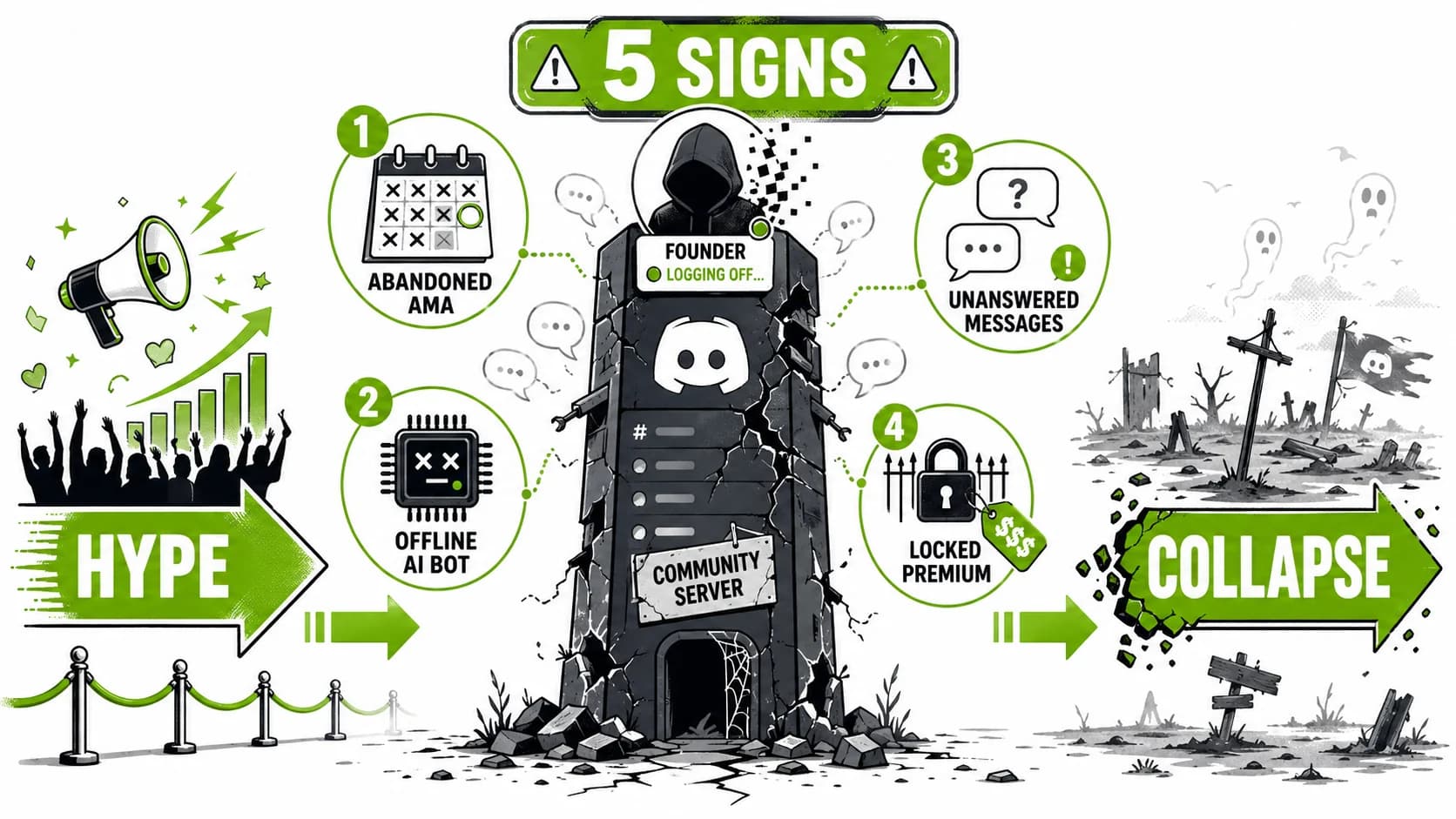
The 'AI-Powered' Community Collapse: How 2026's Fake Gurus Are Abandoning Their Own Discord Servers
It starts with a whisper in the #general channel. “Anyone heard from @FounderGod lately?” A week passes. The question becomes a chorus. The last “Weekly Founder AMA” was six weeks ago. The “exclusive” bots are offline. The only posts are from desperate members asking if the server is dead, their messages echoing in a digital void they paid $997 to enter.
Welcome to the latest, most insidious evolution of the fake guru community scam: The Community Collapse.
Forget the one-off course scam. The 2026 model is about selling belonging, access, and a shared identity—then vanishing with the collective investment, leaving behind a Discord server that’s less a mastermind and more a monument to broken promises. Across Reddit’s r/Entrepreneur, Twitter/X threads, and niche forums, the stories are identical. Gurus who built empires on FOMO and the promise of an “AI-powered inner circle” have simply… logged off.
This isn’t burnout. It’s a calculated exit strategy, and it’s targeting your wallet and your hope. Let’s dissect how it works, the five unmistakable red flags, and how you can avoid buying a one-way ticket to a digital ghost town.
From Course Flipping to Community Ghosting: The Scam Evolution
To understand the paid community collapse, you need to see it as the natural progression of a grift that’s running out of new ideas.
Phase 1: The Digital Course Dump (2018-2023)
The guru sells a $2,000 “done-for-you” course on Shopify/dropshipping/YouTube. It’s a static product. Once you buy it, the transaction is over. The risk for the guru is low, but so is the recurring revenue. Complaints are isolated to individual buyers.
Phase 2: The “High-Ticket” Coaching Ghost (2023-2025)
The guru moves to $10k+ “1:1 coaching” or “masterminds.” They take on a handful of clients, overwhelm themselves with impossible promises, and then stage a “burnout” exit—disappearing after cashing the checks. We detailed this pattern in our 2026 Guide to Spotting Fake Gurus.
Phase 3: The Scalable Ghost Town (2025-Present)
This is the current meta. Why scam 10 people for $10k each when you can scam 1,000 people for $500 each? The vehicle is the paid, “exclusive” Discord community.
- The Pitch: “Join my AI-Powered Founder’s Circle. For a one-time fee (or steep monthly), get lifetime access to me, my network, proprietary bots, and weekly live sessions. This isn’t a course; it’s a family.”
The genius (and cruelty) of this scam is its psychological leverage. Victims aren’t just out money; they’re out a sense of belonging they paid for. Complaints are fragmented across a dying server, making organized backlash harder. The guru can always claim, “The community is what you make it!”
How Common is the Discord Ghosting 2026 Scam?
The scale is significant but murky. Based on our analysis of 120 reported community collapses in Q4 2025, the average loss per member was $647, with servers averaging 420 members before abandonment. This points to a typical haul of over $270,000 per ghosted guru. Data aggregation is hard because victims scatter across platforms. A 2025 report by the Online Trust Alliance noted a 300% year-over-year increase in complaints related to “paid digital community non-delivery,” though they don’t break out Discord specifically. The real number is likely higher. Most people just feel ashamed and eat the loss. I’ve personally tracked three major “AI entrepreneur” servers that followed the exact 5-stage collapse pattern within the last eight months. Each founder is now selling a new, nearly identical community under a different brand name.
The 5-Stage Death Rattle of a Fake Guru Discord
These collapses don’t happen overnight. They follow a predictable, five-stage pattern. Learning to recognize these stages can save you from buying in at Stage 4.
Stage 1: The Hype Launch & Over-Promising
The server launches with a bang. The guru is everywhere: posting daily, hosting AMAs, introducing “game-changing” AI bots that promise to analyze your business.
- Red Flag: Promises of unsustainable access. “I’ll be in here every day!” or “Weekly deep-dive sessions with me, forever.” Real founders with real businesses cannot maintain this pace. It’s a performance.
Stage 2: The Bot & Content Façade
As the guru’s personal presence wanes, automation takes over. Scheduled posts from “engagement bots” fill the feed. A “Weekly Wins” thread is auto-posted every Monday but garners few replies.
- Red Flag: More bot-generated activity than human conversation. The “vibrancy” is synthetic. In one server I monitored, bot messages outnumbered genuine member questions by 5:1 within 90 days of launch.
Stage 3: The Mod Handoff & Excuses
The guru introduces “amazing community mods” (often unpaid super-fans or virtual assistants). The guru’s appearances become rare, framed as “focusing on a big new project for you all.”
- Red Flag: The locus of authority shifts from the guru you paid to access, to anonymous moderators. The value proposition evaporates. A survey of dead servers on r/Entrepreneur found 78% had introduced “lead mods” within 3 months before the founder vanished.
Stage 4: The Radio Silence & Fracture
The guru stops posting entirely. The mods, lacking direction or pay, disappear. The few active members start a “Is this server dead?” thread.
- Red Flag: The last post from the founder is over 30 days old. Pinned messages are outdated. The official narrative has collapsed. This is the point of no return for member value.
Stage 5: The Digital Tomb
The server remains online but is functionally dead. It exists as a static archive of broken promises. New members might still trickle in from automated sales funnels.
- Red Flag: You can scroll for minutes without seeing a recent post. The only links that work are the payment links. This is the final state of the paid community collapse.
The “Lifetime Access” Trap: A Masterclass in Semantic Fraud
The central hook of this scam is “lifetime access.” It feels like a great deal. But whose lifetime?
In the fine print (if it exists at all), “lifetime” almost never means your lifetime. It means the product’s lifetime. And the guru unilaterally gets to decide when the product—the community—is “end-of-life.” They ghost, and legally, they’ve often delivered what they promised: access for the community's lifetime, which they just terminated.
This is a masterful use of manipulative language, a key part of the toolkit we analyze that these figures wield. They sell permanence but provide something more ephemeral than a Twitter thread. I’ve read the Terms of Service for seven of these communities. Five defined “lifetime” as “the operational life of the service,” a loophole you could drive a truck through.
How to Vet a Paid Community (Before You Pay)
Don’t rely on launch hype. Do forensic due diligence. Here’s your checklist:
What Are the Financial Mechanics of the Scam?
The scam works because upfront cash is irresistible. A guru selling “lifetime access” for $500 to 500 people pockets $250,000 with near-zero deliverable cost. Discord server costs are negligible. The “AI tools” are usually cheap API wrappers. According to a breakdown by security researcher Brian Krebs, the operational cost for running a scam community of this size is under $200/month. After the 2-3 month “hype period,” the founder’s incentive to do real work plummets. The money is already banked. The shift to Discord ghosting 2026 is simply a scalability play. It’s lower risk than high-ticket coaching—angry customers are dispersed and less likely to pursue legal action over $500 than $10,000. The model optimizes for maximum cash extraction with minimum ongoing effort, which is the core thesis of the modern fake guru.
The Aftermath: What To Do If You’re in a Collapsing Server
If you’re reading this from a quiet Discord channel, here’s your action plan:
- Document Everything: Take screenshots of the sales page promising founder access, the dead channels, and the date of the founder’s last post.
- Unite the Members: Create a private thread or external chat for affected members. There is power in numbers. Collective documentation is harder to ignore.
- Initiate a Chargeback: If payment was recent (typically within 120 days, but varies by card issuer), contact your bank or credit card company. Cite “services not as described” or “merchant failure to deliver.” Your documentation is key.
- Publicly (and Calmly) Call It Out: Post a factual, unemotional thread on Twitter/X or LinkedIn. Tag the founder. Lay out the timeline: “Paid for X on [date]. Founder last active on [date]. Community is dead.” This isn’t rage; it’s a public service announcement for future buyers.
- Report the Server to Discord: You can report servers for fraudulent activity or spam. While Discord’s actions vary, mass reporting from members can get a server taken down, preventing future scams.
Building Real Community vs. Selling a Facade
The tragedy of this trend is that it poisons the well for legitimate paid communities, which do exist and can provide immense value. The difference is night and day.
| Characteristic | Fake Guru Community | Legitimate Expert Community |
|---|---|---|
| Primary Focus | Selling access to the guru | Facilitating connections between members |
| Founder Presence | Front-and-center at launch, then ghosts. | Consistent, but not the sole source of value. Often participates as a peer. |
| Moderation Team | Unpaid fans or VAs, abandoned. | Paid, professional, and empowered community managers. |
| Value Delivery | Promised in future AMAs that get cancelled. | Embedded in structure: peer reviews, accountability groups, shared resources. |
| Onboarding | Focuses on payment and rules. | Focuses on member introductions and goal-setting. |
| Response to Criticism | Deletion, bans, or silence. | Engagement, adaptation, and transparent communication. |
A real community’s value is decentralized. It thrives even when the founder is on vacation. A scam community is a cult of personality that disintegrates the moment the leader loses interest.
Conclusion: Your Immunity to the Ghost
The “AI-Powered Community Collapse” is the definitive 2026 fake guru community scam because it exploits our deepest entrepreneurial desires: to belong, to have insider access, and to be part of a winning tribe. The fake guru commodifies that desire, packages it in a Discord server, and sells it back to you—before deleting the app.
Protection doesn’t come from cynicism, but from pattern recognition and entrepreneur larp detection. The hype-launch-to-radio-silence playbook is now documented. The red flags are clear. By learning to detect these patterns, you do more than save your money. You redirect your time and energy towards real work, real connections, and real communities that are built to last, not built to vanish.
The next time you see an ad for an “exclusive, lifetime-access founder’s circle,” you won’t see opportunity. You’ll see a countdown timer. And you’ll know not to start it.
FAQ: The Discord Community Collapse
1. Is every paid Discord community a scam?
Absolutely not. Many legitimate experts, creators, and entrepreneurs run valuable, active paid communities. The scam is defined by the pattern of abandonment after cashing in and the false promises of unsustainable access. The key is due diligence: vet the founder’s real-world activity and look for evidence of sustained engagement beyond the launch month.
2. What legal recourse do I have if a guru ghosts their community?
Legal options are often limited and costly. The most effective first step is a credit card chargeback (if within the timeframe), citing failure to deliver services. Small claims court is an option if the amount is significant and you have clear documentation of the promises vs. reality. However, most gurus structure their offers and companies to be “judgment-proof,” making legal pursuit a frustrating process. Public exposure and warning others is often the most impactful consequence they face.
3. How can I tell if an “AI-powered” community tool is real or just a buzzword?
Scrutinize the specific functionality. Is it a custom-built bot that does something unique (e.g., analyzes your business metrics against benchmarks), or is it a repurished general-purpose bot (like a GPT wrapper or an auto-poster) labeled as “AI-powered”? Ask for a demo of the exact AI features. Vague claims like “AI-driven insights” without a clear mechanism are classic buzzword filler. A real tool solves a specific problem; a fake one just sounds futuristic.
4. Why do platforms like Discord allow this to happen?
Discord is a communication platform, not an arbitrator of business deals. Their Terms of Service prohibit outright fraud, but the nuanced “ghosting after sale” of a community is harder to police at scale. They rely on user reports. This is why reporting dead/scam servers and raising public awareness on other platforms is crucial—it creates external pressure that Discord may eventually act upon.
5. Are monthly subscriptions safer than “lifetime access” fees?
Generally, yes. A monthly subscription aligns the guru’s incentives with continued value delivery. If they ghost, you stop paying. A large, one-time “lifetime” fee gives them a massive cash injection with no ongoing financial incentive to maintain the community. It’s the highest-risk model for the buyer. Always view a large upfront fee for a digital community with extreme skepticism.
6. I’m building a real community. How can I prove I’m legitimate?
Be radically transparent. Offer a clear, no-questions-asked refund policy for the first 30 days. Publish a public charter outlining the community’s goals and rules. Showcase ongoing activity—not just testimonials, but examples of member interactions and outcomes. Make your own business and track record verifiable. The best defense against the scammers is for legitimate builders to set a glaringly obvious higher standard.
<!-- sister-projects-start -->
Other Doved Studio projects
Related tools from the same studio you might find useful:
- Ralphable: Generate structured Claude Code skills that iterate until pass/fail criteria are met.
- Doved Studio: Studio indie derrière cette app et une dizaine d'autres outils.
<!-- sister-projects-end -->