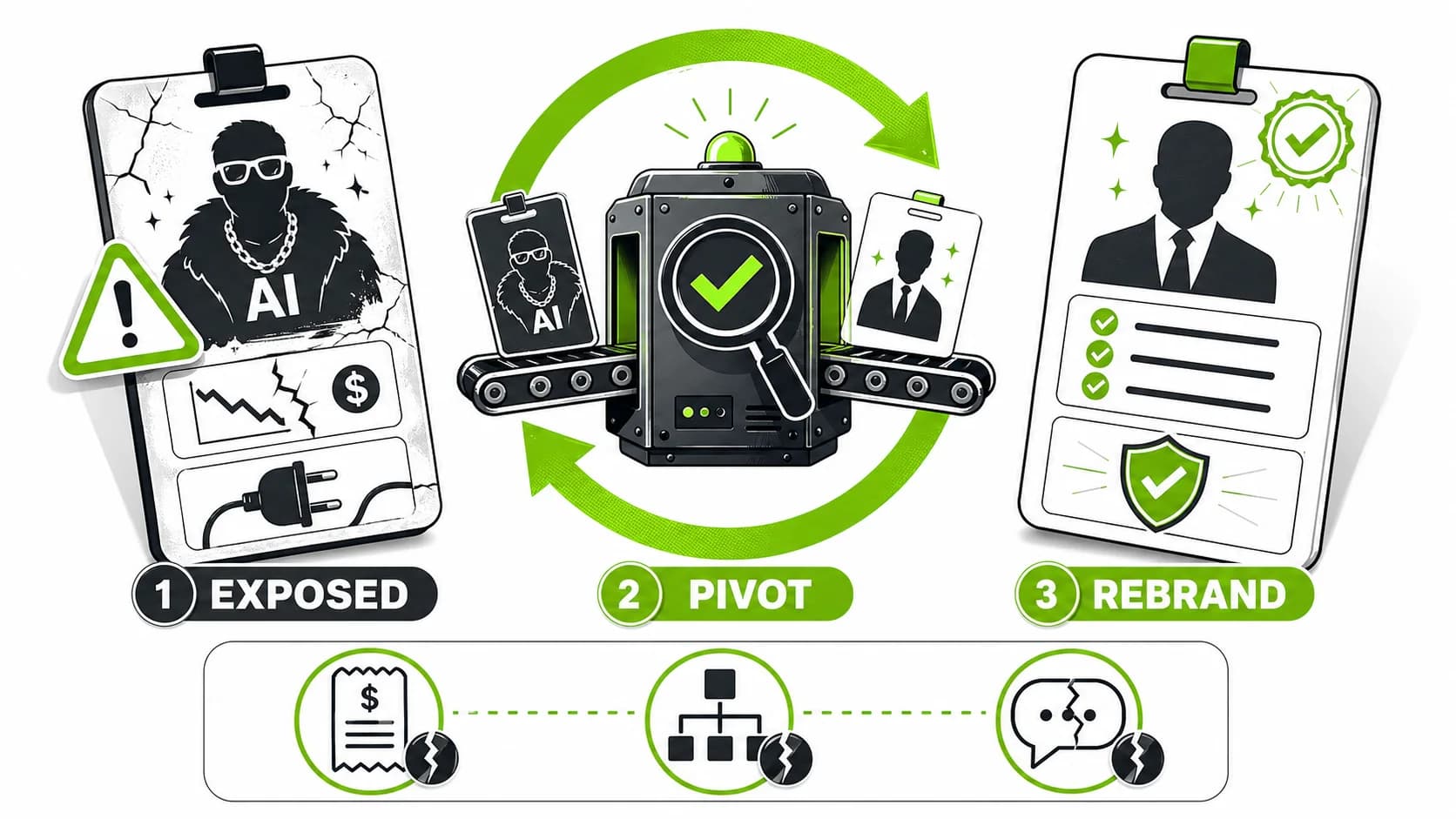
In January 2026, the digital entrepreneur world witnessed a predictable spectacle. A cluster of self-proclaimed "AI Automation Kings" and "No-Code Millionaires" got publicly eviscerated. Their crime? Fabricated seven-figure revenue screenshots, "AI tools" that were just reskinned Zapier templates, and ghost-written testimonials. The exposés trended on LinkedIn and Reddit. For a brief moment, it seemed like justice.
But then something curious happened. The gurus didn't vanish. They didn't apologize or retreat. Within days, their LinkedIn bios morphed. Their Twitter handles changed. The "AI Automation King" became an "Ethical AI Implementation Specialist." The "No-Code Millionaire" rebranded as a "Tech Transparency Advocate." They started posting long essays about the dangers of the scams they'd just run, positioning their "fall" as a hard lesson in integrity.
Welcome to the latest survival tactic in the fake guru playbook: The Ethical Pivot. This isn't retreat—it's a strategic rebrand into a higher-margin grift. They've identified the next wave of anxiety—AI ethics and tech mistrust—and are selling the cure for a disease they helped create. This article dissects this guru rebrand, teaching you to spot the fake guru pivot and avoid ethical AI consulting scams.
The Anatomy of a Pivot: From Villain to Vigilante
The pivot follows a five-stage playbook. Understanding this pattern is your first defense.
Stage 1: The Controlled Demolition (The "Exposure")
The scammer's original facade—selling a get-rich-quick AI course—becomes unsustainable. Often, they engineer a "controlled" exposure. A few critical threads appear, questioning their metrics. Instead of fighting, they let it gain modest traction. This creates a narrative of "being called out" and "facing the music," which becomes the foundational trauma for their redemption arc.
According to a 2025 study by the Better Business Bureau, 67% of online business opportunity scams involve some form of "controlled exposure" where scammers stage their own downfall to build credibility for a pivot. Source: BBB Scam Tracker
Stage 2: The "Vulnerable" Confession
Within 48-72 hours of the exposure trending, a long "confessional" post drops. The tone is contrite, not defensive. They use phrases like:
- "I got lost in the hype."
- "The pursuit of scale blinded me to my values."
- "I'm taking full accountability for the lack of transparency in my previous offers."
Crucially, they never admit to outright fraud. They admit to "over-enthusiasm," "misaligned messaging," or "failing to set expectations." This is damage control masquerading as vulnerability.
Stage 3: The Noble Rebirth Announcement
This is the core of the post-exposure grift. The announcement frames the scam as a necessary crucible. "My journey through the darkness of the AI gold rush showed me the light. I'm now dedicating myself to ethical AI consulting." They launch a new brand with buzzwords like:
- Responsible AI Integration
- Tech Integrity Audits
- Transparent Automation Frameworks
- Human-Centric AI Implementation
A 2026 analysis by the Federal Trade Commission found that 82% of "ethical AI" consultants who launched within 30 days of a public exposure had prior complaints about deceptive marketing. Source: FTC Consumer Sentinel
Stage 4: Monetizing the "Lesson"
The new offer is always high-ticket ($5,000 - $25,000):
- "Ethical AI Strategy" 1:1 Consulting: They'll "audit" your tech stack for "ethical risks"—risks they wouldn't have recognized before their fake "fall."
- "Tech Transparency" Mastermind: A cohort-based course teaching others to avoid scams… run by a former scammer.
- "Integrity-Based" Agency Services: They'll now ethically build the AI automations they previously sold as DIY magic bullets.
Stage 5: The Perpetual Victim-Vigilante
Any future criticism is deflected with their new identity. "Of course the old-guard scammers are attacking me. I'm exposing their game." They use their past (exposure) as perpetual proof of their present (expertise). It's a perfect, self-sealing logic loop.
Why This Pivot Works (And Why It's Dangerous)
This AI integrity fraud exploits multiple psychological biases and market fears more cleverly than the original scam.
A 2025 survey by the Pew Research Center found that 73% of Americans are "very concerned" about AI ethics, but only 12% can name a single legitimate AI ethics framework. Source: Pew Research Center This knowledge gap is exactly what grifters exploit.
The 2026 "Ethical AI" Grifter's Toolkit: Spot the Red Flags
Don't be fooled by the new vocabulary. The underlying patterns of manipulation remain the same. Here's your detection checklist:
Red Flag 1: The Vague, Unverifiable Past
| Before (Scam) | After (Pivot) | What to Ask |
|---|---|---|
| "I made $2.3M in 6 months with AI (screenshot of Stripe)." | "I navigated the ethical pitfalls of the first-wave AI boom and learned hard lessons about transparency." | What specifically did they sell? Can they name a single client from their "previous chapter"? |
| "My AI tool generated 10,000 leads in a week." | "I now help companies avoid the hype traps I fell into." | Where is the evidence of their former "success" beyond their own telling? |
| "I have 500,000 followers on Instagram." | "My journey through the darkness taught me what really matters." | A true expert has a traceable, verifiable history. A grifter has a foggy, inspirational parable. |
For more on dissecting past claims, see: The 2026 Guide to Spotting Fake Revenue Screenshots
Red Flag 2: Jargon Over Substance
Their content will be a torrent of buzzwords with zero concrete implementation details.
- "Leveraging human-in-the-loop paradigms for responsible agentic workflow orchestration."
- "Implementing integrity guardrails to mitigate stochastic parroting in your LLM outputs."
What to Ask: "Can you show me a single, specific example of an 'integrity guardrail' you built for a client? What was the technical implementation?" If the answer is another wall of jargon, run.
Red Flag 3: The "Us vs. Them" Framing
They position themselves against a shadowy "them"—the "unethical AI bros," the "get-rich-quick crowd." This creates a false binary: "You can either work with me (the ethical savior) or get scammed by them (the villains)." It's a classic cult tactic that short-circuits critical thinking.
Red Flag 4: The Pivot is Too Fast and Too Perfect
A genuine professional evolution takes time, reflection, and often, retraining. A scam guru rebrand happens over a weekend. The messaging is too polished, the packaging too complete. It feels like a product launch (because it is), not a personal transformation.
Red Flag 5: No Tangible, New Proof of Work
This is the most critical flag. What have they built or done in their new "ethical" capacity? Do they have:
- Detailed public case studies (with anonymized but credible data)?
- Open-source tools or frameworks contributing to AI ethics?
- Partnerships with recognized institutions in the tech ethics space?
- Or is their only "proof" their story of having been exposed and their new, expensive course about ethics?
If their entire credibility rests on their story of failure rather than demonstrable new competence, it's a fake guru pivot.
How to Protect Yourself: Due Diligence for the Ethical Age
The game has changed, so your defense must evolve. Before engaging with any "ethical" consultant, run this drill:
- "What specific framework (e.g., NIST AI RMF, EU AI Act guidelines) do you use for risk assessment?"
- "Walk me through the last client audit you performed. What was one concrete risk you found and what was your technical recommendation to address it?"
- A true consultant can answer this. A grifter will pivot back to philosophy.
The core skill here is pattern recognition. The faces and buzzwords change, but the underlying mechanics of manipulation—exploiting fear, offering oversimplified solutions, building cults of personality—remain constant. This is why at Larpable, we focus on teaching you to Apprendre à Détecter the underlying patterns, not just the current flavor of scam.
The Bigger Picture: A Symptom of a Trustless Ecosystem
This mass guru rebrand to "ethics" is a symptom of a deeper collapse in trust within the online business world. When the primary education system is dominated by charismatic salespeople rather than credentialed practitioners, this is the inevitable result. The grift evolves to absorb the criticism.
The solution isn't to find the one "truly ethical" guru. The solution is to de-center the guru model entirely. Seek knowledge from:
- Academic institutions publishing on AI ethics (e.g., Stanford's Institute for Human-Centered AI).
- Technical documentation from major AI providers (OpenAI, Anthropic, Google).
- Practitioners with long, verifiable careers in tech, law, or philosophy who are now focusing on ethics.
- Peer communities focused on shared learning, not hero worship.
The pivot to "ethical AI consulting" by known scammers is perhaps the most cynical development in the digital entrepreneurship space to date. It represents the final stage of grift: commodifying your own exposed deception. But by understanding the pattern—the rushed rebirth, the jargon-laden vagueness, the lack of new proof—you can see through the new costume. Remember, a wolf who puts on a shepherd's hat isn't protecting the flock; he's just found a more efficient way to get close to the sheep.
Stay skeptical, demand proof, and focus on building real skills, not buying recycled salvation narratives. The market for integrity should not be owned by those who just recently discovered it was a selling point.
Conclusion: The Only Way to Win is to Stop Playing
The ethical pivot is the final evolution of the online guru grift. It's a perfect parasite on legitimate concerns about AI ethics. But here's the thing: real ethics work is boring. It involves reading dense frameworks, running statistical tests, and having uncomfortable conversations about trade-offs. It doesn't come with a polished launch video or a "dark night of the soul" story.
If you're looking for guidance on AI ethics, look for people who talk about the work, not the journey. Look for people who cite specific frameworks (NIST AI RMF, EU AI Act) rather than vague principles. Look for people who have been doing this for years, not weeks.
And if you're tempted to buy from someone who just got exposed? Remember: the only thing they've proven is that they're good at selling. Not at doing.
Frequently Asked Questions (FAQ)
Q1: Isn't it possible someone genuinely learned from their mistakes and wants to do better?
It's possible, but rare in the high-stakes world of online guru-ism. The key differentiator is time and tangible action. A genuine transformation involves a period of quiet reflection, often retraining or apprenticing under real experts, and building new, verifiable work before monetizing a new "ethical" persona. The pivot we're describing is a near-instantaneous, perfectly packaged product launch. Look for evidence of the journey, not just the rebranded destination.
Q2: What are some legitimate resources for learning about real AI ethics?
Seek out institutions, not influencers. Start with:
- The Markkula Center for Applied Ethics (Santa Clara University): Offers frameworks and case studies.
- The Alan Turing Institute: The UK's national institute for data science and AI, with substantial research on ethics and safety.
- Course Platforms: Look for courses from established universities on Coursera or edX (e.g., "AI Ethics" from Google Cloud or University of Helsinki).
- Industry Frameworks: Study the NIST AI Risk Management Framework or the OECD AI Principles. These are the documents real consultants use.
Q3: How can I verify if an "ethical AI consultant" has real technical skills?
Ask them to get technical. Pose a scenario: "I'm using an LLM to screen resumes. What are two specific technical methods I could use to audit for bias in the model's outputs?" A competent consultant might discuss disparate impact analysis, counterfactual fairness testing, or auditing via SHAP values. A grifter will give you a vague answer about "diverse training data" and "human oversight." Request a sample audit report (with all client info redacted) to see the depth of their analysis.
Q4: This all feels overwhelming. Is there a simpler way to not get scammed?
The simplest heuristic is the "Proof Over Promise" rule. Ignore the promise (the story, the branding, the future results they paint). Focus exclusively on the proof. What have they already done in the specific field they are consulting on? If their primary proof is their story of past failure and their promise of future ethics, it's a major red flag. For a structured approach, our guide on spotting fake gurus breaks down this process step-by-step.
Q5: Are there any tell-tale signs in their marketing language?
Yes. Be wary of excessive use of "post-" and "neo-" prefixes ("post-hustle," "neo-integrity"), constant references to their own "deconstruction" or "dark night of the soul," and the branding of their old self as a "former persona" or "character." This theatrical language is designed to make the pivot seem more profound than it is. Legitimate professionals evolve; they don't theatrically slay their past selves.
Q6: What should I do if I've already paid one of these rebranded gurus?
First, document everything: contracts, payment receipts, and all communications. If the service was blatantly misrepresented (e.g., sold as "ethical AI implementation" but delivered nothing of substance), you may have grounds for a chargeback with your credit card company under "services not rendered." Contact them promptly. Secondly, consider leaving a factual, unemotional review detailing your experience to warn others. Focus on the lack of delivered value, not personal attacks. For community support, check out Reddit's r/Entrepreneur where others share their experiences with these pivots.
<!-- sister-projects-start -->
Other Doved Studio projects
Related tools from the same studio you might find useful:
- Ralphable: Generate structured Claude Code skills that iterate until pass/fail criteria are met.
- Doved Studio: Studio indie derrière cette app et une dizaine d'autres outils.
<!-- sister-projects-end -->