The direct answer: A legitimate employer sends money; a scammer demands it
The rule never changes, even when the job title includes “AI prompt engineer” or “remote crypto analyst”: a real job pays you for completed work. A scam flips the direction of payment — it turns the interview into a pressure sequence that demands money, sensitive identity documents, or both, before you’ve earned anything. In 2026, the same dynamic operates through polished AI-generated recruiter faces, cloned voices on Telegram, and corporate onboarding portals that exist purely to harvest your driver’s license and bank sign-in.
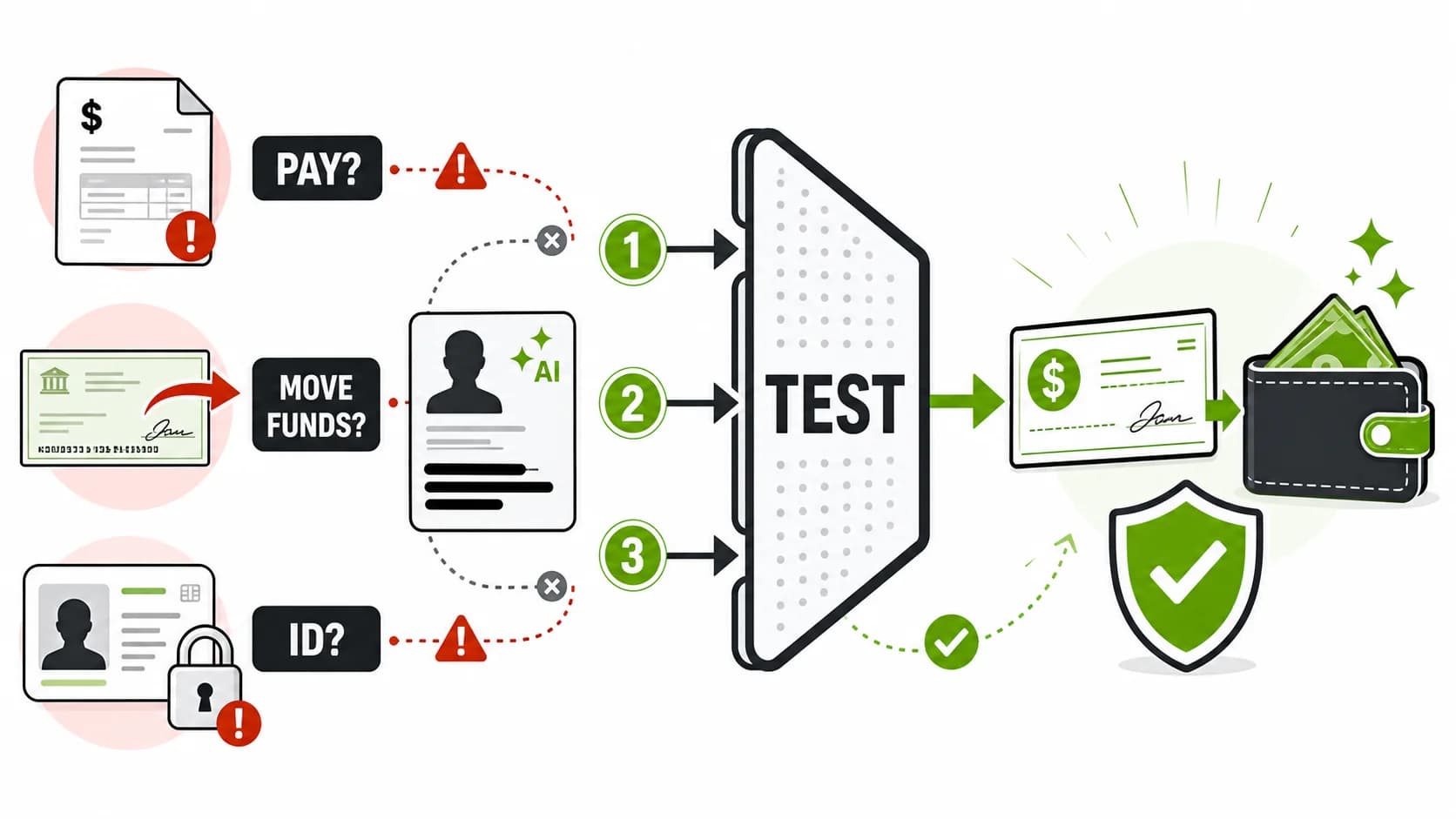
You can condense the entire checklist into three yes/no questions that determine whether you’re dealing with a task-test scam:
If you answer “yes” to any one, you’re inside a scam script. The Federal Trade Commission’s guidance on job scams is blunt: “Honest employers, including the federal government, will never ask you to pay to get a job.” The moment someone presenting a remote role asks for money or bank credentials, walk away. That’s the direct answer. The rest of this section maps the evidence behind that answer and shows you the precise patterns these scams follow, so you can spot them in seconds even when the pitch has been customized for you with AI.
Why this matters now: 3x job scam reports and AI’s deception multiplier
The scale of the problem has changed faster than most awareness campaigns can keep up. The FTC reports that job scam complaints tripled between 2020 and 2024, while losses jumped from $80 million to over $220 million in the same period. Median individual loss in 2024 reached $2,000, a figure that reflects both fake-check scams and the newer “paying to get paid” task-fraud variants. According to the FBI, more than 5,000 cryptocurrency-specific job scam complaints landed at IC3 in 2024 alone, with reported losses exceeding $2.6 billion. Those are not typos — the FBI’s press release on cryptocurrency and AI scams calls the combination a “devastating threat” that bilks Americans through increasingly personalized, automated deception.
AI is not a background factor here; it’s the engine that makes 2026 scams far harder to dismiss. Recruitment videos now feature synthetic voices and lip-synced faces lifted from legitimate LinkedIn profiles. “Recruiters” can clone the tone and meeting rhythm of a real HR manager because the conversation is generated in real time by a large language model. The attackers are counting on job seekers — freelancers, students, career-changers — to conflate technological sophistication with legitimacy. A well-crafted Loom walkthrough of a “task dashboard” that demands a $50 crypto deposit feels plausible precisely because it looks like a remote work tool.
The urgency spikes. With AI slashing the cost of mass customization, one criminal operation can target thousands of potential victims simultaneously through SMS, WhatsApp, and direct messages on freelance platforms, each message tweaked to the recipient’s profile. And because so many of these offers arrive out of the blue from a “recruiter” who found you on a job board, the impulse to engage before verifying is exactly what the script exploits.
Before you internalize the scam stages, watch the official consumer-protection video from the Federal Trade Commission, Fraud — An Inside Look:
youtube: OoB2PKYbu4Q
The video dissects the emotional levers — excitement, fear of missing out, manufactured time pressure — that override logic. The three-minute watch replaces hours of after-the-fact regret because it shows you the same mechanics that will appear in the evidence map below.
Evidence map: How the 2026 AI remote job scam works, source by source
The map below aligns real scam patterns with the specific warnings published by the FTC and FBI. Each stage is backed by a direct source, so you’re not relying on anyone’s intuition — you’re reading the same signals that consumer-protection investigators have flagged.
Stage 1: The too-good-to-be-true offer, now injected with AI polish
Scammers advertise jobs the same way real employers do — on job sites, social media, and through direct outreach. The difference is the follow-up. The 2026 variant often reaches you in a Telegram or WhatsApp message with a professional-looking welcome packet that includes a fake offer letter, a company logo, and a “task portal” link. These facades are trivial to generate with AI image tools and can even incorporate a synthetic video of a “team lead” explaining how you will earn $200–$500 daily by rating products, optimizing AI data, or liquidating cryptocurrencies.
The FTC’s Looking for a new job or business opportunity? page warns that scammers may use real company names or clone entire websites to appear genuine. In 2026, the clone can include a deepfake representative conducting a one-way video “interview” that requires only that you watch, which lowers suspicion.
Source reference: FTC, Job Scams: “They might say they found your resume on a job site, but they really got your contact information from a list sold online.” FTC, Looking for a new job or business opportunity?: “Scammers advertise jobs the same way legitimate employers do — online … sometimes with fake company websites.”
Stage 2: The “task test” that flips the payment direction
Once you’re engaged, the script introduces the twist: you need to complete a “task test” to qualify for the higher-paying assignments. The test might be rating a few Google Maps entries, clicking on ads, or verifying product listings. For the first few micro-tasks, the scam may actually pay you a small amount — $10 or $20 in cryptocurrency — to build trust and demonstrate that the dashboard “works.” That micro-payment is the bait.
Then comes the pivot: to unlock the next task tier, transfer money. The dashboard will show a negative balance, or your “account manager” will explain that you must deposit crypto to access premium tasks that pay out immediately. The FTC’s Paying to get paid task scam spotlight describes exactly this model: “Scammers promise you will earn big money doing simple tasks … but first you have to pay to work.” The spotlight warns that the platforms look like legitimate interfaces with account balances and performance metrics, but the displayed balance is a mirage — you can never withdraw anything beyond the initial low-dollar bait.
In many cases, the scam goes further: it pressures you to recruit others or buy a “certification” course that unlocks “AI partner” status — a variation that bleeds into territory covered by our AI automation course checklist and the fake AI agent agency red flags. The thread is always the same: money moves from your pocket to the scammer’s, not the other way around.
Source reference: FTC, Paying to get paid task scam spotlight: “The catch: you have to pay to get started. And if you pay, you’ll be asked to pay more and more, but you’ll never get the promised work or money.”
Stage 3: The money movement trap — fake checks, crypto conversion, or “mule” duties
A different branch of the remote-job scam skips the task dashboard altogether and casts you as a payment processor. The FBI’s dedicated page on cryptocurrency job scams lays out the signature: “Criminals … tell victims their job involves receiving money and converting it to cryptocurrency.” The victim thinks they’re handling customer payments for a legitimate business; in reality, they’re laundering funds from other scam victims.
The fake-check variation is equally destructive. The “employer” sends a check — sometimes via mobile deposit — and instructs you to use part of it to buy equipment from a specific vendor or to send money back for “overpayment.” The check is counterfeit, but banks make the funds appear available before the fraud is detected. By the time the check bounces, you’ve already sent your own money to the scammer. The FTC’s job scams guidance spells it out: “They’ll tell you to deposit a check, keep part of the money, and send the rest back. It’s a scam.”
A 2026 twist uses AI-crafted payment confirmation screenshots and fake bank transfer notifications to “prove” the check has cleared. We cover the verification techniques for such screenshots in our separate revenue screenshot verification guide; the lesson transfers directly: if the proof of payment is a static image and not a transaction you can verify in your own bank portal independently, treat it as suspect.
Source references: FBI, Cryptocurrency Job Scams: “Criminals … tell victims their job involves receiving money and converting it to cryptocurrency.” FTC, Job Scams: “If you get a check and are told to send back money, that’s a scam.”
Stage 4: ID harvesting disguised as onboarding
The final piece of the evidence map is the request for identity documents. Legitimate employers do need your information — for I-9 forms, tax withholding, or direct deposit — but only after an offer letter is signed and a verifiable HR record exists. The scam accelerates the demand to the interview phase: “Just upload a photo of your ID and bank card to our secure portal to finalize your profile.” That portal is a capture form, and the information is sold or used to open accounts in your name.
The FTC’s consumer advice on job scams includes this red flag: “Scammers will … ask for your personal information, like your driver’s license or Social Security number, to steal your identity.” Combined with the AI-generated recruitment interfaces, the request feels routine. But no real remote employer needs a photograph of your passport before you’ve signed a contract, spoken to a human on camera, and received an IRS-compliant employment document.
The task-test checklist: seven rules to anchor every decision
Map these rules against the evidence above, and you’ll have an automatic stop signal even when the AI recruiter sounds perfect.
The evidence map leaves no room for ambiguity. The FTC and FBI have documented the exact sequences that separate a real remote job from a task-test scam. In 2026, the AI polish is thicker, but the fraud mechanics are identical. The only variable is whether you pause long enough to test the offer against these rules before you hit send on your money or your ID.
Decision table and workflow setup
When an offer arrives—polished, after hours, and delivered straight to your encrypted chat—the checklist alone isn’t enough. Pressure rewires decision-making, and scammers bank on that. This table collapses the most dangerous signal combinations into one glance, letting you match what you’re seeing to a fast exit move. Pair it with the workflow below so you never miss a verification step.
Before you read the table, take 13 minutes to internalize why these signals work on a human brain. The FTC’s documentary Fraud – An Inside Look (official consumer-protection video that helps readers understand fraud mechanics before applying the checklist) dismantles the urgency-and-isolation playbook. That understanding is your mental firewall.
Decision table: red-flag intersections that signal “exit now”
| When you see this combination… | The scam engine is doing this… | Your immediate move |
|---|---|---|
| Offer came via Telegram/Discord/DM, no public job posting, and they ask for a “verification fee” or “security deposit” before your first task. | Classic advance-fee job fraud. The FTC’s job scam hub states bluntly: “Don’t pay for the promise of a job.” | Block. Report to the FTC at ReportFraud.ftc.gov. Do not send a cent. |
| “Employer” sends a check for equipment, then tells you to wire part back, buy gift cards, or fund a crypto wallet for “client optimization.” | Fake check + money-mule recruitment. The FBI’s cryptocurrency job scam alert warns: “The check will bounce after you’ve sent the money.” | Do not deposit the check. Shred it. Report to the FBI’s IC3 immediately. |
| Interview stays entirely on Telegram, WhatsApp, or Signal; no live video with a verifiable human, and the hiring manager requests your ID “to lock in the spot.” | AI-generated recruiter profile + ID harvesting. The FBI’s broader AI-and-crypto fraud report notes criminals use stolen IDs “to open fraudulent accounts and launder proceeds.” | Halt. Insist on a public platform video call with a corporate email domain. If they refuse, you’re no longer talking to an employer. |
| Tasks involve “liking” videos, “optimizing” apps, or “boosting” listings — and a small crypto deposit is required to unlock earnings. | Deposit-to-earn task scam. The FTC’s spotlight on paying to get paid explains: “They tell you to make a deposit first to get paid, then lock you out.” | Stop. No legitimate role requires you to front money to perform tasks. Report to the FTC. |
| “Onboarding” demands a passport scan, bank login, or full SSN before you’ve spoken to a real person or verified the company’s legal registration. | Synthetic identity fraud pipeline. Often linked to the same AI tools described in the FBI’s alert above. | Pause. Real employers collect sensitive data via encrypted HR portals after a formal offer — not over chat. |
Every row in the table connects to a documented enforcement pattern. If you’re inside a conversation that matches even one of these intersections, treat it as a confirmed scam and move to disengage. The workflow below gives you a repeatable sequence so you don’t have to rely on gut feeling alone.
Workflow: from suspicious offer to safe decision (first half)
The full sequence has seven steps; here are the first four, designed to be executed in minutes — before you share a single piece of information.
1. Pause and capture the context
The moment an offer lands in your DMs, emails, or a Telegram group, resist the impulse to reply. Screen-grab everything: the message text, the sender’s profile, the company name, the promised pay, and any urgency triggers (“only 2 spots,” “respond in 1 hour”). The FTC’s guidance on job opportunity scams reminds that scammers “count on you acting on emotion—excitement or fear of missing out.” A 10-minute pause saves you from reacting to a manufactured crisis.
2. Run a 60-second domain and reputation check
Grab the company domain from the recruiter’s email or website. Plug it into a WHOIS lookup and note the registration date — domains younger than six months, especially when tied to a “global” firm, are a blazing red flag. Look for typosquatting: gooogle.com instead of google.com. If the offer references AI automation courses, trading bots, or agency ownership, cross-reference with the AI automation course checklist and AI trading bot scam checklist. Both resources show how scammers fabricate income claims to recruit you into a pay-to-play ecosystem. If the company’s “headquarters” don’t match its domain’s country of origin or the site’s “About” page is a thin collection of stock photos, park the offer in the “do not engage” bin. Our fake AI agent agency red flags guide details many of these mismatches.
3. Enforce the “always two-way video” rule before any data release
In 2026, AI can generate a convincing recruiter profile, a voice clone, and even a static headshot that passes a casual glance. That’s why you must insist on a live video call on a platform where you see the person’s face, hear unscripted answers to off-topic questions, and observe a real-time background that matches a physical office. Legitimate companies use Zoom, Microsoft Teams, or Google Meet with a corporate domain. If the recruiter pushes for audio-only, a generic “Telegram video call,” or claims their camera is broken but they need your ID “to lock in the position,” you’ve hit the third row of the decision table. Exit. The FTC video linked above illustrates exactly how scammers use forced isolation and false intimacy to lower your defenses.
4. Validate the payment flow before any money moves
A job pays you—always. If the interview pivots to a task where you must receive a check, buy crypto, or pay for a “training module,” stop and consult the decision table rows. Then verify any screenshots or statements the “employer” shared using the revenue screenshot verification guide. If the offer demands you purchase a course to qualify for the job, treat it as an upsell scam and check the online course scam checklist. For any request that involves crypto, recall the FBI’s plain-language rule: “No legitimate employer will send you a check and ask you to send money back.” That covers fake-check forwarding, crypto “task unlocking,” and training-deposit sinkholes. If outbound money is part of the equation, you aren’t a candidate—you’re the target.
The remaining steps of the workflow (digital footprint analysis of the “company,” ID-security protocol, and reporting the attempt) continue from here. For now, executing these first four steps consistently will filter out virtually every AI-polished job scam before you send a dime or a scan of your passport.
Even seasoned professionals fall into remote job traps — here are the workflow failures to fix
A polished message, a LinkedIn profile with 500+ connections, and a “hiring manager” who sends a calendar invite within minutes feel legitimate. That feeling is exactly what AI-scam workflows rely on. The biggest mistake in 2026 is not ignorance of the checklist — it’s assuming your own caution will override the rush of a perfectly timed opportunity. Real-life data shows that people who read the red flags still send money or documents when the scam wraps urgency around a familiar task. The task-test checklist only works if your personal workflow eliminates the mental shortcuts that scammers exploit.
The first workflow mistake is treating a preliminary “task test” as proof of a real job. A real employer might ask you to complete a small skill exercise — edit a paragraph, audit a data set, or draft a reply — but it will never require a financial deposit, crypto conversion, or the purchase of equipment from a singular vendor. If you’re told to “activate your work portal” by sending $50 in stablecoin so you can earn $500 in task commissions, you have already moved past the test into the scam’s core. Many victims rationalize the payment as an onboarding fee, especially when an AI-generated contract, complete with realistic clauses, arrives in their inbox. The pay-to-get-paid model is a known construct: the FTC’s “Paying to get paid” task scam spotlight details exactly how a small deposit morphs into escalating demands, but the 2026 variant now hides the same mechanism behind AI agents that simulate a “work dashboard” with fake earnings accumulating in real time.
A second pervasive failure is isolating the decision. Victims who discuss the offer with someone else — a partner, a trusted colleague, or a career coach — exit the scam at a far higher rate. Yet the criminal workflow deliberately pushes communication into private Telegram or WhatsApp channels, where the “supervisor” can apply undiluted pressure without external skepticism. The moment an interviewer demands that you move to an encrypted app and discourages you from sharing the offer with anyone, the workflow becomes a high-probability scam. A practical rule: if you cannot forward the conversation to a friend and receive a calm, second opinion within an hour, the offer fails the task-test checklist automatically.
Misreading the difference between a genuine small task and a task designed to harvest financial credentials is another repeated error. A legitimate company might ask for your tax ID or bank details after a signed offer letter and a verified HR system, not before. The scam workflow reverses this: you receive an “urgent” request for a photo of your ID, a selfie holding the ID, and a utility bill under the guise of identity verification, all before a formal contract. Once those documents are in the scammer’s hands, they are used to open fintech accounts, apply for loans, or impersonate you in subsequent frauds. The Federal Trade Commission’s job scams advice highlights that no legitimate employer will demand your personal documents before you have met the team through a verifiable company channel — not just a video call with a single “manager.”
A subtle but destructive mistake occurs when a task test mimics real platform economics. In the “app optimization” or “data labeling” variant, you perform simple clicks inside a convincing mobile app and see a wallet balance that grows with every completed set. The scam lets you withdraw $30 or $40 once to prove the system works. That single withdrawal — backed by an AI-generated voice note from your “team lead” praising your speed — rewires your risk assessment. The scam now has a psychological anchor: you received real money, so the next “accelerated task tier” that requires a $200 recharge must also be real. The FBI’s warning on cryptocurrency job scams confirms that this “build-trust-then-drain” sequence is the standard playbook, often using USDT or other stablecoins to create a veneer of financial normality. The correct workflow is to flag any task where you must deposit your own assets to unlock higher earnings, no matter how small the initial withdrawal was.
The edge case that traps freelancers and students is the hybrid course-upsell job. A recruiter offers a well-paid remote role as an “AI workflow specialist,” but during the task test you’re informed you need a certification from a partnered platform — available at a discount for the next 48 hours. The job is fake; the course enrollment is the whole business. This tactic borrows heavily from the mechanics covered in the online course scam checklist, where urgency and a “limited cohort” drive payment. A safe workflow has a single rule: a real job pays you, not the other way around. When a task test morphs into a learning purchase, the correct action is to walk away, and — if you’re genuinely interested in upskilling — explore legitimate, zero-cost training from free learning alternatives instead.
Another hybrid edge case is the “AI agency” spin-off. After a few task rounds, the fake employer suggests you can earn more by creating your own “AI agent agency” under their parent brand. You’ll need to register a business account, link a payment processor, and then process client payments on their behalf. It feels like an entrepreneurial promotion; legally, you become a money mule, funneling stolen funds through your personal accounts while keeping a small percentage. The indicators mirror the fake AI agent agency red flags checklist: vague business descriptions, no registered corporate address, and a compensation structure that requires you to move money before earning. A task-test workflow should always include a corporate registry check that takes two minutes — and the refusal to provide a verifiable business registration number ends the conversation.
A final mistake that neutralizes the task-test checklist is over-indexing on a single green flag while ignoring multiple red ones. The scam might include a website, a Terms of Service page, and even a publicly listed phone number used by an unwitting real company. Victims verify that the website exists and stop looking. In 2026, cloning a legitimate company’s entire online presence — including LinkedIn pages, Glassdoor reviews, and press mentions — is a prompt-driven task for a scammer’s LLM pipeline. Deeper verification is non-negotiable: contact the real company through a number you find independently on an official directory, not the one in the email signature. Ask if the recruiter and the job exist. This two-channel verification catches nearly all impersonation scams, but most people skip it because the task test felt “fun” and the first withdrawal cleared.
Workflow mistakes also extend to how you handle revenue proof. Scammers flood private chats with screenshots of other “taskers” celebrating withdrawals of hundreds of dollars. Those images are generated, templated, or recycled. A separate guide on revenue screenshot verification equips you to spot metadata inconsistencies and duplicated transaction hashes. Before you conclude that a task-based payment system is legitimate, apply that check and remember that a single verified payout to another person doesn’t mean you will ever receive one.
The task-test workflow should also incorporate a hard filter for crypto-top-up mechanics. Scammers now frame USDT deposits as “inventory staking” for AI trading bots that guarantee returns — a direct overlap with the red flags in the AI trading bot scam checklist. When a job’s core function is to supply liquidity or “activate” AI investment pools with your own money, you are no longer a worker; you are a liquidity provider for a crime. The FBI’s recent announcement on cryptocurrency and AI scams bilking Americans of billions underscores how quickly these schemes drain wallets through automated, trust-building task interfaces. The safest move is to classify any task that involves connecting a personal crypto wallet or purchasing digital assets as an automatic “exit now” signal, regardless of how seamless the training module appears.
One more edge case related to course upsells warrants attention: the “AI automation course” scam that masks itself as a paid training period before job placement. A recruiter promises a remote automation role after you complete a proprietary course, often decorated with fake accreditations and rich AI-generated syllabi. The cross-check comes from the AI automation course checklist, which reveals the pattern: high upfront cost, unverifiable hiring partners, and a guarantee that evaporates once payment clears. The task-test rule is simple: if the test is a purchase, it’s not a job.
Before you implement any checklist, watching the FTC’s Fraud - An Inside Look video on YouTube helps you understand the mechanical design behind every step above. It shows how scammers engineer emotional pressure, isolate you from the rational brain, and structure the interaction so that protesting feels rude or ungrateful. This knowledge makes it significantly harder for a scammer to hijack your workflow, because you’ll recognize the gaslighting script the moment it appears — not after you’ve already wired funds or uploaded your passport. An edge case that often surprises victims is the “refundable deposit” trick: the task test requires a $100 deposit “for security,” and the dashboard shows it as a balance you can withdraw after 50 tasks. After the 50th task, you get a maintenance fee notice or a “VIP unlock” prompt and never recover the deposit. The pattern repeats. Your workflow must treat any movable asset coming out of your pocket — fiat, crypto, gift card, or a login credential that can be monetized — as a final red flag, no matter how credible the dashboard looks.
Edge cases also include task tests that arrive through compromised accounts of real friends or colleagues. A message from a known contact saying “I just got hired doing AI data tasks and they’re accepting people; just message this Telegram user” lowers your defenses catastrophically. Even if the initial touchpoint is someone you trust, the workflow does not change: apply the seven-rule checklist, never send money, and verify the hiring entity independently. The scammer is simply riding on peer trust to bypass your filter, a mechanism the FTC’s “Looking for a new job or business opportunity?” resource warns about explicitly.
Worked examples: Spotting the scam before you send money or ID
Concrete scenarios expose the mechanics better than abstract rules. Below we walk three real-world-style offers through the seven‑rule checklist, with exact dollar thresholds that turn a suspicious message into a documented scam. Before you run through any example, watch the FTC’s five‑minute breakdown of fraud psychology — Fraud – An Inside Look. It shows how victims are pushed into urgency and isolation, which makes the checklist below much easier to apply.
Scenario 1 – The “data optimization” task test that demands a $75 crypto deposit
You receive a polished WhatsApp message from “NovaHire Talent Solutions.” They found your profile on a job board and offer $35/hour for “remote data processing tasks,” no experience needed. The “HR lead” sends a 10‑page PDF onboarding deck with brand‑accurate logos and an AI‑written welcome note. To “verify your commitment,” you must complete a one‑hour test in their task portal. After five free tasks, the system locks and prompts: Deposit 0.0025 BTC (≈$75) to unlock premium tasks and start earning commissions.
Checklist application:
- Rule 1 – Who initiates the payment? A legitimate employer pays you for work. Here, the direction flips: you must send money first. The FTC’s Paying to Get Paid spotlight confirms that any job requiring you to pay for access, “processing,” or “task levels” is a scam.
- Rule 3 – Is crypto or a payment app demanded? The FBI’s Cryptocurrency Job Scams alert warns that scammers invariably require crypto or instant‑payment apps because the money is nearly impossible to recover.
- Rule 5 – Are the “earnings” conditional on your deposit? When the income figure depends on a buy‑in, the job is a gambling mechanism engineered to make you chase losses. The FBI notes average victim losses in these task scams exceed $4,000 once the initial deposit escalates into “verification” and “tax” demands.
Outcome: Walk away and block the number. No real company funds payroll through employee deposits.
Scenario 2 – The $2,450 equipment check that arrives before your first day
A recruiter on LinkedIn offers a “client relations coordinator” position with a known‑brand software firm. The interview is a quick Zoom chat. You’re hired verbally, and the very next day a FedEx envelope arrives with a cashier’s check for $2,450. Instructions say to deposit it and immediately forward $2,100 via Zelle to an “approved vendor” for a MacBook and headset; you keep $350 as a signing bonus.
Checklist application:
- Rule 2 – Does the money move in your direction without an upstream condition? The check appears to come to you, but you’re required to send most of it out again. Banks must make funds available before a check fully clears, which can take weeks. The FTC’s Job Scams page explains that the check will bounce, leaving you owing the bank.
- Rule 6 – Is the payment amount suspiciously round or large? A $2,450 equipment allowance for a remote coordinator role is excessive. The FTC warns that fake checks often carry rationalizations like “we overpaid so you can buy from our trusted supplier.”
- Rule 4 – Can you verify the company through an independent channel? Call the software firm using the number on its official website – not the one the recruiter gave. In nearly every identical FBI case bulletin, the company has no record of the offer.
Outcome: Do not deposit the check. Shred it. If you’ve already deposited it, notify your bank’s fraud department immediately and do not send any money. The fake‑check threshold most often cited in FTC cases is anything above $500 with a “forward the rest” instruction.
Scenario 3 – Onboarding that asks for passport, SSN, and a selfie before any contract
A “talent acquisition specialist” from “OmniCorp Staffing” rushes you through a chat‑only interview on Telegram, then declares you’re a perfect fit for a $28/hour remote customer service role. To “process your paperwork,” they need a photo of your passport, your Social Security number, and a selfie holding the passport open. They promise to email the formal offer letter afterward.
Checklist application:
- Rule 7 – Are ID documents requested before you have a written, verifiable offer and a live‑call confirmation? The FTC’s Looking for a new job or business opportunity? guidance states never to share sensitive personal information until you’ve confirmed the employer is legitimate through a phone call to a verified company number. Scammers harvest these documents to open credit lines, file tax returns, or sell the data on dark‑web markets.
- Rule 1 again – Who initiates payment/information flow? The interaction is one‑way: you’re giving high‑value identity material while receiving only promises. A legitimate HR department sends you the offer letter and the I‑9 form instructions after you’ve accepted, and they usually process identity verification through a secure payroll platform, not a chat app.
- AI‑specific red flag: The FBI’s Cryptocurrency and AI Scams Bilk Americans of Billions alert notes that AI‑generated headshots and cloned corporate sites make the recruiter’s profile look authentic, but the Telegram‑only communication is a strong signal. Any refusal to hop on a video call with a real human whose face matches a verifiable corporate directory page indicates ID harvesting.
Outcome: Do not send photos or SSN. Freeze your credit if you’ve already sent them, and file an identity‑theft report at IdentityTheft.gov. The minimum‑harm threshold here is zero; no legitimate role-onboarding starts with raw ID documents over a messenger app.
Your source‑backed checklist: seven rules that never change
Anchor every remote‑work offer against this list before you send a cent or a single document.
Use Larpable as your skeptical checkpoint
The checklist above doesn’t take long to run, but romance for a $40/hour remote job can push it aside. Larpable gives you a friction‑free way to pause. Before you click “accept” or send that deposit, feed the entire opportunity through Larpable’s free skeptical framework:
- If the job promises a side‑income course upgrade, run it through the AI automation course checklist.
- If they pitch a business‑in‑a‑box “AI agency,” cross‑check with the fake AI agent agency red flags.
- Any screenshot of rapid earnings needs the revenue screenshot verification guide.
- Crypto‑trading “remote jobs” pair perfectly with the AI trading bot scam checklist.
- If the role turns out to be a gateway to a $997 mastery program, consult the online course scam checklist and the real free learning alternatives that don’t require a recruiter’s “discount code.”
Bookmark this page so the seven rules become muscle memory. Each time an offer lands, open the relevant Larpable checklist side‑by‑side. In 2026, when AI‑generated conversations are indistinguishable from human ones, the tool that saves you is not instinct — it’s a deliberate, verifiable process you repeat every single time.
FAQ: AI remote job scam task‑test checklist
1. What’s the fastest way to tell if a remote job is real?
Ask yourself: Has any money flowed from the company to me, without me first sending something somewhere? Until a legitimate paycheck or a written, verified offer with a W‑2/contractor agreement appears — and you’ve confirmed the company by phone — treat the opportunity as unverified. The FTC’s one‑sentence rule: “If someone says you have to pay to get the job, that’s a scam.”
2. I already sent my money or ID. Can I recover anything?
Act quickly. If you paid via cryptocurrency or peer‑to‑peer app, the funds are likely gone, but report it to the platform and the FBI’s Internet Crime Complaint Center (IC3.gov). If you sent a wire or a check that hasn’t fully cleared, contact your bank’s fraud department immediately — you may be able to stop the transaction. For exposed ID documents, place a fraud alert or credit freeze with the three major bureaus; use IdentityTheft.gov for a recovery plan.
3. Why would a legitimate company ever ask for a small deposit for training materials?
They won’t. The FTC’s Paying to Get Paid leaflet explicitly states that real employers do not charge you for training, certifications, or equipment. If a company is legitimate, they invest in onboarding as a cost of business. Any “deposit” narrative — no matter how small — is a filter designed to find people willing to pay.
4. How do I report an AI‑powered job scam?
File a report with the FTC at ReportFraud.ftc.gov and, if any cryptocurrency or fake check was involved, with the FBI’s IC3. Use the FBI’s Cryptocurrency and AI Scams page as a reference so you can describe the exact tactics. Include chat logs, wallet addresses, and screenshots — agencies use this data to track the moving networks behind the AI‑generated identities.
5. I’m getting job offers via WhatsApp, Telegram, or Signal from “recruiters.” Is that normal?
For entry‑level remote work from a company you’ve never applied to, no. Legitimate recruiters typically start with LinkedIn messages or email from a corporate domain, then move to a phone or video call. Encrypted chat‑app interviews are a red flag by themselves; when combined with a task‑test demand, they tick multiple boxes on the checklist. The FBI’s AI scams bulletin highlights the use of private‑chat pressure to avoid scrutiny.
6. Does Larpable have a checklist for other work‑from‑home scams?
Yes. The site’s entire framework is built around skeptical verification for earning opportunities that look too promising. You’ll find dedicated checklists for business coaching programs that disguise themselves as jobs, AI trading bot promises, fake income proofs, and overpriced courses. Just run the opportunity through the most relevant Larpable guide before you commit time, money, or identity data.