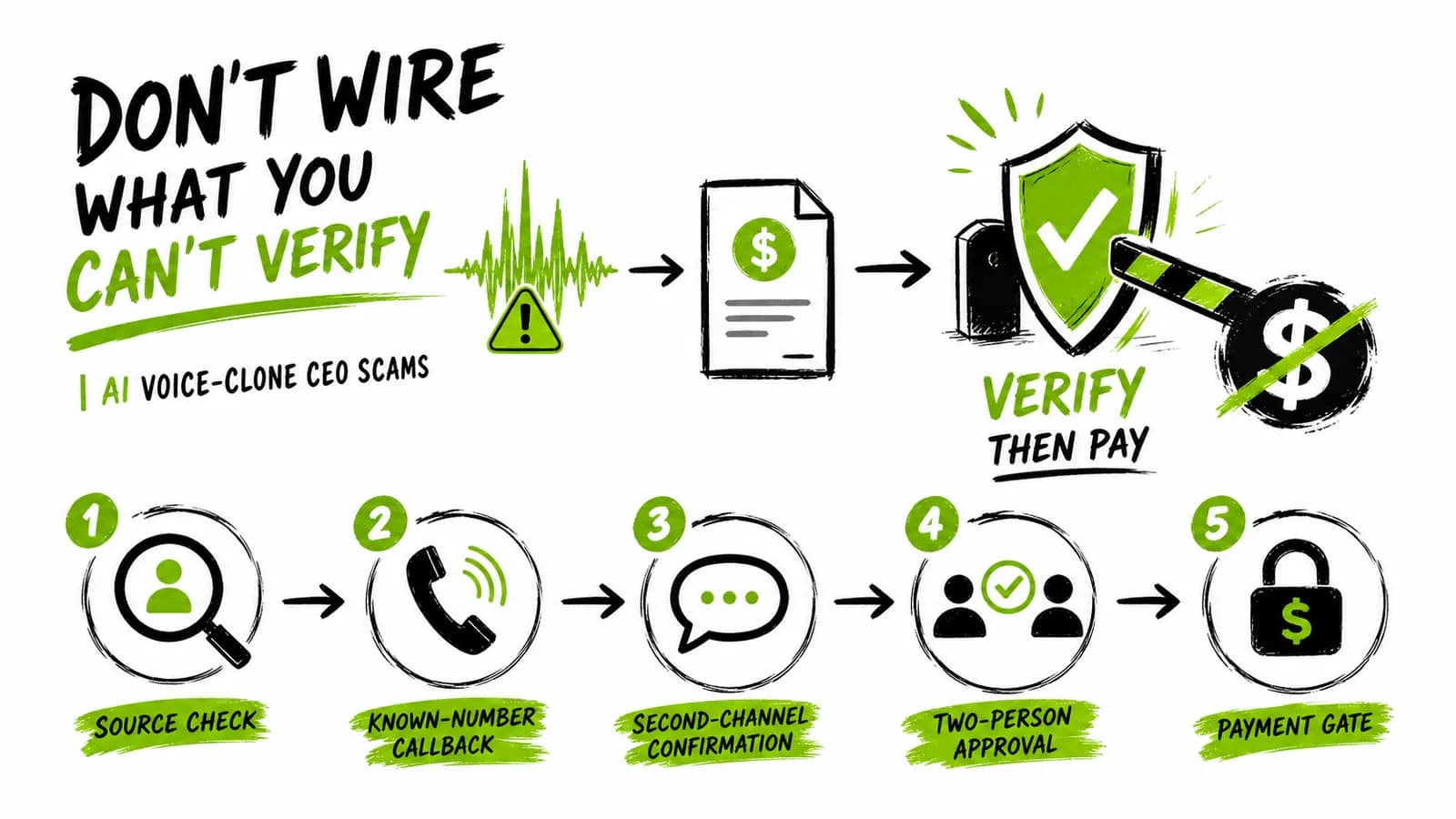
Direct answer: the payment verification ritual you cannot skip
Every payment instruction that arrives through voice, video, or any channel carrying the weight of a familiar executive must be verified through a separate, pre-established, out-of-band path. No exceptions. The ritual is deliberately boring, documented, and impossible to rush because rush is the attacker’s primary tool.
The minimum viable verification ritual for any voice or video payment request has five steps:
If the request is real, the executive will wait 90 seconds. If it is not, the wait is the only thing standing between your organization and a drained account.
This is not hypothetical. Mid‑sized companies and fast‑moving agencies lose six‑figure amounts to these calls. The 2025 Internet Crime Report from the FBI’s IC3 recorded adjusted Business Email Compromise (BEC) losses of over $2.9 billion for 2024, a number that now includes demand transfers initiated or reinforced by voice‑cloned executives. The FBI press release Cryptocurrency and AI scams bilk Americans of billions explicitly warns that voice cloning is being used to impersonate senior leaders and authorize fraudulent transactions, embedding the fraud so deeply in a plausible interaction that victims only discover it when the real CFO asks about the missing funds.
The ritual is not a theoretical best practice; it is the single highest‑return line of defense documented across FBI, FTC, and private‑sector investigations. Organizations that have not operationalized it are relying on luck.
Why this matters now: voice plausibility no longer equals identity
Voice cloning was once a laboratory curiosity that required hours of clean audio. Today, a motivated scammer needs only a few seconds of a target’s speech — drawn from an earnings call recording, a conference talk posted on YouTube, or a podcast interview — to produce a functionally indistinguishable replica. The clone carries not just the words but the cadence, the characteristic pauses, the accent. It can be layered over a spoofed caller ID that matches the executive’s mobile number, or sent as a voice note inside WhatsApp from a compromised account. The result is not a garbled, obviously‑fake robocall. It sounds like your boss.
The FBI’s public warning, covered in the CBS News explainer FBI warns AI is making scams harder to spot, makes the point clearly: an agent demonstrates how voice prints are lifted from social media and weaponized in seconds. The takeaway for operators and finance staff is that voice and video plausibility — the two signals humans have relied on since the telephone replaced the letter — can no longer be trusted as identity proof on their own. The explainer is not an abstract warning. It is a live‑action demonstration of the same technique that has emptied business accounts.
The shift matters because it dissolves the mental model most teams carry. The old BEC email was often detectable: a slightly wrong domain, an odd signature, a push to a new vendor bank account. The voice clone carries none of those tells. It arrives inside a medium we have spent decades training ourselves to trust. When a founder’s voice leaves an urgent voicemail asking for a same‑day wire to close an acquisition, the limbic system says “act now,” not “verify.” That is exactly the asymmetry the attacker is exploiting. The verification ritual above re‑inserts a hard checkpoint precisely at the moment the threat is designed to bypass reflection.
Evidence map: what the data and enforcement bodies are seeing
The numbers are large and the regulatory posture is hardening. The evidence does not suggest that voice‑clone CEO scams are a fringe risk. It shows they are an accelerating component of the world’s most expensive fraud category.
| Source | What it records | Why it matters for the invoice‑payment use case |
|---|---|---|
| FBI IC3 2025 Internet Crime Report | Adjusted BEC losses exceeded $2.9 billion in 2024, remaining the costliest category tracked by IC3. | BEC is the parent category of voice‑clone invoice fraud. The scale means attackers have the resources to invest in sophisticated AI tooling. |
| FBI press release, March 2025 | AI‑enabled scams, including voice cloning, contributed to a historic high in total fraud losses. The Bureau specifically calls out voice cloning as a technique used to impersonate executives and authorize fraudulent wires. | First‑party confirmation from the lead U.S. enforcement body that voice cloning is instrumented inside BEC, not merely a consumer‑family‑emergency concern. |
| FTC Consumer Alert: Fighting back against harmful voice cloning (April 2024) | FTC details cases where cloned voices of business figures were used to request payments, and describes the agency’s Voice Cloning Challenge to spur detection tools. | Demonstrates that the consumer and small‑business worlds are seeing the same technique, and that regulators are treating it as an urgent, solvable problem. |
| FTC Consumer Alert: Scammers use AI to enhance their family emergency schemes (March 2023) | Scammers use a short audio clip to clone a relative’s voice and request an immediate wire. FTC reports individual losses in the tens of thousands per incident. | The family‑emergency template — small audio sample, impersonation, urgent wire — mirrors the CEO invoice scam structurally and shows the same AI pipeline works at scale. |
| CBS News / FBI video explainer | FBI demonstrates voice‑print extraction from social media and the resulting voice clone in a real‑time fraud scenario. | Visual proof that the attack chain is simple, fast, and requires no insider access. Helps decision‑makers understand why voice alone cannot be trusted. |
The FBI’s Business Email Compromise page, which has long guided organizations on wire‑transfer controls, now explicitly discusses AI voice cloning as a force multiplier. The FTC’s Voice Cloning Challenge, which ran through 2024, drew hundreds of proposals for detection and authentication tools, underscoring that the private sector has not yet shipped a widely deployed fix. Until that fix is embedded in every telephony and messaging layer, the burden falls on process — the boring, documented, un‑rushable verification ritual.
A note on how the verification ritual fits a larger fraud‑defense surface. Voice‑clone CEO scams do not operate in isolation. They often arrive alongside clean‑looking invoices that mirror a legitimate vendor’s format, a technique that also shows up in the AI remote job scam checklist and inside the pressure tactics we unpack in our business opportunity claims checklist. The same skepticism that leads you to verify a voice should be applied to the paperwork: confirm the invoice against the purchase order, contact the vendor through a known contact number, and cross‑check banking details against previous payments. The fake AI agency red flags pattern — a polished exterior masking no real operation — is structurally identical to the cloned‑voice payment request. Both present a surface of legitimacy that melts under a simple, out‑of‑band verification step.
If your team already uses a testimonial verification workflow or a side‑hustle earnings claims checklist to catch inflated results, the mental shift is the same: document a boring repeatable check, execute it every time, and never let urgency bypass it. The full Larpable Detect framework gives you a structured way to map these verification rituals across the most common AI‑enhanced fraud vectors your organization faces.
The payment decision table: stop, classify, verify
A voice you have heard a hundred times asks you to rush a six-figure invoice payment by close of business. The caller knows the vendor’s name, the deal size, and the project jargon. The voice cadence, the sigh before a deadline, the slight accent—it all matches. But the bank details are new, the urgency is artificial, and the only person who can overrule the request is the voice on the other end of the line.
This is the AI voice clone CEO scam, and it no longer requires a badly written email. The FBI’s Internet Crime Report for 2025 recorded a surge in business email compromise (BEC) attacks that incorporated generative deepfakes, with estimated losses crossing the $10 billion mark for the first time since the Bureau began tracking the category. Voice cloning has become the accelerant: a thirty-second sample from a conference talk or an Instagram Live is enough to clone a founder’s intonation. When the cloned voice delivers payment instructions—often supported by a clean, legitimate-looking invoice forwarded from a compromised vendor system—the combination feels undeniable.
To break that plausibility spell, every organization needs a stop-and-classify mechanism that forces human reasoning before any payment action. The decision table below maps the most common AI voice invoice scams reported to the FBI’s Internet Crime Complaint Center (IC3) and the FTC, paired with the non-negotiable verification step that should follow. Use it as a wall chart in the finance room or as an interactive checklist inside your payment approval software.
| What you received | Urgency indicators | Voice plausibility triggers | Required verification step |
|---|---|---|---|
| Voice note from the CEO via WhatsApp or Signal, late on a Thursday, demanding a same-day wire to a new beneficiary. | “Client payment deadline,” “confidential deal,” “I’ll explain later—just push it through.” | Familiar laugh, personal nickname, detailed project knowledge. | Do not use the same messaging app to confirm. Call the CEO on a known, pre-registered number—not the one that sent the message—and ask for a live video confirmation using the company’s agreed challenge word. No video, no payment. |
| Call from the CFO while you are driving; the voice sounds strained but urgent, asking to override the approval chain for a “consultant bonus” attached to an unexpected invoice. | “We’ll sort the paperwork after,” “Finance will blow a fuse if this slips.” | Background office sounds (printer, keyboard) cloned from old recordings. | Hang up politely. Wait five minutes—this alone disrupts the emotional pressure—then call the CFO’s office desk line, not their mobile. Request a quick video huddle on your corporate Zoom with a pre-set confirmation phrase. |
| Email from a partner company with a voice attachment claiming the banking coordinates changed “due to a merger,” and the voice matches the partner’s CEO from a recent joint webinar. | “Time-sensitive adjustment,” “our old account is frozen.” | Voice extracted from the public webinar and resynthesized to say the new instructions. | Contact the partner via a phone number you have on file from before this request, ideally from a contract or earlier invoice. Ask for a written confirmation on company letterhead and a live video call. Never rely on the email chain for verification. |
| Slack message with a voice clip from the founder: “Send the escrow payment to this account—I’m in a board meeting and can’t talk.” | “Board pressure,” “we’ll lose the acquisition,” a screenshot of a fake calendar invite. | Cloned voice layered with faint office murmur, matching the founder’s rushed style. | Go to the founder’s EA or the legal counsel directly. Use a separate Slack channel or in-person knocking. The rule: any payment that comes via a one-way voice message must be double-authenticated through a different person inside the organization. |
| Voicemail left on your personal phone from a “major client” you have never spoken to, but the voice matches their YouTube interviews. | “Urgent retainer payment to secure the slot,” the caller’s number shows a spoofed area code. | A famous CEO’s voice synthesized from public keynotes. | Classify as high-risk BEC immediately. Report the number to the IC3 portal and alert your IT security lead. Do not engage. If the client is real, they will reach you through the established contract channel. |
The FBI’s Business Email Compromise guidance emphasizes that “the best defense is a verification process that relies on a separate, trusted method of communication.” The FTC’s Voice Cloning Challenge similarly surfaced an insight: when a payment request originates from a voice or video message you did not schedule, the single most effective countermeasure is an out-of-band verification ritual that the requester cannot spoof because they do not control the channel. As CBS News illustrates in this FBI advisory report, voice cloning tools can layer familiar intonation onto entirely fake sentences, making it impossible for the human ear to distinguish the genuine from the synthetic. So the decision table always points to a pre-set, multi-factor confirmation, never to a gut check. The stop-and-classify reflex is just as essential when you’re on the other side of the hiring desk. Our AI remote job scam checklist covers the parallel scenario where a cloned voice from a fake recruiter tries to extract personal information and upfront fees.
The table works only if it is paired with a workflow that is boring, documented, and impossible to rush. That workflow begins long before a request arrives.
Workflow setup (part 1): before the call connects
The first half of the payment verification ritual is infrastructure that sits idle until the moment it is needed. If you build it on the fly while a fake CEO is pressuring a junior accountant, you have already lost. Here is the setup that every organization must have in place for 2026.
1. A single, non-negotiable payment policy
Every team member who can authorise an invoice or initiate a wire transfer must sign a one-page Payment Integrity Protocol. It should state:
- No urgent payment will ever be executed without dual verification using a live video call and the company challenge word.
- The channel used to receive the request may not be used to confirm it. (A voice note on WhatsApp must be confirmed over a video call or a landline.)
- Banking detail changes must be verified via two separate, pre-existing contacts at the vendor or partner.
- Any deviation from this protocol—even for the founder—triggers an automatic hold and notification to the Chief Security Officer.
Post the protocol where the finance team can see it. Have every new hire read it as part of onboarding. Review it quarterly in a five-minute all-hands standup. The goal is to make the ritual so routine that no amount of urgency can override it. The FBI’s IC3 data shows that organizations with a standing, practiced verification workflow suffered median losses far lower than those without one.
2. The company challenge word
Pick a short, memorable phrase that is never used in everyday office conversation: “periwinkle anchor,” “November whiskey,” “green giraffe 42.” Share it with everyone who can approve payments and their designated alternates. Do not store it in a shared document that could be exfiltrated via a phishing email. The challenge word must be spoken aloud during a live video verification call. If the requester cannot produce it, the payment is frozen, no exceptions. The FTC’s consumer advisory on voice cloning specifically recommends a shared secret phrase for family emergency scenarios; the same principle applies with equal force to corporate payments.
3
Workflow mistakes and edge cases that let fake invoices slip through
Most organizations that adopt a payment verification ritual stop the obvious attempts. The attacker sends a voice note claiming to be the CEO; the employee remembers the challenge word; the call ends. That works until the attacker learns how real workflows bend under pressure. Social engineers, especially those who combine deepfake audio with tailored business context, rely on predictable cracks in the process. The FBI’s 2025 Internet Crime Report recorded over $2.9 billion in reported losses from business email compromise alone, with voice cloning and AI-assisted fraud flagged as a growing sub-vector (IC3 - 2025 Internet Crime Report). Understanding the workflow mistakes—and more importantly, the edge cases where standard checks fail—is how you stop the invoice from being paid before you ever hear a fake voice.
Mistake 1: Treating the call as the only verification event
A common policy says “if you get an urgent payment call, use the challenge word.” But a disciplined attacker will front-load trust with an email thread, a Slack message, or even a non-urgent voicemail that carries the CEO’s cloned voice simply saying, “Hey, check your inbox for the updated contract. Need it paid today.” The employee, already primed by a message that sounds like the boss, checks email, sees an invoice, and reaches for the payment portal. The call-back rarely happens because the attacker never demanded one. The verification was never triggered.
Real-world enforcement data shows that voice cloning is most effective when it corroborates a multi-channel narrative rather than standing alone. The FTC’s 2024 alert on harmful voice cloning warns that “a short audio clip of someone’s voice can be used to create fake messages that sound real.” The alert specifically advises verifying any payment instruction through a separate, trusted channel—not just the one the call came from.
Fix: Your payment policy must define “verification” as confirmation through a second out-of-band channel, not a confirmation on the same call or in the same thread. If the call is on WhatsApp, the challenge-word reply must come via a company-managed phone number or in-person confirmation. A voice call should not be its own witness.
Mistake 2: Over-reliance on the challenge word without a parallel document check
Even when employees remember to use the challenge word, they often skip the invoice review entirely. The logic is “she knew the word, so the invoice must be legitimate.” But an attacker who has compromised a vendor’s email or studied the company’s payment patterns can pair the correct challenge word with a doctored invoice that changes the bank details, the amount, or the due date. The challenge word confirms the speaker’s claimed identity at that moment; it doesn’t validate the payment purpose.
The FBI’s Business Email Compromise resource notes that criminals frequently “spoof email accounts and websites” and “request changes to wire transfer instructions.” A voice clone that passes identity verification can then direct the employee to a fraudulent bank account embedded in an otherwise familiar-looking invoice.
How to close the gap: After voice identity is confirmed, the employee must still walk through a short document checklist:
- Compare the invoice’s bank details against an independently stored vendor master list.
- Confirm the stated project, PO number, and amount match an approved purchase order.
- Call the vendor’s known contact (not the number on the invoice) to confirm the payment request and bank change, if any.
This step feels duplicative, but that duplication is intentional. The voice clone can impersonate your CEO; it can’t impersonate your vendor’s accounts payable clerk on a different phone line.
Mistake 3: Failing to differentiate internal-familiar from external payments
Attackers count on the cognitive shortcut that “this feels like a normal internal request.” When a fake CEO asks an employee to “pay the Q3 research invoice,” and the employee has often processed similar payments, the brain moves into routine-execution mode. The cloned voice slides into that routine without a speed bump. The greatest exposure is with payments that feel internal—moving funds between company accounts, paying a long-time supplier, covering a legal retainer—because they don’t trigger the same stranger-danger alert as a new, unknown beneficiary.
A useful policy refinement: classify every payment request into “external-unfamiliar” and “internal-familiar.” For internal-familiar requests above a certain dollar threshold (e.g., any transfer over $10,000), mandate the same full verification as an external-unfamiliar transfer. The dollar threshold removes the illusion that familiarity is safety.
The CBS News segment featuring FBI warnings provides a current visual explainer of exactly this dynamic: as AI-generated voice and video become indistinguishable from real recordings, the comfort of a familiar voice is no longer a reliable signal. Watching the segment helps leadership teams internalize why the policy must be mechanical, not intuitive—the technology is now propping up the “gut feel” that used to protect us.
Edge case: The hybrid voice + email + invoice attack
A growing pattern noted in FBI reporting involves coordinated hybrid attacks: a cloned voice message on your phone, followed within minutes by an email from a look-alike domain that matches the CEO’s name, containing a cleanly formatted invoice with payment instructions to a money mule account. The FBI’s press release on cryptocurrency and AI scams highlights that criminals are “combining traditional fraud schemes with new technologies, including AI-generated text, voice, and video, to overwhelm victims’ verification habits.”
In this edge case, the employee might catch the email’s spoofed address but still trust the voice message. Or they might call back to the number that appeared in the message—only that number is SIM-swapped or controlled by the attacker. The verification then becomes a self-contained theater.
Protocol for a hybrid alert: When an employee receives an unexpected voice message or call plus an invoice or payment instruction within a short window (say, under one hour), the workflow must escalate. Do not attempt to verify by calling back to the same number. Instead, contact the apparent sender through a pre-registered internal number or in-person (if possible) and treat the entire pair as suspect until cleared. This two-step clearance—voice identity and document verification—mirrors the kind of structured skepticism that the Larpable Detect methodology builds for spotting high-friction impersonation attempts across communication channels.
Edge case: The “broken audio” excuse
A cloned voice may be deliberately distorted, or the caller may claim a bad connection, and then switch to a text channel. “Let me text you the invoice link,” the fake CEO says. Within seconds, a link arrives. The employee, now operating in a text-only verification space, may skip the challenge-word process entirely because the move from voice to text feels like a de-escalation. In reality, it’s a pivot to a phishing payload.
The FTC’s voice cloning challenge was created precisely because such pivots are common. The challenge solicited solutions to detect and resist cloned voice scams, underscoring that a single verification handshake—whether audio or text—is insufficient.
Fix: No payment instruction should ever be validated through a link sent during or immediately after a suspicious call. If the instruction arrives during a call, the employee must hang up, wait, and initiate the verification through your organization’s standard, non-negotiable out-of-band method. The “broken audio” excuse is a red flag that should reset the verification clock, not skip it.
Quick-fix checklist for workflow blind spots
When reviewing your payment workflow, run each edge case through this table:
| Blind spot | What it looks like | Immediate fix |
|---|---|---|
| Single-channel verification | Challenge word spoken on same call, no second check | Require out-of-band confirmation via a company directory number or in-person callout |
| Invoice-blind verification | Voice confirmed, invoice not inspected | Add a mandatory invoice comparison step (vendor master data, PO number, recent payment history) |
| Familiar-payment skip | Internal transfer treated as risk-free | Apply the same dollar-threshold rule to internal transactions as external ones |
| Hybrid voice+email wave | Voice note followed by email with new bank details | Escalate: clear both voice identity and document authenticity before any payment |
| Broken audio pivot | Caller switches to text mid-call | Hang up, wait 5 minutes, initiate verification from saved internal contacts |
The patterns here are consistent across other AI-driven scams. Scammers are increasingly blending high-tech voice deception with low-tech invoice forgery, much like the layered fakery described in the AI remote job scam task-test checklist. Similarly, the same pressure tactics that sell fake AI side-hustle earnings claims appear when a cloned CEO insists that “this is a time-sensitive vendor discount—if we don’t pay by noon, we lose the pricing.” That urgency is the oldest red flag in the book, now weaponized with a voice you trust.
Why the workflow must be boring
A workflow that allows shortcuts for “trusted” coworkers or “low-value” invoices is a workflow that fails. Each mistaken exception is a documented path in law enforcement case files. The IC3 report makes clear that the median loss in BEC cases remains uncomfortably high, and the introduction of AI voice cloning is broadening the attacker pool beyond highly skilled spear-phishers. Defense is not about outsmarting the attacker; it’s about removing the shortcuts the attacker exploits.
Every time your team adapts the verification ritual to an edge case—whether it’s a hybrid attack, a broken audio gambit, or a familiar internal transfer—they are building the same kind of structured verification that protects against fake AI agency red flags and inflated business opportunity claims. The underlying principle—treat every payment instruction as a claim to be verified, not a command to be executed—is the thread that ties scam-proofing across domains.
When in doubt, add friction. The scammer’s entire business model depends on removing it.
Worked scenario 1: the $48,000 supplier switch
Your phone rings at 4:52 p.m. on a Thursday. The caller ID shows your CEO’s mobile number. The voice on the line—unmistakably hers—is slightly rushed but calm: “Hey, James. We need to pay a supplier invoice tonight to avoid a contract penalty. Jasmine in AP is out, so I need you to wire it from the working-capital account. Check your email; I just forwarded the invoice.” The email lands with a PDF and payment instructions to a title company in Nevada.
The voice carries the same cadence and even the same half-laugh your CEO uses when she knows she’s asking for a favor. The invoice amount: $48,250. The domain on the email is off by one letter—the real company uses @domain.co, the email came from @domain.co-c. That’s a clone. The attacker scraped a 90-second keynote clip from YouTube, used a consumer-grade voice-cloning tool, spoofed the caller ID, and sent a clean invoice with a bank account they control.
If the recipient follows a boring payment verification ritual, the attack collapses immediately. The rule is simple: no payment triggered by a voice call—no matter how familiar—can proceed without an out-of-band callback to a pre‑registered number and a parallel document check against the purchase order system. James would hang up, dial the CEO’s internally stored extension, and ask: “Did you just ask me to wire $48,250 to a Nevada title company?” The real CEO would say no. The invoice would be quarantined. No money moves.
The FBI’s 2025 Internet Crime Report recorded over $2.9 billion in losses from business email compromise, a category that now blends with voice‑clone‑assisted invoice fraud because voice adds a lethal layer of social proof (IC3 2025). The agency’s BEC guidance explicitly warns that executives’ voices are being cloned to authorize transfers, and it advises companies to “implement secondary verification methods for payment requests, such as a known phone number callback” (FBI BEC). That one step is the difference between a $48,000 loss and a near-miss story.
Worked scenario 2: the freelancer and the $15,000 urgent retainer
A freelance marketing strategist receives a WhatsApp voice note from a long-standing agency client. The voice says: “We’ve got a make-or-break pitch on Monday. I need you to kick off the creative tonight and I’ll pay a $15,000 advance. I just emailed the new payment details—my CFO changed the bank for this project.” The WhatsApp avatar and number match the client’s usual profile. The voice note is convincing, even references a personal detail the client would know.
The freelancer nearly sends the wire but pauses because a simple rule is baked into her contract: any change to payment instructions requires a live video call where the client states the full amount and the last four digits of the bank account. When she requests that call, the attacker makes an excuse about poor connection. She insists, and the real client has no knowledge of the request. The scam used a voice clone generated from a stolen voicemail greeting and publicly available podcast clips.
The FTC Voice Cloning Challenge was launched exactly because these low-cost clones can disarm even careful professionals. The FTC’s consumer alert on voice cloning underscores that “scammers can use AI to create a clone that sounds just like someone you know” and that anyone receiving a financial request over the phone should “verify it independently before acting” (FTC Consumer Advice - harmful voice cloning). For a freelancer, independent verification means a second channel—video, a text to a different number, or a call to the company’s main line—always initiated by the receiver, never by clicking a link in the message.
The verification checklist: every step before you pay
This checklist is designed to be boring and impossible to rush. Each item is backed by federal fraud prevention guidance.
- [ ] Stop the clock. No payment request that arrives with urgency—tight deadline, secrecy, threat of lost contract—proceeds until you’ve physically stopped the workflow. Say “I’ll need to complete our verification steps” and end the call. Urgency is the scam’s accelerant. The FBI’s BEC page labels tight deadlines and pressure as primary red flags (FBI BEC).
- [ ] Out-of-band callback to a registered number. Do not use the number that called you or the one in the email. Retrieve the executive’s or client’s contact from your internal directory, CRM, or original signature block. Dial it yourself. Ask a direct question: “I just received a payment request for [exact amount] to [payee name]. Did you authorize it?” The IC3 report data shows that secondary channel verification is the single highest-yield defense against impersonation fraud (IC3 2025).
- [ ] Invoice document cross-check. Match the invoice against a valid purchase order, contract, or SOW. Confirm that the payee name, address, and banking details align with the vendor master in your ERP or accounting system. Even a one-character domain difference is a hard stop. If no PO exists, the payment is not routine and requires CFO or owner sign-off.
- [ ] Challenge word + parallel document confirmation. A challenge word alone is not enough (voice clones do not need to know it if the attacker already recorded or generated it), but using it in combination with a document query improves safety. Ask the caller: “What’s the PO number associated with this invoice?” The attacker will likely not have it. If they do, still execute the out-of-band callback.
- [ ] Flag payment destination changes. Any request to update banking details—new account, new bank, new title company—triggers a mandatory second-approver workflow. A 2025 FTC alert on AI-enhanced family emergency schemes noted that payment redirection to an account the recipient doesn’t recognize is a hallmark of cloned-voice scams (FTC Consumer Advice - scammers use AI in family emergency schemes). In a business context, treat a changed bank account as a red alert.
- [ ] Report the attempt. Notify your bank’s fraud department, file a complaint with the FBI’s IC3 at ic3.gov, and alert your team. Quick reporting can freeze transfers and prevent follow-up attacks against colleagues.
Why rehearsal matters: Larpable Detect
Reading a checklist once is not enough to embed a pause where adrenaline would otherwise hijack your decision-making. When a voice you know tells you that a deal will collapse without an immediate payment, your brain wants to act, not verify. Security research on social engineering shows that practiced, low-emotion rituals are the only reliable way to override that rush. That’s why the FBI’s public warnings and the FTC’s guidance all point toward pre‑scripting your response until it’s automatic (FBI - Cryptocurrency and AI scams bilk Americans of billions).
Larpable Detect provides interactive scenarios that simulate AI‑voice‑clone payment requests. You’ll hear realistic cloned calls, process invoices with subtle anomalies, and practice stopping the clock under pressure. The exercises aren’t passive reading; they force you to repeat the ritual until “I’ll call you back on the internal extension” becomes your first reaction. Freelancers who reviewed the AI remote job scam checklist and the fake AI agency red flags have used Detect to pre‑rehearse similar payment traps, and teams deploying the business opportunity claims checklist find that practicing on synthetic examples makes real‑world pattern recognition faster. Before your next urgent “CEO” call, spend ten minutes inside Detect—the ten minutes that can protect a $48,000 wire transfer.
Watch this CBS News segment on AI‑powered scams to understand why voice plausibility no longer equals identity. The FBI’s warning in that video makes the same point as our workflow: if you depend on recognizing a voice to authorize a payment, you are already in the scam’s sweet spot.
FAQ: AI voice clone CEO invoice scams
How can a voice clone fool me if I know my boss’s voice well?
Voice‑cloning technology can replicate tone, pace, and inflection from as little as three seconds of publicly available audio. You are not recognizing a unique biological signature; you’re recognizing a pattern that a neural network can reproduce well enough to fool a familiar listener under pressure. The FBI’s IC3 report explicitly cites AI‑generated voices as a tactic in business payment fraud (IC3 2025). That’s why identity must be verified out‑of‑band, not by ear.
What if the caller ID matches the executive’s mobile number?
Caller ID spoofing is trivial and widely available. Attackers can display any number they choose. The FCC has flagged this as a known enabler of impersonation scams. The countermeasure is always a callback that you initiate to a number you independently retrieve, never the one presented on screen.
Does a company challenge word stop this?
A challenge word adds friction but is not a standalone defense. If a voice clone is generated from a recording that already includes the challenge word, or if the attacker social‑engineers the word from an assistant, it fails. Pair a challenge word with a separate document‑based query (e.g., PO number) and the out‑of‑band callback, as recommended in our AI side‑hustle earnings claims checklist for similar multi‑step verification logic.
I’m a freelancer with no AP department. Can I realistically implement this?
Yes. Your ritual can be contractually required: any change to payment details triggers a live video call where the client states the amount and the last four digits of the destination account. Use one communication channel to receive the request, then verify on another—a text to a known mobile number, a DM in the original project platform, or a call to the company’s published main line. The testimonial verification guide for freelancers uses the same cross‑channel principle.
What should I do if I’ve already paid a fraudulent invoice?
Contact your bank’s fraud department immediately and request a wire recall. Time is critical; many recalls succeed within the first 24–48 hours. File a report with the FBI’s IC3 at ic3.gov and preserve all communication—voice notes, emails, invoice PDFs. Notify your organization’s IT and finance leads to scan for additional attempts, because attackers often re‑target companies that have paid once.
Are these scams increasing?
The FBI’s public data shows a significant rise in AI‑assisted fraud targeting businesses. The 2025 IC3 report recorded 22,530 complaints related to cryptocurrency and AI scams with over $2.9 billion in losses, and the agency released a specific warning that AI voice cloning is being used to amplify business payment fraud (FBI - Cryptocurrency and AI scams bilk Americans of billions). The FTC’s consumer alerts echo a clear trajectory: more complaints, more sophisticated multi‑channel attacks, and a shrinking margin for error if verification is not automated (FTC Consumer Advice - harmful voice cloning).
Sources, verification, and next step
Keep these source references open while applying the checklist: