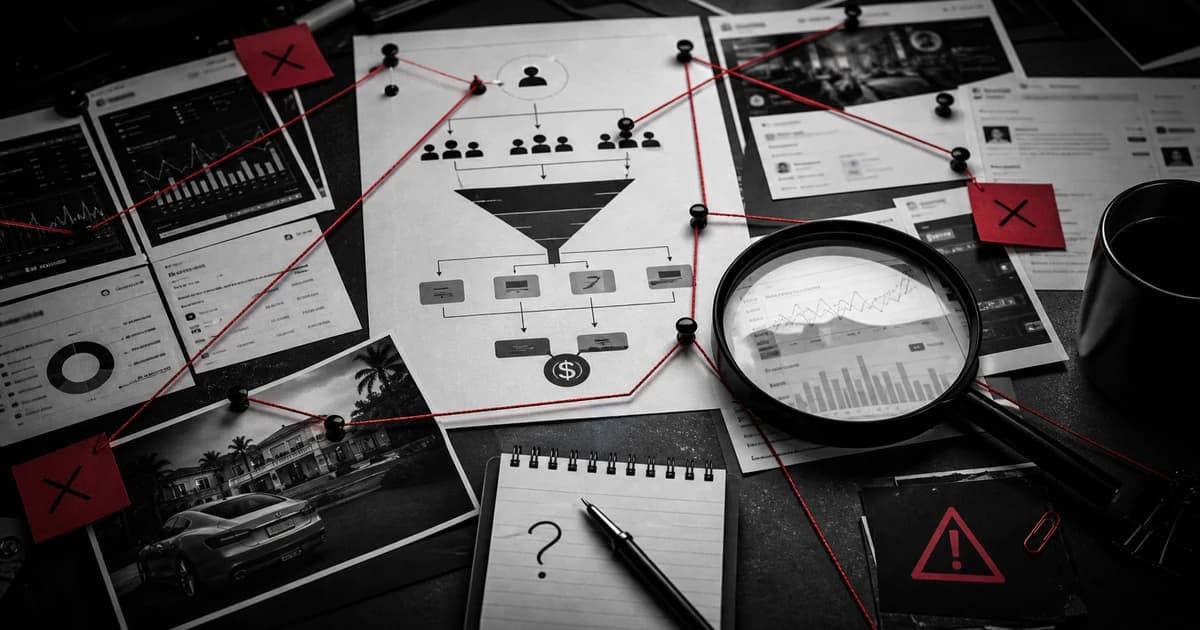
Fake AI Agent Agency: 11 Red Flags Before You Pay for the Blueprint
Short answer: an AI agent agency is not automatically a scam. But if the pitch sells guaranteed clients, effortless fulfillment, hidden software costs, or a "license" to resell vague automation, you are probably looking at an old business-opportunity funnel wearing a new API hoodie.
The phrase "AI agent agency" is perfect for grifters because it sounds technical, urgent, and hard to verify. The buyer imagines autonomous software workers closing leads, booking appointments, answering customers, and printing retainers. The seller shows a dashboard, a demo, and a student screenshot. Between those two moments sits the missing business: who buys, why they trust you, what breaks, who supports it, and what happens after the first invoice.
Sources checked
- FTC Air AI settlement announcement
- FTC Business Opportunity Rule
- FTC money-making opportunity scams
- Better Business Bureau Scam Tracker
The 11 red flags
| Red flag | What it sounds like | What to ask |
|---|---|---|
| Guaranteed retainers | "Land $5k/month clients fast" | What is the median buyer result? |
| Done-for-you claims | "The agent does the work" | Who handles support and failures? |
| Hidden software stack | "Just plug in our system" | What are all monthly costs? |
| Fake scarcity | "Agency licenses close tonight" | Why is the deadline real? |
| Lead list magic | "We give you niches" | Are these leads exclusive and current? |
| Screenshot proof | Stripe, Calendly, dashboards | Can you show representative outcomes? |
| No refund clarity | "Only action-takers win" | Where is the written policy? |
| Tool lock-in | "Use our private platform" | Who owns client data and workflows? |
| Vague compliance | "AI handles everything" | What about consent, privacy, and accuracy? |
| No support model | "Set it and forget it" | What happens when the client complains? |
| Closer pressure | "Are you coachable?" | Can I review offline before paying? |
The agent demo problem
A demo is not a business. A bot answering a sample lead does not prove that dentists, gyms, law firms, recruiters, or clinics will pay you monthly. A clean workflow on a sales call does not prove the tool survives messy customer data, edge cases, spam, compliance constraints, timezone confusion, or angry users.
Real operators can explain failure modes. Performers avoid them. Ask what the agent does when it is uncertain, when the CRM field is missing, when the customer asks for a refund, when the appointment is rescheduled, when the model invents a fact, and when the client wants data deleted.
The income claim test
If the seller says buyers are making money, ask for ordinary outcomes. Not the best student. Not the founder's agency. Not a screenshot from a launch week. Ask for median buyer revenue, refund rate, churn, average time to first client, and total cost including tools, ads, contractors, and sales calls.
The FTC has repeatedly focused on deceptive earnings claims in business-opportunity marketing. AI does not create a legal force field around old deception. If the pitch is "buy this and you are likely to earn," the seller should be able to substantiate that claim.
The client acquisition gap
Most weak AI agency courses hide the hardest part: getting trusted by a real business owner. They show prompts, automations, Zapier diagrams, voice agents, CRM screenshots, and outreach scripts. Then they act as if distribution is a mindset issue.
Ask for the actual channel. Cold email? Local networking? Paid ads? Referrals? Partnerships? Existing audience? Door-to-door? If the seller cannot explain the acquisition motion, you are not buying an agency system. You are buying a collection of demos.
The compliance gap
AI agents touch sensitive surfaces: customer names, phone numbers, calls, messages, appointments, recordings, payment questions, health-adjacent services, legal-adjacent services, and employment-adjacent conversations. A serious course teaches consent, logging, human escalation, privacy, and accuracy limits. A fake course says "AI handles it."
That is not just sloppy. It transfers risk to the buyer and then to the buyer's client.
Safer path
Before paying for a blueprint, build one tiny automation for one real workflow. Pick a boring use case: missed-call summary, quote request triage, appointment reminder, FAQ draft, or lead qualification with human review. Sell it manually to one local business. Track every failure. Only then decide whether you need training.
Read the related Larpable guides: /blog/ai-coaching-business-scam-red-flags-2026, /blog/ai-business-opportunity-scam-ftc-red-flags-2026, and /blog/online-course-scam-signs-2026-complete-checklist.
FAQ
Are AI agent agencies fake?
No. Some are real service businesses. The red flag is exaggerated income, hidden costs, and unverifiable buyer outcomes.
What proof should I ask for?
Median buyer results, refund rate, total cost, acquisition channel, support process, and representative client examples.
Is a live demo proof?
It proves a demo works. It does not prove demand, margins, support, retention, or legal safety.
What if the seller says I am overthinking?
That is pressure, not evidence. Due diligence is normal before paying.