Table of Contents
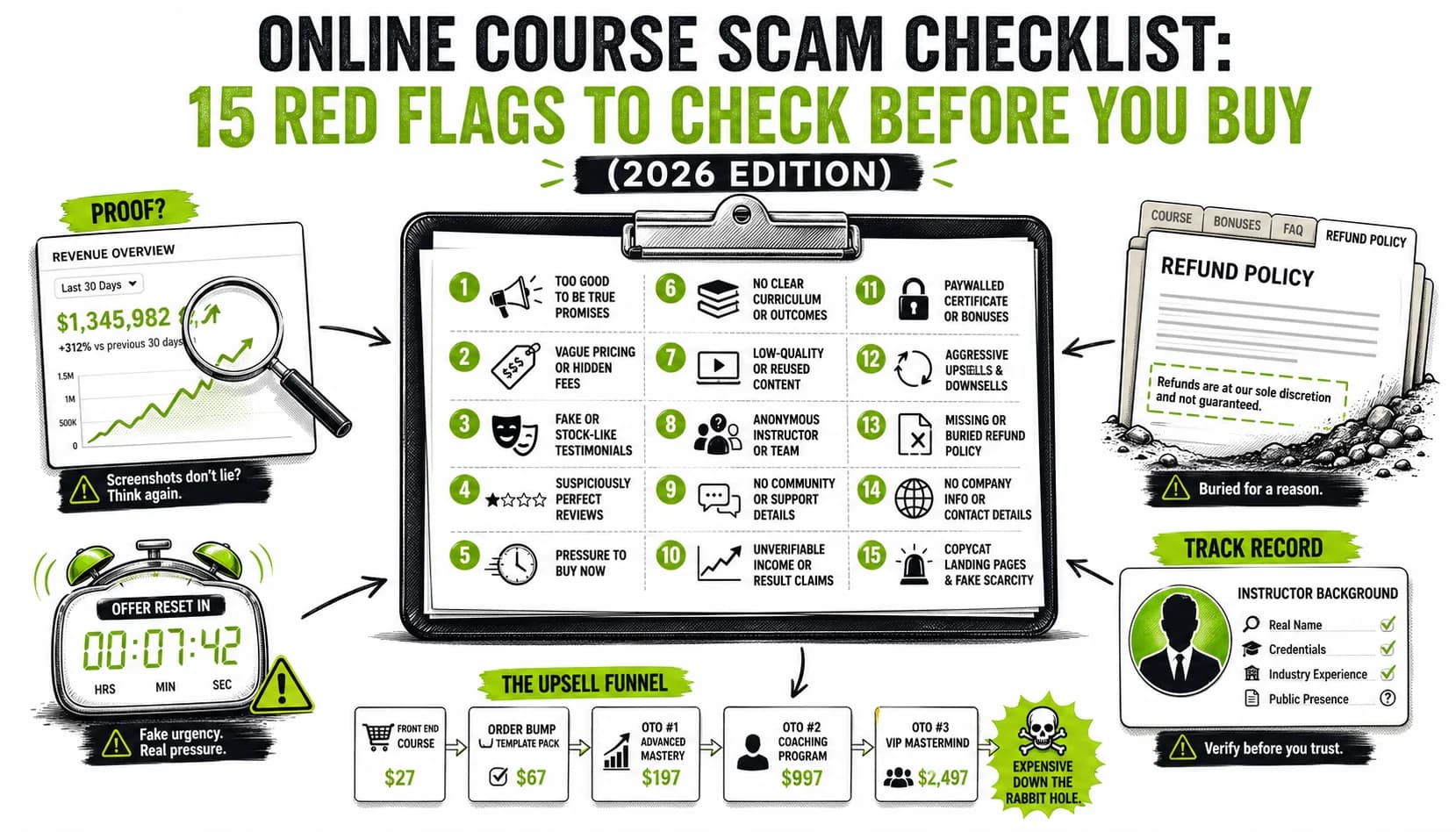
- Why This Checklist Exists
- How to Use This Checklist
- Red Flag 1: Income Claims Without Proof
- Red Flag 2: Countdown Timer That Resets
- Red Flag 3: Refund Policy Buried or Conditional
- Red Flag 4: The Instructor Has No Verifiable Track Record
- Red Flag 5: Testimonials Are All Screenshots
- Red Flag 6: The Upsell Funnel Is Deeper Than the Course
- Red Flag 7: Free Webinar That Is Actually a Sales Pitch
- Red Flag 8: Revenue Screenshots Are Cropped
- Red Flag 9: This Course Pays for Itself
- Red Flag 10: Private Community Is the Real Product
- Red Flag 11: Affiliate Army
- Red Flag 12: No Curriculum Published Before Purchase
- Red Flag 13: The Limited Time Bonus Stack
- Red Flag 14: Success Stories Are All About Selling the Course
- Red Flag 15: No Credentials Beyond I Made Money Online
- The Scoring Guide: Run the Numbers
- FAQ
Why This Checklist Exists {#why-this-checklist-exists}
The global online education market surpassed $185 billion in 2025, according to Grand View Research. The FTC's Consumer Sentinel Network logged over 47,000 complaints categorized under "business opportunity" schemes in 2025 alone — and most victims never file because they blame themselves.
After reviewing over 200 courses across dropshipping, SMMA, crypto trading, AI automation, and "passive income" niches, we found that 15 specific signals appear in virtually every course that extracts money without delivering value. None of these flags alone proves a scam. But they compound. A course with two flags might be mediocre. A course with eight is almost certainly designed to separate you from your money.
Print this page. Bookmark it. Run the numbers before you run your credit card.
How to Use This Checklist {#how-to-use-this-checklist}
This is a binary scoring system. For each of the 15 red flags below, assign a score:
- 0 — the red flag is NOT present
- 1 — the red flag IS present
Tally your score after checking all 15.
Interpreting your score:
- 0-3 flags: The course is probably legitimate. It may still be overpriced, but the creator isn't using predatory tactics. Compare the curriculum to free alternatives before buying — check our guide on free alternatives to every paid guru course.
- 4-7 flags: Proceed with extreme caution. The course may contain useful material, but the creator is using manipulative sales tactics. Demand a trial, look for independent reviews on Reddit (not the creator's testimonial page), and check the refund policy word by word.
- 8+ flags: Walk away. This is almost certainly a scam. Report it to the FTC and the BBB Scam Tracker. Your money is better spent on literally anything else, including setting it on fire for warmth.
Keep a tally as you read each section below.
Red Flag 1: Income Claims Without Proof {#red-flag-1-income-claims-without-proof}
"I made $100,000 last month" is not a verifiable statement. It is a sentence. Anyone can type it. Anyone can say it into a camera with a rented Lamborghini behind them.
Real income proof looks like this:
- Tax returns (redacted for personal info but showing business income lines)
- Full Stripe dashboards — not a cropped screenshot of gross revenue, but a full-page capture showing the date range, refunds, chargebacks, fees, and net revenue
- SEC filings for publicly traded companies or investment funds
Robert Cialdini's Influence: The Psychology of Persuasion documented the "authority principle" decades ago: people trust figures who project expertise, even when that expertise is fabricated. The guru economy weaponizes this. A screenshot of a $100K Stripe dashboard creates perceived authority. The viewer's brain fills in the gaps.
How to verify: Ask for a full-page, unedited Stripe or Shopify screenshot. Cross-reference their claimed revenue with their LinkedIn employee count — a solo creator claiming $100K/month with zero employees is statistically implausible. Check the Internet Archive for conflicting numbers. See our guide to spotting fake revenue screenshots for the full verification toolkit.
Red Flag 2: Countdown Timer That Resets {#red-flag-2-countdown-timer-that-resets}
Open the sales page. See the countdown timer. "Only 17 hours left to enroll at this price!" Note the time. Close the tab. Open it again tomorrow. If the timer has reset — and it will — you are looking at a manufactured urgency engine, not a real deadline.
This tactic exploits what Daniel Kahneman described in Thinking, Fast and Slow as System 1 processing: your fast, emotional brain sees "running out of time" and triggers a fear response before your analytical brain can evaluate whether the deadline is real. Legitimate cohort-based courses with fixed start dates don't need countdown timers because the scarcity is structural, not theatrical.
How to verify: Open the page in an incognito/private browser window. The timer resets because it's driven by a JavaScript cookie. Tools like Wappalyzer can tell you what marketing software the page runs — if you see Deadline Funnel or ClickFunnels, the "deadline" is artificial. Check the Internet Archive for cached versions: if the same "limited time" offer has been running for 14 months, it is not limited.
Red Flag 3: Refund Policy Buried or Conditional {#red-flag-3-refund-policy-buried-or-conditional}
"30-day money-back guarantee" sounds generous until you read the asterisk. Buried in the terms — sometimes in a separate PDF linked at the bottom of a page nobody scrolls to — you'll find conditions designed to make refunds nearly impossible:
- Must complete 80% of the course material before requesting a refund
- Must submit all homework assignments for review
- Must attend at least two live calls
- Refund requests reviewed on a "case-by-case basis" (meaning: denied unless you threaten a chargeback)
- 14-day processing window that conveniently extends past the refund period
The FTC's Cooling-Off Rule provides a three-day cancellation period for certain sales, but online purchases fall into a gray area that scam creators exploit aggressively.
What a real refund policy looks like: Unconditional. Within X days of purchase. No completion requirements. No review process. Money back, period. Companies like Coursera and Udemy offer this because their product is good enough that most people don't ask. If a creator needs to trap you inside the course before they'll consider giving your money back, the course isn't the product — your payment is.
How to verify: Find the refund policy BEFORE purchasing. If it's not on the sales page, email the creator and ask for it in writing. If they dodge the question, you have your answer.
Red Flag 4: The Instructor Has No Verifiable Track Record {#red-flag-4-the-instructor-has-no-verifiable-track-record}
The most important question you can ask about any course creator: What did they do BEFORE they started selling courses?
A legitimate instructor in digital marketing ran campaigns for real companies with real budgets. A legitimate coding instructor built shipping software used by real users. A legitimate investing instructor managed portfolios with audited returns.
A guru's track record starts and ends with selling courses. Their LinkedIn shows "Founder & CEO" of an LLC registered six months before the course launched. Their "portfolio" is the course itself. Their "results" are screenshots of revenue from selling the course to you.
How to verify:
The guru economy thrives on a circular credential: "I'm qualified to teach you because I make money, and I make money because people pay me to teach them." This is a Ponzi structure wearing a ring light. Read more in our guide to spotting fake gurus.
Red Flag 5: Testimonials Are All Screenshots {#red-flag-5-testimonials-are-all-screenshots}
A screenshot of a DM saying "This course changed my life!!! 🔥🔥🔥" is not a testimonial. It is a JPEG. Anyone with five minutes and a basic understanding of inspect element can fabricate a convincing DM screenshot. Entire services exist to generate fake social media posts — Fake Detail and similar tools let you create pixel-perfect Twitter, Instagram, and iMessage screenshots in seconds.
Red flag multipliers:
- Testimonials show first names only ("Sarah K.") — no full name, no photo, no LinkedIn profile
- All testimonials come from the same platform (all Slack messages, all Instagram DMs)
- Testimonial screenshots have inconsistent formatting, font sizes, or pixel densities
- The "student" accounts that posted them have fewer than 100 followers or were created recently
What real social proof looks like: Video testimonials from identifiable people. LinkedIn recommendations you can click through to verify. Case studies with named businesses, specific metrics, and timelines. Verified reviews on independent platforms like Trustpilot or Course Report — platforms the course creator cannot edit or delete.
How to verify: Take any screenshot testimonial and reverse-image search it. Google the "student's" name. If they exist, check if they're also an affiliate for the course (see Red Flag 11). If they don't exist online at all, the testimonial doesn't exist either.
Red Flag 6: The Upsell Funnel Is Deeper Than the Course {#red-flag-6-the-upsell-funnel-is-deeper-than-the-course}
You buy the $47 ebook. It tells you the ebook was just the "foundation" — you need the $497 course for the "real strategies." You buy the course. Module 7 explains that the course was the "framework" — you need the $997 mastermind for "implementation support." You join the mastermind. The mastermind exists primarily to sell you the $5,000 mentorship. The mentorship's main deliverable is access to the $25,000 "inner circle."
This is a value ladder. In legitimate businesses, value ladders make sense — a free trial leads to a paid plan. But in guru economics, each rung delivers the PROMISE of value that was supposed to be in the previous rung. The content gets thinner while the price gets 2-10x higher.
The math test: Add up every product in the creator's funnel. If the total exceeds $10,000 and the creator's primary business IS the course funnel, you are not a student. You are a revenue line item.
Russell Brunson literally wrote the book on this model (DotCom Secrets). He's transparent about it being a sales architecture. The gurus who adopt it are not. For a deeper analysis, read our breakdown of the automation agency course model.
Red Flag 7: Free Webinar That Is Actually a Sales Pitch {#red-flag-7-free-webinar-that-is-actually-a-sales-pitch}
The playbook: "Join my free 90-minute masterclass on [topic]." You register with your email. You show up. For the first 20 minutes, the host tells their "origin story" — broke, desperate, discovered a secret, now rich. For the next 40 minutes, they teach extremely high-level concepts with no actionable detail. For the final 30 minutes, they pitch the paid course. The "free value" was a trailer for the product, not the product itself.
This isn't education. It's a sales presentation wearing a graduation cap.
How to spot it before attending:
- Registration asks for your phone number (SMS follow-up campaigns when you don't buy)
- The webinar is "live" but available at 14 different times today (it's pre-recorded)
- The landing page has more testimonials than topic details
- A "limited replay" is available for 48 hours (urgency for the pitch)
What legitimate free content looks like: It teaches something complete. MIT OpenCourseWare and Khan Academy don't withhold the punchline and sell it separately. The content IS the value.
Red Flag 8: Revenue Screenshots Are Cropped {#red-flag-8-revenue-screenshots-are-cropped}
Income claims are verbal. Revenue screenshots are visual "proof" — and the most commonly fabricated evidence in the guru economy.
What fake screenshots look like:
- Cropped to show only gross revenue (not net after refunds, chargebacks, and fees)
- No visible date range — is this one month or one year?
- No refund line — a $100K gross with $40K in refunds is a $60K business
- Inspect Element edits: any web dashboard's HTML can be changed in seconds
What real revenue looks like:
- Full-page screenshot showing date range, gross, refunds, fees, and net
- Video screen recording (harder to fake)
- Third-party verification via Baremetrics or ProfitWell
Our full guide to identifying manipulated revenue screenshots walks through five verification techniques. Coffeezilla and Spencer Cornelia have documented dozens of cases with fabricated revenue data.
Red Flag 9: This Course Pays for Itself {#red-flag-9-this-course-pays-for-itself}
"This $997 course will pay for itself in your first month." This claim is mathematically specific enough to be falsifiable — and it almost never holds up.
For a $997 course to "pay for itself in the first month," you need $997 in NET profit within 30 days — factoring in time to complete the course (20-40 hours), implement what you learned, and wait for results to materialize (ad testing cycles, SEO timelines, pipeline building).
The FTC's Business Opportunity Rule requires sellers making earnings claims to substantiate them with the number and percentage of purchasers who achieved those results. Ask for this data. They won't provide it.
The real math: According to Teachable's creator economy report, the median online course creator earns less than $1,000 per year from course sales. The people selling you courses about making money are the statistical exception — and their income comes from selling the courses, not from the skills the courses teach.
Red Flag 10: Private Community Is the Real Product {#red-flag-10-private-community-is-the-real-product}
You buy the course expecting structured curriculum. What you get: 12 videos totaling 4 hours of surface-level content, a PDF "workbook," and access to a "private community" on Discord or Skool.
The creator frames the community as the crown jewel. But the network is composed exclusively of other people who bought the course. They don't have expertise. They have the same questions you do.
The community test: Ask who is in this community. If the answer is "other students," the community adds zero expertise. Compare it to free communities like Indie Hackers where real builders share real data without a $997 entry fee. Check if your guru's "community" is actually a ghost town with a paywall.
Red Flag 11: Affiliate Army {#red-flag-11-affiliate-army}
Look for "Become an affiliate" or "Partner program" on the sales page. If the creator offers 30-50% affiliate commissions and a significant portion of their "students" are also affiliates, you're looking at a multi-level distribution system.
The affiliate math: A $997 course with 40% commission pays $399 per referral. A "student" who refers three people has made $1,197 — more than they paid. Their "success story" is that they sold the course, not that they applied it.
How to detect this:
- Google "[course name] + affiliate" or "[course name] + partner program"
- Check if YouTube reviewers include affiliate links in their descriptions
- If more than 30% of positive reviews come from affiliates, the reviews are marketing
The FTC's endorsement guidelines require "clear and conspicuous" disclosure of material connections. Courses that grow on undisclosed affiliate reviews are violating federal guidelines. Report them at reportfraud.ftc.gov.
Red Flag 12: No Curriculum Published Before Purchase {#red-flag-12-no-curriculum-published-before-purchase}
Coursera shows every module and assignment. Udemy displays the full outline with time estimates. Universities publish syllabi.
Scam courses say "trust the process." They show vague modules — "Module 1: Mindset," "Module 2: Foundation," "Module 3: Scale" — without specific lessons or deliverables. If you knew the course contained 4 hours of repackaged YouTube content and 2 hours of motivational filler, you wouldn't pay $997.
Before purchasing, demand: full module and lesson titles, estimated time per section, specific learning outcomes, and a sample lesson. If the creator says "the curriculum is intellectual property," apply the restaurant test: would you pay $200 for a meal at a restaurant that won't show you the menu?
Red Flag 13: The Limited Time Bonus Stack {#red-flag-13-the-limited-time-bonus-stack}
"Enroll today and get $12,847 worth of bonuses FREE!"
The bonus stack is a conversion architecture designed to overwhelm your rational evaluation. It works like this: the course costs $997. But if you buy RIGHT NOW, you also get:
- "The Revenue Blueprint" ($1,997 value) — it's a PDF
- "Client Acquisition Template" ($997 value) — it's a Google Doc
- "Private Strategy Call" ($2,500 value) — it's a 15-minute upsell
- "Lifetime Community Access" ($4,997 value) — it's the Discord from Red Flag 10
- "Swipe File Library" ($2,356 value) — it's screenshots of other people's ads
Total "value": $12,847. You pay "only" $997.
The rule: If the bonuses are "worth" more than the course, the course is worth nothing. A $997 product that delivers $997 in value just costs $997. The bonus stack anchors your brain to $12,847 so $997 feels like stealing. It is. But you're the one being stolen from.
Red Flag 14: Success Stories Are All About Selling the Course {#red-flag-14-success-stories-are-all-about-selling-the-course}
"Student X made $50,000 in their first three months!" Doing what? If the answer is "selling this course to other people," the success story is circular. The "income" came from the ecosystem, not the market.
The market test: Can the skills generate revenue from customers who have NEVER heard of the course? If a student's "success" requires other students as clients or affiliates, the course is a closed economy.
Legitimate outcomes: "I landed a job at [real company]." "I grew freelance revenue from [specific client work]." "I launched a product that external customers use." These are market-facing outcomes. "I made money selling this course" is a distribution fee, not an outcome.
Red Flag 15: No Credentials Beyond I Made Money Online {#red-flag-15-no-credentials-beyond-i-made-money-online}
The final flag, and perhaps the most fundamental: what qualifies this person to teach?
- Teaching marketing? What campaigns did they run for real companies? Which brands?
- Teaching coding? What did they build? Is it on GitHub? Does it have users?
- Teaching investing? Are they registered with the SEC or FINRA? Check BrokerCheck
- Teaching business? What businesses existed before the course?
"I made money online" is not a credential. When the money was made by selling courses about making money, the credential is self-referential. Real experts have employment history, published work, client lists, and conference presentations at events they didn't organize.
For the full verification framework, see our 2026 guide to spotting fake gurus.
The Scoring Guide: Run the Numbers {#the-scoring-guide-run-the-numbers}
You've read all 15 red flags. Now count.
0-3 Red Flags: Probably Legitimate
The course may still be overpriced compared to free alternatives, but the creator isn't using predatory tactics. Compare the curriculum to free resources that cover the same material. If the paid course offers meaningful structure, community, or mentorship BEYOND the free alternatives, it might be worth the investment.
4-7 Red Flags: Extreme Caution
The creator is using manipulative sales tactics even if the underlying content has some value. Before purchasing:
- Search Reddit for "[course name] + review" or "[course name] + scam" — Reddit reviews are harder to fake because the community self-polices
- Ask the creator for curriculum, refund terms, and affiliate disclosure IN WRITING
- Set a calendar reminder for the refund deadline and use it if the content disappoints
- Check if the course creator's reviews are actually from an affiliate marketing arm
8+ Red Flags: Almost Certainly a Scam
Do not purchase. Instead:
FAQ {#faq}
Are ALL online courses scams?
No. The scam segment is a subset — primarily "guru" courses sold through aggressive funnel marketing by individuals whose primary income comes from selling courses, not from practicing what they teach. A course from a verifiable expert with transparent curriculum, fair pricing, and unconditional refunds is not a scam. Platforms like Coursera, edX, and Udemy host legitimate content. The 15 red flags in this checklist specifically target predatory patterns.
How do I get a refund from a scam course?
Start with the creator's refund process, but document everything in writing. If they deny the refund, escalate to your payment processor. Credit card chargebacks under "services not as described" are effective — your card company is legally required to investigate under the Fair Credit Billing Act. PayPal disputes must be filed within 180 days. Crypto or wire transfer recovery is significantly harder, which is exactly why some scam creators prefer those payment methods.
Can I report an online course scam?
Yes. File a complaint with the FTC at reportfraud.ftc.gov. The FTC uses complaint volume to prioritize enforcement actions. Also file with the BBB Scam Tracker and your state's attorney general consumer protection division. If the creator made specific income claims, the FTC's Business Opportunity Rule may apply. In 2024-2025, the FTC brought enforcement actions against several "business opportunity" sellers making unsubstantiated income claims — including settlements exceeding $10 million. Your complaint contributes to the data that triggers these actions.
What is the best way to learn online for free?
MIT OpenCourseWare, Khan Academy, and Google's free certifications in digital marketing and data analytics are all genuinely free. YouTube channels like freeCodeCamp deliver production-quality education at zero cost. See our free alternatives guide for a comprehensive mapping by course category.
How do fake gurus get away with it?
Three structural reasons. First, the legal threshold for "fraud" is high — making aspirational income claims isn't automatically illegal unless the FTC can prove the claims are materially misleading. Second, victims experience shame and rarely report. The "invest in yourself" framing means students blame themselves when the course fails. Third, the content isn't technically "nothing" — there are videos, PDFs, and a community. The product exists. It's just worth dramatically less than charged. The gap between "low quality" and "fraud" is wide enough for an entire industry to operate inside it. Investigative journalists like Coffeezilla and Vice have been instrumental in closing that gap through public accountability.
This checklist is updated regularly as new tactics emerge. Last updated: March 2026. If you found this useful, share it with someone who's about to buy a course. It might save them $997 and several months of regret.
For the full library of guru detection tools and scam breakdowns, visit our pattern detection hub.
<!-- sister-projects-start -->
Other Doved Studio projects
Related tools from the same studio you might find useful:
- Ralphable: Generate structured Claude Code skills that iterate until pass/fail criteria are met.
- Doved Studio: Studio indie derrière cette app et une dizaine d'autres outils.
<!-- sister-projects-end -->