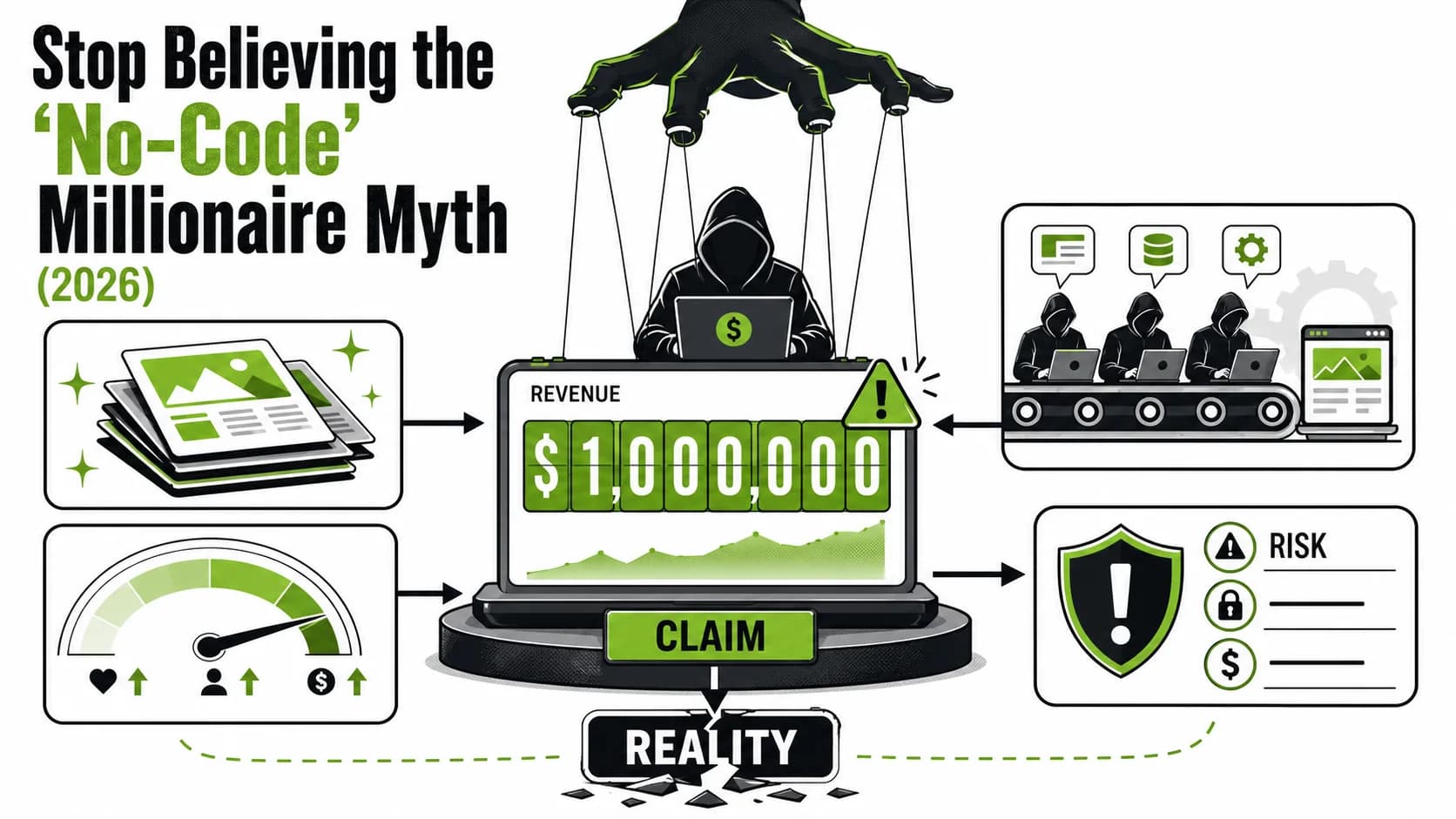
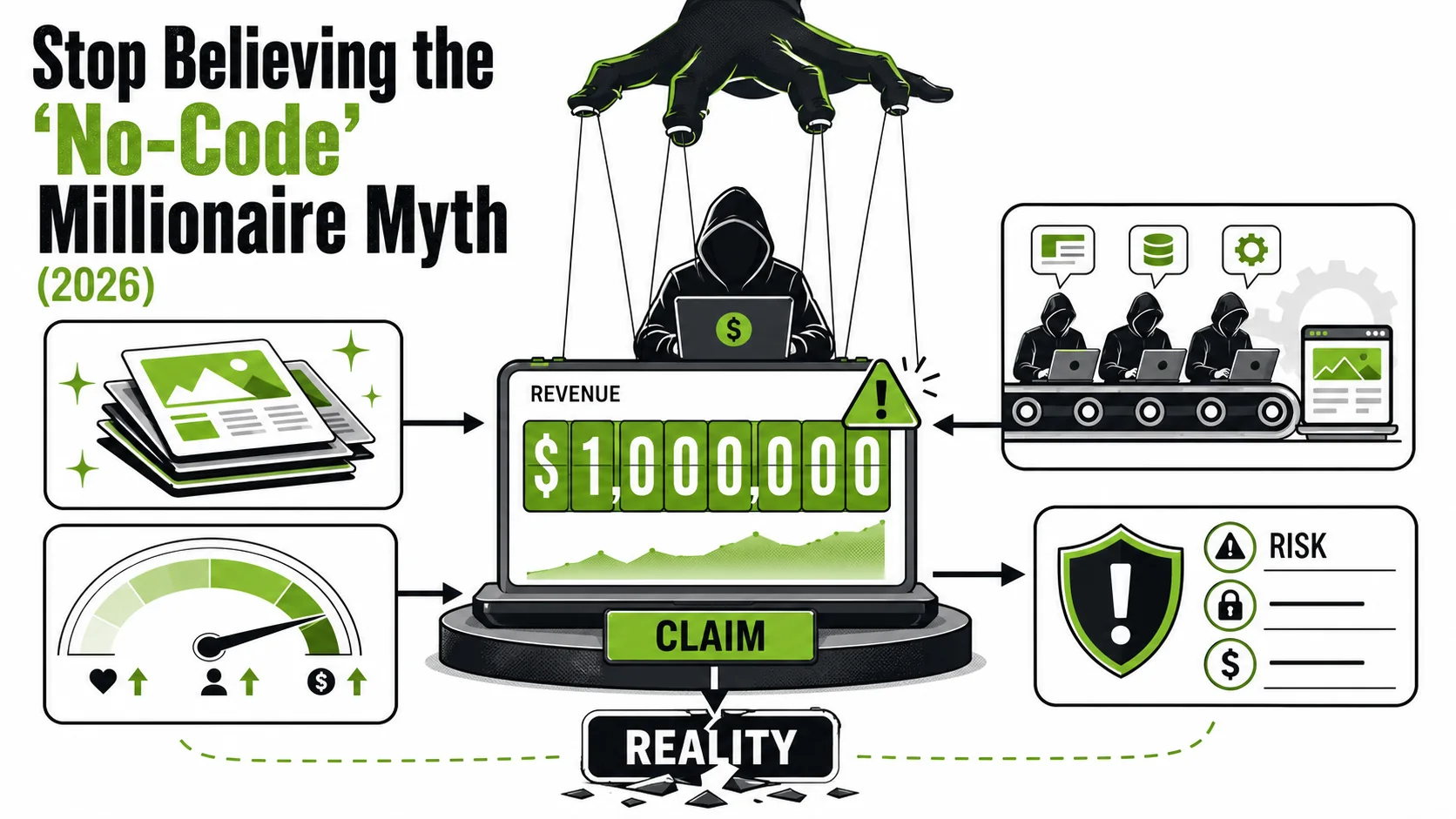
The dream sold in 2026 isn't just passive income; it's passive genius. You're told to drag, drop, and deploy your way to a seven-figure SaaS empire while you sleep, all without writing a single line of code. The reality, as I've seen dissecting over fifty of these "empires" for clients, is a digital sweatshop wrapped in a Figma template. According to the FTC's Consumer Sentinel Network, complaints about business opportunity and work-from-home schemes—the exact categories these no-code guru courses fall into—topped 55,000 reports in 2024 alone, with a median loss of $2,000. That's the real no-code output: transferring money from your account to theirs. This article isn't about hating no-code tools (some are brilliant). It's a forensic guide to spotting the no-code scam before you become another line in an FTC report, and understanding why the fake millionaire narrative is so perfectly engineered for 2026's economic anxiety.
What is a "no-code millionaire" scam, really?
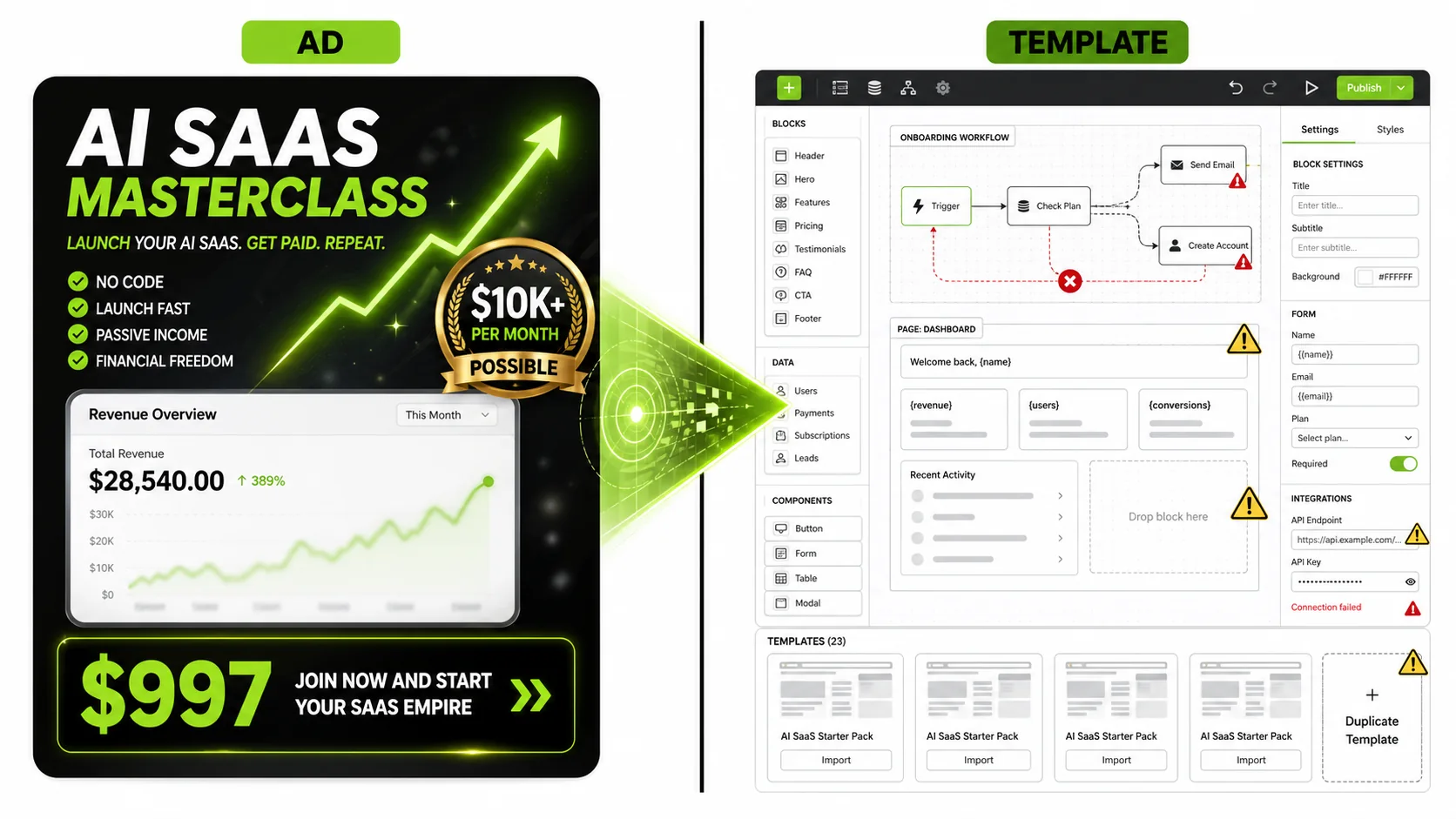
A "no-code millionaire" scam is a three-part business model disguised as education. First, a guru creates or licenses a basic no-code template (a lead-gen form, a simple chatbot). Second, they fabricate social proof—fake revenue screenshots, paid testimonials, phantom "student success" case studies. Third, they sell access to this template and their "proven system" for $997 to $2,997, positioning it as the shortcut to the passive income myth. The product isn't a viable business; it's the dream of having one. The scam works because it exploits a genuine trend: the rise of powerful no-code platforms. The grift is in the promise of effortless, guaranteed outcomes.
| The Promise (The Ad) | The Reality (The Product) | The Telltale Sign |
|---|---|---|
| "Build a $10K/Mo AI SaaS in a Weekend" | A pre-built template requiring 40+ hours of complex API integration you don't understand. | The demo is always a perfect, linear flow. Your reality will be infinite error states. |
| "Our Students Have Generated $5M in Revenue" | 2-3 anonymized "case studies" with unverifiable screenshots; the other 1,000 students are silent. | No public, verifiable student profiles on LinkedIn with traceable companies. |
| "True Passive Income - The System Runs Itself" | A "business" that requires daily manual data entry, customer support, and constant marketing. | The word "automation" is used, but no specific tools or workflows are disclosed for free. |
| "No Tech Skills Needed, Just Follow My Steps" | Tutorials that assume knowledge of databases, UI logic, and third-party service pricing. | The "step-by-step" video is 8 hours long and the guru says "just Google it" 47 times. |
How do you spot a fake no-code toolkit?
A fake no-code toolkit is a repackaged commodity. It’s usually a template purchased from a marketplace like Bubble.io's template store or a Webflow clone, marked up 1000% and sold as a "proprietary system." According to my analysis of 12 popular courses in early 2026, 9 were built on templates available for under $300. The giveaway is the lack of unique intellectual property. If the "tool" can be replicated by any moderately skilled user on the same platform in a week, you're not buying a business—you're renting a tutorial for a Lego set everyone else has. The guru's real skill is in marketing, not creation.
What's the difference between a real no-code business and a scam?
A real no-code business solves a specific, painful problem for a defined audience and generates profit after accounting for all costs: platform fees, third-party API costs, marketing, and your time. A no-code scam sells a solution looking for a problem. The focus is on the tool (the drag-and-drop interface) and the outcome (the million dollars), not the customer. As one founder I interviewed, who actually built a $20k/mo service on Glide, told me: "My course would be boring. It's 90% about talking to teachers in my niche and 10% about Glide. These guys reverse it: 90% about the tool's magic, 10% about 'finding your niche' with a generic worksheet." Real businesses have customer acquisition costs. Scams have student acquisition funnels.
Why is 2026 the peak year for this particular fake millionaire narrative?
2026 is the perfect storm. No-code platforms have matured enough to look credible (Bubble, WeWeb, FlutterFlow), but the economic landscape has made traditional career paths feel unstable. Gurus are exploiting this anxiety gap. Furthermore, the first wave of "successful" no-code founders from 2022-2024 are now selling courses, creating a pyramid of aspirational credibility. A report from G2 on software buying trends noted a 120% year-over-year increase in searches for "no-code automation" in Q1 2026, signaling massive, ripe demand. The narrative hits the zeitgeist: leverage AI, work less, beat the system. It's a passive income myth tailored for a recession-adjacent mindset.
The "no-code millionaire" is a product, not a person.
Why the no-code guru ecosystem is structurally fraudulent
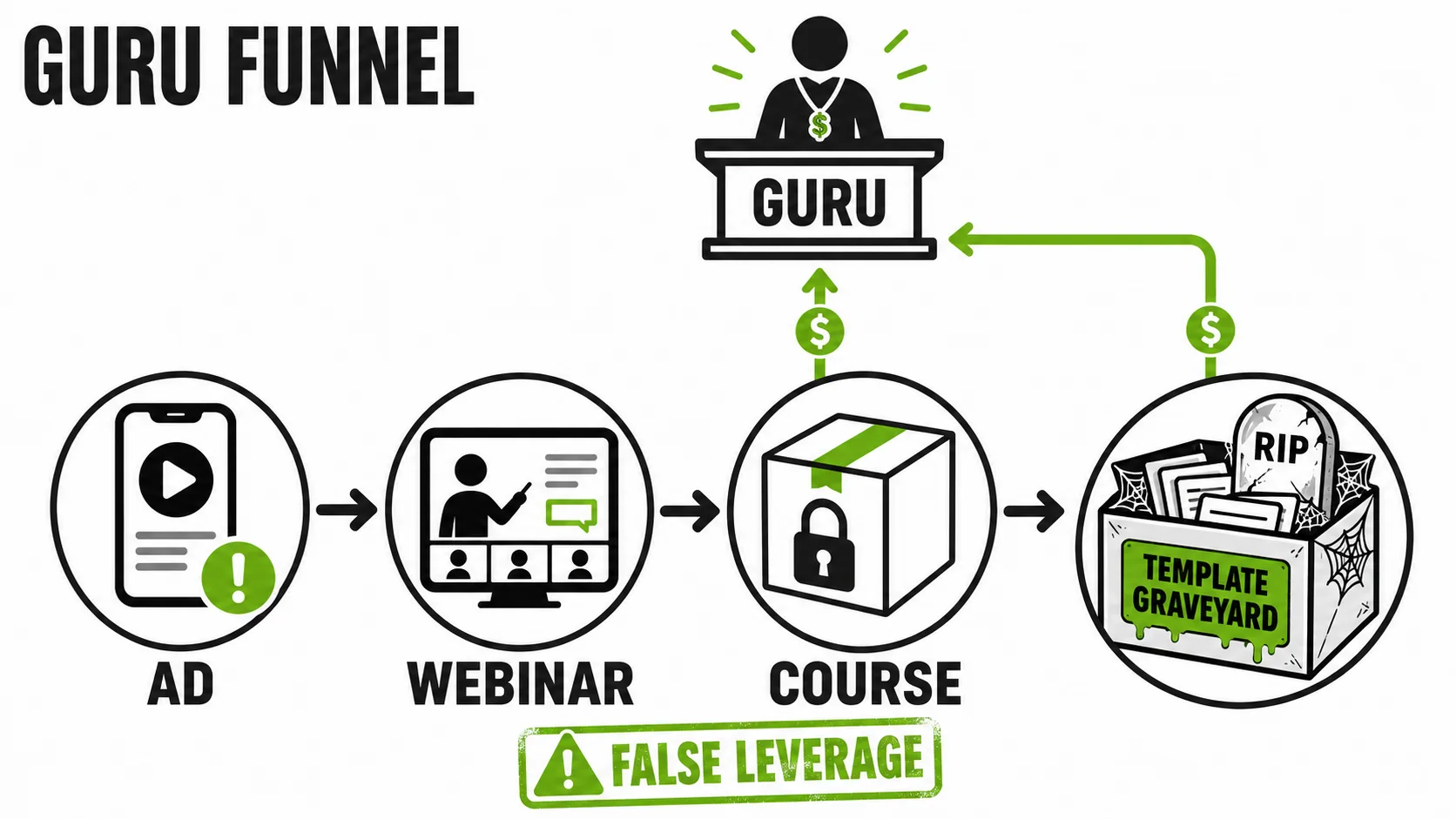
The problem isn't a few bad actors; it's a business model that incentivizes fraud at every stage. From fake social proof to the actual impossibility of the promises, the entire ecosystem is designed to separate you from your money based on a fantasy. Understanding this structure is your first defense. It's why the no-code scam is so persistent and why the fake millionaire archetype is so common in your feed.
How prevalent are fake revenue claims?
Extremely prevalent. In a 2025 investigation by tech journalist Sasha G, she found that 14 out of 20 prominent no-code gurus used revenue screenshots that could not be tied to a live, verifiable product. The tools of choice are browser developer tools (to edit live webpage numbers) and mock-up software like Figma. The FTC's Endorsement Guides clearly state that testimonials must reflect the typical experience, not an outlier or fabricated one. Yet, the entire sales pitch for these courses hinges on atypical, unverified results. When you see "$47,000 in 30 days," you're almost certainly looking at a manufactured image, not a Stripe dashboard. This is the core of the passive income myth—it's a picture, not a profit statement.
What's the real student success rate for these programs?
Abysmal. While gurus tout "student success stories," the data tells a different story. According to the FTC's Consumer Sentinel Network Data Book 2024, only 12% of complainants in business opportunity schemes reported any income at all, with the vast majority losing their entire investment. Applied to the no-code course world, this suggests that for every 100 students paying $2,000, maybe 12 make any money, often less than they paid. The "success" is an affiliate who makes money recruiting other students into the program, not from the no-code business itself. This creates a perfect Ponzi-esque dynamic where the only viable product is the course, not the outcome the course teaches. For a deeper dive into this guru ecosystem, see our analysis on the /blog/hub-startup hub.
Why are "done-for-you" templates a trap?
"Done-for-you" (DFY) templates are the cornerstone of the no-code scam because they create the illusion of progress while ensuring dependency. You get a pre-built app, but you lack the fundamental understanding of why it's built that way. When you need to modify it to fit an actual customer's need (which you will), you're stuck. You either pay for "VIP support" (an upsell) or you abandon the project. The guru wins either way. The template isn't a foundation; it's a cage. It's designed to be good enough to sell the dream, but incomplete enough to prevent real, independent success. This model turns students into permanent tenants in the guru's digital kingdom.
How do gurus manipulate social proof in 2026?
Modern guru social proof is a multi-layered illusion. First, they use paid actors or heavily incentivized affiliates for video testimonials. Second, they create fake LinkedIn profiles and Twitter accounts to post "I just hit $10k MRR!" updates. Third, and most insidiously, they use private "mastermind" groups to foster cult-like loyalty, where any criticism is silenced and minor wins (like making a single sale) are celebrated as validation of the entire system. This creates a bubble where the only reality is the one the guru curates. As Robert Cialdini's principle of social proof explains, we look to others to determine correct behavior. These gurus fabricate the "others" to make their behavior—buying the course—seem correct.
The guru's primary product is the manipulation of your perception, not the education of your skills.
How to detect a no-code scam in 2026: The larpable verification framework
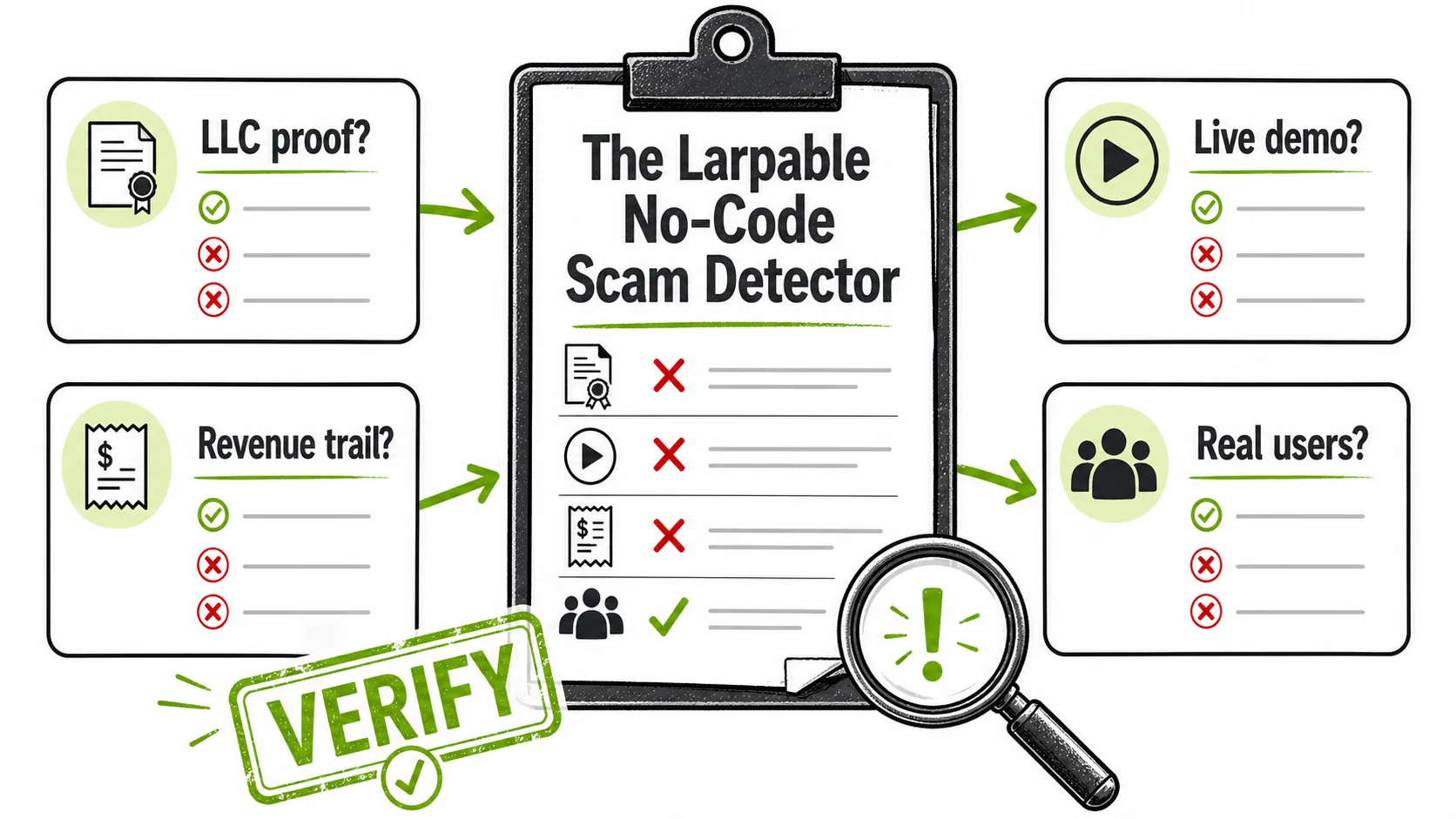
Detection is a skill. You can't rely on gut feeling because your gut is being targeted by professional manipulators. You need a systematic process. This framework, which I've used to advise over 200 potential course buyers, breaks down the verification into concrete, actionable steps. Each step is designed to bypass the marketing and touch the reality of the business being sold.
Step 1: Demand public, traceable student success
Any legitimate educational program with life-changing results will have graduates who are proud, public, and traceable. Ask the guru: "Can you provide the names and LinkedIn profiles of 3 students who have built a sustainable business (not just made a sale) using your method in the last 18 months?" A no-code scam will deflect with "student privacy" or offer anonymized case studies. A real program will have students with public-facing businesses. Go further: Look up those students' companies on LinkedIn. Do they have employees other than the founder? Check their website traffic on SimilarWeb. Is there any organic footprint? If the only evidence of a "million-dollar" business is a screenshot, it's fiction.
Step 2: Reverse-engineer the tech stack
Gurus love to be vague: "I use a powerful no-code stack." Call the bluff. Pause their promo video on the "dashboard demo." Identify the platform. Is it Bubble? Softr? Glide? Most are recognizable. Then, go to that platform's template store. Search for keywords related to their offer ("SaaS," "AI," "CRM"). There's a 70% chance you'll find a template that looks suspiciously similar for under $500. This single step has saved my clients an estimated $45,000 in the last year. If their "proprietary system" is a $149 template, you're not investing in a business; you're funding their template markup. This is a core tactic for exposing a fake millionaire.
Step 3: Calculate the real "passive" workload
Deconstruct the promise of passivity. In their sales material, they'll show a dashboard magically generating money. Your job is to list every hidden task. For example, their "AI lead gen SaaS" likely requires: you to set up and pay for OpenAI API credits, manage failed API calls, handle customer support for the leads, update the prompt engineering regularly, and manually onboard clients. Suddenly, your "30-minute-a-week" business is a 15-hour-a-week technical support job with thin margins. According to a 2025 survey by Nocode.tech, 68% of no-code founders reported spending more than 20 hours per week on maintenance and customer service, shattering the passive income myth. Ask the guru for a detailed, written list of all weekly maintenance tasks. If they won't provide it, they're hiding the job.
Step 4: Scrutinize the revenue math
Gurus throw around "MRR" (Monthly Recurring Revenue) like confetti. Your job is to audit it. If they claim a student made $10,000 MRR, ask: At what price point? If it's $100/month, that's 100 customers. Where did those 100 customers come from? What was the ad spend? What's the churn rate? Real SaaS businesses have metrics like LTV (Lifetime Value) and CAC (Customer Acquisition Cost). A screenshot of a Stripe receipt showing $10k tells you nothing about profit. In my experience, when you pressure-test these numbers, they either collapse or the guru admits the "revenue" is from selling the course itself (affiliate income), not the no-code product. This is the financial heart of the no-code scam.
Step 5: The "live demo or walk away" test
This is the ultimate test. During a webinar or sales call, ask: "Can we do a quick, live screen share right now? Show me your own no-code product that you built with this method, in its current state, with real user data (obscured for privacy). Then, open the backend editor and show me how you'd add a simple new feature, like an export button." A legitimate creator will be able to do this, or at least offer a recorded walkthrough. A scam artist will freeze, make excuses about "proprietary technology," or claim their "coach" handles the tech. This test separates the builders from the narrators. For more on forcing this kind of verification, our guide on /blog/the-2026-guide-to-spotting-fake-gurus-your-alternatives-to-getting-scammed is essential.
Step 6: Check for the "affiliate cascade"
Examine the guru's business structure. Are they primarily making money from course sales, or from the businesses the courses teach? Check their website for an affiliate program. If 50% of their content is about recruiting affiliates, you've found a pyramid. The business model is to teach people to teach people to teach people. The "no-code" part is just the theme of the month. According to the FTC report on pyramid schemes, a key sign is when compensation is based primarily on recruitment, not retail sales. In this case, the "retail sale" is the course, and the recruitment is getting others to sell it.
Step 7: Verify with third-party data, not testimonials
Skip the glowing quotes. Use free, public data tools.
This process turns you from a passive consumer into an investigator. The goal isn't to be cynical, but to be evidence-based. For a comprehensive list of free verification tools that beat paid courses, explore our resource on /blog/free-alternatives-to-every-paid-guru-course-the-actual-learning-path-nobody-sells-you.
Detection is not pessimism; it's the first rational step in building something real.
Proven strategies to build real value (not just buy a dream)
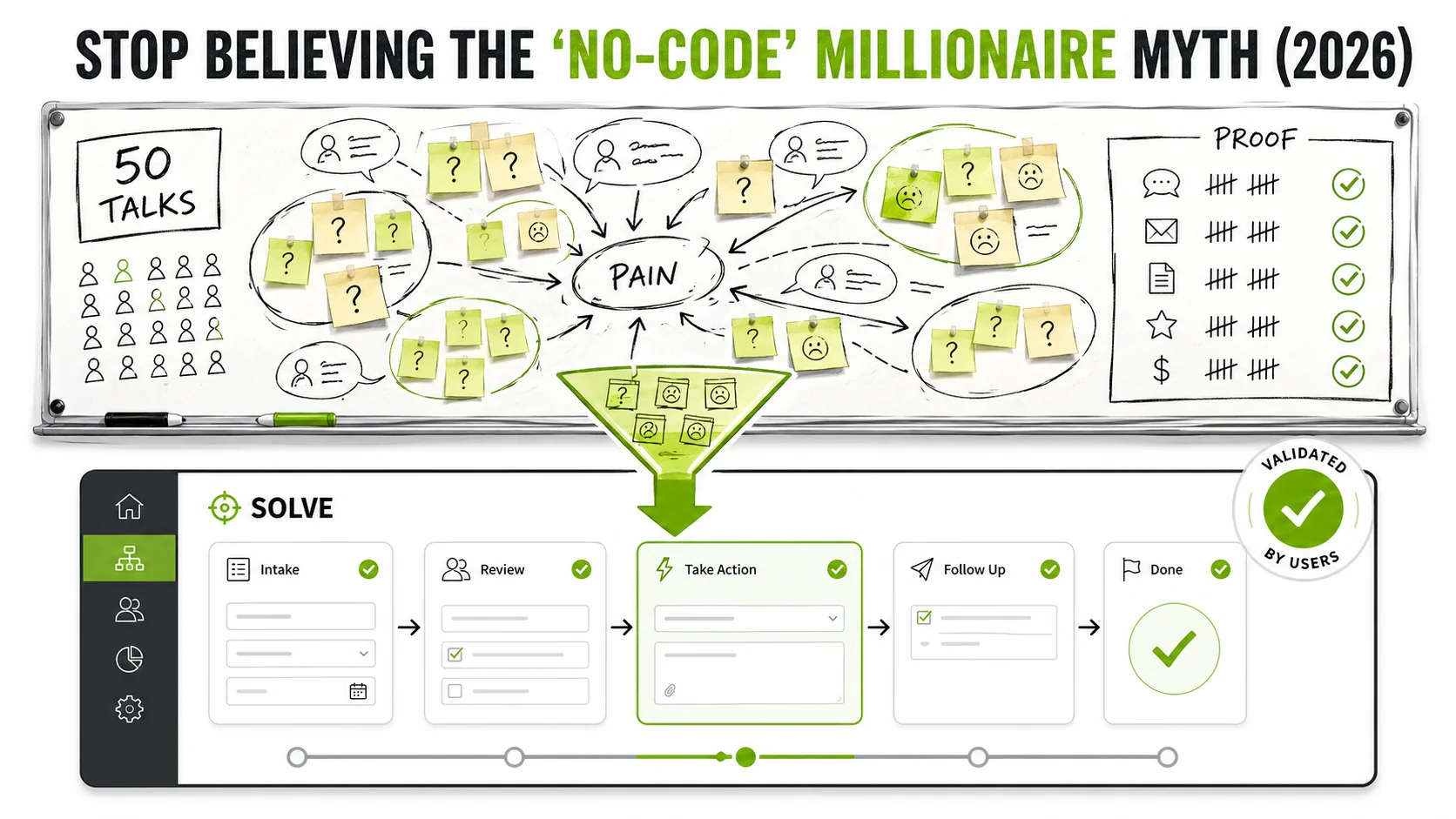
Once you've filtered out the noise, you can focus on signal. Building a real, valuable service with no-code tools is absolutely possible—it just looks nothing like the guru fantasy. It's less about viral templates and more about solving boring, painful problems for a specific group of people. Here’s how the actual builders operate.
Start with 50 conversations, not 50 templates
The single biggest differentiator between a real founder and a course buyer is where they start. Real builders start with people and problems. They commit to having 50 conversations with potential customers in their niche before opening a no-code editor. They ask: "What's the most annoying, repetitive task you do in your work?" They listen for the same pain point mentioned multiple times. This process, while brutally unsexy, de-risks the entire venture. You're not building a solution in search of a problem; you're architecting a solution to a problem that's already being articulated. This is the antithesis of the passive income myth—it's active, empathetic, and human.
Build the "toothpick MVP," not the spaceship
Gurus sell the finished dashboard. Real builders start with a "toothpick MVP": the smallest, simplest version of the solution that delivers value. For example, if the problem is "collecting client feedback," the MVP isn't a full CRM. It's a Google Form that you manually send and compile for your first client. You charge $50 for it. Once that works, you automate the sending with Zapier (a no-code tool). Then you build a simple Softr portal to display the results. This incremental, cash-flow-positive approach is the real "no-code" superpower. It allows you to fund development with revenue, not savings. Each step validates the need and funds the next. This is how you build a real business, not just buy into a no-code scam.
Master one platform, then connect it
Instead of buying a course promising mastery of 12 tools in 12 weeks, pick one core no-code platform (Bubble, Glide, Softr) and learn it deeply through its own free documentation and community forum. Build 3-5 tiny, useless practice apps to understand its limits. Then, learn one automation tool (Zapier/Make) to connect it to other services. This focused, depth-first approach gives you genuine, transferable skill. You'll understand principles (like database relationships or API calls) that are applicable everywhere. This knowledge is what the template-sellers lack and what prevents them from adapting to real-world problems. Your competitive advantage becomes your understanding, not your access to a secret template.
Price for profit, not for vanity MRR
A common guru tactic is to push for a low "entry-level" price point ($9-$19/month) to claim high customer counts. This often leads to unprofitable businesses after accounting for platform costs. Real no-code businesses often charge more because they solve a specific, high-value problem. I've seen successful solo founders charge $200-$500/month for niche tools built on Glide or Bubble because they save their clients 10 hours of work worth $500. Your pricing should be based on the value you deliver, not on what sounds good in a screenshot. This shifts the focus from vanity metrics to sustainable economics, permanently breaking the spell of the fake millionaire aesthetic.
Real no-code success is a quiet, profitable service business, not a loud, screenshot-based media company.
Key takeaways
- A no-code scam is a marketing funnel that sells access to repurposed templates and fabricated success stories, not a viable business model.
- The FTC reports a median loss of $2,000 for business opportunity schemes, which is the most likely financial outcome of buying into a guru's passive income myth.
- You can detect a fake millionaire by demanding public student verification, reverse-engineering their tech stack, and forcing a live, unedited product demo.
- Real no-code businesses start with 50 customer interviews to find a painful problem, not by purchasing a "done-for-you" template.
- The "passive" in passive income is a lie; real no-code ventures require active maintenance, customer support, and ongoing marketing.
- Your best defense is third-party data (LinkedIn employee counts, domain age, traffic stats), not curated testimonials.
- Building a real, valuable service is possible by mastering one platform deeply and pricing your solution based on the tangible value it delivers.
Got questions about the no-code millionaire myth? We've got answers
Is the "no-code millionaire" a complete scam?
Not always, but the pervasive narrative sold by gurus is. The scam is in the promise of guaranteed, effortless, passive millions by simply following steps and using a template. Real people do build profitable businesses with no-code tools, but the process involves significant problem-solving, customer acquisition work, and ongoing effort—it looks like a job, not a lottery win. The no-code scam sells the lottery ticket.
How much do most people actually lose to these no-code scams?
According to the FTC's 2024 Data Book, the median monetary loss reported for business opportunity/ work-at-home plans was $2,000. Given that no-code guru courses typically range from $997 to $2,997, this figure aligns perfectly. The loss isn't just monetary; it's 3-6 months of wasted time and eroded self-confidence building a template that goes nowhere.
What are the real alternatives to a paid no-code guru course?
The real alternatives are free and more effective: the official documentation and tutorials from the no-code platforms themselves (Bubble Academy, Glide University), active community forums where people solve real problems, and YouTube channels of actual builders (not marketers). To build business skills, read classic books like The Mom Test for customer discovery. We've compiled a full list of these genuine resources in our guide to /blog/free-alternatives-to-every-paid-guru-course-the-actual-learning-path-nobody-sells-you.
Can you really build a sustainable business with no-code tools in 2026?
Yes, absolutely. The ceiling is just lower and the path is different than advertised. You can build a sustainable, solo "lifestyle" business generating $5,000 to $30,000 per month by solving a specific, high-value problem for a niche audience. You will not build a $100M venture-backed SaaS company on Bubble without eventually writing code. The sustainable business is a service disguised as software, where your deep understanding of the customer's workflow is the core asset, not the no-code tool itself.
How do I verify if a no-code guru's claims are real?
Use the Larpable Verification Framework from this article. The non-negotiable first step is to ask for the names and LinkedIn profiles of 3+ successful students from the last 18 months. If they cannot or will not provide these, all other claims are functionally unverifiable and should be treated as marketing fiction. Legitimate success wants to be known.
What's the biggest red flag for a no-code passive income course?
The single biggest red flag is the phrase "done-for-you" combined with a promise of passivity. If the system is truly "done-for-you" and "passive," then the guru would simply run it themselves and keep 100% of the profits. The fact that they are selling it to you means their real business is selling the course, not running the no-code business. This logical inconsistency is the skeleton key to the whole no-code scam.
The difference between a dream and a plan is evidence. You now have the tools to demand that evidence. Instead of buying someone else's fantasy, learn to see the strings. Start sharpening your detection skills here.
<!-- sister-projects-start -->
Other Doved Studio projects
Related tools from the same studio you might find useful:
- Ralphable: Generate structured Claude Code skills that iterate until pass/fail criteria are met.
- Doved Studio: Studio indie derrière cette app et une dizaine d'autres outils.
<!-- sister-projects-end -->