Table of Contents
- The Anti-Guru Reading List
- The $997 Business Model, Explained
- Category 1: Digital Marketing Courses ($497-$1,997)
- Category 2: Dropshipping / Ecommerce Courses ($997-$2,997)
- Category 3: Investing / Trading Courses ($997-$4,997)
- Category 4: Coding Bootcamp Alternatives ($2,000-$15,000)
- Category 5: Sales / Cold Outreach Courses ($497-$1,497)
- Category 6: Personal Branding Courses ($297-$997)
- Category 7: Real Estate Courses ($997-$4,997)
- Category 8: AI / No-Code Courses ($297-$997)
- The 3 Things Worth Paying For
- FAQ
The Anti-Guru Reading List {#the-anti-guru-reading-list}
The online education market hit an estimated $399 billion globally in 2025, according to Grand View Research's e-learning market analysis. Buried inside that number is a sub-economy worth roughly $3.2 billion: the "guru course" segment — self-appointed experts selling information products priced between $297 and $4,997 on platforms like Kajabi, Teachable, and Skool.
Here is the dirty secret that no guru will volunteer: nearly every paid course in the guru economy teaches material that is freely available from universities, government agencies, and open-source communities. The information isn't proprietary. The frameworks aren't patented. The "secrets" are public documentation repackaged with a countdown timer and a money-back guarantee designed to expire before you finish the first module.
We mapped the 8 most common guru course categories to their free equivalents. Every resource listed below is genuinely free — no trial that converts to a subscription, no "free" webinar that pitches a paid upsell, no ebook that requires your email for drip-campaign targeting. Bookmark this page. It is the anti-guru reading list, and it will save you somewhere between $997 and $15,000 depending on how many guru funnels you've been sitting in.
The $997 Business Model, Explained {#the-997-business-model-explained}
Before we list the free alternatives, it helps to understand what you're actually paying for when you hand $997 to someone whose primary qualification is owning a ring light.
How Guru Pricing Works
The $997 price point isn't arbitrary. It sits in the psychological sweet spot between "too cheap to be valuable" and "expensive enough to require a payment plan." Payment plans are the key — a $997 course offered at three payments of $397 actually costs $1,191. The financing IS the profit margin. According to pricing psychology research compiled by ConversionXL, the "investment in yourself" frame activates loss aversion: you're not spending money, you're investing it, and failing to invest means losing future earnings. It's the same technique timeshare salespeople have used since the 1970s.
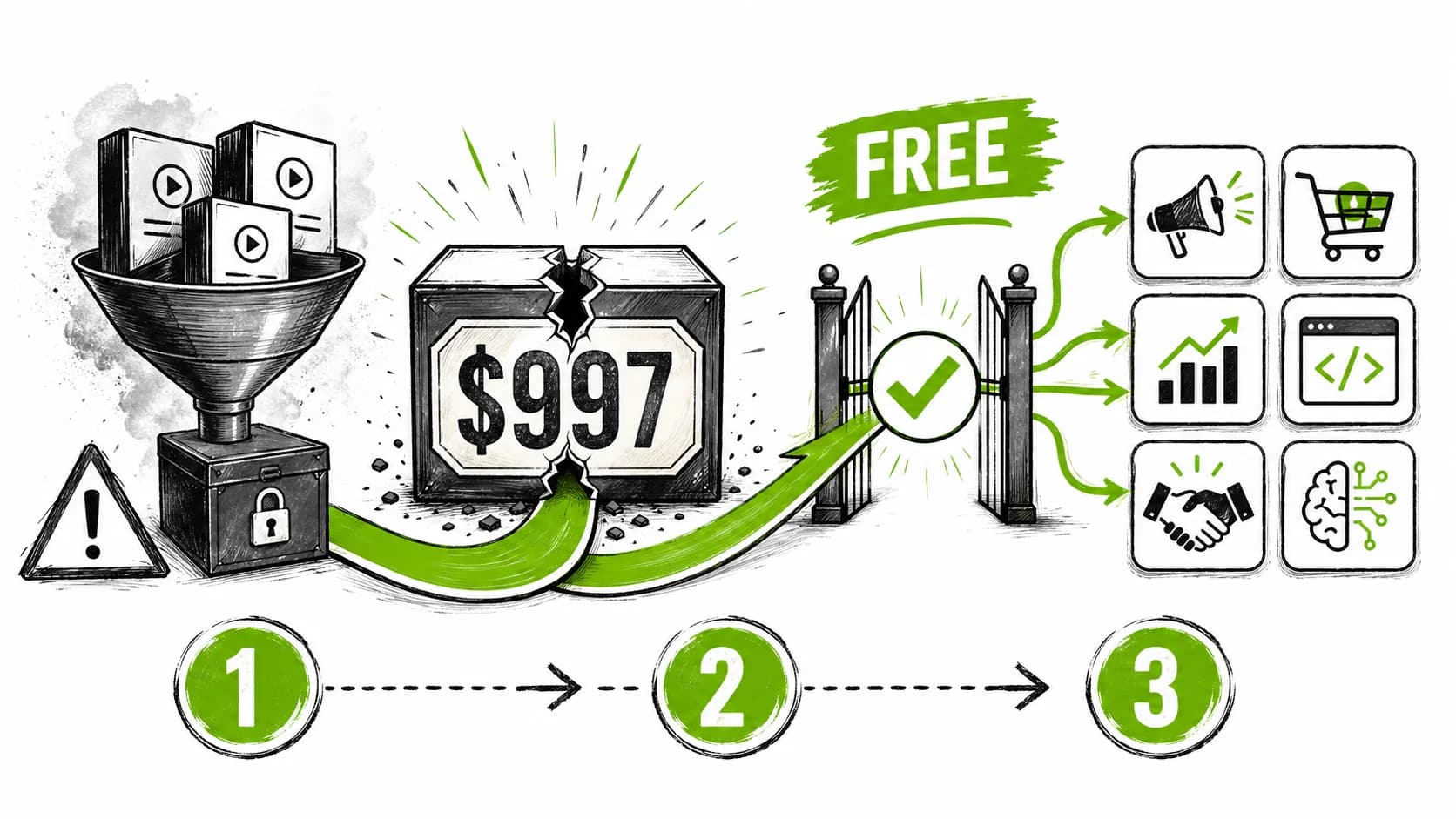
The Typical Funnel
The funnel is nearly identical across all guru niches:
Each rung exists to qualify you for the next rung. The ebook exists to sell the course. The course exists to sell the mastermind. The mastermind exists to create testimonials for the next launch cycle.
What You're Actually Paying For
Strip away the marketing and a guru course delivers exactly three things: curated information, community access, and accountability pressure. That's it. The information is publicly available. The community is a Facebook group or Discord server. The accountability is peer pressure from people who also paid $997 and need to justify the purchase.
The free version of all three: public libraries and open courseware for curated information, Reddit, Discord, and open-source communities for peer interaction, and an accountability partner or study group for pressure. Total cost: $0.
Category 1: Digital Marketing Courses ($497-$1,997) {#category-1-digital-marketing-courses}
What Gurus Teach
Every $997 digital marketing course covers the same curriculum: SEO fundamentals, Google Ads setup, social media strategy, email marketing, content marketing, and "funnel building." The modules are interchangeable between courses. We've seen identical slide templates across courses from different gurus — because they all sourced them from the same PLR (private label rights) content libraries.
Free Alternatives That Teach the Same Material
Google Digital Garage — Google's own marketing certification program. 140 hours of content covering search, display, video, and shopping advertising. The certification is recognized by employers and agencies. The content is maintained by Google's internal teams, which means it's updated every time the platform changes — something no guru course can match because they recorded the videos once and never re-shot them.
HubSpot Academy — Free certifications in inbound marketing, content marketing, email marketing, social media marketing, and SEO. HubSpot's certifications are listed on LinkedIn's recognized certifications database. The courses are taught by practitioners who work at HubSpot, not by people whose primary revenue stream is selling courses about marketing.
Moz Beginner's Guide to SEO — This single guide is better than 90% of paid SEO courses on the market. Moz literally invented the Domain Authority metric. Their free educational content is more authoritative than any guru's interpretation of it.
Google Skillshop — The official Google Ads training and certification platform. Every Google Ads feature, explained by the people who built it. When a guru teaches you Google Ads, they're reading from this documentation and adding their own anecdotes. You can skip the middleman.
Semrush Academy — Free courses on SEO, content marketing, PPC, and competitive research. Taught by industry practitioners, not info-product sellers.
What the Guru Adds vs. These Resources
Nothing. Except a Facebook group with 12,000 members where nobody answers questions and the guru posts once a month. The free resources listed above are made by the companies that build the platforms gurus teach you to use. They are primary sources. Guru courses are secondary interpretations of primary sources, sold at a 10,000% markup.
Category 2: Dropshipping / Ecommerce Courses ($997-$2,997) {#category-2-dropshipping-ecommerce-courses}
What Gurus Teach
Shopify store setup, product research with tools like AliExpress and AutoDS, Facebook Ads targeting, TikTok Ads creative, and "scaling" strategies. Every dropshipping course follows the same arc: find a trending product, build a generic Shopify store, run paid ads, and pray the margins survive after returns, chargebacks, and ad costs.
Free Alternatives
Shopify Learn — Shopify's free educational platform includes full courses on store setup, product photography, ad creative, and business fundamentals. Shopify wants you to succeed because you pay them $39/month. Their incentive is aligned with yours. A guru's incentive ends when your credit card clears.
Oberlo / Shopify Dropshipping Guides — Oberlo popularized modern dropshipping. Their guides (now hosted on Shopify's blog) cover product sourcing, supplier vetting, and logistics in more practical detail than any $997 course. These guides are written by people who built the dropshipping infrastructure, not people who made one sale in 2019 and pivoted to selling courses.
Google Merchant Center Documentation — If you're selling products online, Google Merchant Center is your distribution backbone. Their documentation covers product feeds, Shopping ads, free listings, and performance optimization. It's comprehensive, updated regularly, and free.
Meta Blueprint (Facebook Business) — Meta's official advertising training covers ad creation, targeting, optimization, and measurement. Every Facebook Ads module in every guru course is a diluted version of this content.
The Numbers Gurus Never Mention
The real cost of dropshipping isn't the course — it's the ad spend. Most beginners burn through $2,000-$5,000 in advertising before they learn enough to become profitable, if they ever do. According to Shopify's own 2024 merchant survey, the average new ecommerce store takes 18-24 months to reach consistent profitability.
More damningly, the FTC's Operation Income Illusion, launched in 2024, targeted companies selling "make money online" programs and found that the vast majority of purchasers made little or no money after buying these programs. The FTC didn't mince words: these programs are "selling income opportunities that don't deliver."
Category 3: Investing / Trading Courses ($997-$4,997) {#category-3-investing-trading-courses}
What Gurus Teach
Stock picking, options trading, cryptocurrency "strategies," forex signals, and the ever-popular "passive income through dividends." Trading guru courses are the most dangerous category on this list because they combine financial illiteracy with false confidence. A bad marketing course wastes your money. A bad trading course loses your money AND your savings.
Free Alternatives
MIT OpenCourseWare: Finance Theory I — This is the actual finance course taught at MIT Sloan School of Management. Complete lectures, problem sets, and exams. This is what MBA students pay $80,000/year to access. It is free. It teaches you the mathematical foundations of portfolio theory, risk management, and asset pricing — topics that trading gurus replace with "buy when the chart looks bullish."
Khan Academy: Finance & Capital Markets — A complete, structured curriculum covering interest, debt, stocks, bonds, mutual funds, insurance, and monetary policy. Khan Academy's content has been peer-reviewed and refined over 15 years. The pedagogical quality is world-class. And it's free.
Investopedia — The encyclopedia of investing. Over 30,000 articles covering every financial concept, instrument, and strategy. When a trading guru uses a term you don't understand, they learned it from Investopedia. So can you.
Bogleheads Wiki — An evidence-based investing community built around the principles of John C. Bogle, founder of Vanguard. The Bogleheads philosophy is simple: buy low-cost index funds, diversify, and hold for decades. It's boring. It's free. And it beats 90% of active fund managers over 20 years, according to S&P Global's SPIVA Scorecard, which has tracked active manager performance since 2002.
What Gurus Won't Tell You
The SPIVA data is devastating. Over a 20-year period, 95% of actively managed U.S. large-cap funds underperformed the S&P 500 index. That means the professional fund managers — people with Bloomberg terminals, research teams, and decades of experience — couldn't beat a simple index fund. But a 26-year-old with a $1,997 options trading course is going to teach you to do better? The math doesn't support it. The data doesn't support it. The only thing that supports it is the guru's car payment.
Category 4: Coding Bootcamp Alternatives ($2,000-$15,000) {#category-4-coding-bootcamp-alternatives}
What Paid Bootcamps Teach
HTML, CSS, JavaScript, a frontend framework (usually React), a backend framework (usually Node.js or Python/Django), databases, APIs, version control, and deployment. The standard full-stack curriculum hasn't changed meaningfully since 2018. What has changed is the price: coding bootcamps now charge between $2,000 (deferred tuition models) and $15,000 (upfront payment).
Free Alternatives
freeCodeCamp — Over 10,000 hours of project-based curriculum covering responsive web design, JavaScript algorithms, frontend libraries, backend development, data analysis, and machine learning. Free certifications upon completion. freeCodeCamp has helped millions of people transition into software development careers. Their alumni work at Google, Microsoft, Apple, and Spotify. The entire platform is a 501(c)(3) nonprofit. It is genuinely, completely free.
The Odin Project — A full-stack curriculum that teaches you by building real projects. Covers HTML, CSS, JavaScript, Ruby, Rails, React, and Node.js. The curriculum is maintained by a community of developers who contribute to it as open-source volunteers. It is free, it is thorough, and it has produced professional developers working at every FAANG company.
CS50 by Harvard — The most popular introductory computer science course in the world. Taught by David Malan on edX, completely free to audit. CS50 covers C, Python, SQL, HTML, CSS, JavaScript, and fundamental computer science concepts. The production quality of the lectures is higher than any bootcamp recording. Harvard makes this available for free because their endowment doesn't depend on course sales.
MDN Web Docs — Mozilla's web development documentation. If you need to understand how a web technology works, MDN is the definitive reference. It's maintained by Mozilla, Google, Microsoft, and Samsung. Every web developer uses it daily. It is free and always will be.
Full Stack Open by University of Helsinki — A modern full-stack web development course covering React, Redux, Node.js, MongoDB, GraphQL, and TypeScript. University-level curriculum, free to access, and used as the actual coursework for University of Helsinki CS students.
The Track Record
These free resources have produced more employed developers than most paid bootcamps. freeCodeCamp alone has verified over 40,000 alumni who got developer jobs after using their platform. The Odin Project's Discord server has over 500,000 members, many of whom share their job placement stories publicly. The resources are free. The results are documented. The only thing missing is the $15,000 invoice.
Category 5: Sales / Cold Outreach Courses ($497-$1,497) {#category-5-sales-cold-outreach-courses}
What Gurus Teach
Cold email templates, LinkedIn outreach scripts, "objection handling" frameworks, CRM setup, and pipeline management. The irony of the sales guru niche is thick enough to cut: the best evidence that someone is good at sales is that they convinced you to buy a course about sales.
Free Alternatives
HubSpot Sales Certification — A complete free course on inbound sales, including prospecting, connecting, exploring, and advising. HubSpot's sales methodology is used by thousands of companies. The certification is free and recognized.
Gong's Content Library — Gong analyzes millions of sales calls using AI. Their blog, webinars, and research reports contain more actionable sales data than any guru course. They publish win rate data, talk-to-listen ratios, and objection handling patterns derived from real calls — not hypothetical frameworks from someone who hasn't closed a deal since 2017.
SaaStr YouTube Channel — Over 2,000 free videos from founders and sales leaders at companies like Salesforce, Slack, Zoom, and Snowflake. These people collectively manage billions in ARR. Their tactical advice comes from running actual sales organizations, not from selling courses about running sales organizations.
YCombinator Startup School — Free curriculum from the most successful startup accelerator in history. Covers sales, growth, fundraising, and product-market fit. Alumni include Airbnb, Stripe, Dropbox, and Reddit.
The Meta-Irony
The best salespeople don't buy sales courses. They read the free material, practice on real prospects, analyze their results, and iterate. The single best way to get better at sales is to make 100 cold calls and track what works. That costs $0 and a phone.
Category 6: Personal Branding Courses ($297-$997) {#category-6-personal-branding-courses}
What Gurus Teach
Content strategy for social media, "authority positioning," audience building, engagement tactics, and monetization through sponsorships or digital products. The personal branding niche has a recursion problem: the guru's personal brand IS selling a course about personal branding. Remove the course, and the brand collapses. This should tell you everything about the transferability of the advice.
Free Alternatives
Gary Vaynerchuk's Content Library — Gary Vee has published over 3,000 hours of free content across YouTube, podcasts, and social media. You can disagree with his style, but you can't argue with the output. His content covers every aspect of personal branding: platform selection, content repurposing, audience growth, and monetization. It is all free. He makes his money from VaynerMedia and VaynerX, not from course sales.
Seth Godin's Blog — Over 8,000 blog posts spanning 20+ years. Seth Godin literally wrote the book on permission marketing, purple cows, and being remarkable. His blog is the single best free resource on marketing thinking and brand positioning. When personal branding gurus teach you about "standing out," they're paraphrasing Seth Godin. Read the source.
Building a StoryBrand Podcast — Donald Miller's framework for brand storytelling is used by thousands of companies. The podcast is free and covers the complete methodology.
Ali Abdaal's YouTube Channel — Over 500 free videos on productivity, content creation, and building an audience. Ali documents his process transparently, including revenue numbers and failures. The free content is the product.
The Recursive Scam
Here's the question every personal branding course purchaser should ask: "If your personal branding advice is so effective, why is your primary income from selling a course about personal branding instead of from the brand itself?" If the guru's brand collapses without course revenue, the methodology doesn't work. It's a Ponzi scheme of attention — each cohort of students creates content promoting the guru, which attracts the next cohort of students.
Category 7: Real Estate Courses ($997-$4,997) {#category-7-real-estate-courses}
What Gurus Teach
House flipping, wholesaling, rental property acquisition, "creative financing" (subject-to, seller financing), and BRRRR (Buy, Rehab, Rent, Refinance, Repeat). Real estate guru courses are among the most expensive and the most deceptive. They sell the dream of passive income while omitting the capital requirements, market risk, and legal liability.
Free Alternatives
BiggerPockets — The largest real estate investing community in the world. Free forum, free podcast (900+ episodes), free articles, and free calculators. BiggerPockets has more real estate investing knowledge than every guru course combined, and it's contributed by actual investors who own actual properties.
HUD Homebuyer Education — The U.S. Department of Housing and Urban Development provides free homebuyer education, counseling, and resources. This is the federal government teaching you about real estate. It's not glamorous. It is accurate.
Local REIA (Real Estate Investors Association) Meetings — Free or low-cost ($10-$20) local meetups where active investors share deals, strategies, and lessons learned. These rooms contain more practical knowledge than any online course because the people in them are doing deals in your specific market.
Investopedia Real Estate Investing Guide — Comprehensive, free coverage of every real estate investing strategy, from REITs to house hacking to commercial property.
The FTC Has Opinions
Real estate guru companies have a documented history of deceptive practices. The FTC has taken enforcement action against multiple real estate education companies for misrepresenting income potential. In 2024 and 2025 alone, the FTC settled with at least 10 real estate guru companies for practices including: fabricating success stories, hiding mandatory additional purchases that cost thousands beyond the initial course, and using "free" seminars as high-pressure sales environments. If the government is suing these companies for fraud, perhaps the information they sell isn't worth $4,997.
Category 8: AI / No-Code Courses ($297-$997) {#category-8-ai-no-code-courses}
What Gurus Teach
"How to make money with ChatGPT," prompt engineering, AI automation, no-code app building with Zapier or Make.com, and "building an AI agency." This is the newest guru niche and arguably the most absurd. The technology changes every 3 months. A course recorded in January is outdated by April. You are paying $997 for a snapshot of documentation that was already free when it was current.
Free Alternatives
OpenAI Documentation — The official ChatGPT and GPT-4 documentation, written by the people who built the models. Every "prompt engineering" course is a simplified reading of this documentation with screenshots.
Anthropic Claude Documentation — Complete documentation for Claude, including prompt engineering guides, best practices, and API reference. Written by AI researchers, not course sellers.
Google AI Studio / Gemini Documentation — Google's AI platform documentation covers Gemini models, multimodal capabilities, and integration patterns. Free, authoritative, current.
Zapier University — Zapier's free training platform teaches automation workflows using their tool. Since Zapier is the tool most "AI automation" gurus teach you to use, learning from the source eliminates the middleman.
Make.com Academy — Free courses on visual automation, API integration, and workflow design. Make (formerly Integromat) is the other tool gurus charge you to learn about.
No Code Founders YouTube — Free content on building products without code, including real case studies and build-alongs.
DeepLearning.AI Short Courses — Free courses taught by Andrew Ng and industry practitioners covering LangChain, vector databases, fine-tuning, and RAG. This is Stanford-level AI education, free, and continuously updated.
The Fastest-Depreciating Asset in Education
AI courses are the only product category where the depreciation rate exceeds the consumption rate. By the time you finish a 6-week AI course, the tools have changed, the APIs have been updated, the best practices have shifted, and at least two of the platforms covered in the course have launched entirely new features or pivoted their pricing. That $997 course is a time capsule of a technology that moves faster than any instructor can record. The documentation — free, maintained by the companies building the tools — is always current. The courses never are.
The 3 Things Worth Paying For {#the-3-things-worth-paying-for}
Fairness requires acknowledging that some paid education IS worth the price. Here's where the line sits:
1. Accredited University Degrees and Certificates
A degree from an accredited institution carries weight in hiring processes that no Udemy certificate will ever match. If you're choosing between a $997 guru course and putting that money toward a community college course, choose the accredited option every time. The credential is recognized, the education is vetted, and the institution has a reputation to protect.
2. Niche Technical Certifications
Certifications from AWS, Google Cloud, Microsoft Azure, Cisco, PMP, and similar organizations are worth paying for because they are recognized industry standards with verified exam processes. An AWS Solutions Architect certification opens doors that no guru certificate ever will. These certifications cost $150-$400, not $997-$4,997, and they're accepted globally.
3. Small-Group Coaching from Verified Practitioners
If someone has a verifiable track record — not screenshots, not testimonials, but publicly auditable results like a LinkedIn profile with real employment history, a business with visible revenue (tax returns, not Stripe screenshots), or published case studies from recognizable clients — paying for small-group access to that person can be worthwhile. The key word is verifiable. If the only evidence of their success is the course sales page, the evidence IS the course sales page.
FAQ {#faq}
Are ALL online courses scams?
No. Accredited university courses, industry certifications (AWS, Google, PMP), and courses from verified practitioners with auditable track records provide genuine value. The problem is specifically with self-proclaimed "gurus" who sell repackaged free information at premium prices, using manufactured urgency and unverifiable income claims. The test is simple: can you verify the instructor's credentials and results independently of their sales page? If the answer is no, the course isn't worth the risk.
How do I verify if a guru's revenue claims are real?
Three methods. First, check their business on your state's Secretary of State website to verify it's a real registered entity. Second, look for their company on the Better Business Bureau and check for complaints. Third, search for FTC enforcement actions using the FTC's case database. If a guru shows Stripe screenshots but refuses to share their Schedule C or audited financials, the screenshots are marketing materials, not evidence.
What's the best way to learn marketing for free?
Start with Google Digital Garage for the certification (it's recognized by employers). Then do HubSpot Academy's Inbound Marketing certification. Read the Moz Beginner's Guide to SEO. Join r/marketing and r/SEO on Reddit. Follow practitioners on LinkedIn who work at agencies and tech companies — not people who sell courses. This path takes 3-6 months and costs $0. It will make you more employable than any $997 course.
Should I ever pay for a course?
Yes, but only when three conditions are met: (1) the instructor has verifiable, auditable credentials independent of course sales, (2) the price is proportional to the material — a $200 technical course is reasonable, a $4,997 "mentorship" with vague deliverables is not, and (3) you've exhausted the free alternatives first. If the free resources cover 90% of the material (they usually do), the paid course is only worth the 10% delta — and that delta is almost never worth $997.
How do I find free communities for accountability?
Reddit has active communities for every niche on this list — r/Entrepreneur, r/learnprogramming, r/personalfinance, r/realestateinvesting, r/marketing. Discord servers exist for every skill and industry, many with thousands of active members. freeCodeCamp's forum has a vibrant developer community. BiggerPockets' forum serves real estate investors. These communities provide the accountability and peer support that guru courses charge for — without the $997 admission fee. Find one, introduce yourself, and ask for an accountability partner. Someone will say yes within 24 hours.
Every resource linked in this article is free as of March 2026. We verify links quarterly. If you find a broken link or a resource that has moved behind a paywall, contact the larpable editorial team so we can update this guide.
Related reading on Larpable:
- Is the SMMA Course Worth It in 2026?
- Is a Dropshipping Course Worth It in 2026?
- How to Spot a Guru Scam in 30 Seconds
- The Psychology Behind Why You Almost Bought That Course
- Red Flags in Online Course Sales Pages
<!-- sister-projects-start -->
Other Doved Studio projects
Related tools from the same studio you might find useful:
- Ralphable: Generate structured Claude Code skills that iterate until pass/fail criteria are met.
- Doved Studio: Studio indie derrière cette app et une dizaine d'autres outils.
<!-- sister-projects-end -->