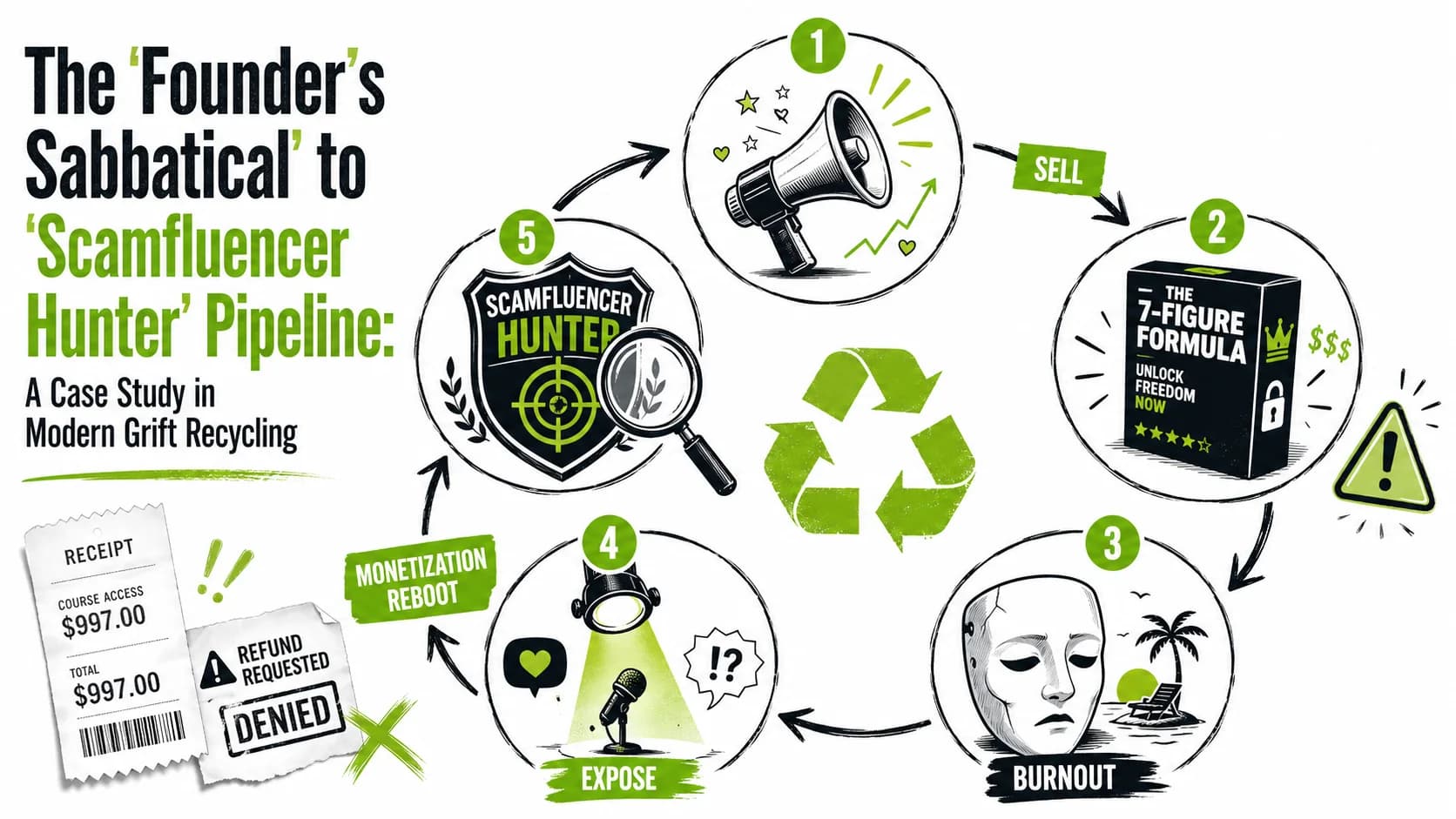
If you've spent more than ten minutes on entrepreneur Twitter or LinkedIn this month, you've seen it: the dramatic, teary-eyed video. A familiar face, once the poster child for "rise and grind" culture, now sits in soft, diffused lighting. They speak in a hushed, confessional tone about the "toxic industry" they were once a part of. They've seen the light. They're here to warn you. They are, they declare, a scamfluencer hunter.
This isn't a random act of conscience. It's the latest, most sophisticated stage in the guru lifecycle, a predictable pipeline of grift that recycles failure into a new, more defensible form of success. When the "7-Figure Blueprint" course stops selling, and the community starts asking uncomfortable questions about refunds, the savvy fake guru doesn't retreat—they rebrand. They weaponize their own failed credibility to build a new, more resilient one.
This article is your decoder ring. We're dissecting the cynical, five-stage evolution from hustler to "hunter," mapping the telltale signs at each phase, and giving you the tools to see the grift before it sees you. Because in 2026, the most dangerous predator isn't the one selling the dream—it's the one selling you the nightmare they just escaped.
Stage 1: The Hustle Porn Architect
Every pipeline needs a source. This stage is characterized by unbridled, often fabricated, ambition. The individual builds a personal brand on the altar of extreme output.
- The Grift: Selling the "how" of success they haven't sustainably achieved. This includes mastermind groups, "done-for-you" agency services, e-commerce "dropshipping secrets" courses, and crypto/NFT "alpha" groups.
- The Aesthetic: Lamborghini thumbnails, revenue screenshots on iPhone notes (a skill we teach you to spot), backdrop of a rented supercar or WeWork office, and a vocabulary saturated with "leverage," "synergy," "crushing it," and "the game."
- The Telltale Crack: The facade begins to splinter under predictable pressures. Look for:
* Refund Request Escalation: A noticeable uptick in "Where's my refund?" comments, initially met with aggressive defense ("You didn't implement!") before being deleted.
* The Pivot Tease: Vague posts about "evolving," "new chapters," and "listening to my higher self." The hustle porn architect is preparing the narrative soil for the next seed.
This is the foundation. For a deeper dive into recognizing these early-stage larpers, our 2026 Guide to Spotting Fake Gurus breaks down their most common tactics.
Stage 2: The Founder's Sabbatical & The "Burnout" Rebrand
The grift has hit a ceiling. Engagement is down, sales have stalled, and the community's skepticism is rising. It's time for a controlled demolition of the old identity.
- The Grift: Monetizing the failure of Stage 1. The "burnout" is packaged not as a failure of their model, but as a noble sacrifice on the altar of ambition, from which they have learned sacred lessons they can now sell to you.
- The Narrative: A long-form LinkedIn post or YouTube video titled "Why I Walked Away From 7 Figures" or "The Dark Side of Hustle Culture." They speak of panic attacks, lost relationships, and an empty soul despite the "success." Crucially, they never admit their core product was a scam. They frame it as their own personal failing—they worked too hard at the wrong thing.
- The New Product: The "Founder's Sabbatical" playbook. This morphs into:
* Coaching: "Burnout-to-breakthrough" 1-on-1 coaching packages.
* Content: A new feed filled with mindfulness quotes, morning routines involving ice baths, and podcasts about "energetic alignment in business."
They've swapped the Lambo for linen shirts, the "crush it" for "be here now." But the engine—selling a solution to a problem they created—remains the same.
Stage 3: The "Healed" Guide & The Community Purge
Having sold the story of their breakdown, they must now sell the story of their breakthrough. This stage is about consolidating a new, "wiser" audience and surgically removing the old one.
- The Grift: Selling wisdom and access derived from a transformation that is, at best, exaggerated. They position themselves as the healed guide who can help you avoid the traps they "fell into."
- Key Actions:
2. The Doctrine Shift: Their content aggressively criticizes their old self (a safe target). They condemn "hustle porn," "toxic productivity," and "get-rich-quick schemes"—the very pillars they built their previous empire on. This creates a powerful illusion of growth and credibility.
3. The Premium Re-Launch: They introduce a new, high-ticket offering. It's often a "group container," "alignment accelerator," or "sovereign founder's circle" priced at 2-3x their old course. It's vaguer, more spiritual, and harder to hold accountable.
This stage is a masterclass in narrative control. The critic is silenced, the past is reframed as a lesson, and the revenue stream is re-established under a new, morally superior brand.
Stage 4: The Righteous Pivot: Becoming the "Scamfluencer Hunter"
The "healed guide" persona has a shelf life. To achieve true longevity and tap into a growing cultural skepticism, the ultimate pivot arrives: becoming the hunter of their former kind.
- The Grift: The most meta-grift of all. They now sell protection from the very industry they helped proliferate. Their insider knowledge (of tactics they used) becomes their ultimate selling point.
- The Launch: A dramatic video series or thread "exposing" a former peer or a generic guru tactic. The content is often 90% accurate—that's what makes it dangerous. They mix real, useful criticism with their own agenda.
- The New Business Model:
* The Paid Newsletter/Community: "Join my Scam Shield Patreon/Discord for exclusive breakdowns and my 'Guru Red-Flag Checklist.'"
* Consulting: "Hire me to audit a business opportunity or coach you on due diligence."
They have successfully externalized the villain. The problem is no longer their own past actions, but the "industry" out there. They have become the hero of their own story, and they are selling you a ticket to the sequel. This trend is exploding, and we analyze its specific mechanics in our article, From Scamfluencer to Scamfluencer Hunter: The Newest Fake Guru Pivot of 2026.
Stage 5: The Self-Referential Empire & The Inevitable Loop
In the final stage, the pipeline becomes a closed loop. The hunter becomes the institution.
- The Grift: Selling the methodology of scam-busting, which inevitably creates a new dogma. They become the authority figure of skepticism, a position just as lucrative and prone to corruption as the one they "exposed."
- The Hallmarks:
The Infallibility Complex: Any criticism of their* methods or paid products is framed as "you're defending scammers" or "you just don't get it."
* The Inevitable Hypocrisy: They launch a $2,000 "Scam-Proof Your Business" course. They sell "accountability partnerships" that look suspiciously like masterminds. They use the same FOMO tactics ("only 10 spots left!") they once decried. The hunter has built a new farm, and they are once again the farmer.
The cycle is complete. The hustle architect, through burnout, healing, and righteous rebellion, has built a more resilient, criticism-proof empire. The grift has been fully recycled.
How to Spot a Fake "Scamfluencer Hunter"
Not everyone calling out bad actors is a grifter. Genuine critics exist. The key is pattern recognition. Ask these questions:
The ultimate goal isn't to find a better guru—even an "anti-guru" guru. The goal is to develop your own internal compass. This is the core of what we teach at Larpable. It's not about who you follow; it's about learning how to detect the patterns yourself, so you never need to rely on another self-appointed hunter again.
The Psychological Playbook: Why This Pipeline Works
This pipeline isn't just clever marketing; it's a sophisticated psychological operation that exploits universal human narratives.
| Narrative Arc | Psychological Hook | How The Grifter Exploits It |
|---|---|---|
| The Fall (Stages 1-2) | Schadenfreude & Relatability | We are drawn to the downfall of the arrogant. Seeing the "7-figure guru" burn out makes them human, and we relate to struggle. |
| The Redemption (Stage 3) | Hope & The Second Chance | We are wired to root for redemption. Their "healing" story sells us the hope that we, too, can transform our failures. |
| The Rebellion (Stage 4) | Righteous Anger & Tribalism | Identifying a common enemy (the scam industry) creates a powerful in-group/out-group dynamic. Joining the "hunt" feels morally righteous. |
| The Authority (Stage 5) | The Need for Certainty | In a complex world, a clear voice that says "I know who the bad guys are" provides cognitive relief. We trade skepticism for the comfort of a leader. |
The grifter, consciously or not, is selling us a story we are desperate to buy: that failure can be alchemized into wisdom, that chaos can be ordered by a strong voice, and that we can find safety in their hard-won knowledge.
Breaking the Cycle: Your Anti-Grift Checklist
Your defense is proactive skepticism. Before you buy a course, join a community, or trust a "hunter," run through this checklist:
Audit the Revenue Stream: Where does 80% of their money come from? If it's from teaching people how to spot scams, their business requires* scams to exist. This is a fundamental conflict of interest.
- Demand Specificity Over Vibe: "Toxic energy" and "bad vibes" are not analysis. Look for them dissecting specific claims (e.g., a revenue screenshot), specific funnel tactics, or specific broken promises. Vague condemnation is content; specific criticism is craft.
- Search for the "Before" Archives: Use the Wayback Machine or search old Twitter handles. Do their past actions align with their current righteous persona? A total blackout of past content is a major red flag.
- Watch How They Handle Money: Do they offer clear, no-questions-asked refund policies? Or are their terms filled with legalese designed to protect them? Their relationship with money is the ultimate tell.
True empowerment in the modern entrepreneurial space doesn't come from finding a trustworthy guide. It comes from becoming your own most trusted guide. It comes from understanding that the marketplace of ideas is also a battlefield of narratives, and your mind is the territory to be won.
For a comprehensive framework on navigating this world without falling for the latest pivot, explore our central hub on Entrepreneurship & Critical Thinking.
FAQ: The Scamfluencer Hunter Pipeline
Q1: Aren't some of these "hunters" providing a real service by exposing scams?
Absolutely. Many journalists, researchers, and reformed insiders provide invaluable work. The distinction lies in transparency, methodology, and primary motive. A legitimate investigator cites sources, welcomes peer review, and their income isn't solely tied to the expose industry. A grifter uses exposure as a lead magnet for a nearly identical business model to the ones they condemn.
Q2: What should I do if I bought a course from someone in Stage 1 and now they're in Stage 4 "exposing" others?
First, recognize the psychological play. They are hoping you are so invested in their new, righteous narrative that you'll forgive their past actions. You have every right to hold them accountable. Politely but publicly ask (in their new community) what specific restitution they are offering to their past customers. Their response will be incredibly revealing.
Q3: Is it ever possible for a fake guru to genuinely reform?
Genuine reform is possible but exceptionally rare and looks very different from the pipeline described. It involves: 1) Full, public, and specific accountability (naming the scam, not just "my past"). 2) Tangible restitution to those harmed (refunds, donations). 3) A prolonged period of quiet action, not an immediate monetizable pivot. 4) Earning trust through years of consistent, non-exploitative behavior—not launching a "scam-hunting" course in 6 months.
Q4: Why is this "pipeline" so effective on social media platforms?
Social media algorithms reward dramatic narrative arcs, strong emotions (anger, outrage, righteousness), and consistent creator output. The "hustle-to-hunter" pipeline is a pre-packaged, multi-season drama that ticks every algorithmic box. It creates immense engagement, which the platform promotes, which fuels the grifter's reach, creating a perfect feedback loop of profit.
Q5: What's the alternative to following any of these gurus or anti-gurus?
The alternative is skill-based, community-driven, and skepticism-first learning. Seek out:
- Skills, not secrets: Learn copywriting from a certified course, accounting from a textbook, coding from freeCodeCamp.
- Peer groups, not gurus: Join communities based on mutual support and shared projects, not idolization of a leader.
- Primary sources, not interpreters: Read the SEC filing, the court document, the original study—not just the Twitter thread about it.
- Your own judgment: Invest in developing your pattern detection skills above all else. This turns you from a passive consumer of narratives into an active analyst of them.
<!-- sister-projects-start -->
Other Doved Studio projects
Related tools from the same studio you might find useful:
- Ralphable: Generate structured Claude Code skills that iterate until pass/fail criteria are met.
- Doved Studio: Studio indie derrière cette app et une dizaine d'autres outils.
<!-- sister-projects-end -->