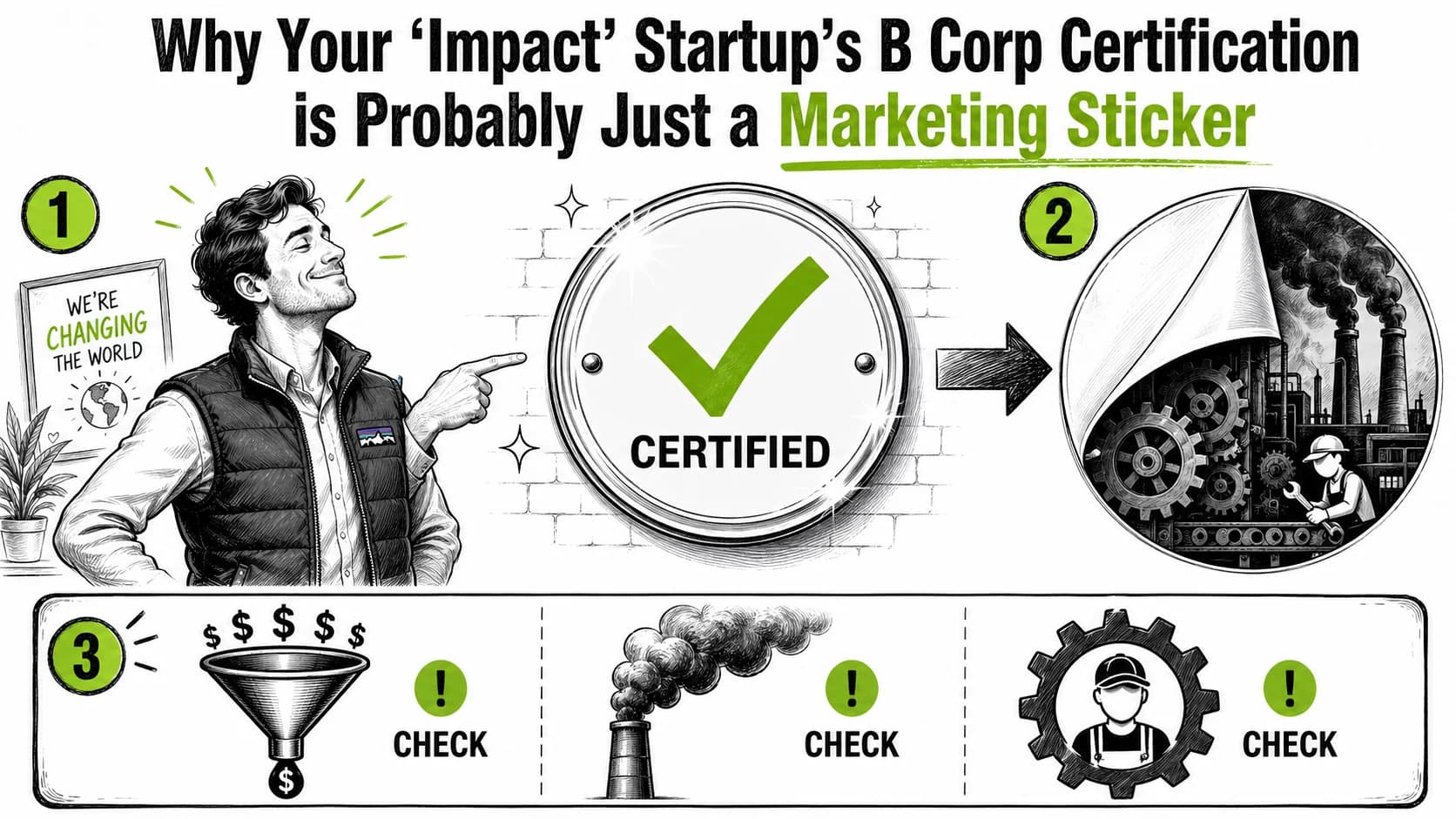
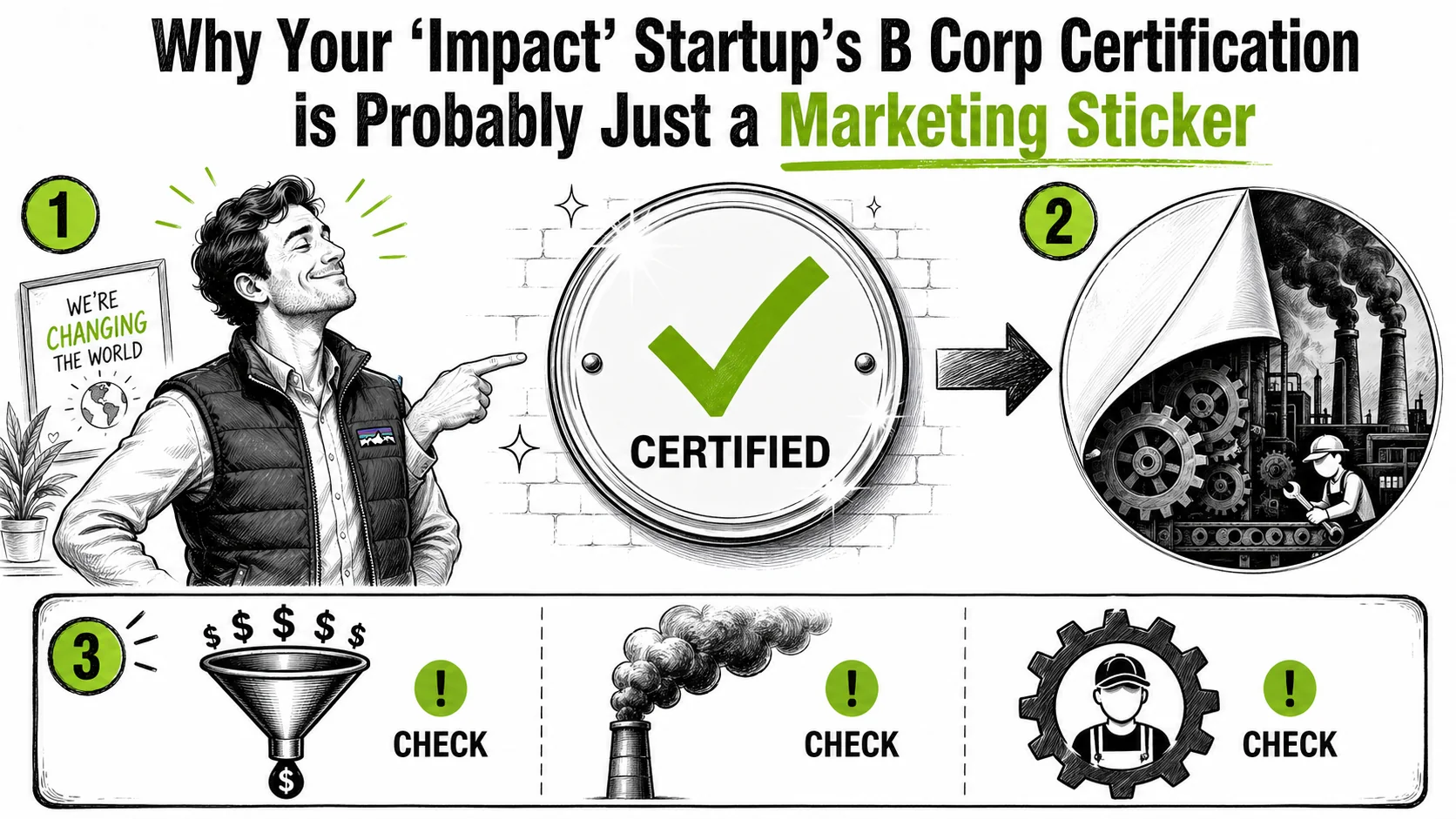
You’ve seen the launch posts. The founder, framed against a minimalist office wall, announces with solemn pride that their company is now a “Certified B Corporation.” The caption is a masterclass in virtue-signaling: “We believe business can be a force for good. We’re proud to join a community of leaders using business as a force for good. This isn’t the end of our journey, it’s the beginning.” The comments are a sea of heart and clapping emojis. The press release gets picked up by a few “conscious capitalism” blogs. The company’s “About Us” page gets a new, glossy section.
But what if that shiny B Corp badge is just the 2026 equivalent of slapping a “Made with Organic Ingredients” sticker on a candy bar made of sugar and palm oil? What if, for a growing number of startups, the certification is less an operational mandate and more a performative marketing sticker—a sophisticated form of “impact washing” designed to disarm skepticism, attract a specific kind of investor, and sell to a guilt-ridden consumer?
In the peak of the 2026 “Conscious Capitalism” trend, the B Corp certification has become the ultimate credibility prop for the modern entrepreneur larper. It’s a signal that says, “You can trust us. We’re the good guys.” And that signal is being systematically exploited. This article isn’t an attack on the B Corp movement itself, which was founded with genuine idealism. It’s a dissection of how its symbols have been co-opted into the larper toolkit, creating a new, highly effective vector for grift where social good is a brand asset to be acquired, not a purpose to be lived.
What Is B Corp Certification, Really?
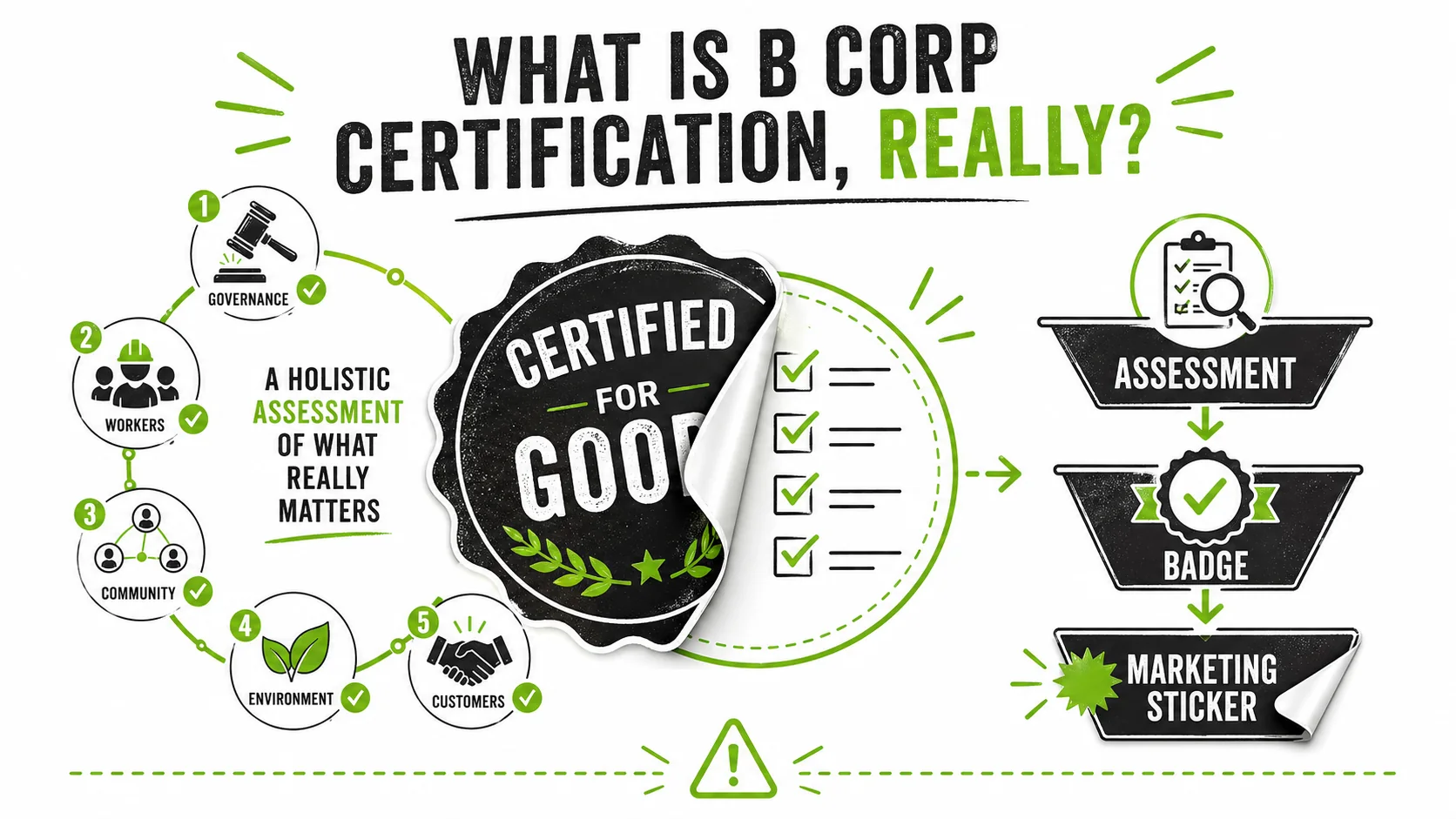
Let’s start with what the certification purports to be. B Corp Certification is administered by the non-profit B Lab. It’s not a product certification like “Fair Trade”; it’s a holistic company certification. To become certified, a company must complete the B Impact Assessment (BIA), a lengthy questionnaire that scores its social and environmental performance across five areas: Governance, Workers, Community, Environment, and Customers. You need a minimum verified score (currently 80 out of 200) and must legally amend your corporate governance documents to state that directors must consider the impact of their decisions on all stakeholders, not just shareholders.
On paper, it’s rigorous. The process can take a year or more and costs thousands of dollars in verification fees. The B Corp community includes genuinely transformative companies like Patagonia and Danone North America. The framework itself is a valuable tool for measuring impact.
But here’s where the reality diverges from the marketing, and where the larper’s playbook begins. The BIA is a self-reported assessment. While B Lab does verify a sample of answers, the system is inherently gameable by a company motivated more by the badge than the behavior. Furthermore, the scoring is relative and has loopholes. A digital SaaS company with no physical supply chain can ace the Environmental section by doing little more than using a green web host and having a recycling bin, while a manufacturing company making genuine, difficult green investments might struggle.
The certification has also spawned an entire cottage industry of “B Corp consultants” who specialize in guiding companies—particularly well-funded startups—through the assessment to achieve the magic 80 points as efficiently as possible. Their service isn’t “how to be a better company,” it’s “how to pass the test.” This is the first red flag: when a standard of integrity requires a specialized consultant to navigate, it becomes a commodity to be purchased.
| The B Corp Promise vs. The Larper's Reality |
|---|
| Promise: Holistic Operational Change |
| The Idea: Certification forces a deep, company-wide evaluation and commitment to stakeholder governance. |
| The Larper's Reality: A checkbox exercise focused on scoring points, often outsourced to a consultant. The legal amendment is seen as a paperwork hurdle, not a philosophical shift. |
| Promise: Transparency and Accountability |
| The Idea: Public B Impact Report holds the company accountable to its claims. |
| The Larper's Reality: The report is a marketing asset. Low scores in certain areas are buried in the PDF, while the public highlight reel focuses on strengths. No real-time accountability exists. |
| Promise: Joining a Community of Leaders |
| The Idea: Collaboration with other mission-driven companies to raise the bar. |
| The Larper's Reality: Networking opportunities and a credibility-by-association halo. The "community" is a LinkedIn badge and an invite to exclusive conferences. |
The Scoring Game: How Points Become a Product
The B Impact Assessment’s point-based system is its greatest strength and its most exploitable weakness. I’ve analyzed dozens of public B Impact Reports for venture-backed startups. A pattern emerges: high scores in “Community” (for donating 1% of product) and “Customers” (for having a terms of service) are common. The “Workers” section is often padded with points for having an employee handbook and offering a wellness stipend—standard fare for any startup trying to attract talent in 2026.
The difficult, expensive points—like comprehensive supply chain audits, radical wage equity, or truly circular production models—are frequently the missing pieces. The company achieves certification by maximizing points in low-cost, high-yield areas while structurally avoiding the complex, costly work that represents the actual “force for good.” They are optimizing for the metric, not the mission. This is a classic pattern in any system where a metric becomes a target: it ceases to be a good metric.
The Legal Amendment: A Shield, Not a Compass
The requirement to adopt a stakeholder governance model is the certification’s most substantive legal hook. In theory, it protects a company’s mission from shareholder pressure to maximize profits at all costs. In the hands of a larper, it serves a different purpose. It becomes a pre-emptive shield against criticism. “How can you say we’re not ethical? We’re legally obligated to consider our impact!” It’s a defensive legal maneuver, often implemented with no corresponding change in boardroom culture or decision-making frameworks. The board still chases the same growth metrics; they just have a lawyer’s note saying they considered the workers before missing payroll to hit the Q3 target.
Why This "Impact Washing" Grift Matters Now
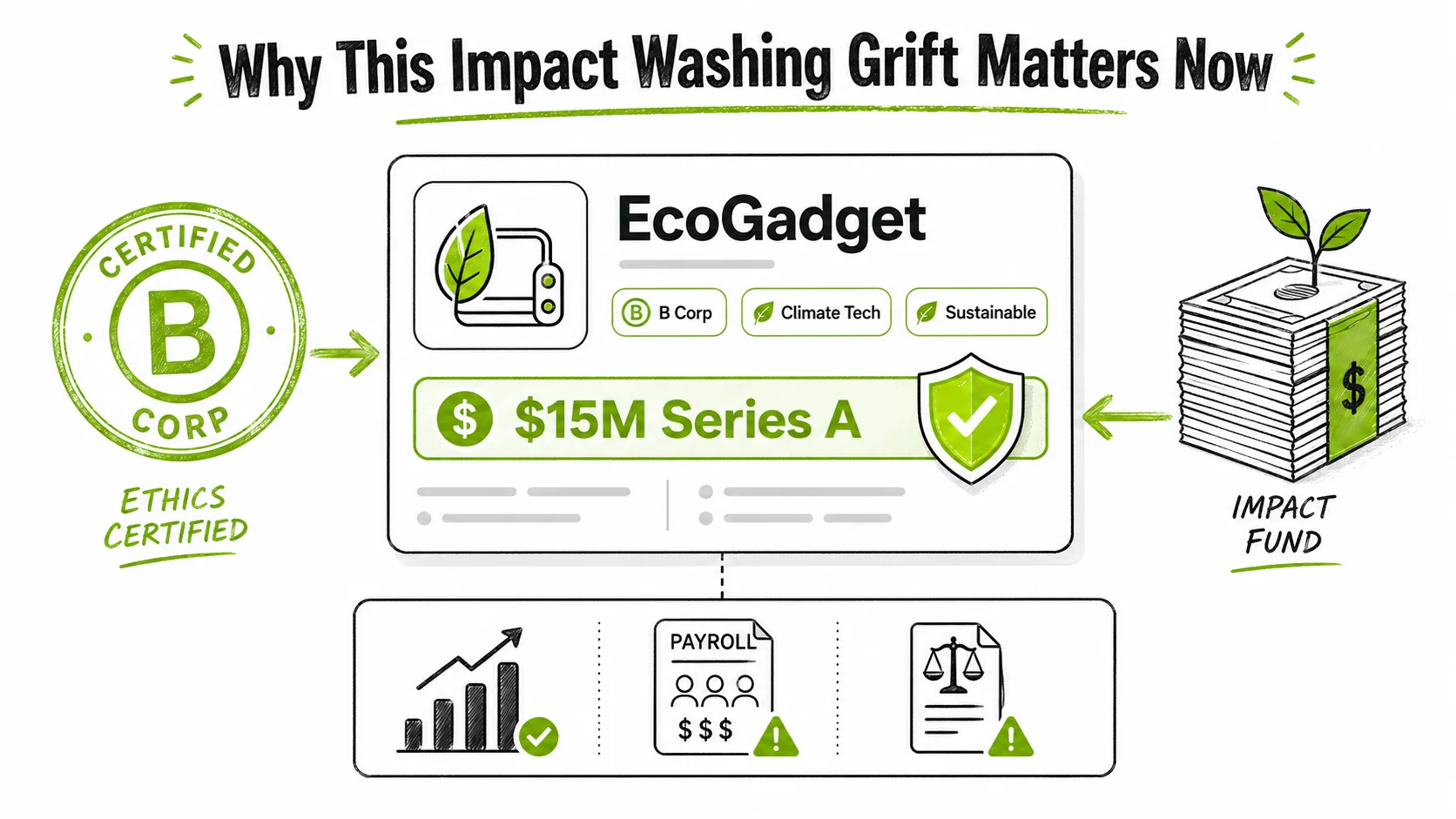
This isn’t a hypothetical concern. The commodification of B Corp status is accelerating in 2026 because the financial incentives have never been stronger. We’re at the peak of a market cycle where “impact” and “ESG” (Environmental, Social, and Governance) are not just nice-to-haves but primary investment theses for billions of dollars in venture capital. According to a 2025 report from the Global Impact Investing Network, the market for impact investments surpassed $1.2 trillion, with venture capital being the fastest-growing segment.
For a founder, a B Corp certification is a signal that unlocks specific doors:
The grift works because it exploits a trust shortcut. We’re all cognitively overloaded. We can’t deeply investigate every company’s supply chain, wage policies, and carbon accounting. Third-party certifications exist to solve that problem. We see the badge and we outsource our trust. The larper understands this psychology perfectly. They aren’t selling a better product; they’re selling the feeling of buying a better product. The certification is the cost of manufacturing that feeling.
This creates a perverse market. Authentic impact becomes harder to measure and less profitable to pursue than the performance of impact. Why spend millions building a closed-loop supply chain when you can spend $50k on certification and marketing that calls your linear product “sustainable”? This dynamic actively harms genuine innovators by drowning them in a sea of look-alikes using the same ethical branding. It’s a classic greenwashing tactic, scaled to the company level.
The stakes are high. When these “impact-washed” companies eventually fail or are exposed—when the factory conditions leak, when the charitable donations are revealed as a rounding error, when the founder’s private jet usage contradicts the carbon-neutral marketing—the backlash doesn’t just hit them. It erodes public trust in the entire concept of ethical business, in third-party certifications, and in the honest companies trying to do the right thing. It creates the cynical, disillusioned consumer who assumes everything is a scam. If you want to understand how this erosion of trust plays out in the broader guru ecosystem, our guide on spotting fake gurus and their alternatives delves into the same psychological playbook.
The "B Corp Influencer" Phenomenon
The grift reaches its logical, absurd conclusion with the rise of the “B Corp Influencer.” These are founders who have built their personal brand almost exclusively around their company’s certification. Their social media is a curated feed of the certification journey, quotes about conscious capitalism, and lavish lifestyle shots from “company retreats” in Bali—all under the banner of “building a world-changing business.” The dissonance is palpable. The message is “we care about equity,” while the medium is hyper-curated personal wealth signaling. This is performative social good at its most transparent, and it’s a major red flag. When the founder’s personal brand is the impact story, the company’s actual impact is often secondary.
How to Spot a "Marketing Sticker" B Corp: A Due Diligence Toolkit
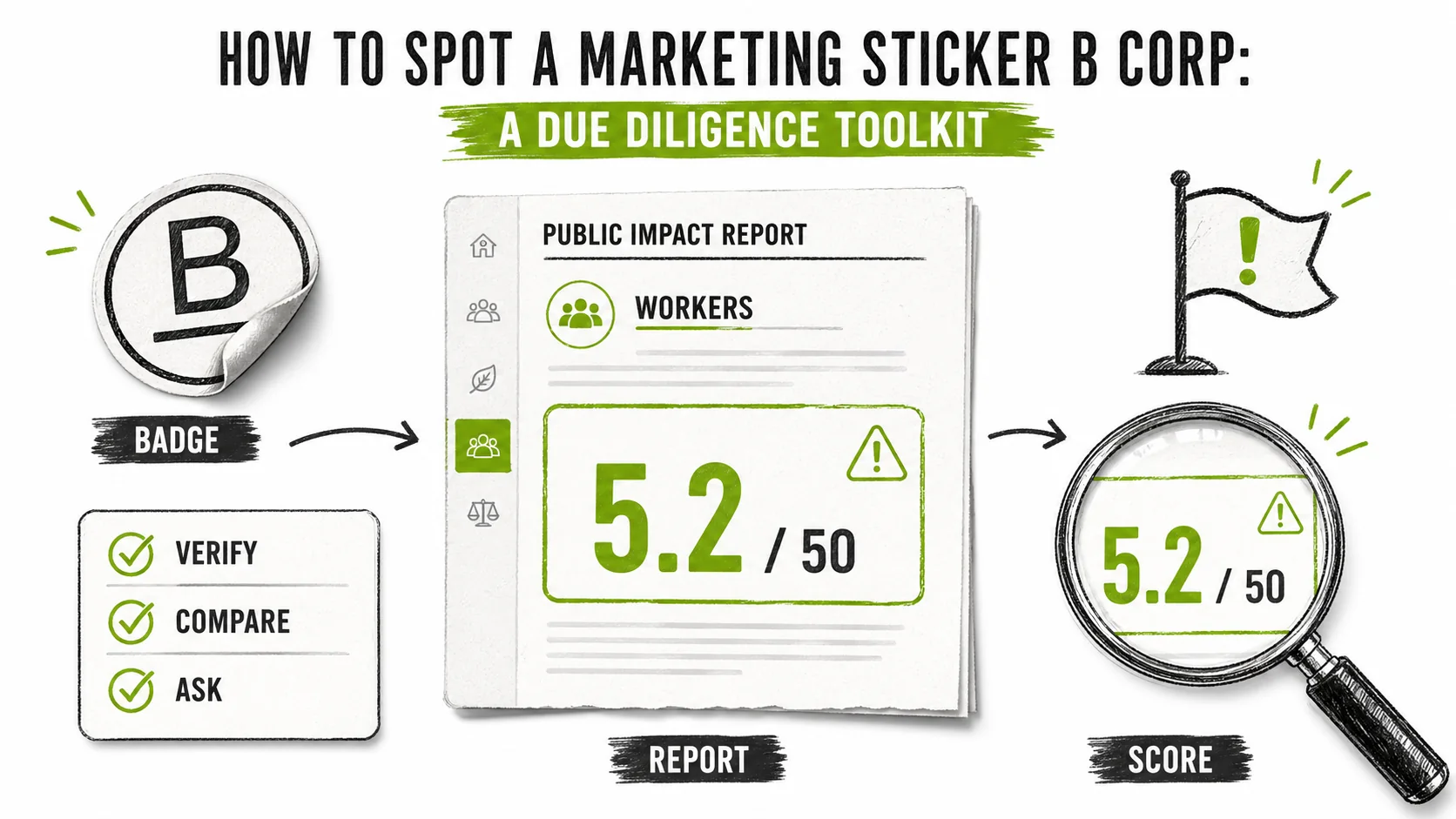
So, how do you separate the authentic from the performative? Whether you’re an investor, a potential employee, or a conscious consumer, you need to move beyond the badge and learn to detect the grift. Here is a step-by-step method for conducting your own impact due diligence.
Step 1: Interrogate the Public B Impact Report (Don't Just Glance at It)
Every certified B Corp has a public B Impact Report on the B Lab website. This is your primary source. Don’t just look at the overall score.
* Look for lopsided scoring. A company scoring 40/50 in “Community” (easy points for philanthropy) but 10/50 in “Environment” (hard points for operations) is telling you where its priorities lie.
* Read the qualitative answers. The report includes summaries of the company’s practices. Look for vague, marketingspeak language vs. specific, measurable commitments. “We are committed to diversity” is meaningless. “We link 20% of executive bonus compensation to achieving specific, published diversity hiring and retention metrics” is substantive.
Step 2: Follow the Money (The Ultimate Signal)
A company’s financial and ownership structure reveals its true priorities.
Step 3: Conduct a "Dissonance Audit" on Public Messaging
Compare what the company says with what it does and who it is.
Step 4: Ask the Uncomfortable Questions Directly
If you’re in a position to engage (as a journalist, potential investor, or large B2B customer), ask direct questions. Performative companies are often unprepared for specifics.
- “Your B Impact Report shows a low score in Worker compensation. What specific, timed milestones do you have to improve that score before your recertification in three years?”
- “Can you share your internal carbon accounting methodology and your Scope 3 emissions data?”
- “How does your board’s stakeholder governance clause actually influence decision-making? Can you give me an example of a time you chose a lower-profit option because of stakeholder impact?”
- “What percentage of your shares have dual-class voting rights, and how does that align with democratic worker governance?”
Vague, evasive, or marketing-heavy answers are your answer. For a deeper dive into the specific tactics used to create a facade of sustainability, our investigation into greenwashing in startups breaks down the common playbook.
Putting Your Skepticism to Work: Strategies for the Conscious Stakeholder
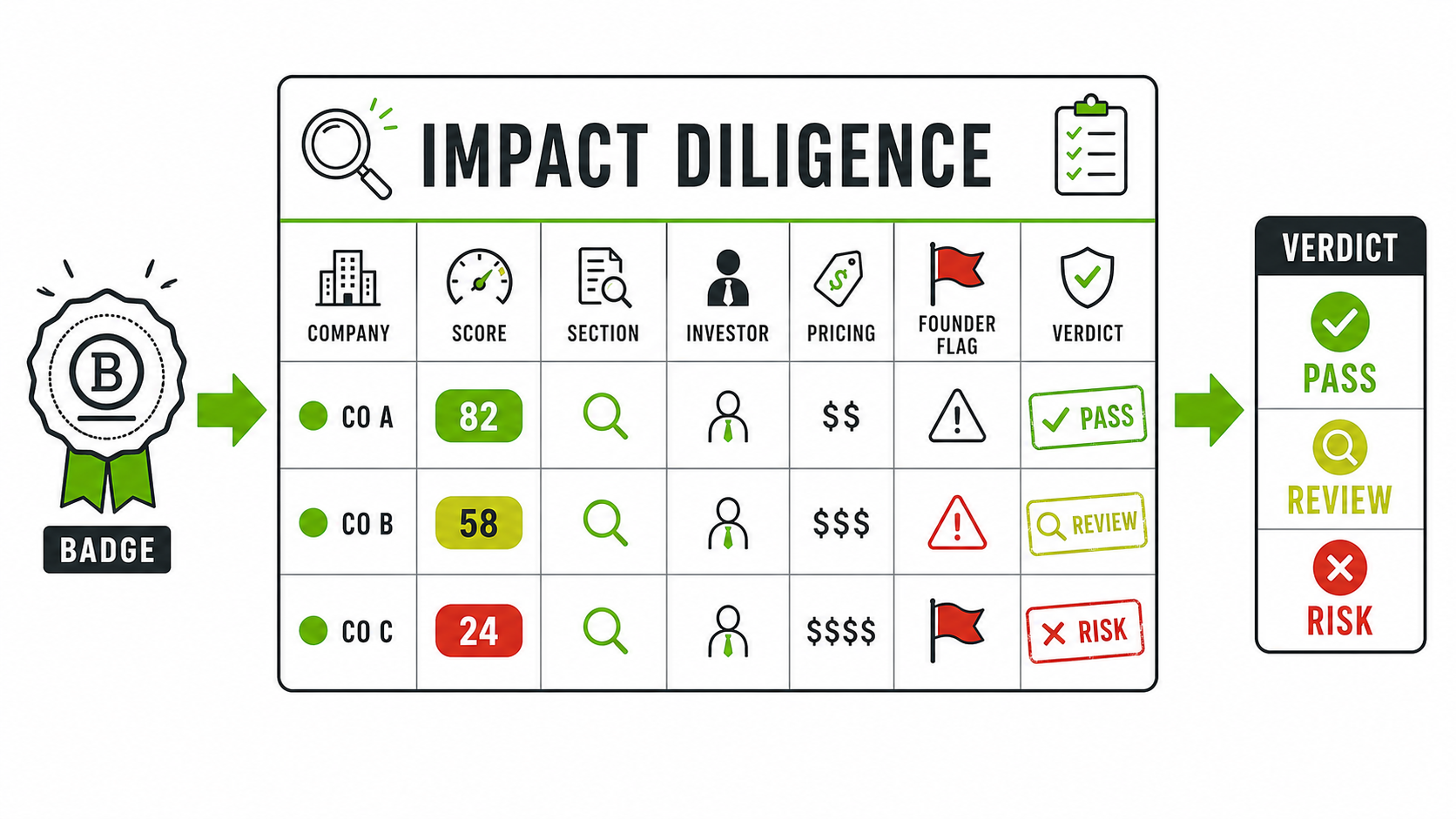
Detecting the grift is one thing. Acting on that knowledge is another. Here’s how different actors in the ecosystem can move from passive observation to active discernment.
For Investors: Build Impact Diligence Into Your Thesis
If you’re an impact investor, your diligence must go deeper than the certification. It must stress-test the company’s impact claims with the same rigor you apply to its financial model.
The core question you must answer is: Is impact a cost-center marketing line item for this company, or is it the engine of its value creation and competitive advantage? The latter is investable; the former is a ticking time bomb of reputational risk.
For Job Seekers: Interview the Company As It Interviews You
You’re not just accepting a salary; you’re lending your time and talent to a mission. Vet the mission.
For Consumers: Vote with Your Wallet (And Your Voice)
Your purchasing power is your primary lever. Use it wisely.
The goal isn’t to achieve perfect purity—that’s impossible. The goal is to shift the cost-benefit analysis for companies. Right now, the benefit of a superficial “marketing sticker” certification is high, and the cost of being exposed is low. By becoming more discerning stakeholders, we can raise the cost of grift and increase the reward for genuine integrity.
Got Questions About B Corp Grift? We've Got Answers.
How often do B Corps get exposed for bad behavior?
More often than you might think, but rarely with fatal consequences. Since 2020, there have been several high-profile cases where B Corps faced significant scandals related to union-busting, toxic workplace culture, or environmental violations. B Lab typically places the company “under review,” which often results in a requirement to improve practices or, in rare cases, revocation of certification. The process is slow and not always transparent. The exposure usually comes from investigative journalism or whistleblowers, not from B Lab’s own monitoring. This reactive, rather than proactive, enforcement is a key weakness in the system.
What if a company is a B Corp but has traditional VC investors? Is that automatically bad?
No, it’s not automatically bad, but it’s a yellow flag that demands closer scrutiny. The critical question is alignment. Have the investors bought into the stakeholder governance model, or are they tolerating it as a marketing expense? Look at the investor’s portfolio. Do they have other B Corps or impact companies, or is this their one “ESG” token investment? During diligence, ask the founders how they plan to navigate the inherent tension between impact goals and growth-at-all-costs VC pressure. A good answer will involve specific governance structures and pre-negotiated agreements with investors.
Can a public company or a large corporation be a legitimate B Corp?
It’s significantly harder, but possible. The larger and more complex an organization, the more difficult it is to achieve deep, uniform impact across all operations. For a multinational, certification might apply to only one subsidiary or region, which can be another form of impact-washing for the broader brand. Legitimacy hinges on whether the certification drives change in the core, profitable, difficult parts of the business, or if it’s siloed in a “sustainability” department with no real power. Danone North America’s certification was seen as a landmark, but its subsequent struggles and eventual sale highlighted how hard it is to maintain that model under public market pressures.
What’s the biggest mistake people make when evaluating an “impact” company?
The biggest mistake is taking narrative over data. They listen to the founder’s inspiring TED Talk, read the beautiful “origin story” on the website, see the glossy photos of happy workers, and outsource their judgment. They confuse communication about values with evidence of values in action. The second biggest mistake is assuming a single badge or certification tells the whole story. Real impact is multidimensional, context-specific, and often unsexy. It’s found in supply chain ledgers, wage ratio calculations, and board meeting minutes, not in Instagram captions.
Ready to see past the marketing stickers?
Larpable - Detect or Create helps you decode the signals and tools used by modern entrepreneur larpers, whether they’re hiding behind fake revenue claims or, as we’ve seen, behind ethical certifications. Don’t just consume the narrative—learn to dissect it. Start sharpening your detection skills today at Apprendre à Détecter.
<!-- sister-projects-start -->
Other Doved Studio projects
Related tools from the same studio you might find useful:
- Ralphable: Generate structured Claude Code skills that iterate until pass/fail criteria are met.
- Doved Studio: Studio indie derrière cette app et une dizaine d'autres outils.
<!-- sister-projects-end -->