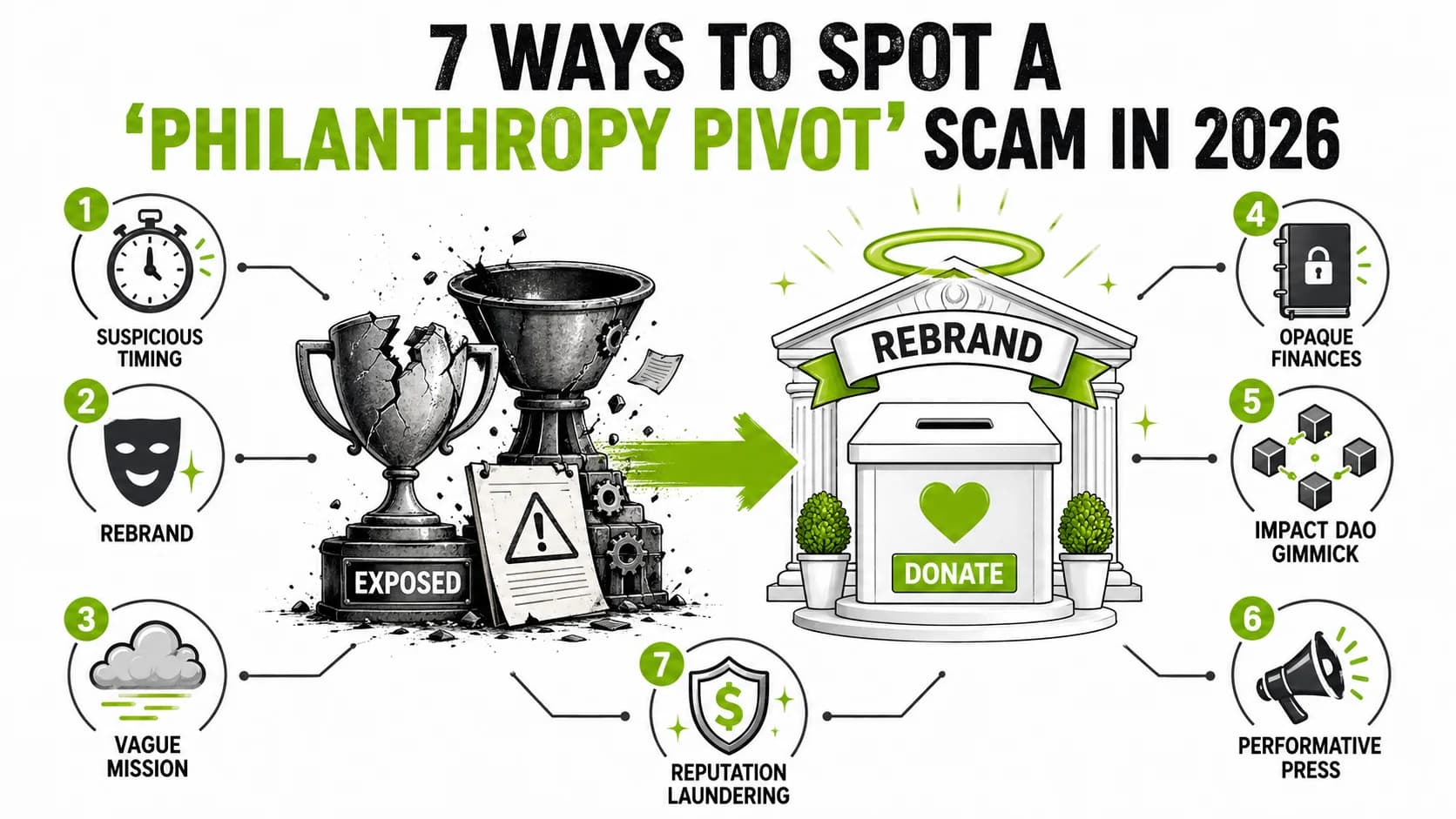
The digital graveyard of 2025’s fallen gurus is a crowded place. Their AI-powered courses have been debunked, their revenue screenshots exposed as Photoshop masterpieces, and their "7-figure funnels" revealed as elaborate Ponzi schemes. But in the startup ecosystem, death is rarely permanent—it’s just a prelude to a rebrand.
Enter 2026’s most insidious trend: the Philanthropy Pivot.
Following a wave of damning exposés in early 2026, a curious pattern emerged. Disgraced founders and gurus, facing total reputational ruin, didn’t slink away. Instead, they announced a sudden, profound awakening. Overnight, profit-driven "visionaries" transformed into altruistic "impact leaders," launching vague charities, "regenerative" funds, or blockchain-based "Impact DAOs." The timing was always impeccable: the charity announcement dropped precisely 72 hours after the fraud allegations hit TechCrunch.
This isn't generosity; it's reputation laundering. It’s a cynical play to cloak past sins in the virtuous fabric of social good, using performative altruism to scrub search results and solicit fresh capital from a new, morally-conscious audience. Your donations aren't planting trees; they're funding a PR campaign.
To navigate this new landscape of cynical rebrands, you need a sharper lens. Here are the 7 definitive ways to spot a Philanthropy Pivot scam before you become an unwilling participant in a guru’s redemption arc.
1. The "Sudden Sainthood" Timeline
The most glaring red flag is the timeline. Authentic philanthropy is typically a gradual evolution, a thread woven through a person’s or company’s history. The pivot scam is a jarring, context-free 180-degree turn.
How to Spot It:
- The Crisis-Charity Correlation: Map their public announcements. Is the launch of the "Ocean Cleanup DAO" directly preceded by headlines about their failed, polluting manufacturing startup? The tighter the correlation between scandal and charity, the higher the cynicism.
- Zero Precedent: Scour their past content, interviews, and business practices. Was "giving back" ever a mentioned value before the pivot? If their entire digital footprint screams "hyper-capitalist extraction" until last Tuesday, the sainthood is likely synthetic.
- The Language Shift: Listen to the vocabulary. An authentic pivot might retain some core identity. A scam pivot involves a complete personality transplant—yesterday’s "crushing it" bro-speak is replaced overnight with buzzwords like "stewardship," "legacy," and "healing the planet."
The Due Diligence Move: Create a simple timeline. List their key business milestones and controversies in one column. In another, list their public statements about ethics, community, or charity. If the second column is empty until a crisis hits, you’re witnessing a tactical retreat, not a transformation.
2. The Vaguely Virtuous Mission Statement
Real charities have specific, measurable goals: "Provide 100,000 malaria bed nets in Region X by 2025," or "Fund STEM scholarships for 50 young women from City Y." Philanthropy Pivot operations thrive on beautiful, meaningless vagueness.
How to Spot It:
- Buzzword Bingo: Their mission will be a soup of high-impact, low-accountability terms. "Leveraging Web3 to create regenerative futures and uplift global consciousness." "Building equitable ecosystems for planetary healing." It sounds profound but commits to nothing.
- The "Everything Problem": They aim to solve "education," "poverty," or "climate change" as monolithic wholes, rather than tackling a defined, addressable piece of the puzzle. This grandiosity is a feature, not a bug—it’s impossible to hold them accountable for failing to solve "climate change."
The Due Diligence Move: Ask the "How?" question relentlessly. If the mission is "to empower creators," ask: How? Through grants, education, tool access? Who selects them? What are the criteria? What is the budget? Vague missions evaporate under specific scrutiny.
3. Opaque Structure & The "DAO Dodge"
To avoid legal accountability and traditional oversight, pivot scammers love obscure legal and technical structures. The favorite vehicle of 2026 is the Decentralized Autonomous Organization (DAO).
How to Spot It:
- Charity as a Crypto Project: The "charity" is primarily promoted as an opportunity to buy a token. The whitepaper talks more about token utility, staking rewards, and "value accrual" than about the social impact. The roadmap features exchange listings before school builds.
- The Accountability Void: They’ll say, "It’s a DAO, so the community decides everything!" This is a dodge. In practice, the founder or a small inner circle controls the multi-signature wallet or the voting power. There are no bylaws, no board of directors, and no way to audit spending.
- Shell Foundations: In traditional finance, it might be a complex network of LLCs and non-profits based in offshore jurisdictions, making financial flows impossible to trace. The money disappears into a corporate labyrinth.
The Due Diligence Move: Demand clarity on structure. Is it a registered 501(c)(3)? Where can you find its EIN and public tax filings (Form 990)? If it’s a DAO, who holds the private keys to the treasury? How are spending proposals made and voted on? Legitimate entities are not afraid of these questions.
4. Impact Theater Over Tangible Results
For the philanthropy pivoter, perception is the impact. The goal is to generate content that looks altruistic, not to create verifiable change.
How to Spot It:
- The Photo-Op Philanthropy: The entirety of their "impact" is documented in highly-produced video reels and photos. They are always the hero in the frame—handing a single check on a stage, posing with children in a village (often without consent), planting a single tree. The activity ends when the camera stops rolling.
- Metrics That Don’t Matter: They report on "awareness reached" (social media impressions), "community members" (Discord joiners), or "funds deployed" (money moved to another one of their wallets), not on outcomes. You’ll never see a third-party audit, beneficiary testimonials, or longitudinal studies.
The Due Diligence Move: Look for evidence of work that exists independently of the founder’s personal brand. Are there updates from field partners? Annual reports with audited financials? Can you find beneficiaries talking about the project on their own channels? Real impact creates its own paper trail.
5. The Funding Loop of Life (Your Money Feeds the Machine)
This is the core engine of the scam. The "charity" is not an end; it’s a new funnel. Its primary purpose is to raise new money to fund the founder’s lifestyle, pay for legal defenses related to old scams, and finance the marketing of the charity itself.
How to Spot It:
- Sky-High "Operational Costs": If they report finances at all, you’ll see an enormous percentage of donations going to "marketing," "consulting fees" (paid to the founder’s other company), "travel," and "administrative expenses." Very little trickles down to the stated cause.
- The Donor-as-Customer Pipeline: The charity is a top-of-funnel lead generator. Donors are immediately added to email sequences pitching premium "impact investor" circles, masterminds on "conscious capitalism," or token presales for the next big thing. Your goodwill is monetized.
- Recycling Old Audiences: The initial "funding round" for the charity comes from the same community that was burned by the founder’s last venture. The pitch is emotional: "Help me make things right. This time it’s for good." It’s a loyalty test that extracts guilt-based funding.
The Due Diligence Move: Apply the "Overhead Myth" test wisely. While legitimate charities need to spend on operations, be deeply suspicious of where it goes. Are they renting a WeWork in Bali for "the team"? Is the founder taking a "modest stipend" that happens to be $500k per year? Use tools like Charity Navigator (for U.S. non-profits) or demand transparent, itemized blockchain ledgers for DAOs.
6. The Weaponization of "Negativity" and "Healing"
This is the manipulative masterstroke. The pivot scammer preemptively frames any skepticism as a moral failing on your part.
How to Spot It:
- The "Why So Negative?" Gambit: When asked tough questions, they respond with wounded idealism. "Why are you attacking a force for good?" "We’re just trying to help people. Your cynicism is what’s wrong with the world." They position themselves on the moral high ground and paint due diligence as toxicity.
- Community Policing: Their loyal followers, invested in the redemption story, will aggressively attack skeptics. Asking "What’s the charity’s EIN?" gets you labeled a "hater" or "agent of the old paradigm."
The Due Diligence Move: Separate the person from the project. You can wish someone well on their personal journey while still demanding concrete answers about the entity they’re asking you to fund. Legitimate impact leaders welcome smart questions as a way to improve. As we detail in our broader guide, The 2026 Guide to Spotting Fake Gurus & Your Alternatives to Getting Scammed, emotional manipulation is a cornerstone of the modern scam.
7. The Silent Sunset (The Planned Obsolescence)
The Philanthropy Pivot is not designed to last. It’s a bridge. Once it has served its primary purposes—diluting search results, generating fresh capital, and rebuilding a "thought leader" platform—it will be quietly sunsetted.
How to Spot It:
- The Gradual Fade: Updates become less frequent. The ambitious goals from Year 1 are quietly forgotten. The "global initiative" narrows to a single, stalled pilot project.
- Broken Promises on Autonomy: If it was a DAO, promises of transitioning to community control never materialize. The keys are never handed over. The project simply stagnates until the website expires.
The Due Diligence Move: Look for commitments to permanence. Do they have an endowment plan? A succession strategy? Are they building institutional knowledge, or is everything dependent on the founder’ charisma? A project designed for legacy thinks in decades, not news cycles.
Protecting Yourself in the Age of Performative Altruism
The Philanthropy Pivot is perhaps the most dangerous scam because it weaponizes our best instincts—our desire to help, to forgive, to be part of something meaningful. It turns virtue into a vulnerability.
The antidote is not cynicism, but rigorous discernment. Don’t listen to the story; examine the structure. Don’t admire the mission statement; audit the metrics. Your compassion is a resource—allocate it with the same diligence you would your financial capital.
The skills to deconstruct these elaborate ruses are no longer niche; they are essential literacy for anyone operating online. This is precisely why we built the toolkit at Larpable—to help you move from instinct to analysis. If you want to systematically develop your ability to see through not just charity scams but the full spectrum of modern entrepreneurial fakery, start by learning to Détecter les signes.
For a deeper dive into the specific mechanics and case studies of this 2026 trend, explore our companion analysis: The AI-Powered Founder's Philanthropy Pivot: How 2026's Exposed Gurus Are Laundering Their Reputations with Fake Charities.
And for a continuous stream of patterns, red flags, and satirical takes on startup culture, make sure to bookmark our Startup Hub.
FAQ: Philanthropy Pivot Scams
1. What's the difference between a genuine founder turning to philanthropy and a "pivot scam"?
A genuine transition is usually gradual, evidenced by long-standing personal values or integrated corporate social responsibility (CSR) that predates any crisis. The work is specific, structured, and often involves partnering with established NGOs. The focus is on the cause, not the founder's personal redemption narrative. A pivot scam is a sudden, reactive, and vague announcement following scandal, characterized by opaque structures, a focus on marketing the founder's new image, and a lack of tangible, verifiable outcomes.
2. Are all crypto or DAO-based charities scams?
No, but the decentralized and often unregulated nature of crypto makes it a fertile ground for scams. Legitimate crypto-philanthropy projects (like The Giving Block-facilitated charities) are transparent, use crypto as a donation tool, and partner with registered non-profits. Scam DAOs treat the charity itself as the crypto product, prioritizing tokenomics and speculation over measurable impact. Always check if there's a registered legal entity behind the DAO and how treasury funds are managed.
3. What are the most reliable sources to vet a charity?
- In the U.S.: The IRS Tax Exempt Organization Search (for EIN verification) and watchdog sites like Charity Navigator, GuideStar, and BBB Wise Giving Alliance, which rate charities on financial health, accountability, and transparency.
- Globally: Look for registration with the relevant national charity commission (e.g., Charity Commission for England and Wales). For any entity, demand their publicly filed annual reports and audited financial statements (Form 990 in the U.S.).
- For DAOs/Web3: This is trickier. Look for on-chain transparency of the treasury wallet (using a block explorer like Etherscan), clearly written governance documentation, and evidence of successful, community-voted grant disbursements to verifiable recipients.
4. A founder I follow just announced a big charity after some bad press. What are the first three things I should do?
5. Isn't it good that bad actors are at least trying to do good, even if for the wrong reasons?
This is a seductive but dangerous idea. "Impact washing" dilutes the meaning of real philanthropy, diverts crucial resources and attention from legitimate organizations, and ultimately erodes public trust in all charitable giving. Furthermore, it often directly monetizes and perpetuates the scammer's harmful network. Allowing reputational laundering incentivizes more fraud, not less. Consequences, not redemption arcs, are what deter bad behavior.
6. How can I support real social impact without getting scammed?
Support established, transparent organizations with long track records in the cause area you care about. Consider donating directly to local, community-based NGOs where your dollar goes further. If you're interested in innovative models, look for venture philanthropy funds or impact investors with transparent portfolios and measurable outcome frameworks. Always do your homework: give with your head as much as your heart.
<!-- sister-projects-start -->
Other Doved Studio projects
Related tools from the same studio you might find useful:
- Ralphable: Generate structured Claude Code skills that iterate until pass/fail criteria are met.
- Doved Studio: Studio indie derrière cette app et une dizaine d'autres outils.
<!-- sister-projects-end -->