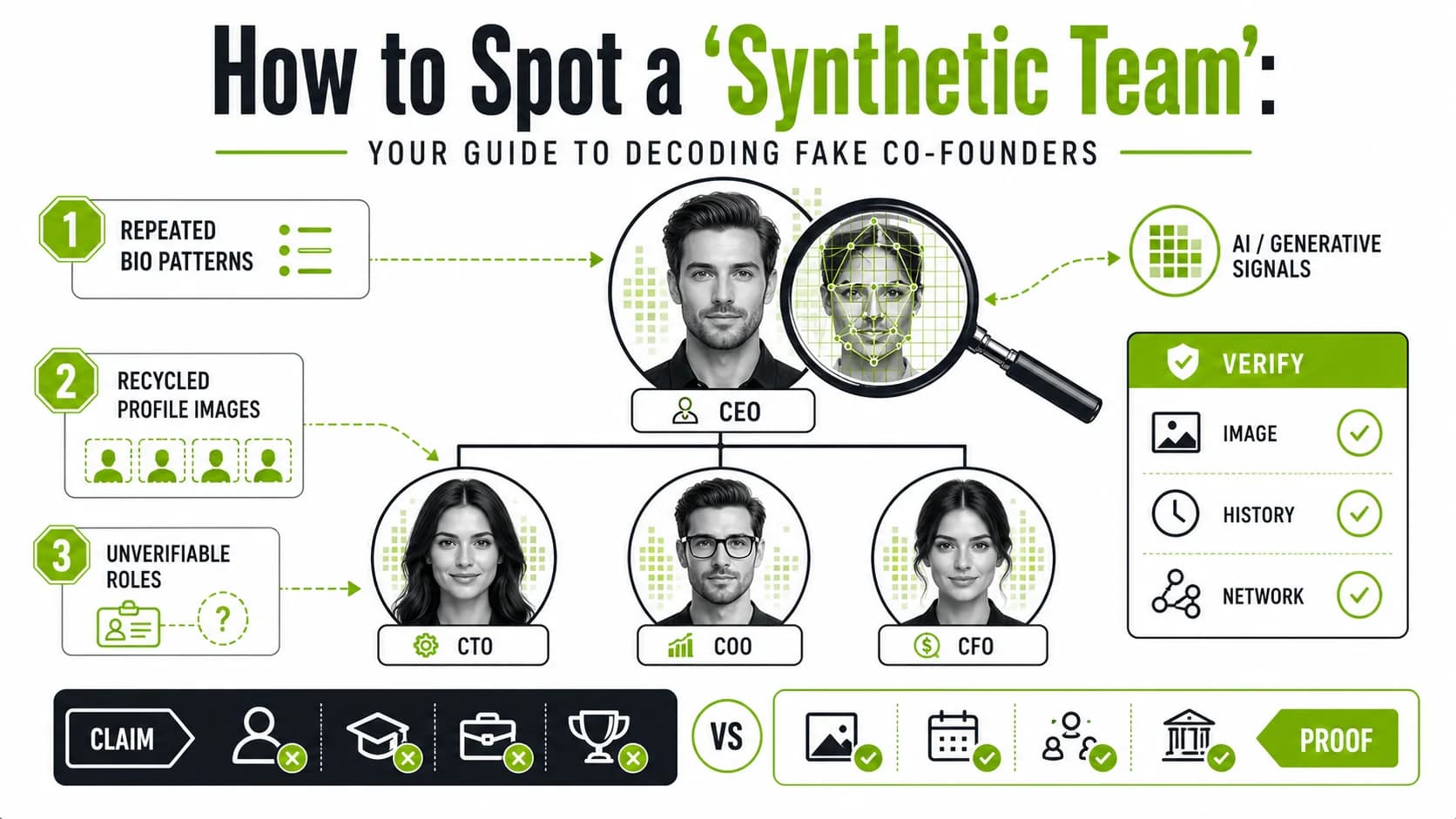
Remember when a solo founder with a suspiciously perfect LinkedIn profile was the biggest red flag? That was amateur hour. The game has leveled up. The most sophisticated scams now feature entire fabricated crews—phantom CTOs, ghost marketing leads, and fake co-founders who exist only as pixels and prompts. A synthetic team is the latest evolution of entrepreneur larping. It’s about creating a believable ecosystem of fake professionals to lend legitimacy and absorb scrutiny. This guide will dissect their anatomy, reveal the tells, and give you a practical toolkit for verification.
This shift exploits our trust in groups. A team implies collaboration and shared risk. For investors, it's a powerful social proof signal. Now, that signal is being counterfeited systematically. We'll walk through how to spot these fabrications, from visual forensics to narrative stress tests, to protect yourself in the current landscape of startup scam detection.
What Exactly Is a Synthetic Team?
A synthetic team is a collection of fictional professional identities created to support a deceptive business narrative. These personas have names, AI-generated headshots, fabricated resumes, and shallow digital footprints. The goal is to mimic a functioning, multi-disciplinary team capable of executing a complex vision, thereby securing investment, partnerships, or customers under false pretenses.
The concept builds on the simpler synthetic founder. As due diligence for spotting lone fakes improved, scammers adapted by creating safety in numbers. A team allows for specialization—a "CTO" for tech depth, a "CMO" for growth hype—making the venture appear more credible than the lone, often non-technical, real founder behind it could alone. It’s a confidence game scaled for the digital age.
The Building Blocks of a Fabricated Crew
A synthetic team follows a strategic blueprint designed to pass a casual glance. It's a cast of characters, each with a role.
- The Anchor: The one real person. They are the public face who does video calls and handles money. Their profile is often the most polished, acting as the "proof" that legitimizes the others.
- The Specialist Phantom: This AI-generated persona fills a critical expertise gap. For a non-technical founder, the "CTO" is essential. This profile will have a jargon-filled bio, a GitHub with forked repos, and employment history at large firms where verification is hard.
- The Supportive Ghost: These are "early employees" in less-scrutinized roles like Head of Design. They add headcount and run social media accounts, but their bios lack depth and personal history.
- The Network of Echoes: Sometimes, fabrication extends to fake client testimonials, advisor profiles, or synthetic "investor" entities. This creates a closed loop of references that all point back to each other, simulating external validation.
| Characteristic | Solo Synthetic Founder | Synthetic Team |
|---|---|---|
| Primary Risk | Profile inconsistency. | Interpersonal inconsistency, unnatural group dynamics. |
| Digital Footprint | One deep, possibly inconsistent profile. | Multiple shallow, overly consistent, recently created profiles. |
| Social Proof | Relies on solo achievements. | Leverages the illusion of collaboration. |
| Failure Point | A single deep-dive background check. | A request for a spontaneous, multi-person video call. |
| Common Use Case | Quick grifts. | Larger investment rounds, complex tech ventures. |
This isn't theoretical. A March 2026 TechCrunch investigation detailed "SynthLabs," a startup that raised $2.5M based on a team of five where three were fabrications, with headshots traced to an AI generator and resumes plagiarized from real professionals. The tools are cheap and accessible. A 2025 Stanford Internet Observatory report noted the cost of generating a plausible digital identity dropped nearly 90% since 2022 due to generative AI.
Why Synthetic Teams Are a Bigger Problem Than You Think
You might think you're too smart to be fooled. These scams aren't designed to survive deep diligence; they're built to get past initial gates—to secure the first meeting and build momentum so red flags get rationalized away. The damage extends beyond lost cash.
They Erode Trust Across the Ecosystem
Every successful synthetic team operation makes genuine, early-stage startups look suspicious. It forces investors to spend more on background checks, hurting bootstrapping founders. It makes customers wary. This climate of suspicion is a tax on innovation, paid by the honest players. When you doubt if a mentor is real, the foundation of knowledge-sharing cracks.
They Enable Larger, More Damaging Scams
A solo founder has a credibility ceiling. A synthetic team smashes through it. It allows pitches for larger enterprise contracts and bigger investment rounds because the story includes the "manpower" to deliver. The 2026 "DevOps.ai" scandal, where a $15M Series A was secured based on a team of eight (only two real), showed how synthetic teams unlock larger frauds. This is startup scam detection at its most critical.
They Create Legal and Ethical Nightmares
What happens when a synthetic "employee" is on legal documents? Liability becomes a tangled mess. The identities used are often composites of real people's work histories, leading to identity confusion and harm to innocent professionals. This is industrial-scale identity theft. Data from the U.S. Federal Trade Commission shows a 300% year-over-year increase in reports of business scams involving fabricated team members since 2024. This is a mainstream threat.
How to Spot a Synthetic Team: A Step-by-Step Investigation Guide
Spotting a synthetic team requires connecting dots, not just checking boxes. You're evaluating the story of their collaboration. These methods move from quick public checks to involved investigations.
Step 1: The Visual Forensics Check
Humans are terrible at spotting AI-generated faces, but tools are not. This is your first line of defense.
Start with a reverse image search on every headshot. Use Google Lens or TinEye. Right-click on each team photo. You're looking for three results: a hit on a stock photo site, the same photo linked to different names, or a flag from an AI detection tool like Hive Moderation. I once found a "CTO's" photo on a Slovakian stock image site selling "generic businessman #4." Look for the "uniform" effect—if all photos look like they came from the same AI photoshoot, be suspicious. Real early-stage team photos are often casual and inconsistent. Zoom in. Do eyes have realistic light reflections? Are earlobes symmetrical? Multiple visual oddities add up.
Step 2: The Digital Timeline Audit
A synthetic persona has a birth date. Your job is to find it. Check LinkedIn profile URLs; long ID strings are older. New profiles (under 6-12 months) for all "key team members" of an old project is a red flag. Scrolling through a profile's activity section often reveals a "content void." Real professionals leave a digital paper trail of thoughts, shares, and interactions spanning years. A synthetic profile's content starts abruptly and relates only to the current venture. No old opinions, no personal asides. Check cross-platform sync. Does the "CTO" have a GitHub? If it exists but has no meaningful commits or a history created last month, that's a tell. Real developers have messy, iterative commit histories. This principle of looking for the unnatural absence of a past is key.
Step 3: The Narrative Stress Test
Move from auditing profiles to auditing the team's story. The fiction cracks under logical pressure. Ask the anchor founder, "How did you and [Co-Founder X] meet?" The story should be specific and personal. "We met at a hackathon at Stanford in 2023" beats "We connected online through a shared vision." Independently ask the same question to another purported team member. Do the stories match? In a synthetic team, backstories are often vague or conflicting. Scrutinize claimed work histories. If two members overlapped at a past company, ask a casual question about it. Fabricators create impressive individual histories but forget to weave a believable shared past. The most effective test: request a low-stakes, multi-person video call. Propose an informal chat to get the whole team's perspective. The operator will almost always deflect with excuses about travel or deep work. A real, passionate early-stage team usually jumps at the chance.
Step 4: The Technical & Corroborative Deep Dive
For roles claiming specific credentials, verify them. If a fake co-founder claims a degree, a quick email to the university's alumni verification office can confirm it. For a large investment, this is warranted. If the "CTO" is listed as an inventor on patents, search the USPTO database. Use your network. If they claim a past job, can anyone you know who worked there confirm it? LinkedIn's "How You're Connected" feature can show a path for a discreet inquiry. The goal isn't 100% certainty on every point but to build a composite picture. One yellow flag might be an anomaly. Three or four form a pattern. For more on the ecosystem that breeds this, see our analysis on the performative decay of startup culture.
Advanced Strategies: Putting Your Detection Skills to Work
Once you know the basics, develop proactive strategies. Move from playing defense to establishing a strong offense against AI-generated persona scams.
Build a Standardized Diligence Protocol
Don't reinvent the wheel. Create a simple checklist template. This forces consistency. Your protocol should include: visual forensics for all key members, notes on profile ages, the "How did you meet?" question, records of requests for group interaction, and a section for verifying one key credential per core technical role. Having this protocol signals you take verification seriously, raising the barrier for scammers. This systematic approach is what separates those who occasionally spot a fake from those who have integrated pattern-detection into their mindset.
Leverage the Network Effect
The entrepreneur and investor community is the best immune system. In trusted circles, share anonymized red flags. "Heads up, seeing a new pattern where all co-founder LinkedIn profiles were created in the last 4 months" is valuable intelligence. Normalize direct verification. Make it standard to say, "We verify major employment history. Can you provide a contact for verification or sign a consent form?" A legitimate founder will understand. A fraudster will evaporate. This directness cuts through the ghost before it does damage.
Focus on Outputs, Not Just Bios
A real team builds real things. Shift evaluation energy from their claimed credentials to their work. For a technical product, request access to a development sandbox. Ask nuanced questions about architecture trade-offs. A real CTO will explain details; a phantom will give vague answers. Ask for the "before" version—early wireframes or commit history from months ago. Fabricators create a polished "now" but struggle to fake a believable, messy "then." Talk to early users you find yourself. Ask if they've interacted with support. The texture of real interactions is impossible to fake at scale.
Frequently Asked Questions About Synthetic Teams
How common are synthetic teams really?
Exact numbers are elusive, but all indicators point to a rapid increase. Law firms in venture capital report a significant uptick in identity fraud cases over the past 18 months. Regulatory bodies like the FTC have issued specific warnings. It's a regular occurrence in due diligence, especially for deals sourced through digital channels like Twitter DMs. The Stanford Internet Observatory report from 2025 frames this as part of a broader "digital identity crisis."
What's the single biggest mistake people make when evaluating a team?
They confuse activity for authenticity. A team with slick LinkedIn profiles and active Twitter accounts looks legitimate. People stop there. The mistake is not digging deeper to check the provenance of that activity—where the photos came from, when the profiles were born. Authenticity is messy; fabrication is often suspiciously clean. It’s a core principle in our guide to detecting narrative laundering.
Can a synthetic team ever include a real person?
Absolutely, and this is the most dangerous configuration. Often, one or two real individuals orchestrate the scheme, populating their company with fabricated specialists to fill credibility gaps. The real person acts as a shield, making the operation seem plausible. The due diligence challenge becomes isolating and verifying each claimed team member, not just the one you met.
Should I publicly call out a company I suspect has a synthetic team?
Be extremely careful. Publicly accusing a specific company of fraud without ironclad evidence can lead to defamation lawsuits. The safer route is to conduct private diligence, share generalized red flags with your network (without naming names), and walk away. If you have concrete proof, consider reporting it to authorities like the SEC or FTC rather than starting a public feud. The FTC's page on investment scams details how to file a report.
The Bottom Line on Synthetic Teams
The synthetic team is the logical endpoint of a world where every signal of credibility can be manufactured. It’s not a future problem; it’s a present reality. Your defense is a blend of skepticism, technology, and old-fashioned verification. Use the tools—reverse image searches, timeline audits, narrative tests. Trust the network effect by sharing patterns. Most importantly, value tangible output over polished biography. The cost of falling for a well-crafted fiction is more than money; it's the erosion of trust that the entire startup ecosystem relies on. Stay vigilant, verify relentlessly, and remember: if a team seems too perfectly cast for their roles, they probably are.
Larpable - Detect or Create helps you move beyond gut feelings and build a systematic defense against the latest deception tactics. From synthetic founders to entire fabricated teams, we provide the tools and frameworks to separate the real builders from the expert larpers. Stop wondering and start verifying. Learn to Detect
<!-- sister-projects-start -->
Other Doved Studio projects
Related tools from the same studio you might find useful:
- Ralphable: Generate structured Claude Code skills that iterate until pass/fail criteria are met.
- Doved Studio: Studio indie derrière cette app et une dizaine d'autres outils.
<!-- sister-projects-end -->