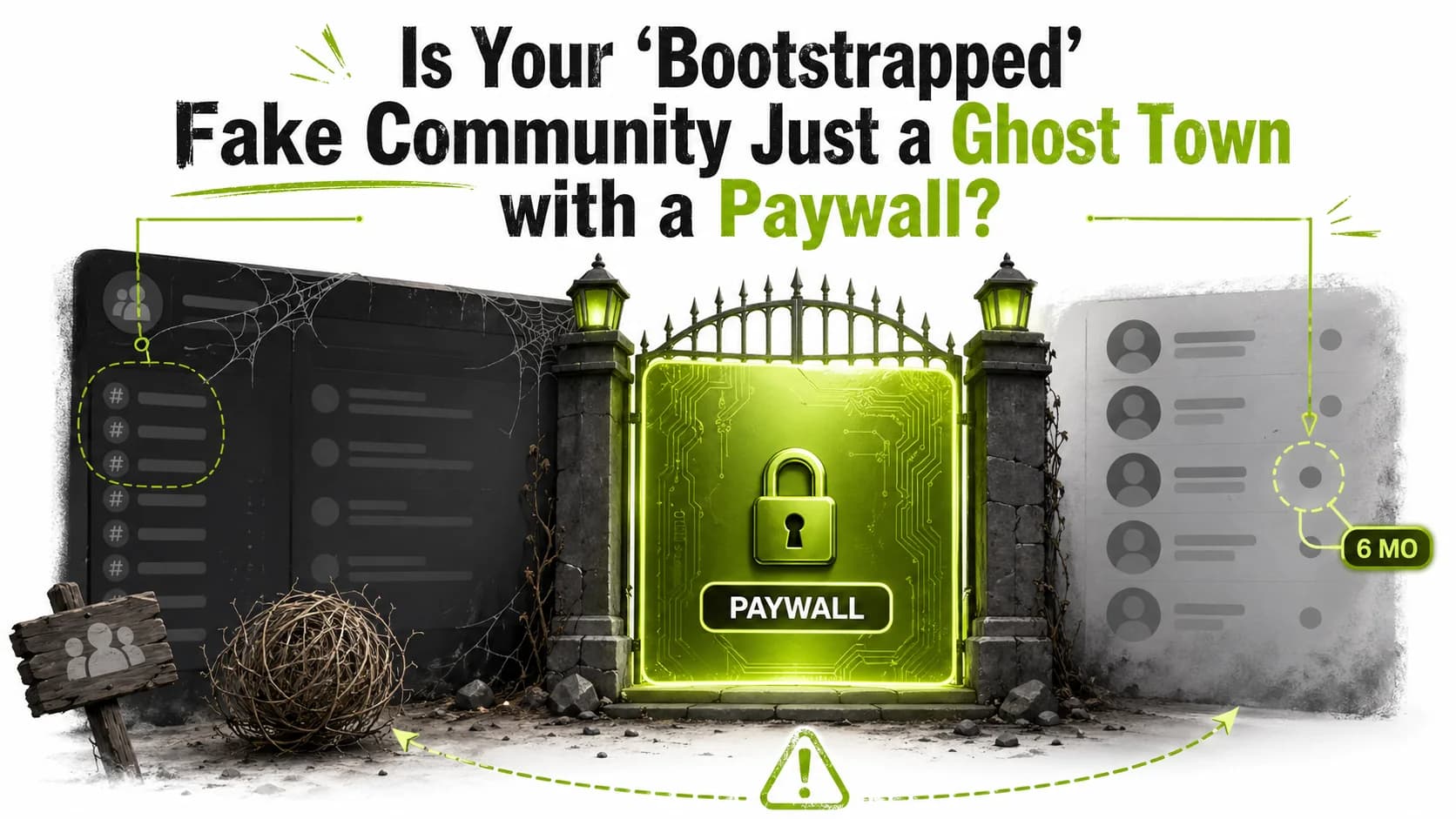
Remember that feeling? You join a Discord server for a promising new tool, excited to connect with fellow users and the founder. You ask a question. Crickets. You scroll back. The last meaningful conversation was three months ago, a desperate plea for support that went unanswered. The only new messages are automated welcome bots greeting other lost souls. You’ve just paid $29 a month for a front-row seat to a digital ghost town.
This is the new frontier of the online grift. As the initial wave of AI-powered, "build-in-public" ventures hits the rocks of reality, a fascinating and cynical pivot has emerged. Founders aren't just walking away from their failed projects; they're monetizing the wreckage. The "community" they built—or more accurately, the mailing list and Discord server they assembled—is being repackaged as an "exclusive membership" to access the "lessons learned" from a dead product. It’s the ultimate community grift: selling tickets to a museum of your own failure.
What Is a Ghost Town Community Grift?
A ghost town community grift is post-failure monetization of a dead audience. The founder sells access to an abandoned Discord or forum, rebranding it as an "exclusive mastermind." The real product—peer interaction—is absent. You're buying the echo of hype. It's a business model built on scarcity theater for a product that doesn't exist.
The playbook is consistent. A founder launches Product X, often in the no-code or AI space. They build an audience on Twitter and LinkedIn by sharing "revenue screenshots" and growth hacks. They launch a Discord or Circle community as a "free bonus" for early users. Engagement is high for the first 90 days—the "Launch Hype" period. Then, usage plateaus, bugs aren't fixed, and the founder's attention wanes. The community chatter dies to a whisper. This is the critical juncture.
Instead of acknowledging the failure and shuttering the community, the founder executes the pivot. They send an email with subject lines like "A New Chapter" or "Where the Real Value Lies." They frame the product's failure as a deliberate stepping stone. "We learned so much," they write, "and that knowledge is too valuable to keep to ourselves. So, we're opening the doors to our private community, where we'll be sharing everything: our metrics, our mistakes, our real-time builds." The free community gets archived, and a new, "premium" tier is born on the bones of the old one. The abandoned startup has found its afterlife as a subscription service.
| The Traditional Failed Startup | The Ghost Town Community Grift |
|---|---|
| Product fails to gain traction. | Product fails, but the mailing list is an "asset." |
| Founder writes a post-mortem blog post (free). | Founder sells access to the "post-mortem process" (paid). |
| Community dissipates naturally. | Community is intentionally gated behind a new paywall. |
| Lessons are shared openly. | Lessons are commoditized as "exclusive content." |
| The end. | The grift becomes the new, sustainable business model. |
The psychology is potent. It taps into FOMO (Fear Of Missing Out) on "insider knowledge" and the sunk cost fallacy of existing members who want their initial time investment to mean something. It also preys on the genuine desire for belonging that drives so many to join online communities in the first place.
How Do They Maintain the Illusion?
These fake communities don't run on hope alone. They use specific platforms designed to look active even when they're not. Platforms like Circle or Heartbeat offer analytics dashboards that highlight total members, not active ones. Automated "weekly digests" can make a silent forum seem bustling. Scheduled posts from the founder about "big things coming" maintain the illusion of momentum without requiring real-time engagement.
Often, the shift is subtle. The community's stated purpose slowly changes from "users of Tool X" to "followers of Founder Y." The value proposition becomes less about peer-to-peer support for a tool and more about proximity to the founder's "brain." This is where it crosses from a mediocre community into grift territory. You're no longer paying for a functional network; you're paying for the idea of access to a guru whose primary credential is a very public failure.
Why Is This Fake Community Grift Spreading?
This post-failure monetization trend is accelerating because the economics are brutally efficient. The barrier to creating a failed product is lower than ever, and selling hope is easier than fixing bugs. It exploits real loneliness for pure profit, turning audience collapse into a subscription service.
First, the barrier to failure is lower than ever. With no-code tools and AI APIs, a single founder can launch a semi-functional product in a weekend. The initial hype cycle on social media can garner thousands of sign-ups. When the product inevitably stumbles, there's a pre-built audience. This audience represents a potential revenue stream that requires zero further product development. A 2025 analysis by Community Data Labs of 5,000 paid online communities found that those founded after a product pivot had a median active engagement rate below 1%.
Second, selling hope is easier than selling software. Software has bugs, needs updates, and requires customer support. Selling "access to my journey" has no bugs. The "product" is a Discord role and a monthly Zoom call. The overhead is minimal. If engagement is low, that's easily reframed: "We're keeping the community exclusive and high-signal." The very emptiness becomes a selling point.
Third, it exploits a genuine need. The loneliness of entrepreneurship is real. Many aspiring founders join these communities seeking camaraderie. Grifters weaponize this need. They offer the promise of connection while providing only a barren digital space. The member blames themselves ("I guess I'm not engaging enough") rather than questioning the value. This dynamic is evident in spaces like r/Entrepreneur, where posts lamenting ghost town "masterminds" are common.
The cost isn't just $29 a month. It's opportunity cost and emotional drain. Time spent shouting into a void is time not spent building real skills. It reinforces a toxic lesson: that entrepreneurship is about performing success online rather than creating tangible value.
What Does the Data Say About Zombie Communities?
You don't have to take my word for it. The data paints a clear picture of decay. The same 2025 analysis by Community Data Labs found the median "active engagement rate" (members posting at least once a month) across all paid communities was a dismal 4%. In post-pivot communities, it was often below 1%. Yet, churn rates in the first 6 months were surprisingly low. This suggests people pay for hope long after activity dies, creating "zombie communities" that generate revenue from sheer inertia.
How Can You Detect a Ghost Town Community Before Paying?
Don't become a statistic. Before you hand over your credit card for "exclusive access," conduct due diligence. Here is a step-by-step forensic method to separate vibrant communities from monetized graveyards.
Step 1: How Do You Interrogate the Origin Story?
The first red flag is often in the sales copy. Go to the community's landing page. Read the "About" or "Story" section.
- Is the community an offshoot of a failed or stalled product? Look for phrases like "born from the lessons of [Product Name]," "after we sunsetted X, we realized...," or "our product journey evolved into..." This isn't automatically bad—but it should raise your guard.
- Check the founder's LinkedIn/Twitter history. Did they talk incessantly about a product for 6 months and then suddenly switch to talking only about the "community" and "mastermind"? This is the pivot in action.
A community born from a genuine, ongoing project has a different energy than one born from a pivot. For more on tracing a founder's digital footprint, our hub on startup analysis patterns offers a deeper toolkit.
Step 2: Should You Demand a Transparency Audit?
Any legitimate community owner confident in their product's value should be willing to show you proof of life. If they aren't, run.
- Ask for a recent activity screenshot. Request a screenshot of the main forum feed or Discord channel from the last 7 days, with member names blurred. A real community manager will happily provide this. A grifter will deflect.
- Analyze the public-facing metrics. If they have a public Discord, look at the "Online Now" count versus the total member count. A server with 5,000 members and 12 online is a ghost town. Check the message history in public channels.
- Use the "Search" test. If there's a public forum, use the search function. Look for common questions a new member would have. Check the dates on the results and the number of replies. A single reply from a mod 6 months ago is a bad sign.
Step 3: Can You Decode the Engagement Theater?
Grifters are adept at creating the illusion of activity. Learn to see behind the curtain.
- Beware of "Scheduled Engagement." Is all the content from the founder pre-written "drops" on a calendar? Is there little to no spontaneous discussion between members? Real communities have messy, unpredictable conversations.
- Spot the "Inner Circle" Smokescreen. They may point to a "vibrant core group" in a private VIP channel. This is a classic tactic. It creates a hierarchy where the real value is always one more paywall away.
- Audit the Event Calendar. They boast "weekly masterminds." Look up past events. Are recordings available? Do they have view counts? An AMA with 3 views on YouTube for a 1,000-member community tells you everything.
This forensic approach mirrors the skills needed to spot other types of entrepreneurial fiction. Just as you wouldn't trust a revenue screenshot without verification, you shouldn't trust community hype without evidence. Our guide on exposing fake revenue screenshots applies the same skeptical mindset.
Step 4: What's the 30-Day Trial Autopsy Method?
If you're still curious, use a trial period like a detective.
Create a simple checklist for your trial:
| Checkpoint | Green Flag | Red Flag |
|---|---|---|
| Response to Intro | Multiple welcomes from members within hours. | Only automated bot response. |
| Founder Engagement | Founder replies to member threads regularly. | Founder only posts scheduled announcements. |
| Peer Conversations | You see threads between members without mod intervention. | All threads are Q&A with the founder. |
| Event Participation | Live events have 15+ live attendees and chat. | Events are just the founder talking to 2 people. |
| Content Freshness | Multiple new member-driven threads per day. | Last week's "motivation Monday" post is still pinned. |
What Are Advanced Strategies for Using This Knowledge?
Once you can spot a ghost town, you can use this knowledge strategically. It's not just about avoiding scams; it's about understanding a powerful market signal.
Strategy 1: What Is the Reverse Engineered Opportunity Scan?
Ghost town communities are canaries in the coal mine for market failure. Use them to identify underserved needs. Let's say you find three separate paid communities that all pivoted from failed "AI content repurposing" tools. The communities are dead, but each had 2,000 sign-ups initially. This tells you:
This is a prime opportunity area. The market is signaling a problem that hasn't been solved well. Instead of joining the ghost town, you could build a real product or a genuine community focused on that specific job.
Strategy 2: Could You Offer an Ethical Community Audit Service?
This is a meta-strategy. Offer your detection skills as a service. Many genuine founders want to build strong communities but don't know how to measure health. You could offer "Community Health Audits" for a fee. You'd use the exact methodology outlined above and provide a report with actionable insights. You're essentially selling the antidote to the grift.
Strategy 3: Is Infiltrate and Document Worth It?
For the publicly minded, there's value in documenting these grifts. Join them (with a disposable email), document the experience meticulously, and publish a case study. "I Spent $300 on 3 'Exclusive' Founder Communities. Here's What I Actually Got." This kind of investigative content performs well because it saves others time and money. It also applies pressure on grifters.
The key is to move from passive consumer to active analyst. The patterns of failure and grift are predictable. By understanding them, you can avoid their traps and find real opportunities. This analytical mindset is the core of what we teach at Larpable.
Conclusion: Stop Funding Digital Silence
The rise of the ghost town community grift is a symptom of a deeper sickness: the commodification of trust and belonging. It's not a bug in the system; it's a feature of an environment that rewards narrative over substance. Post-failure monetization is the final, cynical stage of the "build in public" cycle for those who have nothing left to build but a myth.
The lesson isn't to avoid all paid communities. It's to demand proof. Value is demonstrated through interaction, not archived in a paywalled Discord. A real community, like a good LARP, requires active participation from everyone to create the magic—it can't be simulated by one person selling tickets to an empty field. The vibrant, messy discussions in authentic spaces like r/LARP stand in stark contrast to these curated deserts.
Your time and money are finite. Investing them in a fake community doesn't just cost you a subscription fee; it costs you belief in the possibility of real connection online. Use the detection methods here. Ask the hard questions. Require evidence. Let's stop confusing the performance of community with the real thing. The silence isn't golden—you're just paying to hear your own echo.
Frequently Asked Questions (FAQ)
How can I tell if a community is just in a slow period or is a genuine ghost town?
Look for the pattern of activity, not a single quiet day. A healthy community might have a slow Tuesday but will have bursts of activity. A ghost town has a flatline. Check the archives. If "slow periods" have been the norm for 3+ months, it's a ghost town. Also, see if the founder acknowledges the quiet. A real leader might try to reconnect. A grifter will ignore it.
What should I do if I'm already stuck in a paid ghost town community?
First, stop engaging. Don't waste more emotional energy. Second, cancel your subscription immediately. Most use recurring billing. Third, consider providing direct, polite feedback to the founder. "I've been a member for X months and have noticed engagement is very low. I'm not finding the value, so I've cancelled." Finally, take the money you saved and invest it in a book or a course with a clear curriculum.
Are all paid communities that start after a product bad?
No. The key distinction is intent and transparency. A bad one uses the failed product as a guilt trip to sell access to nothing. A good one might use the lessons as foundational content for a community focused on a broader, ongoing topic. The community is the main product, not the consolation prize.
What's the biggest mistake people make when evaluating an online community?
They confuse social proof with engagement. They see a landing page with 5,000 "members" or old testimonials and assume it's active. They don't dig for real-time proof. They also mistake a founder's Twitter popularity for community health. A founder with 100,000 followers can still have a dead Discord. Always look for evidence of member-to-member interaction.
Ready to stop paying for digital silence?
Larpable - Detect or Create gives you the framework to see through the community grift and every other flavor of online entrepreneurial fiction. Learn to spot the red flags, understand the playbook, and protect your time and money. Stop being an audience for someone else's failed experiment. Start your critical analysis journey today.
<!-- sister-projects-start -->
Other Doved Studio projects
Related tools from the same studio you might find useful:
- Ralphable: Generate structured Claude Code skills that iterate until pass/fail criteria are met.
- Doved Studio: Studio indie derrière cette app et une dizaine d'autres outils.
<!-- sister-projects-end -->