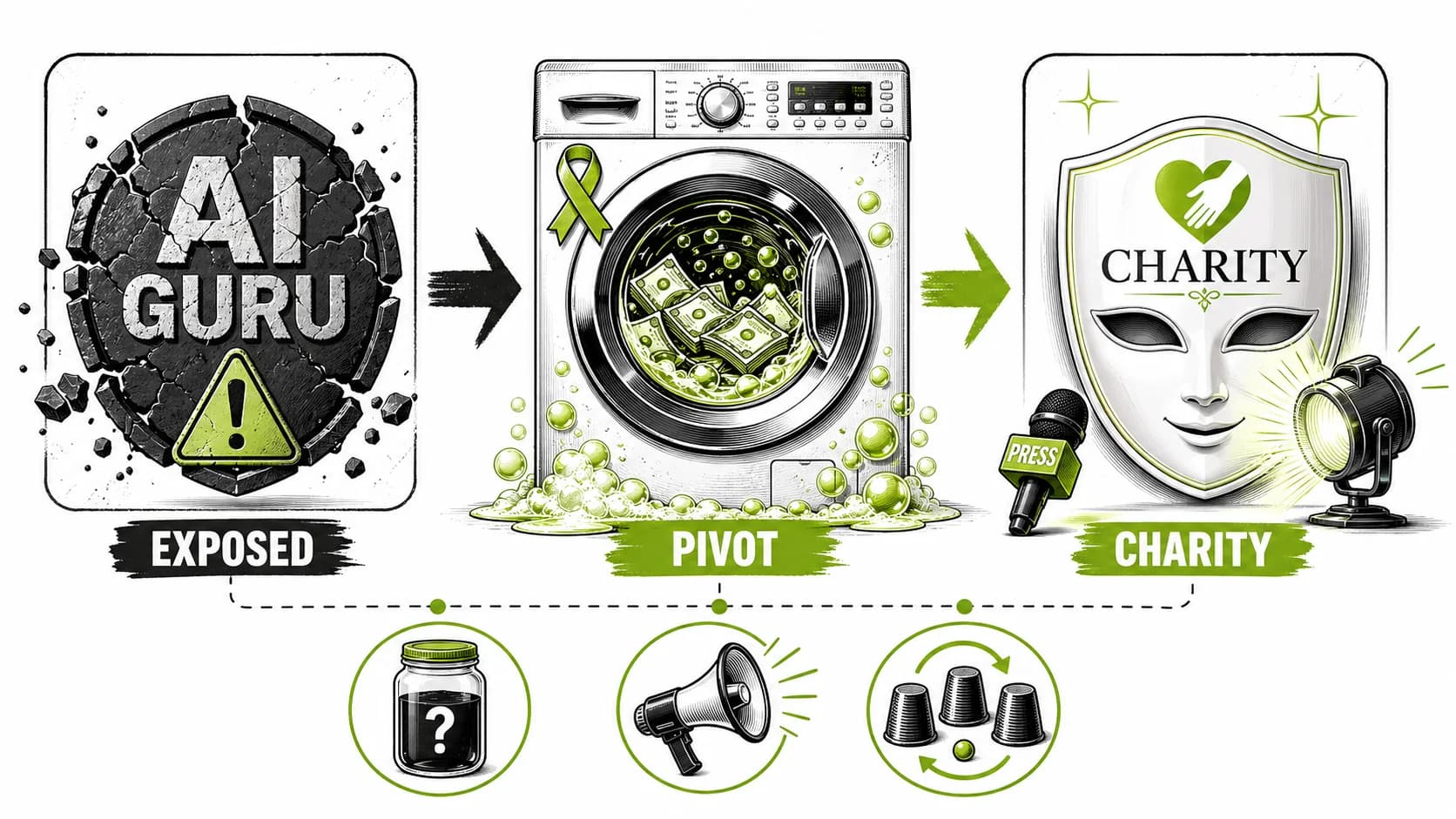
Remember when a founder's downfall meant slinking off to a private island to count their ill-gotten gains? How quaint. In 2026, the playbook has been rewritten. The modern disgraced "AI-preneur" doesn't hide; they rebrand. And their weapon of choice is no longer a dubious SaaS dashboard, but a splashy, media-friendly philanthropic initiative.
The script is now familiar: a wave of FTC crackdowns and deplatformings in late 2025 leaves a trail of exposed "gurus" with scorched-earth reputations and dwindling affiliate revenue. Then, like clockwork in early 2026, the headlines shift. TechCrunch, Forbes, and a chorus of LinkedIn influencers begin heralding the "redemptive journeys" of these same figures, now framed as "impact-driven philanthropists" launching charities for AI literacy, digital equity, or mental health.
This isn't altruism; it's reputation laundering. It's a calculated, cynical pivot designed to exploit our collective goodwill, secure positive press, and build a new, more resilient funnel—all while doing the bare minimum of actual good. Welcome to the era of "impact washing," where a charity is just a shell entity for a grift that never truly died. Let's dissect the playbook so you can spot the shell game before you're asked to open your wallet or your mind.
The Perfect Storm: Why Philanthropy is the 2026 Grift of Choice
To understand why every other exposed guru now has a .org domain, you need to see the market forces at play. It's a perfect storm of push and pull factors.
The Push: The Burning Platform of 2025
The traditional guru monetization playbook—selling overpriced courses, masterminds, and "done-for-you" services—became exponentially riskier. Regulatory bodies finally caught up. The FTC's Q4 2025 enforcement wave targeted false earnings claims and unsubstantiated "AI automation" promises, resulting in hefty fines and mandated refunds. Payment processors like Stripe and PayPal tightened their terms of service for "high-risk" coaching businesses. Social platforms, under pressure to clean up "get-rich-quick" misinformation, began demonetizing and shadow-banning prominent figures. The old revenue streams were drying up or becoming legally perilous.
The Pull: The Untarnished Halo of Philanthropy
Enter philanthropy. A charitable foundation offers a powerful suite of benefits for a reputation in tatters:
- Media Reset: Journalists are often more willing to cover a "founder gives back" story than another fraud allegation. It's a fresh, positive narrative.
- Credibility Laundering: Partnerships with legitimate (often unaware) nonprofits, universities, or community groups transfer their credibility to the disgraced founder.
- A New, Defensible Funnel: You can't easily sell a "How I Lied About My Revenue" course. But you can absolutely sell an "Impact Investor Mastermind" or a "Conscious Capitalism Summit" tied to your charitable brand. The audience is the same; the packaging is bulletproof.
As noted in a recent TechCrunch article on the trend, this "crypto-philanthropy" model (though now adopted by AI gurus) allows scandal-plagued founders to "pivot their narrative from profit-at-all-costs to purpose-driven leadership," often before any legal restitution is made to their original victims. Source: TechCrunch, "The Rise of Crypto-Philanthropy," 2025.
The Fake Philanthropy Playbook: A Step-by-Step Breakdown
The rollout follows a predictable, almost algorithmic pattern. Here's the six-step playbook every savvy observer should recognize.
Step 1: The Strategic "Fallow Period" & Victim Narrative
Immediately post-scandal, the guru goes quiet—but not too quiet. They post vague, reflective content about "lessons learned," "burnout," or "the toxicity of the online space." The goal is to reframe their exposure for fraud not as a consequence of their actions, but as a personal trial they endured. They transition from perpetrator to victim. This period builds a thin layer of "humility" necessary for the redemption arc.
Step 2: The "Life-Changing" Pilgrimage
Next, a catalyst. This is usually a well-documented trip to a developing country, a retreat, or a meeting with a real humanitarian (always photographed). The content shifts: "Seeing the real struggles in [Country] changed my entire perspective. I realized my pursuit of wealth was empty." This provides the emotional justification for the pivot. It's the origin story for their new philanthropic persona.
Step 3: Launching the Shell Entity
The charity is announced with high-production-value videos and press releases. The branding is impeccable: minimalist logos, aspirational language about "empowerment" and "access." Key things to scrutinize here:
- The Name: Often includes words like "Future," "Global," "Access," "Foundation," "Collective." It's broad and emotion-driven.
- The Structure: It's frequently a private foundation or a donor-advised fund (DAF), not a public charity. This allows for maximum control with minimal transparency. Financials are not required to be publicly disclosed in detail.
- The Mission: Vast and vaguely defined. "Bridging the AI divide," "Fighting digital poverty." It's hard to measure, and therefore hard to hold accountable.
Step 4: The "Proof of Concept" Event
A single, highly publicized event becomes the charity's entire proof of work. They might donate 50 laptops to a single school, host a one-day coding workshop, or plant 100 trees. This event is documented exhaustively across all social channels. Every photo, every thank-you from a beneficiary, is repurposed as content for years. This one event serves as the "see, we're legit!" response to all future skepticism. The cost is a tiny fraction of the marketing budget used to promote it.
Step 5: Monetizing the Mission
This is the core of the grift. The charity becomes the top of a new funnel:
Step 6: Aggressive Credibility Stacking
The founder now uses the charity to gain speaking slots at legitimate conferences (often on "ethical tech" or "social impact"), secure podcast interviews with well-meaning hosts, and co-brand content with actual experts. Each of these becomes a "trust signal" used to silence critics: "How can I be a scammer if I spoke at this university or partnered with that NGO?" It's a form of social proof arbitrage.
How to Spot a Reputation-Laundering Charity: The Larpable Detection Kit
Don't be fooled by the tear-jerking video montages. Here's your actionable toolkit to separate real impact from impact theater.
1. Follow the Money (The Transparency Test)
- Red Flag: No easily accessible, detailed financial audit on their website. Just a pie chart with huge slices for "Programs" with no breakdown.
- Green Flag: Full IRS Form 990 (for US orgs) publicly posted, showing clear line-item expenses, reasonable administrative costs (<15%), and salaries for key staff.
- Action: Search the charity's name + "Form 990" on ProPublica's Nonprofit Explorer or GuideStar. If it's a private foundation or DAF, expect near-zero transparency—a major warning sign.
2. Audit the "Impact" (The Metrics Test)
- Red Flag: Vague, emotional outcomes only. "Inspired 10,000 people," "raised awareness," "changed lives." No measurable, verifiable data.
- Green Flag: Specific, measurable, and time-bound goals. "Trained 250 teachers in X curriculum, resulting in a 40% pass rate increase on Y exam within one school year."
- Action: Ask: "What specific, quantifiable thing did you do, and how do you measure its effect?" If the answer is more storytelling, it's a marketing operation.
3. Examine the Founder's Timeline (The Motive Test)
- Red Flag: The charity was founded within 6-18 months of a major public scandal, regulatory action, or business collapse involving the founder.
- Action: Do a simple news search: "[Founder's Name] scandal 2024" or "[Founder's Name] FTC." The timeline tells the true story. Our guide on spotting fake gurus dives deeper into investigating a founder's history.
4. Scrutinize the Monetization Link (The Funnel Test)
- Red Flag: The charity's website, newsletter, or social media consistently promotes the founder's paid courses, masterminds, or consulting services. The "Donate" button is small; the "Apply for my $10k Mastermind" button is large and glowing.
- Green Flag: The charitable entity is operationally and financially separate from the founder's for-profit ventures. Any cross-promotion is minimal and clearly disclosed.
- Action: Look for the customer journey. Are you being gently guided from "learn about our mission" to "invest in yourself to change the world" (i.e., buy a course)? If so, the charity is a lead magnet.
5. Evaluate Governance (The Independence Test)
- Red Flag: The board of directors is comprised solely of the founder's spouse, best friend, and business partners. It's an echo chamber.
- Green Flag: An independent, diverse board with relevant expertise (in law, finance, the cause area) that has clear oversight powers.
- Action: Check the "Our Team" page. If it looks like a family reunion, the charity is a personal piggy bank, not a legitimate institution.
Mastering these detection skills is what we teach in our core path: Apprendre à Détecter. It's about building immunity to emotional manipulation.
The Real Cost: Why This Grift is Particularly Pernicious
This isn't a victimless crime. Fake philanthropy causes tangible harm:
- It Diverts Resources: Donations and attention flow to theatrical, inefficient shell operations instead of evidence-backed, grassroots charities doing hard, unglamorous work.
- It Delays Justice: It allows bad actors to rebuild influence and financial power without ever making amends to their original victims. The fraud is never addressed; it's just draped in a cloak of virtue.
- It Corrupts Language: It turns terms like "impact," "purpose," and "giving back" into meaningless marketing slogans, stripping them of their power.
Comparison Table: Real Charity vs. Reputation-Laundering Shell
| Feature | Real Charity | Reputation-Laundering Shell |
|---|---|---|
| Founding Timeline | Years before scandal, stable career | 6-18 months after public scandal |
| Financial Transparency | Public Form 990, audited statements, <15% admin costs | No public filings, vague pie charts, >40% admin/fundraising |
| Impact Metrics | Specific, measurable, time-bound goals | Vague emotional outcomes ("inspired thousands") |
| Board Composition | Independent experts, diverse backgrounds | Founder's spouse, friends, business partners |
| Monetization Link | Separate from founder's for-profit ventures | Direct funnel to $10k+ masterminds and courses |
| Program Spending | 75%+ on actual charitable programs | Often <50%, with huge marketing budgets |
| Accountability | Subject to IRS scrutiny, watchdog ratings | Minimal oversight, private foundation structure |
Protecting Yourself & Supporting Real Change
So what should you do when you see a flashy new founder-led charity?
The "philanthropy pivot" is the latest, most sophisticated adaptation in the guru lifecycle. It represents a grift evolving in response to market pressure. By understanding the playbook, we can stop laundering their reputations and start holding them to account. Let's ensure our desire to do good isn't used as a tool to do more harm.
Summary: The Guru Scandal Recovery Playbook
Here's the short version: When a guru gets caught, they don't disappear. They launch a charity. The guru scandal recovery playbook involves a six-step process: fallow period, pilgrimage, shell entity launch, proof-of-concept event, monetization of mission, and credibility stacking. The charity scam is not about helping people—it's about rebuilding a reputation and a revenue stream. Use the detection kit above to spot the difference.
FAQ: Fake Philanthropy & Reputation Laundering
What's the difference between "impact washing" and real philanthropy?
Real philanthropy is motivated by a desire to create positive change, is transparent about its operations and finances, and measures its success by tangible outcomes for beneficiaries, not PR value for the founder. Impact washing (like "greenwashing") is the practice of using the appearance of philanthropy—the language, imagery, and gestures—to conceal a primary motive of reputation repair, profit, or distraction from harmful practices. The charity is a means to a self-serving end.
Are all founder-led charities scams?
No, absolutely not. Many incredibly effective and ethical charities are founded by successful entrepreneurs who bring operational rigor and genuine passion to a cause. The key differentiators are timing, transparency, and integration. A charity founded years into a stable career, with clear financials and a firewall between it and the founder's business, is likely legitimate. One launched as an immediate response to scandal, with opaque finances and a direct funnel to high-ticket offers, is a red flag.
What legal structures should I look out for?
Be most cautious of Private Foundations and Donor-Advised Funds (DAFs) when used by individuals recently involved in scandal. These structures offer significant tax benefits and allow the founder to maintain total control over the funds while requiring minimal public disclosure. A Public Charity (501(c)(3) in the US) is generally subject to more transparency requirements, though it's not a guarantee of legitimacy on its own. Always check for the publicly available Form 990.
How can I verify a charity's financials?
In the United States, use:
- ProPublica's Nonprofit Explorer: Search for the charity's exact name to find its IRS Form 990, which details revenue, expenses, executive salaries, and program spending. Source: ProPublica Nonprofit Explorer
- GuideStar (Candid): Provides similar Form 990 data along with charity profiles and sometimes self-reported impact information. Source: GuideStar by Candid
- Charity Navigator: Rates larger charities based on financial health, accountability, and transparency. If a splashy new "foundation" isn't listed here or on the other sites, it's often because it's too new or structured to avoid scrutiny. Source: Charity Navigator
What's a good percentage for "program spending"?
While not a perfect metric, reputable charity watchdogs often consider organizations that spend at least 75% of their total expenses on program activities (the actual charitable work) to be efficient. Be wary of organizations where administrative and fundraising costs eat up 40% or more of every dollar. However, also be skeptical of organizations claiming 99% program spending—this can sometimes indicate accounting tricks or a lack of investment in necessary infrastructure.
I think I've donated to a fake charity. What should I do?
First, stop any recurring donations immediately through your payment provider. You can report suspicious charitable solicitations to:
- The FTC: At ReportFraud.ftc.gov. Source: FTC Report Fraud
- Your State Attorney General's Office: Most have a charities bureau or consumer protection division.
- The IRS: For potential tax fraud (if they provided a fraudulent tax receipt).
While getting a refund may be difficult, reporting helps build a case for regulatory action and protects others. Consider it a (frustrating) lesson in due diligence, and channel your future giving towards vetted, transparent organizations.
This article is part of our ongoing series on pattern detection in the digital economy. For more on spotting scams, check out our guides on fake revenue screenshots and fake gurus.
<!-- sister-projects-start -->
Other Doved Studio projects
Related tools from the same studio you might find useful:
- Ralphable: Generate structured Claude Code skills that iterate until pass/fail criteria are met.
- Doved Studio: Studio indie derrière cette app et une dizaine d'autres outils.
<!-- sister-projects-end -->