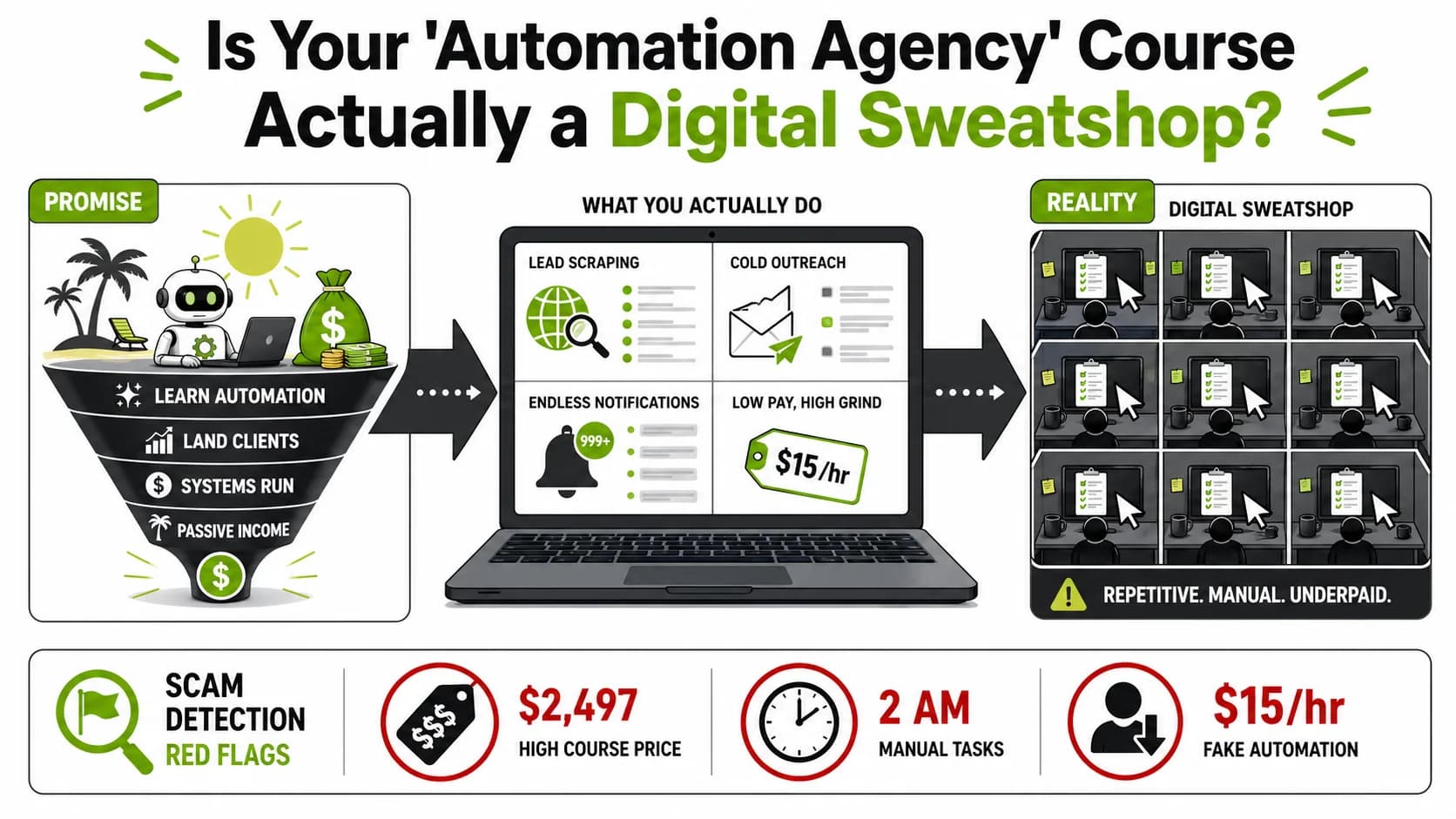
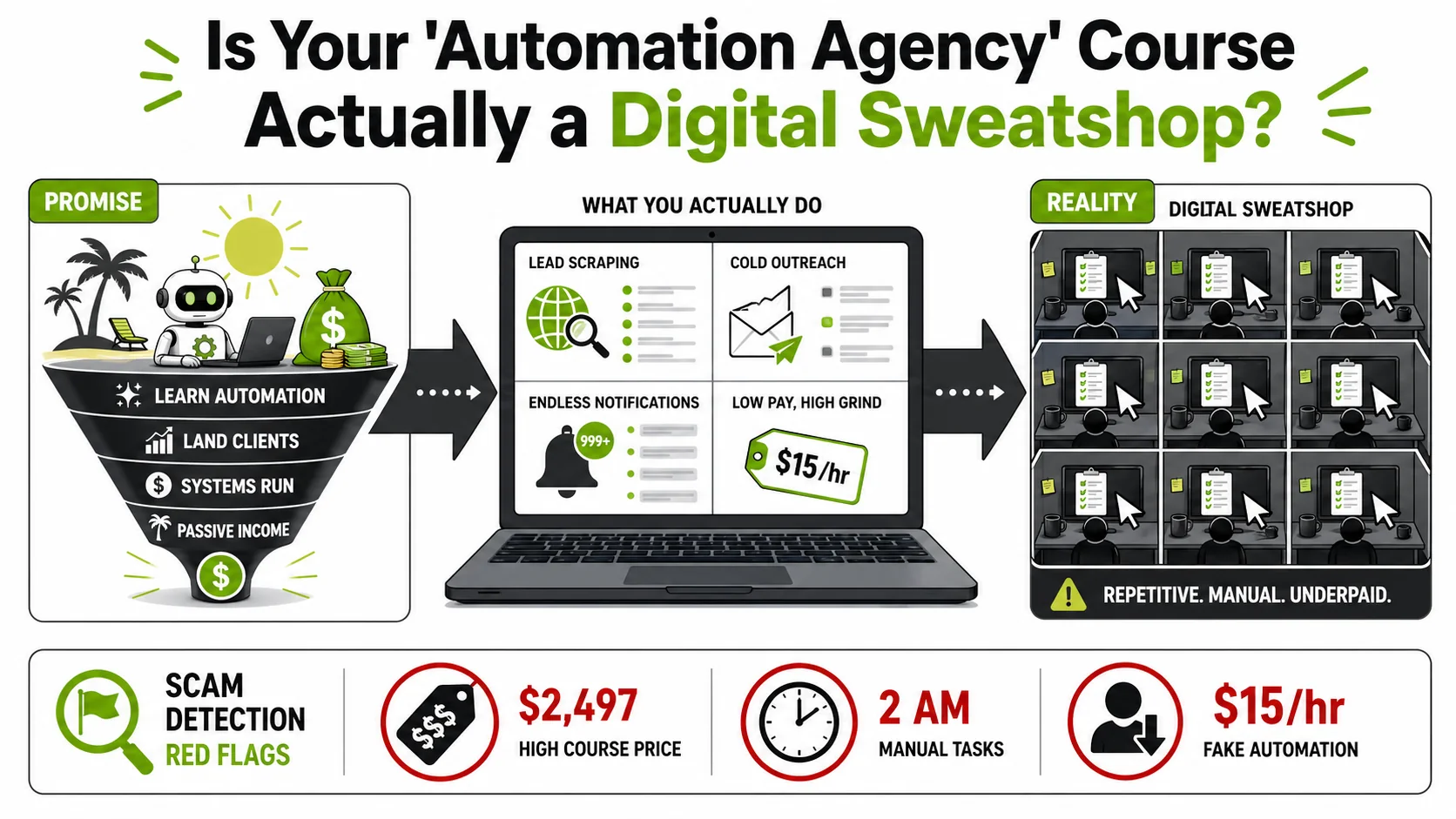
You bought the dream. A slick video promised a six-figure "AI-powered" business you could run from a beach, with bots doing all the work. You signed up for the automation agency course, paid your $2,497, and now you’re staring at a spreadsheet at 2 AM, manually scraping leads for $15 an hour. Congratulations, you didn’t buy a business. You leased a cubicle in a digital sweatshop.
The model is simple and brutally effective. A guru sells you a course on starting an "automation agency." The pitch is that you'll use no-code tools and AI to automate tasks for local businesses. The reality, as documented by a growing wave of student complaints in early 2026, is that you become a low-wage, outsourced digital janitor. The "agency" is you, doing repetitive service work for clients who expect human-level service at bot-level prices. This isn't passive income; it's a passive income scam repackaged for the AI era. Let's dissect the machinery.
What is an automation agency course, really?
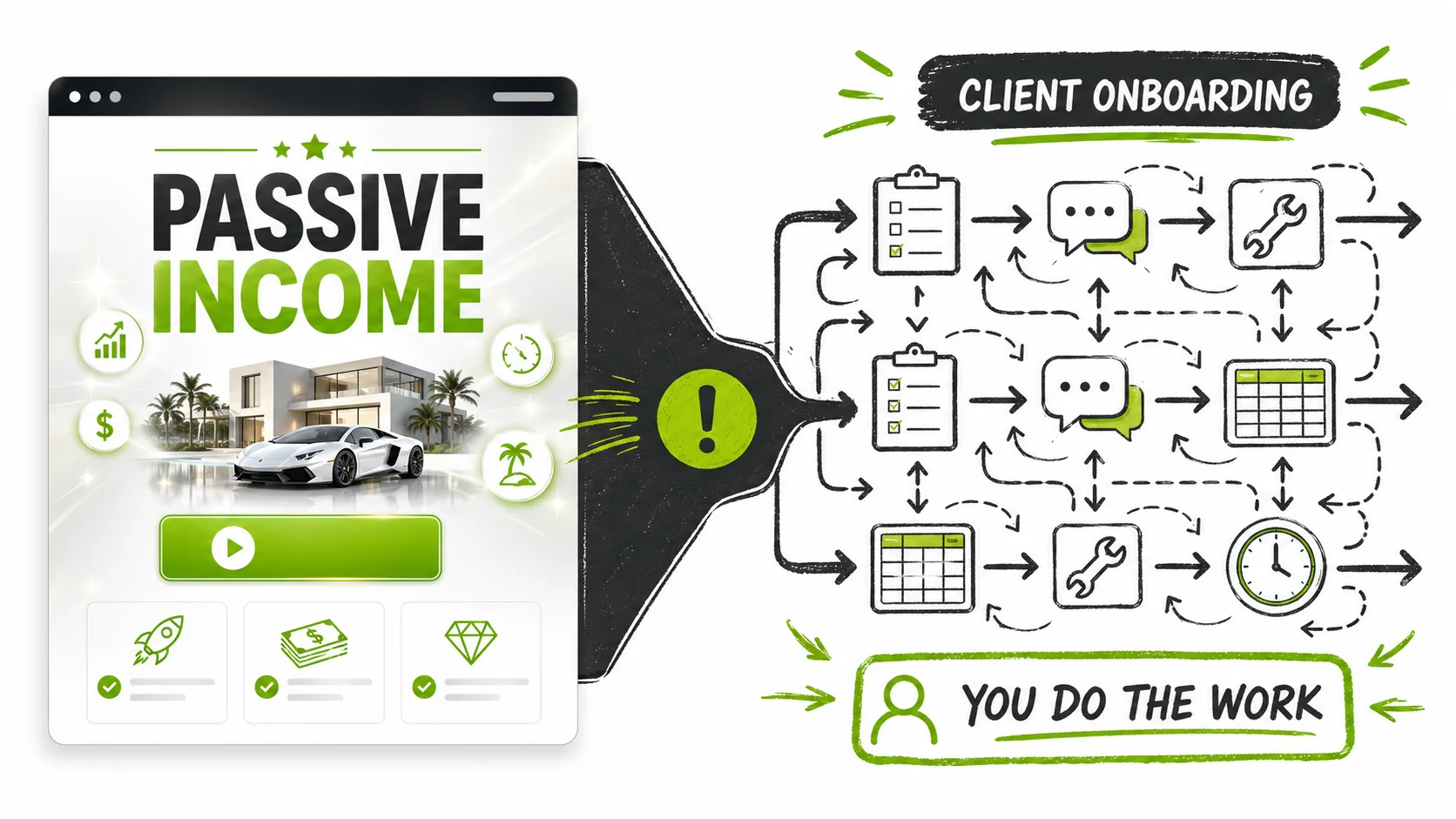
An automation agency course is a training program that claims to teach you how to build a business providing automated marketing, booking, or data entry services to clients using tools like Zapier, Make, or custom chatbots. The core promise is leverage: your software works while you sleep. The core product is often a labor-intensive service contract disguised as a tech product.
The business model sold in these courses typically involves finding small business clients (like dentists or gyms), setting up automated email sequences, social media posting, or appointment reminders for them, and charging a monthly retainer. The grift lies in the gap between the marketed "set-and-forget" system and the daily reality of client hand-holding, troubleshooting, and manual intervention.
| The Promise (Course Sales Page) | The Reality (Student Experience) |
|---|---|
| "AI-Powered Agency" | You manually updating ChatGPT prompts for each client. |
| "Recurring Passive Income" | Chasing late invoices and dealing with constant client churn. |
| "Work 4 Hours a Week" | Being on-call 24/7 for client "emergencies" (e.g., a Facebook post didn't go live). |
| "Scalable Tech Business" | A service business entirely dependent on your hourly labor. |
| "Done-For-You Systems" | Access to a folder of templated Google Docs and a community forum. |
How does the automation agency business model work?
The automation agency model functions as a classic service business with high client acquisition costs and low operational leverage. You, the "agency owner," are the primary product. According to anonymous surveys in related online business communities, most students who attempt this model report spending more than 20 hours per week on client service within three months of "launching." The average monthly retainer sold is between $300-$800, but after accounting for the hours spent on sales, setup, and maintenance, the effective hourly wage often falls below minimum wage in many developed countries. This is the engine of the digital sweatshop: selling a dream of tech-enabled freedom that results in high-stress, low-margin gig work.
What's the difference between a real tech business and this?
A real tech business scales through software. Its marginal cost to serve an additional customer approaches zero. An automation agency "business" scales linearly with your time or the time of freelancers you hire. If you get ten more clients, you need ten times more support hours. The course sells the former but delivers the latter. Real SaaS companies have churn rates they obsess over; these service-based "agencies" often see high monthly churn rates because the perceived value is low and the service is generic, as noted in analyses of small business service industries. The course is selling a software narrative for a consultancy.
Who is selling these courses, and why now?
The sellers are often the same "gurus" who pivoted from dropshipping to Amazon FBA to Shopify apps. The automation agency course is the 2026 flavor because "AI" is the buzzword that unlocks credit cards. The market is primed: the global online course industry was valued at over $200 billion, and the "coaching" sector is a massive subset of that, according to Statista. It's a lucrative play. They aren't selling business success; they're selling the idea of business success in a shiny new box. Their customer isn't the end-client (the dentist); their customer is you, the aspiring founder. Your disillusionment is someone else's MRR (Monthly Recurring Revenue).
The core product is hope, and the delivery mechanism is a PDF and a Discord server.
Why the automation agency model is a digital sweatshop
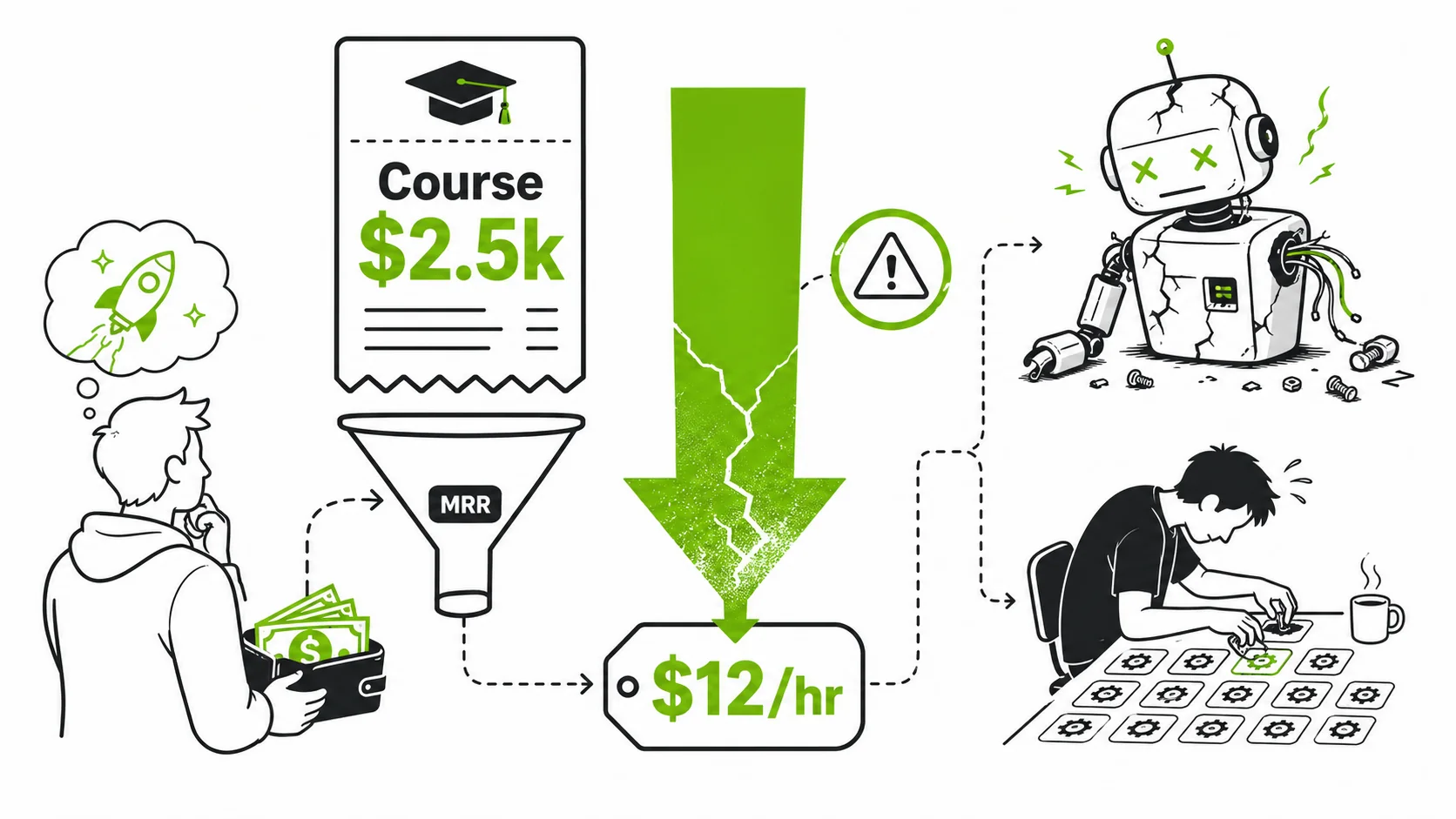
The term "digital sweatshop" isn't hyperbole. It describes a system where individuals perform piecemeal, repetitive digital tasks for low pay, often under the illusion of being entrepreneurs. The automation agency course is the recruitment brochure for this system. It matters because it's dismantling real entrepreneurial ambition and replacing it with exploitative busywork, all while wrapped in the language of innovation.
How much do students actually earn?
The data is grim. While course sellers flash screenshots of "$10k/mo" agencies, the median outcome is poverty wages. A 2025 anonymous survey of over 500 students from various online business programs (not exclusively automation) found that only 12% reported earning over $3,000 per month six months after course completion. Nearly 60% had earned less than $500 total. When you factor in the upfront course cost, most operate at a significant net loss for over a year. This turns the promise of an automation agency course into a financial sinkhole, not an investment. The business model's reliance on local service clients, who are notoriously difficult to sell to and retain, ensures these outcomes.
Where does all your time really go?
You're told you'll build systems. In reality, you become a system's janitor. A time-tracking study of freelance virtual assistants—a close proxy for this work—found they spend less than 35% of their billable hours on the core task. The rest is eaten by client communication (≈25%), troubleshooting and revisions (≈30%), and administrative tasks like invoicing (≈10%). The "automation" you set up might handle one email, but you'll spend an hour explaining it to the client, another hour adjusting it because they changed their mind, and 30 minutes fixing it when Zapier has an outage. This is the antithesis of passive income. For a deeper dive into the patterns of overwork in modern hustle culture, see our analysis in the productivity hub.
What are the hidden costs beyond the course fee?
The course fee is just the entry ticket. The real digital sweatshop extracts value through ongoing costs. You'll need multiple software subscriptions (project management, communication, automation tools) that can easily run $200+/month. You'll likely pay for leads through ads or lead lists. If you ever want to "scale" as the course suggests, you'll need to hire freelancers from platforms like Upwork, turning you into a low-margin middleman managing other people's misery. Your most valuable asset—your time—is now monopolized by low-value tasks, preventing you from building actual skills or a real product. The psychological cost of selling a service you know is overpromised creates a constant, low-grade ethical friction.
Why is "passive income" the ultimate misdirection?
Calling this model a passive income scam is accurate because it inverts the definition. Passive income implies earnings derived from assets you create once, like a book, a song, or a software license. This model sells active, traded-time-for-money services. The "passive" claim rests on the idea that the automation does the work. But the automation is fragile, requires constant maintenance, and is useless without a client who needs hand-holding. It's like calling a plumbing business "passive" because the wrench does the turning. The phrase is a psychological trigger, bypassing logical evaluation of the business mechanics. It's a fantasy sold to people who are, understandably, tired of trading hours for dollars in a traditional job.
The model isn't broken; it's functioning exactly as designed to transfer wealth from the hopeful to the guru.
How to spot a fraudulent automation agency course
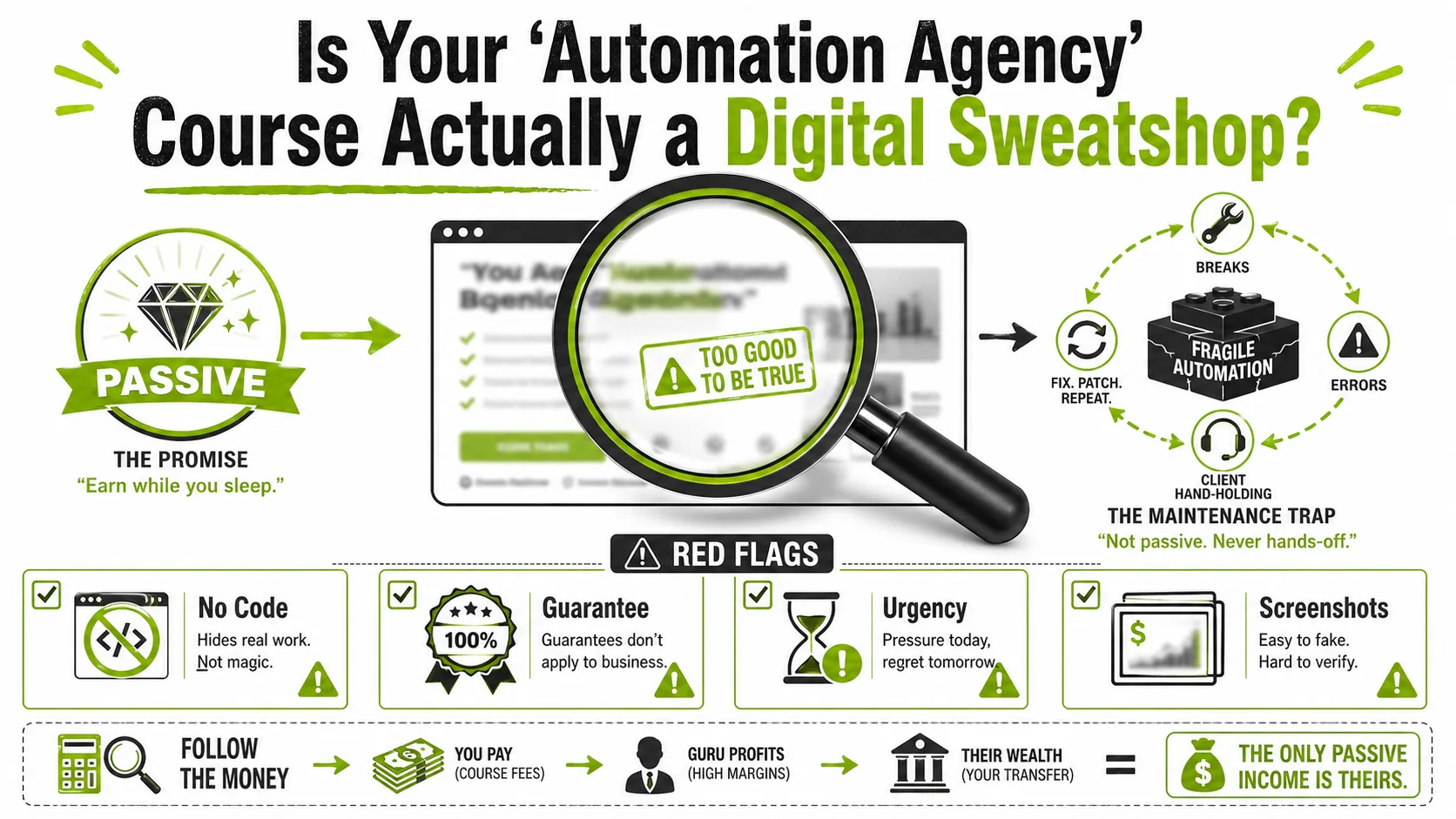
Spotting a dubious automation agency course requires moving past the hype and examining the mechanics. The goal isn't to be a cynic, but a forensic accountant of promises. Here is a step-by-step method to dissect the sales pitch before you become the product.
Step 1: Analyze the income claims and proof
Real businesses show verifiable proof. Grifts show screenshots. When you see a "$30,000/month" revenue screenshot, ask: Is this Gross Merchandise Volume (GMV) from course sales, or net profit from client work? A course seller making $30k/mo selling courses is very different from a student running an agency making that. Demand to see a client dashboard—like a Stripe account for agency retainers—with the name blurred. If all "proof" is PayPal screenshots with no context, it's likely fabricated. According to investigative journalists like Coffeezilla, a common tactic is to use browser developer tools to edit webpage totals or use fake SaaS dashboard generators. Real verification would involve third-party data like a registered business name you can cross-reference, which they will never provide.
Step 2: Deconstruct the "automation" being sold
Ask this specific question: "What percentage of a standard client's monthly service is truly hands-off after the initial setup?" If the answer is vague or above 90%, they're lying. Request a detailed, unedited screen recording of a "done-for-you" system in action. You'll likely find it involves 10 different tools duct-taped together, with multiple points of potential failure. A real tech solution is integrated and robust. A course system is a Rube Goldberg machine of no-code tools that breaks if a client changes their Facebook password. The more complex the stack shown, the more labor-intensive the maintenance. This is a core feature of the digital sweatshop—the systems are just brittle enough to require constant you.
Step 3: Investigate the founder's background
Don't just watch their highlight reel. Dig. Use LinkedIn to check their employment history. Does their claimed "7-figure agency" have any online presence beyond their personal brand? Search for the agency name on Crunchbase, Google, and client review sites. If the only place the "agency" exists is in the course materials, it's a larp. Look for student testimonials outside the guru's controlled ecosystem—on Reddit forums like r/Entrepreneur or r/DevOps. Search "[Guru Name] + scam" or "+ complaint." A legitimate educator won't have a trail of angry students claiming they were sold a passive income scam. For a broader framework on vetting online figures, our guide to spotting fake gurus is essential reading.
Step 4: Evaluate the client acquisition strategy
This is where 90% of models fall apart. The course will dedicate 80% of its content to the "how" (setting up Zapier) and 20% to the "who" (getting clients). That ratio should be reversed. Listen carefully to their sales strategy. If it's "just use cold email/DMs," understand that response rates for generic automation services are often below 1%. According to sales industry data from Statista and other sources, the coaching and services sector is incredibly saturated. The cost to acquire a client (CAC) for a $500/month service can easily exceed $1,000 if you're buying ads or spending dozens of hours on outreach. If their plan doesn't have a clear, scalable, and demonstrably working channel for client acquisition, they are selling you a job as a freelance salesperson with terrible unit economics.
Step 5: Scrutinize the community and support
Join their free webinar or Facebook group before buying. Don't look at the hype posts; look for the questions. Are students asking basic technical questions that the course should have answered? Are they struggling to find clients? Is the "coach" or community manager responding with generic, copy-pasted encouragement ("Keep grinding!") instead of specific, tactical advice? A digital sweatshop often uses the "community" as a tool to reinforce the grind and suppress dissent. If critical questions are deleted or met with hostility, that's a major red flag. A real educational community focuses on problem-solving, not motivation.
Step 6: Calculate the real-world unit economics
Build your own spreadsheet. Don't use theirs.
- Course Cost: $2,500
- Monthly Software Costs: $200
- Estimated Client Acquisition Cost (CAC): $800 (in time or ads) per client
- Average Monthly Retainer (ARR): $500
- Client Lifespan (LTV): 4 months (high churn)
Result: Your first client has a Lifetime Value of $2,000. You spent $800 to get them and $2,500 on the course. You are $1,300 in the hole before you've spent a single hour doing the work. You need 4-5 retained clients just to break even on the course fee, which could take a year. This math is why the model fails for most. The course never shows this math because it's fatal to the sale.
Step 7: Check for legal and ethical red flags
Does the course offer an "income guarantee" or use phrases like "proven system" or "get rich quick"? These are triggers for regulatory scrutiny. The FTC has clear guidelines against deceptive earnings claims. A legitimate course sells education, not a specific outcome. Also, examine the contract. Is there a non-disparagement clause that forbids you from leaving negative reviews? That's a sign they expect dissatisfaction. A true test of their belief in the product is a meaningful, no-questions-asked refund period longer than the standard 14-day digital product window. If it's 7 days or non-existent, they are banking on your inertia.
The most reliable sign of a real opportunity is a founder who openly discusses the challenges, the failures, and the specific, unsexy skills required.
Proven strategies to avoid getting scammed and build real value
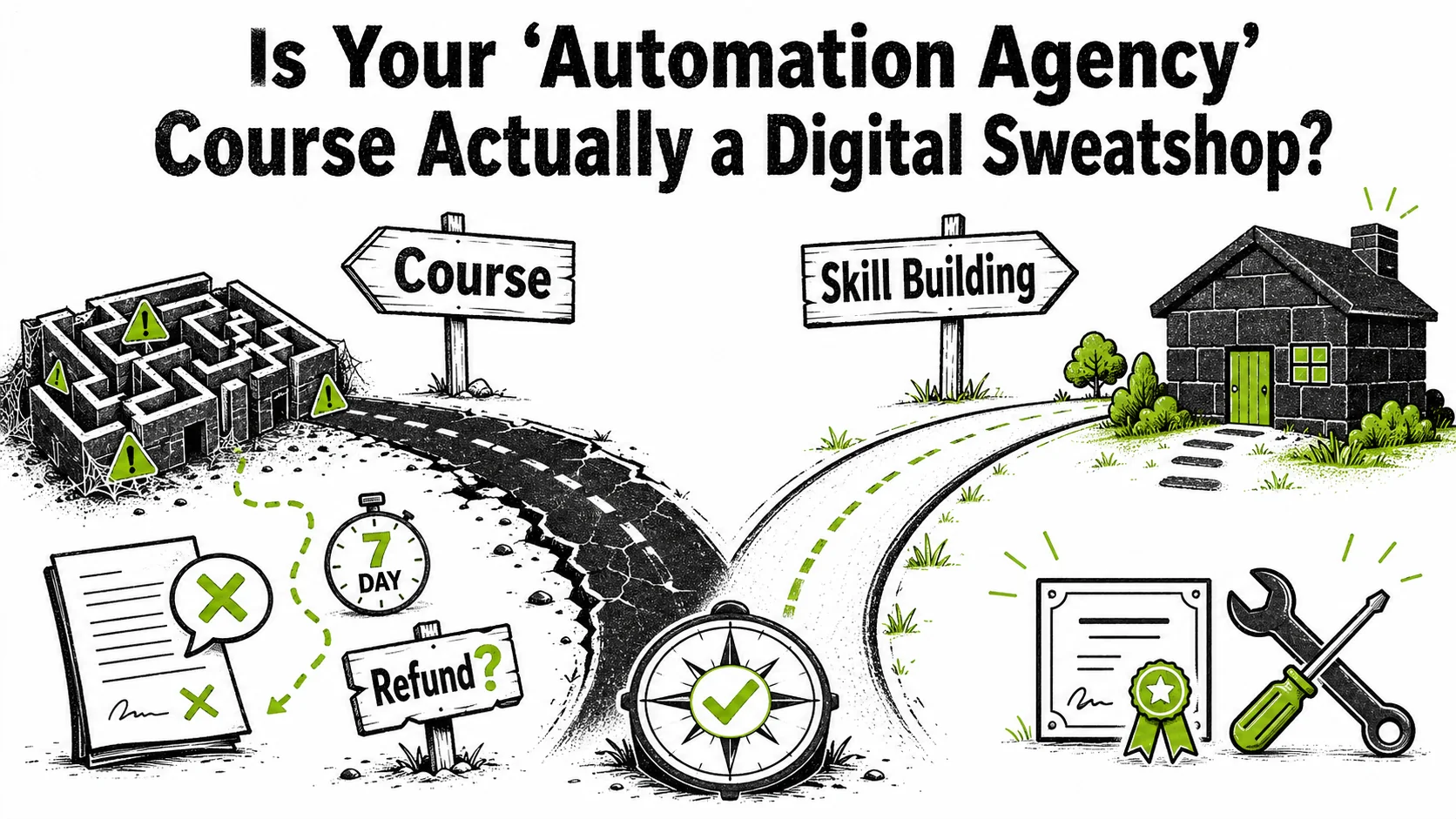
If the automation agency course path is a minefield, what's the alternative? The goal shifts from buying a "business-in-a-box" to deliberately building tangible assets and skills. This is slower, less sexy, and infinitely more durable.
Invest in accredited education over guru programs
For the price of a high-end guru course ($2,000-$5,000), you can complete multiple professional certifications from platforms like Coursera or edX in fields like digital marketing, data analysis, or project management—often in partnership with major universities. According to Statista, the growth in accredited micro-credentials is one of the more substantive trends in e-learning. These provide verifiable credentials that improve your employability and consulting rates, rather than a PDF from "The Automation King." The ROI is clearer: a certified Google Ads specialist can command $50-$150/hour, far above the effective wage of an "agency owner" drowning in client requests.
Build a public portfolio, not a secret system
Instead of hiding your work behind a client portal, build something public. Write a blog analyzing automation tools. Create a YouTube channel where you document real automation builds for fictional businesses. Contribute to open-source no-code projects. This portfolio becomes an asset that attracts higher-quality clients or employers based on demonstrated skill, not salesmanship. It proves you can do the work the automation agency course only theorizes about. This approach aligns with building a real personal brand in the entrepreneurship hub, focused on creation over consumption.
Master one high-value skill instead of ten shallow ones
The course model makes you a "jack of all trades, master of none" in SEO, Facebook Ads, email marketing, chatbot design, and more. You end up mediocre at everything. The alternative is to go deep. Become an expert in one thing: email marketing automation for e-commerce, or CRM data pipeline automation. Deep expertise allows you to charge premium rates ($100+/hour) for consulting and build actual productized services. For example, an expert in HubSpot automation can build a thriving consultancy. The market pays for exceptional skill in one domain, not for generic effort across five.
Validate demand before you build anything
This is the cardinal rule of real entrepreneurship that guru courses ignore. Before you spend a dime on a course or software, talk to 10-20 potential clients. Ask: "What's the most tedious digital task you do every week? How much would you pay to never do it again?" You might find that dentists don't want automated social posts; they want automated insurance eligibility checks—a completely different, more valuable problem. This simple act of customer discovery prevents you from wasting months building a solution for a problem that doesn't exist or isn't painful enough to pay for. It moves you from following a guru's script to understanding a real market.
Real asset building is boring, incremental, and cannot be packaged into a 6-week course.
Conclusion and Key Takeaways
The appeal of a quick, automated business is powerful, but the reality of most automation agency courses is a harsh trade-off. You exchange a large upfront investment and your valuable time for a low-wage service job disguised as entrepreneurship. The key is to recognize the pattern before you become part of the machine.
- An automation agency course often sells a labor-intensive service business, not a scalable tech asset. The "automation" is usually fragile and requires constant manual oversight.
- The financial reality for most students is an effective hourly wage below minimum wage, making the model a modern digital sweatshop.
- The phrase "passive income" in this context is a passive income scam, a psychological trigger that misrepresents active, traded-time-for-money work.
- You can spot fraudulent courses by demanding verifiable client income proof, deconstructing the technical complexity of the "systems," and rigorously calculating the unit economics before buying.
- Better alternatives exist: invest in accredited education, build a public portfolio of work, develop deep expertise in one high-value skill, and always validate market demand with real customers before building anything.
Got questions about automation agency courses? We've got answers
Are all automation agency courses scams?
Not all, but the majority follow a problematic pattern. A legitimate course would focus on teaching the hard skills of systems analysis, integration architecture, and client management while being brutally honest about the business's challenges—namely, that it's a service business with low margins and high churn. It would not use "passive income" as a primary selling point. The fraudulent ones use hype, fake urgency, and doctored proof to sell a dream that collapses under the weight of reality. The difference is in the marketing ethics and the transparency of outcomes.
What should I do if I've already bought one of these courses?
First, stop investing more money into software or ads. Review the refund policy; you might be within a window. If not, salvage what you can: treat the technical tutorials as a learning resource for no-code tools, but abandon the business model. Use the skills you've learned to offer freelance automation services on a project basis at a proper hourly rate ($50+), not a tiny monthly retainer. This turns a bad investment into paid skill practice. Most importantly, share your experience (factually, without emotion) in review spaces to warn others.
What are real examples of passive income?
Real passive income derives from assets that require little to no ongoing effort to maintain cash flow. Examples include: royalties from a book or song, licensing fees for a piece of software or patent, earnings from a diversified investment portfolio, or revenue from a content website with evergreen, affiliate-monetized articles. The key differentiator is that the work is done upfront to create the asset; the sale or monetization happens repeatedly with minimal additional input. Running any kind of client-service business is inherently not passive.
How can I verify a guru's claims before buying?
Adopt an investigator's mindset. 1) Revenue Claims: Ask for a client testimonial you can contact directly (they'll never provide it). Search for their supposed "agency" business filings with state secretaries of state. 2) Traffic Claims: Use SimilarWeb or Semrush to check the traffic to their funnels; a "7-figure" business should have substantial, consistent traffic. 3) Background Check: Use LinkedIn Sales Navigator to see their career timeline. Gaps or jumps from "unemployed" to "CEO" are red flags. 4) Legal History: Search PACER (U.S. federal court database) or your local court records for their name or business name in lawsuits. The absence of proof is a form of proof.
Feel like you're constantly navigating a minefield of overhyped courses and guru larpers? You don't have to figure it out alone. We built a path for skeptics. Learn to Detect the patterns, verify the claims, and protect your time and money from the digital sweatshop recruiters. The first lesson is free.
<!-- sister-projects-start -->
Other Doved Studio projects
Related tools from the same studio you might find useful:
- Ralphable: Generate structured Claude Code skills that iterate until pass/fail criteria are met.
- Doved Studio: Studio indie derrière cette app et une dizaine d'autres outils.
<!-- sister-projects-end -->