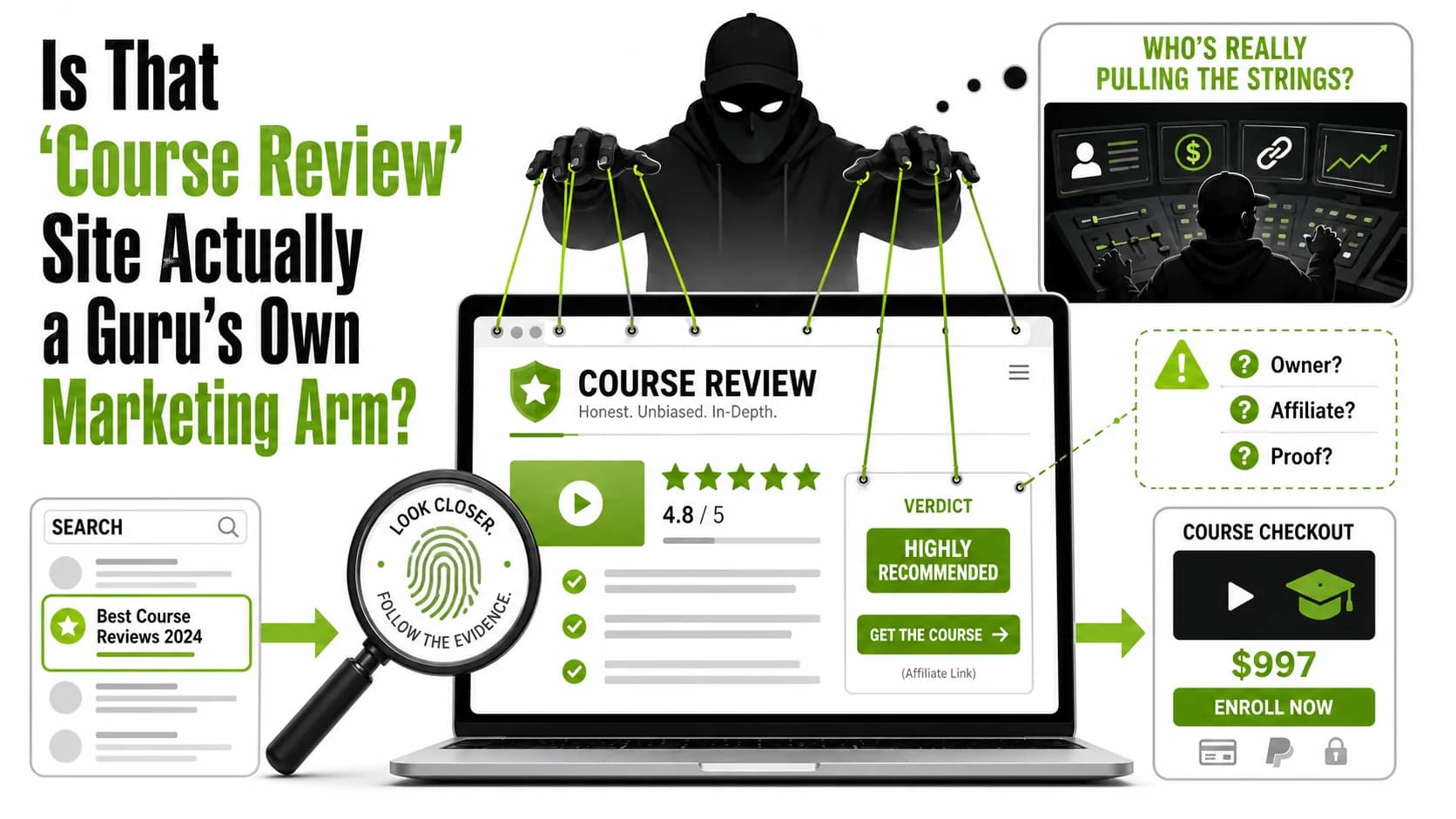
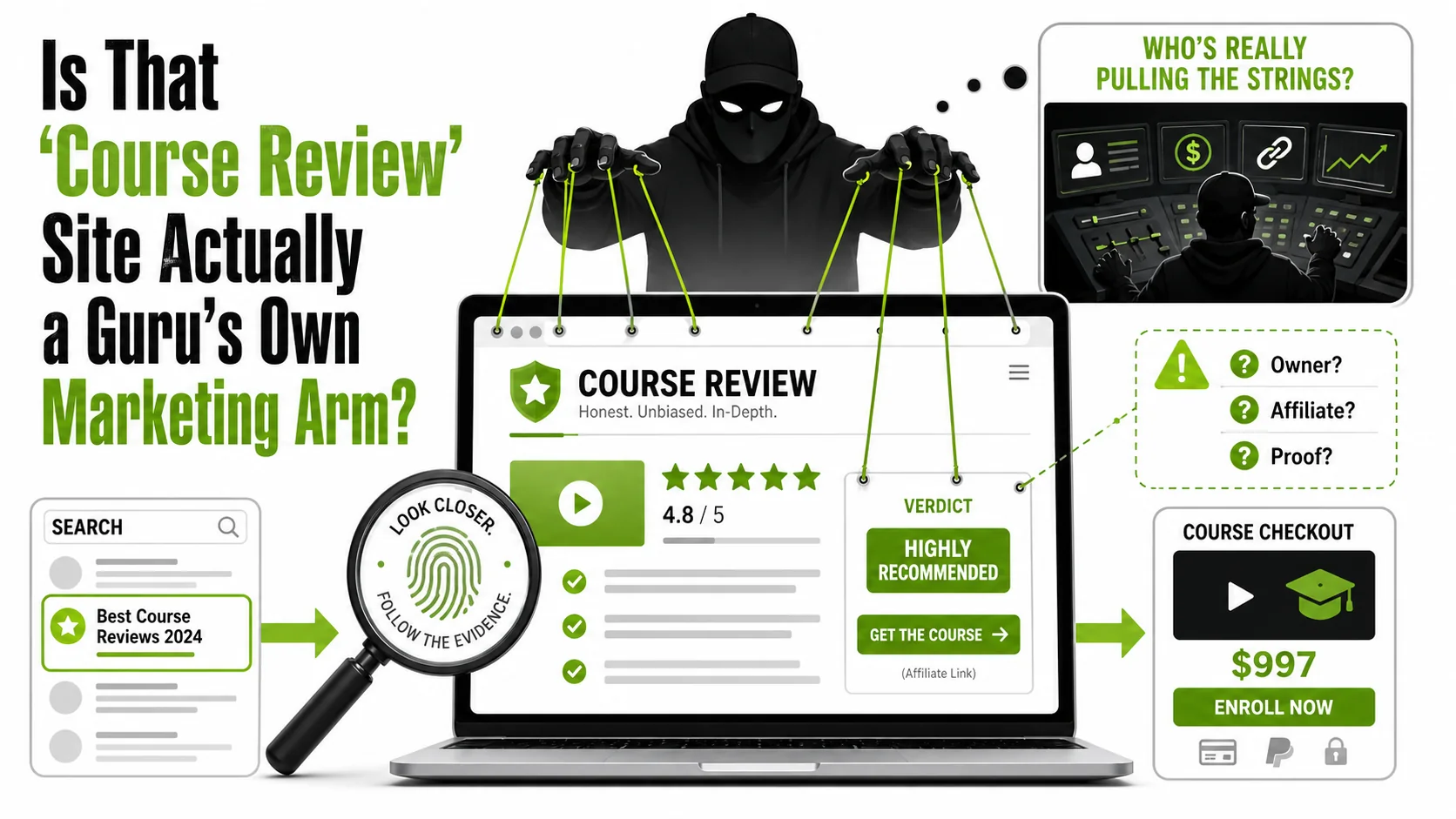
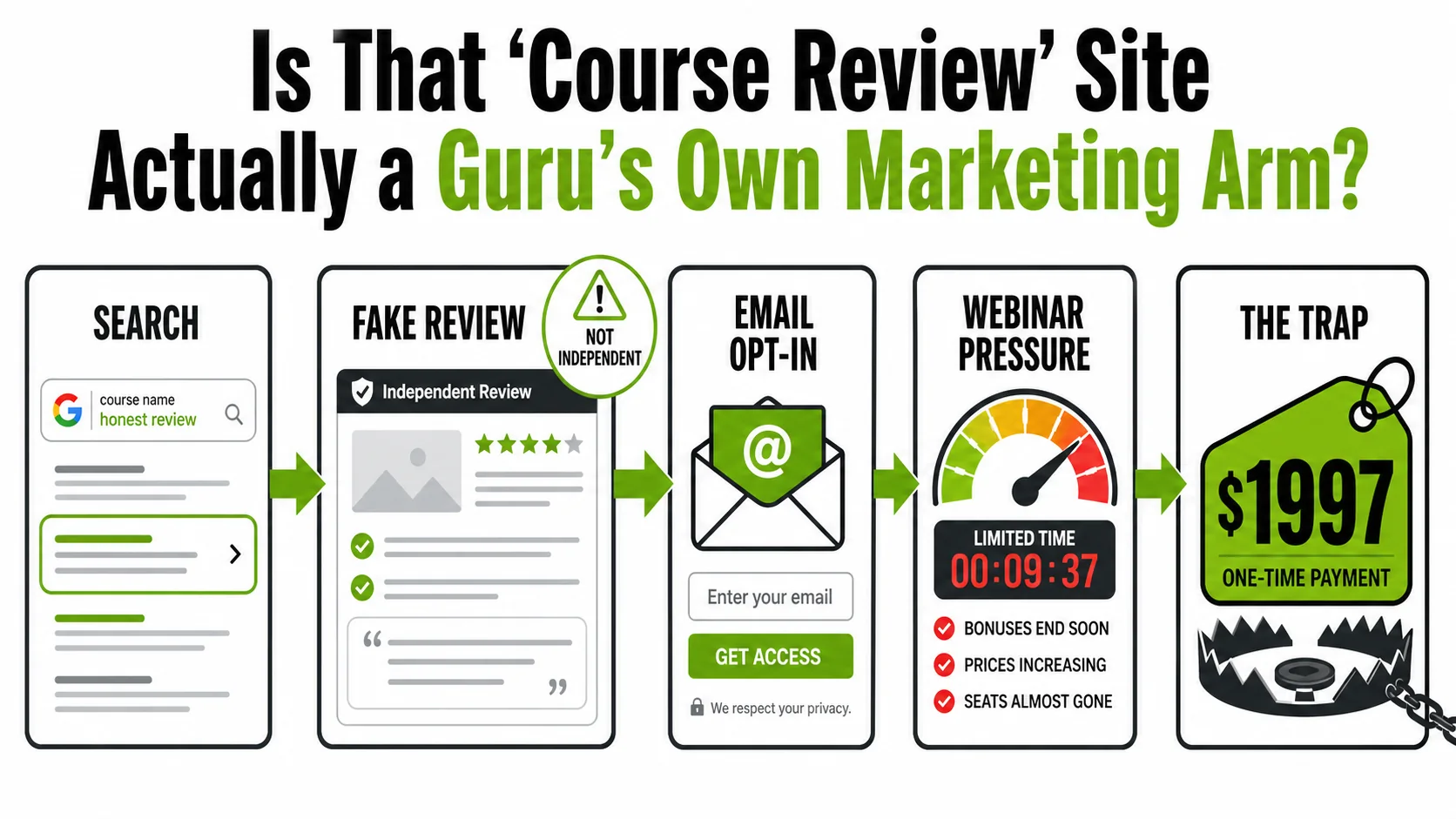
You’re hunting for a course on AI copywriting. You Google “best AI copywriting course 2026.” The first result isn’t Udemy or Coursera. It’s a slick, modern website called “Digital Skills Audit” with a headline: “We Tested 12 Top AI Copywriting Courses So You Don’t Have To.” It feels like a public service. It’s a trap. Welcome to the 2026 flavor of the course review scam, where the puppet master owns the theater, writes the reviews, and sells the popcorn—all while wearing a critic’s hat.
This isn't just shady affiliate marketing. It's a full-spectrum guru marketing funnel disguised as journalism. The "independent" reviewer is the guru, their "top pick" is their own overpriced course, and your trust is the commodity being traded. According to the FTC's Consumer Sentinel Network, education-related fraud and complaints have become a persistent category, with losses often running into the thousands per victim. The game has evolved from fake testimonials on a sales page to building entire fake review sites as lead-generation engines. Your job is to become a forensic auditor before you become a customer. Let’s dissect the puppet strings.
What is a fake review site?
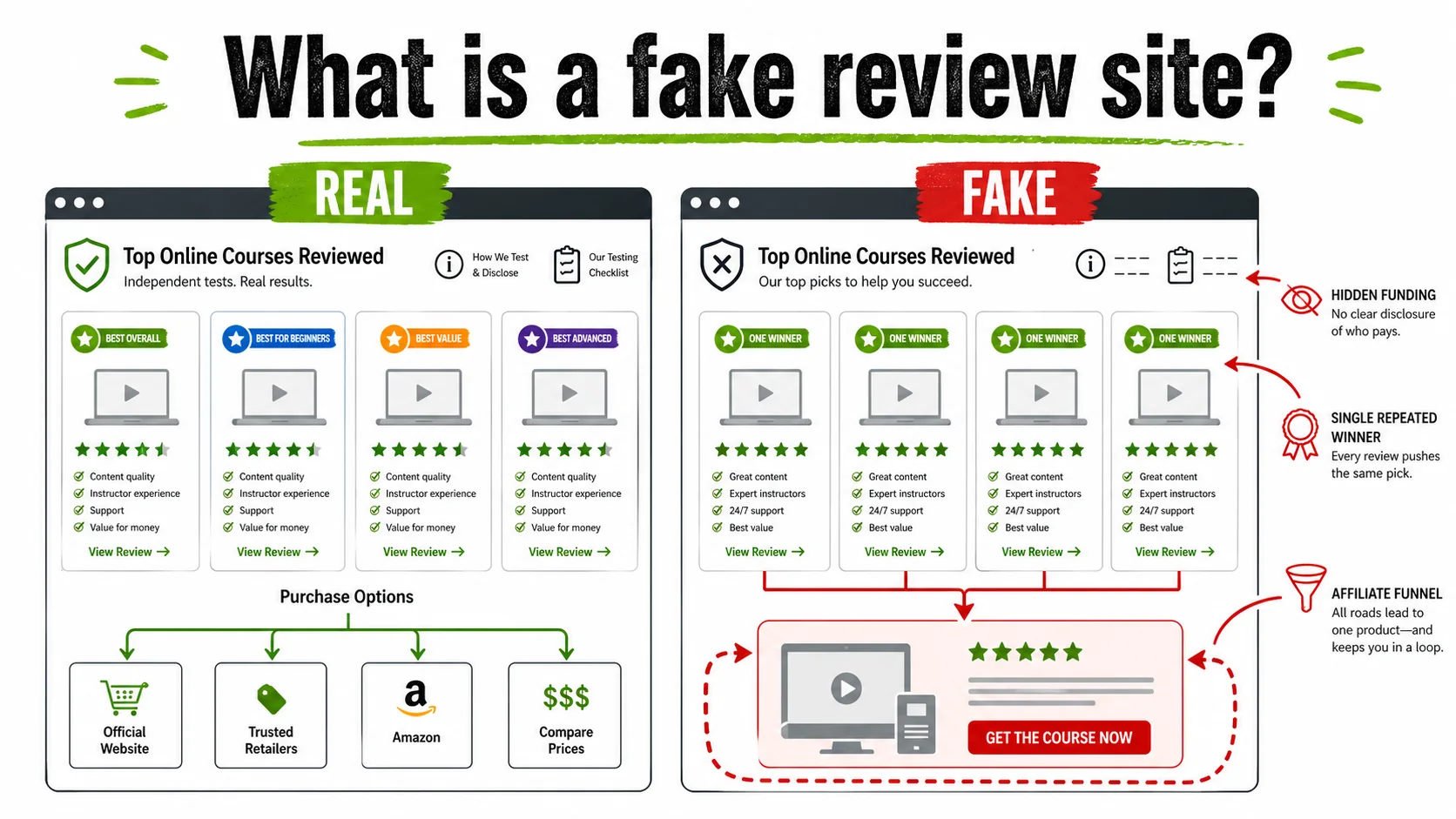
A fake review site is a website designed to look like an independent, authoritative source of product comparisons and recommendations, but which exists primarily to funnel traffic and affiliate revenue to a single creator or a small network of connected products. It is a sophisticated guru marketing funnel built on the corpse of consumer trust. The core deception is the illusion of objectivity. These sites mimic the format of legitimate review platforms (like Wirecutter in its prime) but remove the actual editorial independence, rigorous testing, and conflict-of-interest disclosures.
The business model is simple: create content that ranks for high-intent search queries (“best [niche] course,” “[skill] course reviews”), establish fake credibility, and then direct all traffic to a single purchase option—almost always the site owner’s own course or a close affiliate’s product. The entire operation is a closed loop designed to look like an open marketplace.
How do you spot a fake review site from a real one?
Real review sites have diversity in winners, transparent revenue models, and editorial separation from the products reviewed. A fake review site has one winner, opaque funding, and content that always leads back to one source. Look for the "Always Bridesmaid, Never the Bride" test. If you read ten "Top 5" lists on the same site across different niches (e.g., "Top 5 Crypto Courses," "Top 5 Dropshipping Courses," "Top 5 YouTube Courses") and the same company or guru's product is always #1, you're not looking at reviews. You're looking at a brochure.
What's the difference between affiliate marketing and a course review scam?
All affiliate marketing is not a scam. A legitimate affiliate site discloses its partnerships and may genuinely recommend a variety of products based on merit. A course review scam specifically manufactures the context of the review to deceive. The scam is in the framing. It’s the difference between a movie critic who gets free screenings (disclosed) and a film director who creates a fake film criticism YouTube channel that only exists to praise their own movies while pretending to pan competitors. The FTC Endorsement Guides require clear and conspicuous disclosures of material connections, a rule these fake sites systematically violate by hiding ownership.
How profitable is this deception?
Extremely. The economics make perfect, cynical sense. Building a basic review site costs maybe $2,000. A single high-ticket course sale can net $1,000-$2,000. If the site ranks for just a few high-volume search terms, it can generate dozens of sales per month. The FTC's 2024 Consumer Sentinel Data Book notes that imposter scams and business imposters are among the top fraud categories reported; a fake review site is simply a business imposter. Instead of pretending to be the IRS, it pretends to be Consumer Reports. The return on deception is high, and the regulatory risk, while growing, is still a step behind.
A fake review site is a confidence trick built with WordPress and SEO plugins.
Why fake review sites are the new frontier for scams
Because we’re tired of traditional ads and we’ve built an immunity to obvious sales pitches. The modern consumer, especially in the online course and coaching space, is skeptical. We expect a sales page to lie. But we still, naively, expect a review site to tell the truth. Gurus have simply weaponized that last bastion of trust. The fake review site is the logical endpoint of a marketing arms race where authenticity is the ultimate commodity to counterfeit.
This shift matters because it corrupts the very information ecosystem we use to make decisions. When you can’t trust a seemingly neutral third party, your research process breaks down. You either become paralyzed or you roll the dice. This environment is perfect for the mediocre product to thrive, because it eliminates fair competition. The best course doesn’t win; the course with the best fake review site does.
How does this erode trust in digital education?
It creates a cynical, polluted landscape where every piece of advice is presumed to be monetized. This isn't just bad for students; it's bad for legitimate creators. When fraudsters deploy sophisticated fake review sites, they raise the customer acquisition cost for everyone by forcing legitimate businesses to shout louder over a cacophony of lies. The entire sector's credibility takes a hit, making it harder for good courses to find their audience. You start to wonder if that genuinely useful, affordable course you found is just a scam you haven’t figured out yet. For more on navigating this minefield, our guide on spotting fake gurus dives deeper.
What are the legal and regulatory risks?
They are increasing, but slowly. The FTC’s rules on endorsements are clear: if there’s a material connection between the endorser and the seller, it must be disclosed. Owning the course and the review site that praises it is the ultimate material connection. The FTC has brought cases against individual influencers for failing to disclose a free trip. A coordinated fake review site operation is a much larger violation. However, enforcement is a game of whack-a-mole. The FTC’s 2024 data shows they’re tracking the problem, but until there are high-profile cases with severe penalties, the risk-reward calculation still favors the scammer. It’s a regulatory grey zone that’s currently painted in dollar-green.
Who is most vulnerable to this tactic?
Ironically, the savvy beginner. The complete novice might buy the first flashy ad they see. The true expert doesn’t need these courses. It’s the person who has done some research, knows to avoid the obvious sales pages, and is actively seeking “unbiased” comparisons. They are using the correct defense mechanism—looking for third-party validation—but the weapon they reach for has been booby-trapped. This demographic is prime for a course review scam because they are taking the right steps but on a corrupted map.
Fake review sites work because they exploit our correct instinct to seek independent advice.
How to perform a forensic audit on any review site
This is your detective kit. You are not just a consumer; you are an investigator. Your goal is to trace the ownership, follow the money, and break the illusion of independence. Each step below should take you 2-5 minutes. If you hit a dead end or a red flag, your audit is complete: walk away. The entire point of larpable is to equip you with this exact skill set—to see the strings before you buy the puppet.
Step 1: Run a reverse WHOIS and DNS investigation
Who owns this domain? Start with a free WHOIS lookup (like ICANN Lookup). Often, privacy protection services will hide the owner. That’s a yellow flag for any site claiming to be a transparent review platform. Next, use a tool like WHOIS History or check the DNS records. Look for other domains registered to the same email or name. I once traced a “Best Shopify Apps” review site back to an email that also owned “ShopifyMasteryCourse.com” and “DropshipWith[Name].com.” The connection was the digital equivalent of a signed confession. If the review site and the course site share a registration entity, you’ve uncovered the core of the course review scam.
Step 2: Analyze the “About Us” and author bios with skepticism
Read the “About Us” page like a prosecutor. Is it filled with vague, trust-building platitudes (“our mission is truth!”) but devoid of specific, verifiable details about the team? Do the author bios use stock photos or overly polished headshots? Right-click and “Search Google for this image.” If the “expert reviewer’s” face is also selling dental insurance on a stock photo site, you have a problem. Real experts have digital footprints—LinkedIn profiles, GitHub commits, bylines on other publications. Fake reviewers are ghosts with a biography written by ChatGPT.
Step 3: Conduct the “One-Winner” pattern test
This is the statistical heart of the audit. Browse the site’s archive. Look at 5-10 different review roundups. Do they all crown a champion from the same company or by the same creator? For example, if “AI Course Review Hub” declares “Course A” the best for ChatGPT, “Course B” (from the same creator as A) the best for Midjourney, and “Course C” (again, same creator) the best for automation, you’ve found a marketing arm, not a review hub. The probability of a single creator consistently producing the absolute best product in multiple adjacent sub-niches is astronomically low. This isn’t meritocracy; it’s monopoly.
Step 4: Follow the money (affiliate link autopsy)
Hover over the “Get the Best Deal” or “Visit Site” button. Does the link URL contain a clear affiliate tag (like “?ref=”, “?aff=”, “/affiliate/”)? That’s normal for affiliate sites. The critical test is where it goes. Click it (in a private/incognito window). Does it take you directly to the sales page for the course? Or does it go to a splash page, webinar registration, or email opt-in that is branded identically to the review site? The latter is the smoking gun. It means the review site and the course sales funnel are part of the same technical infrastructure. They’re not just affiliated; they’re conjoined twins. This is the technical signature of a guru marketing funnel.
Step 5: Check for negative or balanced reviews
A real review site has pans. It has articles titled “Why We Didn’t Recommend [Popular Course]” or “The Overhyped [Skill] Program.” A fake site has only positive or “soft” negative reviews (e.g., “The only downside is it’s so comprehensive you might feel overwhelmed!” which is not a downside, it’s a compliment in disguise). Search the site for the word “avoid,” “scam,” “bad,” or “not worth it.” If every article is a variation of “The 5 Best…”, you’re on a lead generation list, not a publication. This lack of critical content is a direct result of the site’s purpose: it exists to convert, not to inform.
Step 6: Scrutinize the “methodology” section
Any legitimate review platform will explain how they test: length of use, testing criteria, team members involved. A fake site will have either no methodology or a page filled with meaningless jargon. “We evaluate based on curriculum depth, instructor engagement, and community value” tells you nothing. How do you measure “instructor engagement”? Did you interview students? Track completion rates? If they can’t describe their process beyond buzzwords, they didn’t do the work. They just copied the sales page bullet points and called it a review.
Step 7: Look for cross-promotion in the “free tools” or “resources”
Many of these sites offer a “free cheat sheet” or “course selection quiz” in exchange for your email. Download it. Is the PDF covered in logos and calls to action for one specific course or guru? Is the “personalized” quiz result always the same course, just with your name inserted? This is the lead magnet within the lead generation site—a matryoshka doll of manipulation. Your email is then funneled into a sequence that reinforces the “independent” recommendation you just received, creating a powerful, self-reinforcing illusion. For a broader look at these entrepreneurial traps, explore our entrepreneurship hub.
| Legitimate Review Site Signal | Fake Review Site Red Flag |
|---|---|
| Discloses affiliate links clearly | Hides or buries disclosure in fine print |
| Features multiple “winners” across brands | Same creator/company wins every comparison |
| Has a detailed, specific methodology | Vague or non-existent testing process |
| Publishes critical “avoid” reviews | All content is positively framed |
| Team has verifiable, external identities | Anonymous or stock-photo “experts” |
| Links go to vendor site | Links go to co-branded webinar/opt-in page |
A forensic audit proves ownership, motive, and method—the three pillars of the scam.
Proven strategies to find genuinely useful courses
Once you’ve ruled out the fake review sites, you need a positive strategy for finding good information. This is about building a network of trust, not just avoiding traps. The goal is to find signal in the noise, which requires looking in less obvious places than the first page of Google.
Strategy 1: Seek “Un-monetized” communities, not review sites
The best course recommendations I’ve ever gotten came from niche Slack groups, Discord servers, or subreddits where sharing affiliate links is banned. Look for communities of practitioners, not consumers. In a subreddit for data scientists, a question about the best machine learning course will yield answers based on painful experience, not commission percentages. The advice is messy, opinionated, and contradictory—which is how you know it’s real. These communities have a shared sense of identity that transcends a quick buck; their credibility is tied to their standing in the group, not their affiliate revenue. This is the antithesis of the fake review site.
Strategy 2: Use LinkedIn as a verification tool, not a discovery tool
Don’t search for courses on LinkedIn. Search for people who have the job or skill you want. Look at their “Licenses & Certifications” section. Which courses do they actually list on their professional profile? When someone puts a course completion on their LinkedIn, it’s a stronger endorsement than any online review because it’s attached to their real professional identity. You can also see patterns: if you look at 50 successful UX designers and 30 of them list the same foundational course, that’s a powerful data point. This is social proof that has actual stakes.
Strategy 3: Favor platforms with enforced refund policies
Place more trust in learning platforms that have strong, platform-enforced refund policies (like Udemy’s 30-day policy) or free audit options (like Coursera). This reduces your risk dramatically and aligns the platform’s incentives with yours: if the course is bad, they have to process the refund. A guru selling from their own fake review site will have a restrictive, often predatory refund policy (e.g., “no refunds after 7 days” or “you must complete 50% of the course to be eligible”), because their entire funnel is designed to prevent buyer’s remorse from turning into a returned product.
Strategy 4: Apply the “Project Portfolio” test
Before buying a course, ask: what is the tangible project I will build? A good course is project-based. A bad course is theory-based. Search for the course name on YouTube or GitHub. Can you find people showing off the projects they built using the course? A portfolio piece is the ultimate review. If the only results are the sales page and affiliated fake review sites, that’s a major warning. If you find independent developers showcasing work crediting the course, you’ve found legitimate validation. This moves you from reading opinions to inspecting outputs.
Finding a good course requires ignoring the loudest voices and listening to the most practical ones.
Conclusion and Key Takeaways
The digital learning landscape is filled with helpful resources, but also sophisticated traps. By understanding the mechanics of deception, you can protect yourself and find truly valuable education.
- A fake review site is a guru marketing funnel in disguise, designed to create a false consensus around a single product by mimicking independent journalism.
- The core forensic audit involves tracing domain ownership, testing for a “one-winner” pattern, and dissecting where the “review” links actually lead.
- Legitimate review platforms show diversity in recommendations, have transparent methodologies, and publish real criticism.
- The most reliable course recommendations often come from un-monetized professional communities and the project portfolios of past students, not from SEO-optimized review hubs.
- Tools like larpable exist to train you in this pattern recognition, shifting you from a potential victim of a course review scam to an informed investigator.
FAQ: Got questions about fake review sites?
Are all “best course” websites scams?
No, but a significant portion operate with severe conflicts of interest that invalidate their “best” claims. The key is disclosure and diversity. A legitimate site might use affiliate links but will clearly disclose that relationship and, crucially, will have different “winners” in different categories based on actual testing. The scam isn’t in making money from recommendations; it’s in fabricating the authority to make those recommendations while hiding the fact that you are recommending yourself. The course review scam is defined by this hidden ownership.
What should I do if I’ve already bought a course from a fake review site?
First, request a refund immediately, citing the site’s undisclosed material connection to the product (this may be a violation of the FTC Endorsement Guides). Document everything: screenshot the review site, the sales page, and your WHOIS findings showing common ownership. If the refund is denied, dispute the charge with your credit card company, providing this documentation as evidence of deceptive marketing. Finally, report the operation to the FTC. While individual reports may not trigger immediate action, they contribute to the pattern of data the FTC uses for larger cases.
Can I trust reviews on platforms like Udemy or Coursera?
You can trust them more than a standalone review site, but with caveats. Platform reviews are subject to incentive manipulation (e.g., students offered extra content for a 5-star review) and selection bias (the most motivated or most angry students are more likely to review). Look for detailed, mid-length reviews that discuss specific pros and cons, not just “loved it!” or “hated it.” Also, check the instructor’s response to negative reviews. A defensive, angry response is a red flag; a thoughtful response addressing the concern is a green flag.
How is “larpable” different from these sites?
larpable does not sell courses, coaching, or have affiliate links to the products we dissect. Our revenue model is not tied to your purchase decision. We are a satirical educational platform with two paths: teaching you to DETECT manipulation (like fake review sites) or analyzing the TOOLKIT used to create it. We are the whistleblower, not the vendor. Our goal is to make you immune to the guru marketing funnel, not to redirect you into a different one.
The next time you see a “perfect” review, remember: true objectivity is rare, but true deception is now a template. Your best defense is a little cynicism and a lot of clicking. Ready to see the strings on every puppet?
<!-- sister-projects-start -->
Other Doved Studio projects
Related tools from the same studio you might find useful:
- Ralphable: Generate structured Claude Code skills that iterate until pass/fail criteria are met.
- Doved Studio: Studio indie derrière cette app et une dizaine d'autres outils.
<!-- sister-projects-end -->