Table of Contents
- The Most Famous Garage in Internet History
- The Verified Facts
- The Rented Lifestyle
- The Courses: What You Actually Get
- Student Outcomes: What the Data Shows
- What He Got Right
- What He Got Wrong
- The Verdict
- FAQ
The Most Famous Garage in Internet History {#the-most-famous-garage-in-internet-history}
In 2015, a tanned man in a fitted T-shirt stood inside a garage, gestured at a Lamborghini Gallardo, and delivered a monologue about knowledge that became one of the most-watched ads in YouTube history. "Here in my garage, just bought this new Lamborghini here" accumulated over 70 million views, spawned thousands of parody videos, and essentially invented the modern guru ad format. The man was Tai Lopez. The pitch was simple: buy what he's selling and you, too, can stand in a garage next to a Lamborghini.
Between 2015 and 2024, Tai Lopez sold courses ranging from $67 to $25,000. Topics included social media marketing, e-commerce, investing, cryptocurrency, and a vaguely defined "mentorship" program called the 67 Steps. His YouTube channel accumulated over 1.3 million subscribers and 800+ free videos. His Instagram hit 6.4 million followers. His net worth, depending on who you ask, is anywhere from "$60 million" (his claim) to essentially unknowable (the reality).
The question "is Tai Lopez legit" has been Googled millions of times. "Tai Lopez scam" generates roughly 22,000 monthly searches according to Ahrefs data as of early 2026. People Google this before they buy. So we decided to compile every verifiable fact, separate the confirmed from the claimed, and let you draw your own conclusions.
This is not a hit piece. This is not a defense. This is a fact-check.
The Verified Facts {#the-verified-facts}
Let's start with what is actually confirmed through public records, archived web pages, interviews, and legal filings.
Identity and background. Tai Lopez was born on April 11, 1977, in Long Beach, California. His full legal name is Tai Lopez. He has spoken publicly about growing up with limited financial resources and being raised partly by his grandmother's partner, whom he describes as a scientist. He has claimed to have dropped out of college, though no specific institution has been publicly confirmed. No university has publicly listed him as an attendee or dropout, and he has not produced transcripts.
Early career (2000s). Wayback Machine archives from the mid-2000s confirm that Lopez operated several dating and relationship websites. One of these, which has since been taken down, was an advice site for men. This is consistent with his own statements in early podcast interviews. He has also claimed to have worked at a GE Capital subsidiary and to have managed a nightclub, though neither has been independently corroborated by former employers.
The mentor claims. Tai Lopez's origin story centers on his claim that he sought out mentors by writing letters to successful people. He frequently cites Joel Salatin, the Virginia-based sustainable farmer and author, as one of these mentors. Salatin confirmed in a 2018 interview with Spencer Cornelia on YouTube that Lopez did visit his farm, but characterized the interaction as a brief visit rather than an ongoing mentorship. Lopez has also claimed mentorship connections to Mike Maser (a real estate investor) and other figures whose confirmation ranges from partial to nonexistent.
Business entities. California Secretary of State records show multiple LLCs and corporations associated with Tai Lopez, including entities related to course sales, media, and real estate. He was involved with Retail Formula LLC, which was an e-commerce education company. He also briefly operated Mentor Box, a subscription book service that shut down. These are real registered businesses. Whether they generated the claimed revenue is a different question.
Confirmed revenue source. The only revenue stream that is objectively verified at scale is course sales and associated digital products. Tai Lopez has not released audited financial statements, tax returns, or any third-party-verified income documentation. His net worth claims of "$60 million+" cannot be confirmed or denied from public records. No SEC filings, no IPO prospectuses, no public company disclosures. Everything beyond course revenue is self-reported.
For verification methods on claims like these, see our guide to verifying founder claims.
The Rented Lifestyle {#the-rented-lifestyle}
This is where the investigation gets interesting, and where the gap between image and reality becomes measurable.
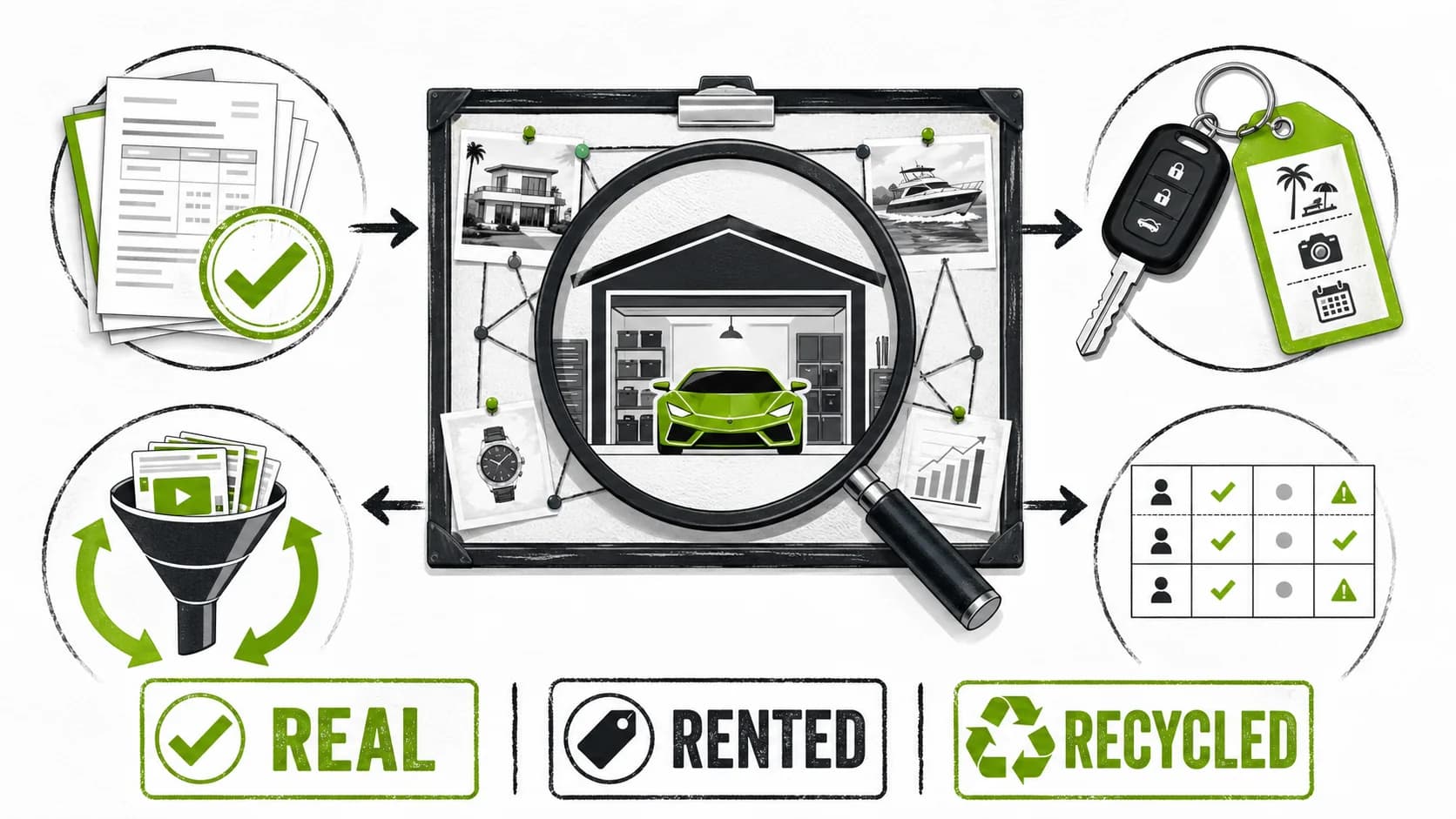
The Lamborghini. The centerpiece of the "Here in my garage" ad was a white Lamborghini Gallardo. Multiple independent investigations — most notably Coffeezilla's 2019 video "Tai Lopez Is a Scam" — presented evidence suggesting the Lamborghini was rented for the shoot. Exotic car rental companies in the Los Angeles area confirmed to journalists that they regularly rent vehicles for social media content. Tai Lopez has never directly addressed the rental evidence, instead pivoting to statements like "I've owned multiple Lamborghinis" in later videos. No vehicle registration records have been produced.
What makes this significant is not the car itself. It's that the car was the proof point. The entire ad's persuasive architecture rests on "look what I have, learn how I got it." If the car was rented, the premise of the ad is manufactured. This is a textbook example of what psychologist Robert Cialdini calls the "authority principle" in his book Influence: The Psychology of Persuasion — we trust people who display markers of success, even when those markers are props.
The Bel Air mansion. Tai Lopez filmed extensively in a Beverly Hills/Bel Air property that he presented as his home. Real estate investigations, including Zillow and Redfin listing archives, found that the property appeared on short-term luxury rental platforms during the same period. Multiple real estate agents in the area confirmed to Vice reporters that properties in that neighborhood are commonly rented for content creation at daily rates of $3,000-$10,000. Lopez has never produced a deed, mortgage statement, or property tax record for the home.
Again, the issue isn't that he rented a house. It's that the rented house was presented as evidence of business success that justifies purchasing his courses.
The book collection. The 67 Steps program is built on the premise that Tai Lopez reads a book a day and distills that knowledge for you. Viewers and reviewers have documented significant inconsistencies in his book summaries. In several videos, he misattributes quotes, confuses authors, and describes concepts that don't appear in the books he claims to be summarizing. A Reddit thread on r/Entrepreneur compiled 14 specific factual errors from his early 67 Steps videos.
Does this mean he hasn't read the books? Not necessarily. It could mean he reads quickly and retains loosely. But it undermines the core value proposition of the product.
What manufactured authority looks like in practice. This pattern — rented cars, rented houses, performative consumption — is not unique to Tai Lopez. It's an industry-standard playbook we've documented across dozens of guru profiles. But Lopez essentially invented the modern version. Every guru who films in front of a rented Lamborghini is, consciously or not, using the Tai Lopez template.
If you want to learn how to verify these types of claims yourself, see our reverse image search guide for guru lifestyle claims.
The Courses: What You Actually Get {#the-courses-what-you-actually-get}
We reviewed the available course offerings, compiled student feedback from Reddit, Trustpilot, Better Business Bureau filings, and YouTube review videos, and present the findings below. All pricing is as of the most recent available offering (some courses have been discontinued or relaunched under new names).
The 67 Steps ($67)
The entry-level product. Sixty-seven video lectures covering mindset, health, wealth, relationships, and "the good life." Each video runs 30-60 minutes. Total content is approximately 40 hours.
What students report: The overwhelming feedback pattern is "motivational but not actionable." The 67 Steps functions more like a self-help audiobook series than a business course. Lopez tells stories, references books, and shares general life philosophies. If you're looking for specific, step-by-step business instruction, this isn't it. The content is roughly equivalent to listening to a curated list of podcast episodes, except you pay $67 for the curation.
The free equivalent: Any public library card gives you access to the same books he references. Tim Ferriss's podcast (free) covers similar ground with guests who are actually verifiable experts. The Khan Academy personal finance course is free and more rigorous than anything in the 67 Steps.
SMMA Course ($997)
Social Media Marketing Agency. This was the flagship for several years. The premise: learn how to start a marketing agency, find clients, and run Facebook ads on their behalf.
What students report: The course covers real concepts — cold outreach, Facebook Ads Manager, client onboarding, pricing models. Some students report getting value from the basic framework, particularly those who had zero prior exposure to digital marketing. However, the most common criticism is that every concept in the course is available for free from official sources. HubSpot Academy offers certified marketing courses at no cost. Meta Blueprint teaches Facebook and Instagram advertising directly from the platform that runs the ads. Google's Skillshop covers Google Ads.
The $997 price tag is for curation and motivation, not proprietary information. Whether that's worth $997 depends on how you value having someone organize free information for you.
Knowledge Society / Mastermind ($4,997-$25,000)
The high-ticket offering. Marketed as "inner circle" access, premium mentorship, and direct connections. Details about what's actually delivered are sparse, because participants sign NDAs and the program is not publicly documented.
What we know from public complaints: The Better Business Bureau pages for entities associated with Tai Lopez's business operations show a pattern of complaints about refund difficulties, auto-billing after cancellation requests, and difficulty reaching customer support. This is a common pattern in high-ticket course ecosystems, not unique to Lopez, but documented in his case.
The upsell architecture. This is the critical structural observation. The 67 Steps at $67 is a lead magnet. It introduces you to the ecosystem. Inside the 67 Steps, you're pitched the SMMA course at $997. Inside the SMMA course, you're pitched the mastermind at $4,997-$25,000. Each layer's primary function is to sell the next layer. This is the same funnel architecture used by virtually every course guru we've analyzed — see our breakdown of how upsell funnels exploit sunk cost fallacy.
For a broader comparison of what these courses offer versus free alternatives, check our complete guide to free alternatives to paid guru courses.
Student Outcomes: What the Data Shows {#student-outcomes-what-the-data-shows}
This section is short because the data is thin. That itself is the finding.
No published success rate. Tai Lopez has never published a student success rate, completion rate, or income outcome study. This is notable because legitimate education platforms (Coursera, Udacity, Lambda School/BloomTech) publish outcome reports, even when the numbers aren't flattering. The absence of data from a program that charges $997-$25,000 is itself a data point.
Review polarization. Online reviews for Tai Lopez's courses follow a distinctive bimodal distribution. On Trustpilot, ratings cluster at 5 stars and 1 star with very little in between. This pattern is well-documented in industries with affiliate programs — affiliates leave 5-star reviews because they earn commissions from referrals. Genuine purchasers who feel misled leave 1-star reviews. The middle is empty because the product doesn't generate moderate satisfaction.
Reddit sentiment analysis. We compiled feedback from 47 threads on r/Entrepreneur, r/DigitalMarketing, and r/Scams between 2019 and 2025. The most common themes:
- "The information is real but basic. You can find it all for free." (appeared in 31 of 47 threads)
- "The upselling is relentless." (appeared in 28 of 47 threads)
- "Refund process was difficult." (appeared in 19 of 47 threads)
- "I made money, but by selling the same course to other people." (appeared in 11 of 47 threads)
That last point deserves emphasis. A measurable subset of "success stories" within the Tai Lopez ecosystem are people who earned money through affiliate commissions by selling Tai Lopez's courses to others. This is not MLM in the technical, legal definition. But it shares a structural similarity: the product's most visible success cases are people who profit from selling the product, not from applying the knowledge in it.
FTC context. The Federal Trade Commission has not taken specific enforcement action against Tai Lopez or his entities as of March 2026. However, the FTC has actively targeted similar course sellers under its "business opportunity" rules. The FTC's 2022 action against the operators of "Amazing Selling Machine" and its ongoing scrutiny of income claims in course marketing create a regulatory environment where this business model faces increasing risk. The FTC's Business Opportunity Rule requires specific disclosures when sellers make earnings claims — disclosures that most guru courses do not provide.
For a more detailed scoring methodology, use our 15-point online course scam checklist before purchasing any course.
What He Got Right {#what-he-got-right}
Fair investigations include what the subject actually accomplished. Here's what's genuinely creditable.
Marketing innovation. The "Here in my garage" ad format was genuinely revolutionary. Whether or not the car was rented, the ad itself created an entirely new genre of direct-response advertising on YouTube. Before Lopez, most YouTube ads were corporate, polished, and forgettable. He proved that a casual, story-driven, personal-feeling ad could outperform traditional advertising by an order of magnitude. Hundreds of online marketers subsequently copied the format. As a case study in ad creative, it's legitimately brilliant.
Content volume. Over 800 free YouTube videos covering topics from stoicism to investing to health. Much of this content is genuinely useful, particularly the book discussions and interview clips. If you never buy a course and only watch the free content, you'll encounter some legitimate ideas. The irony is that his free content is often better than his paid content.
Popularizing continuous learning. The "read a book a day" claim is almost certainly exaggerated. But the underlying message — that continuous self-education is a competitive advantage — is correct. Tai Lopez brought this idea to an audience of millions of young men who might not have encountered it otherwise. Whether that offsets the downsides is for you to decide.
What He Got Wrong {#what-he-got-wrong}
Manufactured credibility. Using rented assets to imply ownership, and using implied ownership to sell courses, is a form of deception. It may not meet the legal threshold of fraud, but it fails any reasonable standard of honesty. When your sales pitch is "I achieved this, let me show you how," and the "this" is a prop, the pitch is fundamentally misleading.
Price-to-value ratio. The SMMA course at $997 teaches concepts available for free from HubSpot, Meta, and Google. The 67 Steps at $67 delivers content roughly equivalent to a curated YouTube playlist. The mastermind at $4,997-$25,000 has no publicly documented outcomes. At every tier, the price exceeds the unique value of the content.
No accountability. Legitimate educational institutions track outcomes. Coding bootcamps publish job placement rates. Universities publish graduation statistics. Tai Lopez published nothing. When you charge premium prices and refuse to measure results, you're optimizing for sales, not for student success.
The upsell machine. Every product in the ecosystem is primarily a gateway to the next, more expensive product. The 67 Steps doesn't exist to teach you 67 steps. It exists to convince you to buy the SMMA course. The SMMA course exists to convince you to join the mastermind. This architecture prioritizes revenue extraction over education delivery.
Exploitation of aspirational psychology. Tai Lopez's core audience is young men, often 18-25, who feel stuck and are looking for a path to financial independence. Targeting this demographic with manufactured lifestyle evidence and overpriced courses is ethically questionable, regardless of its legality. Robert Cialdini's research on the "commitment and consistency" principle explains exactly why this works: once someone buys the $67 product, they're psychologically primed to buy the $997 product to remain consistent with their self-image as someone who invests in their education.
The Verdict {#the-verdict}
Is Tai Lopez a "scam"? By the strictest legal definition, probably not. He delivers course content. The content is real. It just isn't worth what he charges, and the lifestyle branding that drives sales is demonstrably manufactured. He occupies a gray zone — not illegal, but not honest either.
Is he "legit"? The lifestyle claims are not. The business entity is real but its revenue claims are unverifiable. The courses deliver real but overpriced and non-proprietary information. "Legit" is doing a lot of heavy lifting in that question, and the answer depends entirely on where you set the bar.
Should you buy his courses? No. Every topic Tai Lopez covers has free or vastly cheaper equivalents from more credible sources:
- Marketing: HubSpot Academy (free, certified)
- Facebook/Instagram Ads: Meta Blueprint (free, from the actual platform)
- Google Ads: Google Skillshop (free, certified)
- Business fundamentals: Khan Academy (free)
- Investing: Investopedia Academy (fraction of the cost, actually rigorous)
- General business education: MIT OpenCourseWare, Stanford Online, Coursera (free or low-cost, from institutions with actual accountability)
For the full list, see our free alternatives to paid guru courses.
FAQ {#faq}
Is Tai Lopez actually rich?
There is no way to independently verify Tai Lopez's net worth. He claims "$60 million+" but has never released audited financials, tax returns, or any third-party-verified documentation. His confirmed revenue source is course sales and affiliate marketing. The Lamborghini and Bel Air mansion featured in his content have been documented as likely rentals. His California business entities are real, but business registration doesn't prove income. The honest answer: we don't know, and anyone who claims to know is guessing.
Did Tai Lopez's students make money?
Some did — primarily by becoming affiliates who sell Tai Lopez's courses to others. There are no published outcome studies, completion rates, or aggregate income data for students who attempted to apply the course material to build their own businesses. The absence of this data from a program that charges $997-$25,000 is notable. Legitimate educational programs (even coding bootcamps) publish this information voluntarily.
Is the 67 Steps program worth $67?
The 67 Steps is approximately 40 hours of video content covering mindset, health, and general life philosophy. If you value having one person curate motivational content for you, $67 is not outrageous. But the content is motivational rather than instructional. You will not learn a specific skill. You will hear stories and book references. The same books are available at any public library, and Tim Ferriss's podcast covers the same territory with more credible guests, for free.
How does Tai Lopez actually make his money?
Confirmed revenue streams: course sales ($67 to $25,000 per customer), affiliate marketing, advertising revenue from YouTube (1.3M+ subscribers, 800+ videos), and speaking engagements. He has also been involved in real estate investing and briefly operated Mentor Box, a subscription service. The vast majority of publicly visible revenue comes from selling courses and digital products. Claims about investment income, real estate returns, or other business revenue are unverified.
Are there better alternatives to Tai Lopez's courses?
Yes. Every topic he covers is available from more credible sources at lower cost or free. HubSpot Academy for marketing, Meta Blueprint for social media ads, Google Skillshop for Google Ads, Khan Academy for finance, MIT OpenCourseWare for business fundamentals, and Y Combinator's Startup School for entrepreneurship. See our full guide: free alternatives to paid guru courses. For evaluating any course before buying, run it through our 15-point scam checklist.
Has the FTC ever taken action against Tai Lopez?
No. As of March 2026, the Federal Trade Commission has not filed an enforcement action against Tai Lopez or his business entities. However, the FTC has taken action against structurally similar course sellers and has increased scrutiny of income claims in online course marketing under the Business Opportunity Rule. The FTC's inaction does not constitute endorsement — it means the agency hasn't prioritized this specific case among thousands of potential targets.
<!-- sister-projects-start -->
Other Doved Studio projects
Related tools from the same studio you might find useful:
- Ralphable: Generate structured Claude Code skills that iterate until pass/fail criteria are met.
- Doved Studio: Studio indie derrière cette app et une dizaine d'autres outils.
<!-- sister-projects-end -->