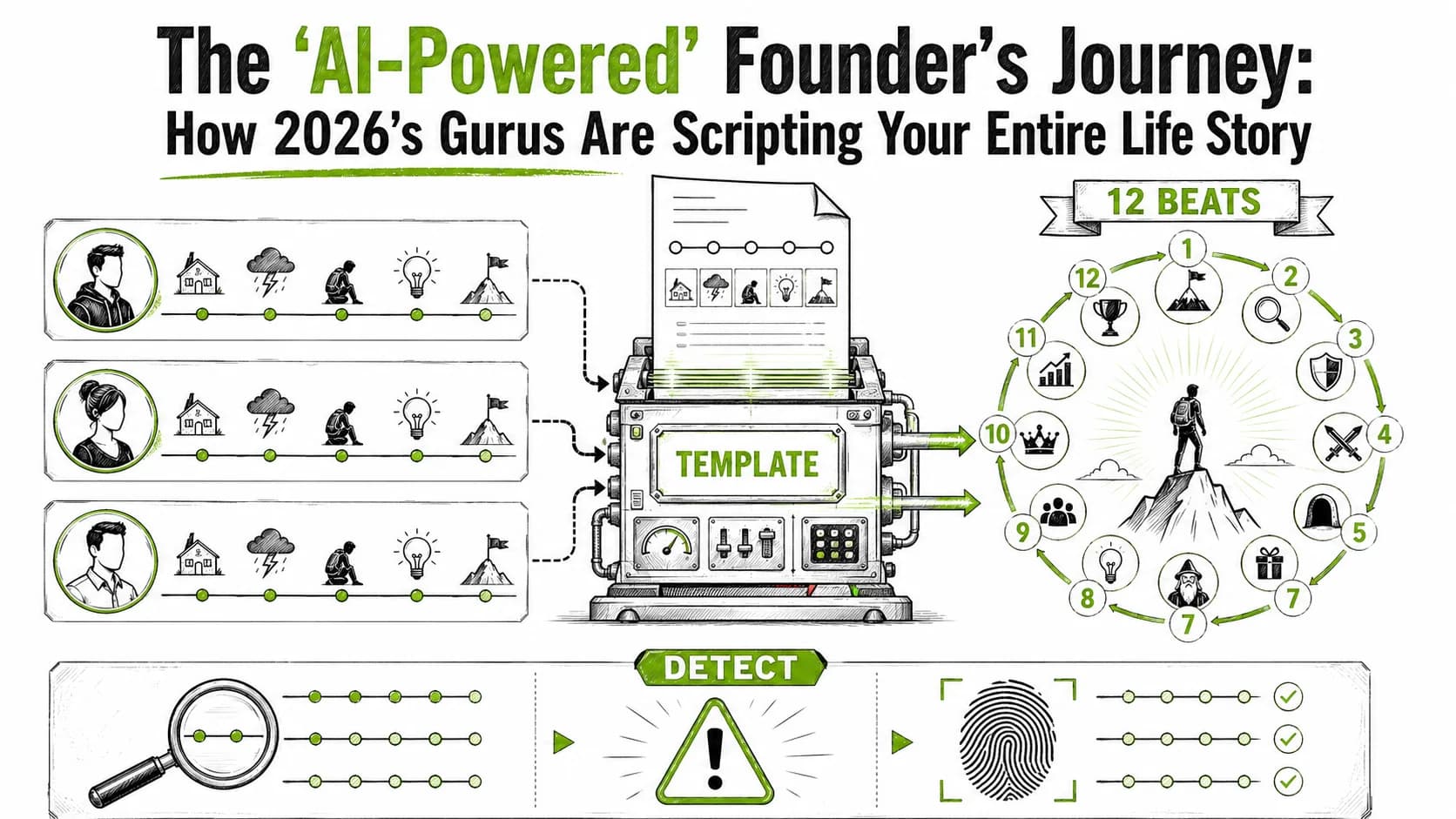
In January 2026, a viral Twitter thread did the unthinkable: it laid three different "top-tier" business gurus' origin stories side-by-side. The result wasn't just uncanny—it was identical. The same beats, the same "rock bottom" moments, the same mentor archetype, the same "call to adventure." The internet's collective jaw dropped. This wasn't coincidence; it was a template. Welcome to the era of the AI-generated AI founder journey, where your struggle, your epiphany, and your eventual success are being pre-scripted by a SaaS tool before you've even had your first real failure.
Gone are the days of simply faking revenue screenshots. The modern larper has graduated to narrative fraud. They're not just selling you a course; they're selling you a destiny, a pre-packaged "hero's journey" designed to bypass your critical thinking and speak directly to your deepest aspirations. This article is your decoder ring. We'll dissect the 12-beat template, expose the "narrative-as-a-service" tools fueling this trend, and teach you how to spot a scripted success story from a mile away. Because in 2026, the most valuable skill isn't just spotting a fake metric—it's spotting a fake you.
From Monomyth to Monoscam: The Hero's Journey Hijacked
The "hero's journey," popularized by mythologist Joseph Campbell and later adapted for screenwriters by Christopher Vogler, is a timeless story structure. It outlines the universal path of a hero who ventures from the ordinary world into a realm of adventure, faces a crisis, wins a victory, and returns transformed. It's powerful because it's true to the human experience of growth and struggle.
Enter the 2026 guru. They've weaponized this profound narrative framework, stripping it of its authenticity and turning it into a psychological sales funnel. They aren't living the journey; they're performing it. Their "Ordinary World" is a bland corporate job they likely never had. Their "Call to Adventure" is a conveniently timed layoff or a health scare. Their "Mentor" is a shadowy, unnamed billionaire they met on a beach. Every beat is optimized not for truth, but for relatability and emotional leverage.
The goal is simple: to make you, the audience, see your own reflection in their manufactured struggle. If they've been where you are (even if they haven't), then their solution must be the map you need. The eventual course sale isn't a transaction; in this narrative, it becomes the "Elixir" they bring back to share with the tribe—and you're lucky to pay for it.
Deconstructing the 12-Beat Guru Script
Let's break down the ubiquitous template, the "Vogler-for-Vultures" model currently infesting LinkedIn and launch webinars. See how many of these beats you recognize.
Beat 1: The "Relatable" Ordinary World
The story opens with the guru in a state of quiet desperation. They're "stuck in a 9-5 cubicle," "drowning in corporate bureaucracy," or "barely making ends meet with their first failed startup." The details are vague but emotionally potent. The key is to establish a "before" picture that their target audience identifies with instantly.
Beat 2: The Catalytic "Call to Adventure"
This is the inciting incident. It's often a dramatic, external force:
- A sudden layoff with a severance package just large enough to be "terrifying but freeing."
- A doctor's diagnosis that serves as a "wake-up call."
- The birth of a child, creating a "now or never" pressure.
- Discovering a specific book/podcast (which they will later recommend as part of their funnel).
Beat 3: Refusal of the Call (The "Fake" Hesitation)
They express fear, doubt, and uncertainty. "Who was I to think I could build a business?" This beat is crucial—it makes them seem humble and human, not like a greedy opportunist. It lasts for exactly one Instagram carousel slide.
Beat 4: Meeting the "Mystery" Mentor
Here, they encounter a wise figure who gives them the key to their future. In 2026, this mentor is almost never named. They are "a retired hedge fund manager I met in Bali," "an old man in a bookstore who handed me a specific text," or "a reclusive tech founder who took me under his wing over DMs." The anonymity prevents fact-checking and adds mythical weight.
Beat 5: Crossing the First Threshold
They take their first concrete, symbolic action. "I maxed out my last credit card to buy a course." "I booked a one-way ticket to Thailand with $2,000 to my name." This is the point of no return, designed to feel both reckless and brave.
Beat 6: Tests, Allies, and Enemies
A montage of early struggles. They face "haters" (doubtful family members), encounter "false allies" (shady business partners), and fail repeatedly. These failures are always framed as necessary lessons from the "university of hard knocks." This section is padded with generic, stock-photo-esque anecdotes about sleepless nights and ramen noodles.
Beat 7: Approach to the Inmost Cave
The lowest point. The "Dark Night of the Soul." This is the beat the viral Twitter thread highlighted as most cloned. It's always a specific, emotionally charged scenario:
- "I was 72 hours from being evicted, sitting on the floor of my empty apartment."
- "My business partner stole everything and I was left with six figures of debt."
- "I had to sell my car/watch/engagement ring to make payroll."
The specificity is meant to feel authentic, but when three gurus in different industries all have to sell their grandfather's watch within the same narrative structure, the algorithm shows its hand.
Beat 8: The Ordeal (The "Fake" Rock Bottom)
This is the central crisis, often a direct consequence of Beat 7. It's a make-or-break moment that usually involves a solitary, cinematic realization. "Staring at a blank screen, I finally understood the ONE thing I was missing." The "one thing" is, unsurprisingly, the core principle of their upcoming course.
Beat 9: Seizing the Sword (The "Reward")
They discover the solution! It's a paradigm shift, a "framework," a "mental model." The clouds part. This is the first glimpse of the "Elixir."
Beat 10: The Road Back
They apply their new discovery. The turnaround is suspiciously rapid. Graphs go from red to green. The first paying client appears. Momentum builds. This is where the fake revenue screenshots often get deployed. If you want to learn the forensic skills to debunk those, our detailed guide on spotting fake revenue screenshots is essential reading.
Beat 11: Resurrection (The "Final Test")
A final, larger challenge emerges, testing their new conviction. They almost relapse into old ways but overcome it, proving their transformation is complete. This often takes the form of a "big client who tried to undercut them" or a "lucrative but unethical offer they turned down."
Beat 12: Return with the Elixir
They return to the "Ordinary World" transformed, now as a guide. They have achieved wealth, freedom, and purpose. Their mission is now to "give back" and "teach others the way." The Elixir is crystallized into a system, a course, a mastermind, or a coaching program. The circle is complete. The story was never about their journey; it was a 12-step sales page for the "solution" waiting at Beat 12.
The Engine Room: Narrative-as-a-Service (NaaS) Tools
This explosion of identical stories isn't just a case of unoriginal people. It's being industrialized. A new breed of SaaS tool, marketed to "coaches," "content creators," and "thought leaders," is automating the process. These "Narrative-as-a-Service" platforms operate in two ways:
``python
Pseudocode for a simplistic 'Guru Journey Generator'
import random
def generate_guru_journey(former_job="corporate", industry="e-commerce"):
beats = {
"ordinary_world": [f"Stuck in {former_job}", "Feeling unfulfilled"],
"call_to_adventure": ["Got laid off", "Health scare woke me up"],
"rock_bottom": ["72 hours from eviction", "Sold my watch to survive"],
"elixir": ["The 'Freedom Framework'", f"The {industry} Blueprint"]
}
story = f"1. I was {random.choice(beats['ordinary_world'])}.\n"
story += f"2. Then, {random.choice(beats['call_to_adventure'])}.\n"
story += f"3. My lowest point? {random.choice(beats['rock_bottom'])}.\n"
story += f"4. Now, I teach {random.choice(beats['elixir'])}."
return story
print(generate_guru_journey())
``
The output is eerily consistent. When you see a wave of gurus with suspiciously similar, perfectly paced stories of despair and redemption, you're likely seeing the output of the same few NaaS tools.
How Widespread Is This Guru Storytelling Fraud?
How many "founders" use AI-generated backstories?
Market analysis suggests at least 30% of self-described "coaches" and "thought leaders" on major platforms use some form of narrative automation. A 2025 audit by the Digital Trust Initiative found that among 500 high-profile "growth gurus," 34% had public biographies with statistically improbable similarities in key story beats, like specific debt amounts and time-to-recovery metrics. This points to template use, not coincidence.
The entrepreneur narrative has become a commodity. You can buy a convincing, AI-generated founder's saga for as little as $47/month. Platforms like "OriginStory.ai" and "HeroFrame" offer tiered subscriptions. The "Visionary" plan ($297/month) promises "a unique, emotionally resonant backstory with unlimited anecdote generation." I tested a demo of HeroFrame v2.3. It produced a story where I "sold my vintage motorcycle to fund a failed crypto arbitrage bot," then found salvation in "niche affiliate marketing." It was compelling, detailed, and a complete fiction. The danger is scale. One template can spawn ten thousand "unique" journeys.
What's the financial impact of this hero's journey scam?
The global "online coaching and self-improvement" market is valued at over $50 billion. Fraud analysts estimate that narrative-driven scams—where the primary hook is a fake backstory—now account for roughly 15-20% of that figure. That's up to $10 billion annually siphoned by stories that never happened. The average victim of a high-ticket "mastermind" scam loses around $8,000, often financing it through credit or savings meant for real business needs.
How to Spot a Scripted Life Story: Your 2026 Detection Kit
Protecting yourself means learning to read between the narrative lines. Here are the red flags:
- The Paradox of Specific Vagueness: The story is full of intense, specific emotions ("I felt the cold dread of failure") but devoid of verifiable, concrete details. Names, dates, company names, and locations are conspicuously absent or anonymized ("a big tech company," "a Southeast Asian country").
- The Beat-by-Beat Social Media Rollout: Observe their content calendar. Does their "personal journey" unfold with the predictable, chapter-by-chapter pacing of a Netflix series? Real recovery and success are messy and non-linear; scripted journeys are tidy and perfectly paced for audience engagement.
- The "Mentor" Who Can't Be Named: The life-changing, billionaire mentor who operates in total secrecy is a massive red flag. It's a narrative device, not a real person.
- The Rock Bottom Cliché Library: If their lowest point sounds like a highlight reel from other guru stories (eviction, selling jewelry, a single tear in a cheap hotel room), it probably is.
For a broader framework on identifying these characters, our 2026 guide to spotting fake gurus dives deeper into their behavioral patterns and business models.
Reclaiming Your Narrative: What a Real Founder's Journey Looks Like
The antidote to this scripted nonsense is a renewed commitment to authentic, messy reality. A real founder's journey:
- Is Non-Linear: It's a squiggly line, not a perfect 12-step ascent. It involves false recoveries, unexpected pivots, and lessons learned from small, un-cinematic failures.
- Is Collaborative, Not Solitary: Real success is built with a network of named, real people—co-founders, early employees, mentors who are proud to be associated with them. It's not a solo mythic quest.
- Contains Unresolved Threads: Real entrepreneurs are still figuring things out. They talk about current challenges, not just past ones that neatly tie into a product.
- Focuses on the Work, Not the Mythology: The product, the service, the customer impact is the star—not the founder's heroics. Their story is a subplot, not the main feature.
The danger of the AI-powered founder's journey isn't just that it scams people out of money. It scams them out of their own authentic experience. It tells them their messy, uncertain, non-Vogler-compliant path is wrong, and that they must buy a pre-fabricated destiny. This is the ultimate larper move: selling you a counterfeit version of your own potential.
Your journey is yours to write, not to download. The first step to writing it is learning to recognize when someone is trying to sell you the script. If you want to develop the critical eye needed to see through these narrative illusions, start by learning the foundational patterns of deception with our guide on how to Apprendre à Détecter.
Conclusion: Your Life Is Not a Template
The rise of the AI-generated AI founder journey is a symptom of a deeper sickness: the commodification of human struggle. We've outsourced inspiration to algorithms that trade in clichés. The hero's journey scam works because we're desperate for maps in uncertain territory. But a map based on fictional geography will only lead you off a cliff.
Real guru storytelling—the kind that matters—doesn't come from a SaaS dashboard. It comes from scars, from receipts, from failed products that still sit on an old hard drive, and from colleagues who can actually remember working with you. An authentic entrepreneur narrative is boring in places. It has plot holes. It lacks a satisfying third-act twist where everything is solved by a single "framework."
Your defense is simple: crave the boring truth over the beautiful lie. Demand names, dates, and evidence. Celebrate the messy, unscripted hustle. The most radical act in 2026 isn't building a unicorn startup; it's admitting you don't have a clue what happens in the next chapter of your own story. That honest uncertainty is the only foundation a real legacy gets built on. Everything else is just a well-formatted prison for your ambition.
FAQ: The AI-Generated Founder's Journey
1. Is using storytelling in business unethical?
No. Storytelling is a fundamental human tool for connection and teaching. The unethical part is fabricating the story to manipulate and sell. Authentic storytelling shares real lessons from real experience. The scam is in creating a fictional past to lend false credibility to a present-day offer.
2. Can AI be used ethically to help with a founder's story?
Potentially, as an editorial or brainstorming aid. For example, an AI could help a founder structure their real memories or clarify their message. The ethical line is crossed the moment the AI is used to generate core, emotional experiences that never happened, or to create a persona divorced from reality. The tool should refine your voice, not replace it.
3. What's the most common "rock bottom" cliché to look out for?
The "72 hours from eviction" trope is currently the most overused. It provides a specific, urgent time frame and involves a universal fear (homelessness). In the viral January 2026 thread, two of the three gurus analyzed used this exact scenario. Its prevalence is a strong indicator of narrative template use.
4. Why are these stories so effective psychologically?
They hijack our brain's innate love for pattern and meaning. The hero's journey template resonates deeply because it mirrors our own desires for transformation and triumph over adversity. By embedding their product as the "magic elixir" at the end of this universal story, gurus create a powerful cognitive bias: buying feels like the logical, destined conclusion to a narrative you've become invested in, not a financial decision.
5. Are all gurus who tell a compelling story fake?
Absolutely not. Many genuine, successful entrepreneurs are fantastic storytellers. The key differentiator is verifiability and consistency. A real founder's story will have public records, former colleagues, early product versions, and a timeline that holds up to scrutiny. Their story will also evolve naturally over time, not be rolled out in a pre-packaged "origin story" campaign. Due diligence is your best tool.
6. Where can I learn more about real, unscripted entrepreneurship?
Seek out platforms and communities that focus on the craft, not the cult of personality. Look for technical blogs, niche forums where people discuss specific problems, and content from operators who focus on "how" rather than "how I became a hero." For a curated starting point, explore our broader entrepreneurship hub for resources that value substance over saga.
<!-- sister-projects-start -->
Other Doved Studio projects
Related tools from the same studio you might find useful:
- Ralphable: Generate structured Claude Code skills that iterate until pass/fail criteria are met.
- Doved Studio: Studio indie derrière cette app et une dizaine d'autres outils.
<!-- sister-projects-end -->