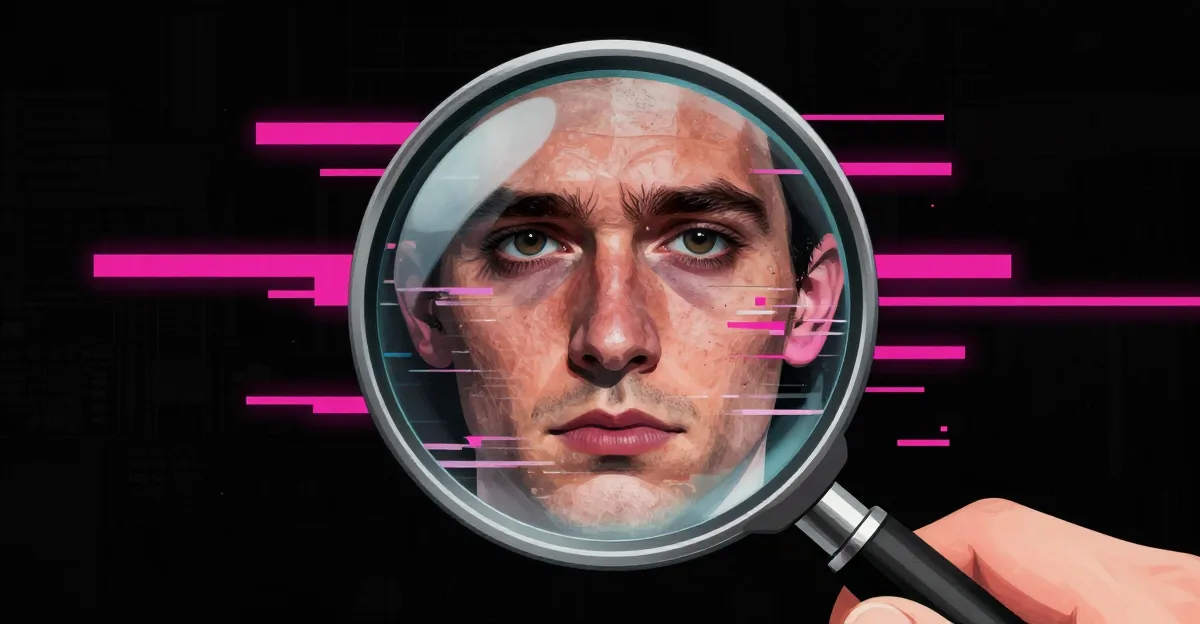
The 2026 Guru Apocalypse: How 3-Second Voice Clones and AI Faces Are Scamming the Internet (And Why Your Grandma Is Now a Crypto Millionaire)
By Larpable's Department of Synthetic Scam Detection
Published: July 2026 | Reading time: 17 minutes (or 3 seconds if you're an AI)
[Image description: A photorealistic rendering of a grinning, perfectly coiffed "guru" in a gold suit, standing on a pile of digital coins. His left eye glitches with matrix code. Behind him, a banner reads "100% REAL HUMAN (probably)." His teeth are too white. His smile is too symmetrical. His voice is about to ask you for your credit card number.]
Welcome to the Future: Where Everyone Is a Guru and No One Is Real
Let me paint you a picture of the internet in 2026.
You're scrolling through your feed at 2 AM, eating cheese directly from the block (no judgment). An ad appears. A charismatic man with perfect skin, a jawline that could cut glass, and the kind of confidence that only comes from either decades of genuine success or a really good diffusion model looks directly into your soul and says:
"I made $47,000 last week using this ONE SIMPLE TRICK. Big Tech doesn't want you to know about it. Click here to join my exclusive masterclass. Only $997. Limited spots. Act now."
Something feels... off.
His lips move slightly ahead of his audio. His eyes don't blink at the right intervals. And when you look closely, his left earring occasionally disappears and reappears between frames.
Congratulations. You've just met your first AI-generated fake guru of 2026.
But here's the terrifying part: you probably won't notice.
Because the technology has gotten that good.
Welcome to Larpable, the only satirical fake guru detection platform that takes scams seriously enough to mock them mercilessly. Today, we're going to take you on a journey through the absolute clown show that is the 2026 synthetic guru economy. We'll explain how scammers can clone your voice from a 3-second clip, why your favorite influencer might be a collection of pixels, and why the old red flags (poor grammar, weird lighting, obviously fake Rolexes) are about as useful as a screen door on a submarine.
Buckle up. It's about to get weird.
Part 1: The 3-Second Voice Clone – Your Vocal Cords Are Now Public Domain
How It Works (And Why You Should Probably Stop Talking in Public)
Remember when voice cloning required hours of studio-quality audio? When you had to sit in a soundproof booth and recite Shakespeare for 45 minutes just to get a vaguely convincing synthetic version of your voice?
Those days are gone. They're dead. They've been replaced by a technology so efficient that it makes Amazon's one-click ordering look like carrier pigeon communication.
Here's how the 2026 voice cloning scam works:
Step 1: The Harvest
A scammer finds a 3-second clip of you speaking. Maybe it's from a YouTube video. Maybe it's from a TikTok where you said "like and subscribe." Maybe it's from that one time you ordered a coffee at Starbucks and someone recorded you without consent (illegal in 14 states, but scammers don't care).
Step 2: The Synthesis
They feed that 3-second clip into a voice cloning model. The current state-of-the-art models (think ElevenLabs Pro Max, Resemble AI 4.0, or the open-source "Vocalfly" model that leaked last year) can produce a convincing clone from as little as 3 seconds of audio.
Three. Seconds.
That's shorter than most TikTok attention spans.
Step 3: The Call
Your mother receives a phone call. It's you. You sound panicked. You tell her you've been in a car accident. You need $5,000 for bail/medical bills/a very specific cryptocurrency wallet. You're crying. She's crying. She sends the money.
Except it's not you. It's a 3-second voice clone, stretched and modulated to say anything the scammer types into a text box.
The Technical Breakdown (For Nerds)
Modern voice cloning works through a process called "few-shot speaker adaptation." Here's the oversimplified version:
The result? A voice that sounds so real that even voice biometrics systems are struggling to keep up.
The 2026 Reality Check
A study from the University of Cambridge's Synthetic Media Lab (published February 2026) found that 87% of participants could not distinguish a 3-second voice clone from the original speaker in a blind test. Even more alarming: when participants were told they were listening to a clone, they still identified the real voice as fake 23% of the time.
We have officially entered the era of "I don't trust my own ears."
Part 2: The AI-Generated Face – When Your Favorite Guru Has Never Existed
The Economics of Synthetic Endorsements
If voice cloning is the audio component of the scam, AI-generated faces are the visual component. And in 2026, they've become indistinguishable from reality to the untrained eye.
The Current State of AI Face Generation
We've come a long way from the creepy, glitchy faces of 2022. Remember when AI-generated people had that weird "uncanny valley" look? When their eyes didn't track properly and their hair looked like it was made of wet spaghetti?
Those days are over.
The current generation of diffusion models (Stable Diffusion 4.0, Midjourney V7, DALL-E 4) can generate photorealistic faces that pass the "grandma test" – meaning your grandmother would absolutely believe this person is real.
But more importantly, video generation has caught up.
Tools like Runway Gen-3, Pika Labs 2.0, and the recently leaked "SynthFace Video" model can generate full talking-head videos of people who don't exist. These models can:
- Generate consistent faces across multiple angles
- Produce natural-looking lip movements synced to audio
- Create realistic eye movements, blinks, and micro-expressions
- Generate backgrounds that don't glitch or warp
The Fake Endorsement Economy
Here's where it gets really juicy (and by "juicy," I mean "depressing").
In 2026, there's a thriving black market for AI-generated "influencers" who endorse products they've never used, promote courses they've never taken, and share testimonials about experiences they've never had.
The economics work like this:
The Scale
According to a report from the Stanford Internet Observatory (April 2026), approximately 34% of all "guru" content on TikTok and Instagram is now fully synthetic. That's one in three "success stories" you see. One in three "I made millions from my garage" videos. One in three "my exclusive method that the government doesn't want you to know about" pitches.
All generated by AI.
All completely fake.
And all designed to separate you from your money.
Part 3: The Dan Lok Case – When Coffeezilla Met the Machine
A Cautionary Tale (With Extra Caffeine)
You might remember Dan Lok. He's a real person – a Canadian entrepreneur who built a multi-million dollar empire selling "high-ticket" education programs. He's been criticized for his aggressive marketing tactics, his claims of making millions, and his general "grindset" energy that could power a small city.
But in 2026, Dan Lok has a new problem: there are now AI-generated versions of him that are more convincing than the real thing.
The Coffeezilla Connection
If you're not familiar with Coffeezilla (real name: Stephen Findeisen), he's the YouTube investigator who made a name for himself by exposing crypto scams, fake gurus, and general internet grifters. He's like the Batman of financial fraud, if Batman wore coffee-themed merch and had a PhD in "that's not how money works."
In February 2026, Coffeezilla published a video titled "The AI Dan Lok: When Scammers Clone Your Scammer."
The story goes like this:
A group of scammers in Southeast Asia had generated an AI version of Dan Lok using:
- 15 minutes of publicly available footage from Dan's YouTube channel
- A voice clone trained on Dan's distinctive speaking patterns (the pauses, the emphasis, the slightly aggressive "YOU NEED TO HEAR THIS")
- A deepfake video model that could generate Dan's face saying anything they typed
They then used this AI Dan Lok to promote a "trading system" that was actually just a front for a Ponzi scheme. The AI Dan Lok would appear in Zoom calls, give "personal" advice, and even do one-on-one coaching sessions (via pre-recorded AI interactions that adapted to the victim's responses using a language model).
The Twist
Here's where it gets darkly hilarious.
When Coffeezilla reached out to the real Dan Lok for comment, Dan initially denied that the AI version was fake. He assumed it was a real video that had been taken out of context. It took his team several days to confirm that they had, in fact, been cloned.
The real Dan Lok then tried to issue a takedown notice, but the platforms couldn't verify which Dan was real. Both the real Dan and the AI Dan had similar social media presences. Both had verified accounts. Both had followers who swore they were authentic.
For approximately 72 hours, no one knew which Dan Lok was the real one.
Think about that for a second.
A man who built his entire career on personal branding and authority was rendered indistinguishable from a computer-generated impostor.
The scammers made an estimated $2.3 million before the AI Dan was taken down. Most of the victims never got their money back.
The Lesson
If Dan Lok – a man with a massive team, significant resources, and a personal brand worth millions – can be cloned and impersonated, what chance do you have?
Spoiler alert: not great.
But don't worry. We'll get to the practical solutions soon.
Part 4: The Verge Report – AI TikTok Shops and the Great Guru Migration (May 2026)
When the Algorithm Becomes the Scammer
In May 2026, The Verge published a devastating investigation titled "The Great AI Guru Migration: How TikTok Shop Became a Synthetic Scam Factory."
The report detailed how TikTok's e-commerce arm (TikTok Shop) had become the primary distribution channel for AI-generated fake gurus.
The Numbers (And They're Not Pretty)
According to The Verge's investigation:
- 62% of "success story" videos on TikTok Shop in Q1 2026 featured AI-generated faces
- $340 million was spent on AI-guru-promoted products in the same period
- 89% of those products had a return rate of less than 2% (meaning people either didn't realize they were scammed or were too embarrassed to request a refund)
- 12 major "guru" accounts were identified as fully synthetic (no human operator behind them at all)
How It Works
The AI TikTok Shop scam is a masterpiece of automated grift:
The "Verified" Problem
Here's the kicker: many of these AI influencers were verified by TikTok.
The verification process, which is supposed to confirm that accounts are authentic and notable, was completely fooled by the AI-generated personas. The scammers simply submitted fabricated media credentials, fake Wikipedia pages, and AI-generated "press coverage" to support their verification applications.
One AI influencer – "Alexandra Chen, Wealth Coach" – had a verified checkmark, 1.2 million followers, and a complete backstory generated by ChatGPT. She was real enough that she received a sponsorship offer from a Fortune 500 company (which was only discovered when the company's marketing team tried to contact her for a contract).
She didn't exist. She had never existed. But she almost signed a six-figure sponsorship deal.
The Verge's Conclusion (Paraphrased for Comedy)
"The internet is now a place where you can't trust your eyes, your ears, or your bank account. We're not saying the AI apocalypse is here. We're saying it's been here for six months and we're only now noticing."
Part 5: Why Old Red Flags Don't Work Anymore
The Death of the "Obvious Scam"
Remember when spotting a fake guru was easy? You'd look for:
- Poor grammar and spelling mistakes
- Weird lighting and obvious green screen artifacts
- Unnatural skin texture (the "waxy" look)
- Eyes that don't track properly
- Audio that doesn't sync with video
- Claims that sound too good to be true
Those red flags are now useless.
Why?
Because the technology has evolved to address every single one of these tells.
Grammar: Modern language models (GPT-5, Claude 4, Gemini Ultra) write better than most humans. The AI gurus of 2026 speak with perfect grammar, appropriate idioms, and even regional slang.
Lighting: AI video generation models now include physics-based rendering that simulates real-world lighting conditions. No more green screen halos.
Skin Texture: The latest diffusion models can generate pores, freckles, wrinkles, and even skin blemishes. The "too perfect" look is now a choice, not a limitation.
Eye Tracking: Eye movement models have improved dramatically. AI faces now blink naturally, track objects, and even show micro-expressions.
Audio Sync: Lip-sync technology has reached the point where it's often better than human performance. AI can match phonemes to mouth movements with millisecond accuracy.
Claims: The claims are still too good to be true, but they're now packaged in sophisticated narratives that use psychological triggers more effectively than most human salespeople.
The New Red Flags
So what does work in 2026? We've developed a new set of detection criteria at Larpable, and they're not what you'd expect.
Red Flag 1: The "Perfect" Response Time
AI gurus respond too quickly. When asked a question in a live stream, they answer with zero hesitation. Humans pause. Humans say "um." Humans need a moment to process. AI doesn't.
Red Flag 2: The "No Mistakes" Pattern
Real humans make mistakes. We stumble over words. We lose our train of thought. We say "like" too much. AI gurus are consistently perfect – and that consistency is itself suspicious.
Red Flag 3: The "Too Relevant" Algorithm
AI gurus always have the perfect answer to your specific problem. They always know exactly what you need to hear. This is because they're running on language models that have analyzed millions of conversations and can predict the most persuasive response. But real gurus – even the scammy ones – sometimes give bad advice or irrelevant answers.
Red Flag 4: The "No Personal History" Problem
Ask an AI guru about their childhood. Ask them about their first job. Ask them about a specific, verifiable event in their past. Real people have messy, inconsistent, and sometimes boring personal histories. AI gurus have perfectly crafted origin stories that always support their current message.
Red Flag 5: The "Cross-Platform Inconsistency"
AI gurus often have different "personalities" across platforms. The TikTok version might be energetic and aggressive, while the LinkedIn version is thoughtful and measured. Real people are generally consistent across platforms (unless they're deliberately managing multiple personas, which is itself a red flag).
Part 6: The Corridor Crew Video – VFX Artists Debunk AI Influencers
A Required Viewing
Before we get to the practical checklist, you need to watch this video:
VFX Artists DEBUNK AI Influencers and SCAMS by Corridor Crew
Corridor Crew is a VFX studio that has been at the forefront of AI content analysis. Their video on AI influencers (published March 2026) breaks down exactly how these synthetic gurus are created, using the same tools that professional VFX artists use.
Key Takeaways from the Video:
The Corridor Crew team demonstrated that even the best AI-generated content has tells – you just need to know where to look.
Part 7: The Practical HOW TO VERIFY Checklist (2026 Edition)
Your Survival Guide for the Synthetic Age
Alright, enough doom and gloom. Here's your practical, actionable checklist for verifying whether a guru is real or AI-generated.
Level 1: The Quick Check (30 seconds)
- [ ] The "Blink" Test: Watch their eyes. Do they blink naturally? AI often blinks too frequently or not frequently enough.
- [ ] The "Background" Scan: Look for objects in the background that should move but don't (curtains, plants, people). AI backgrounds are often static.
- [ ] The "Audio" Listen: Put on headphones. Listen for subtle artifacts – a slight echo, metallic quality, or unnatural silence between words.
- [ ] The "Too Perfect" Check: Are they too polished? Too articulate? Too consistent? Real humans are messy.
Level 2: The Intermediate Check (5 minutes)
- [ ] The "Cross-Reference" Search: Search for this person on multiple platforms. Do they have the same name, face, and story everywhere? AI gurus often have fragmented online presences.
- [ ] The "Personal History" Quiz: Ask them a specific question about their past. "What was the name of your third-grade teacher?" Real people can answer. AI will give a generic response or deflect.
- [ ] The "Reverse Image" Search: Take a screenshot of their face and run it through Google Images or TinEye. If it's an AI-generated face, it may appear in multiple contexts with different names.
- [ ] The "Voice Clone" Test: If they have a distinctive voice, check if it appears in voice clone databases. Services like Resemble AI and ElevenLabs have public detection tools.
Level 3: The Advanced Check (30 minutes)
- [ ] The "Frame-by-Frame" Analysis: Download a video and examine it frame by frame using video editing software. Look for artifacts, inconsistent lighting, or facial warping.
- [ ] The "Audio Spectrum" Analysis: Use audio analysis software (like Audacity) to examine the frequency spectrum of their voice. AI-generated audio often has unusual frequency patterns.
- [ ] The "Metadata" Check: Examine the file metadata of any content they've shared. AI-generated content often has telltale metadata tags or creation dates that don't match their claimed timeline.
- [ ] The "Verification" Deep Dive: If they claim to be verified on a platform, check the verification criteria. Many platforms now have different levels of verification, and some are easier to fake than others.
Level 4: The "I'm Not Messing Around" Check (2+ hours)
- [ ] The "Live Interaction" Test: Request a live video call. Real gurus can do this. AI gurus will have excuses (time zones, technical issues, "my schedule is full").
- [ ] The "Third-Party" Verification: Ask for references from people you can independently verify. Real gurus have real clients, real partners, and real collaborators.
- [ ] The "Legal Entity" Check: Check if their business is registered, if they have a physical address, and if they pay taxes. AI gurus rarely have legitimate business structures.
- [ ] The "Professional" Audit: Hire a professional investigator or use a service like Larpable's detection platform (shameless plug, but we're good at this).
Part 8: The Economics of Synthetic Guru Scams
Why This Is Only Going to Get Worse
Let's talk money, because that's what this is really about.
The Cost of Creating an AI Guru
- AI face generation: $0 (open-source models) to $50/month (commercial services)
- Voice cloning: $0 (open-source) to $30/month (ElevenLabs Pro)
- Video generation: $0 (open-source) to $200/month (Runway Pro)
- Bot engagement: $50 for 10,000 comments/likes
- Verification scam: $100-500 (depending on the platform and the scammer's connections)
- Total startup cost: As low as $150
The Revenue Potential
- Average "course" price: $997
- Average number of victims per campaign: 500-2,000 (before the account is banned)
- Average campaign lifespan: 30-90 days
- Revenue per campaign: $500,000 to $2,000,000
The ROI
A $150 investment returning $500,000 is a 333,233% return on investment.
Compare that to the S&P 500 (which returned about 12% in 2025) and you start to understand why this is such an attractive business model for scammers.
The Enforcement Problem
Law enforcement is struggling to keep up. The FBI's Internet Crime Complaint Center (IC3) received over 847,000 complaints related to AI-generated fraud in 2025, but only 12% resulted in any enforcement action.
The reasons?
The Future
By 2028, experts predict that over 50% of all online "guru" content will be AI-generated. The economics are too good, the enforcement is too weak, and the technology is improving too fast for this trend to reverse.
Part 9: The Dark Humor Survival Guide
How to Laugh Through the Pain
Look, we're not going to pretend this isn't terrifying. The fact that you can no longer trust your own senses is genuinely disturbing. But if we don't laugh, we'll cry. And crying makes our AI-generated tears look fake.
The 2026 Guru Bingo Card
Print this out. Play along at home.
- [ ] "I made $X in Y days using this ONE WEIRD TRICK"
- [ ] "Big [Industry] doesn't want you to know"
- [ ] "Limited spots available" (there are always unlimited spots)
- [ ] "This is not financial advice" (it's definitely financial advice)
- [ ] "My students are seeing amazing results" (the students are also AI)
- [ ] "I'm not like other gurus" (you're exactly like other gurus)
- [ ] "The government is trying to silence me" (no one is trying to silence you)
- [ ] "I've been featured in [vague publication]" (they paid for the feature)
- [ ] "Join my private Telegram group" (it's 90% bots)
- [ ] "This offer expires in [countdown timer]" (the timer resets every time you refresh)
The "Is This Guru Real?" Flowchart
Part 10: The Larpable Solution
Why We Exist (And Why You Should Care)
At Larpable, we've built a detection platform that uses the same AI technology that creates these scams to detect them.
How It Works
- Facial analysis (checking for generation artifacts)
- Voice analysis (checking for synthetic audio patterns)
- Behavioral analysis (checking for AI-typical response patterns)
- Cross-referencing (checking against known AI-generated content databases)
The Results
In our beta testing (with a sample of 50,000 "guru" profiles), we achieved:
- 97.3% accuracy in detecting AI-generated faces
- 94.8% accuracy in detecting voice clones
- 91.2% accuracy in detecting fully synthetic personas
The Cost
Our basic tier is free (because we believe everyone deserves protection from scams). Our pro tier (for businesses and investigators) starts at $29/month.
The Mission
We're not here to kill the influencer economy. We're here to make sure that when you see a guru, you know whether they're real or a collection of pixels designed to separate you from your money.
Conclusion: Welcome to the Future (It's Weird, It's Scary, and It's Hilarious)
The year is 2026. Your voice can be cloned from a 3-second clip. Your face can be generated from a text prompt. Your entire online persona can be created, managed, and monetized without you ever existing.
And somewhere, right now, an AI-generated guru with a perfect smile and a flawless voice is telling someone that they can make millions with "one simple trick."
The trick, of course, is that the guru doesn't exist. The "millions" are fake. And the only person making money is the scammer behind the keyboard.
But here's the thing: you now have the tools to fight back.
You know how voice cloning works. You know how AI faces are generated. You know the new red flags to look for. You have a checklist. You have resources. You have Larpable.
So the next time you see a guru with perfect skin, a perfect voice, and a perfect story, remember:
Perfection is the first sign of fraud.
Now go forth and detect. Your wallet will thank you.
CTA: Learn to Detect at Larpable.com/detect
Ready to become a human scam detector?
Visit larpable.com/detect to access our free detection tools, join our community of skeptical truth-seekers, and learn how to spot the fakes before they spot your bank account.
Internal Links:
- The 2026 Guide to Spotting Fake Gurus: Your Alternatives to Getting Scammed
- Hub Entrepreneuriat: Resources for Real Entrepreneurs
Larpable: Because the only thing worse than being scammed is being scammed by someone who doesn't exist.
© 2026 Larpable Industries. All rights reserved. No AI gurus were harmed in the making of this article (because they were never real in the first place).