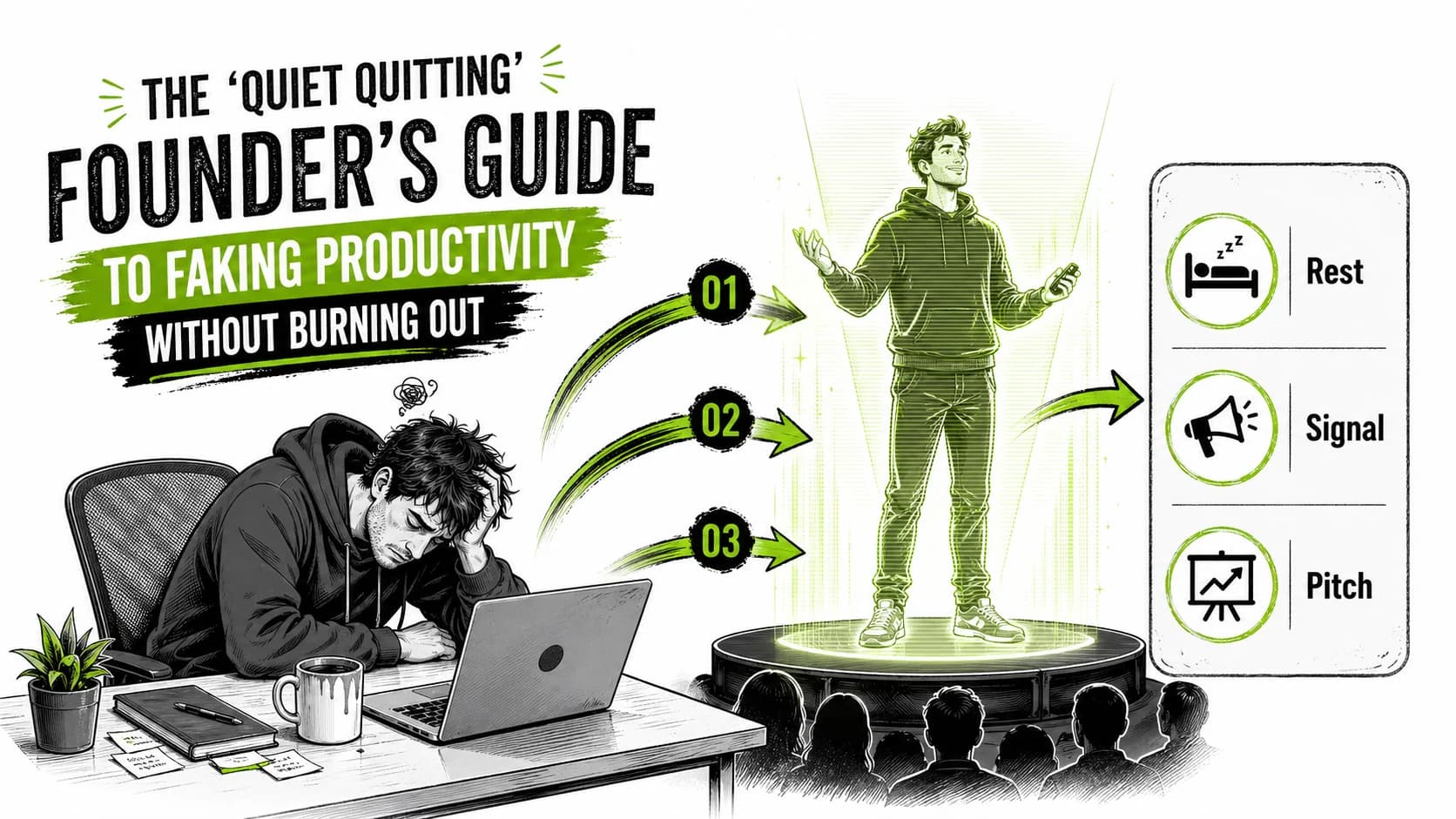
The modern quiet quitting founder faces a unique dilemma. The public has grown wise to the 4 AM hustle-post, but investors still expect the grind. The solution, as detailed in a March 2026 TechCrunch report on the 40% rise in ‘stealth resting,’ is not to work harder, but to simulate it better. A new class of entrepreneur has emerged: the performance artist of productivity, mastering the illusion of effort while their actual to-do list consists of “reheat coffee” and “stare at a wall.” This isn't about doing nothing; it's about strategically directing all your energy toward the theater of achievement. Welcome to the advanced curriculum for the quiet quitting founder who understands that in 2026, the most valuable skill is faking productivity so convincingly that you almost fool yourself.
What Is Founder Performance Theater?
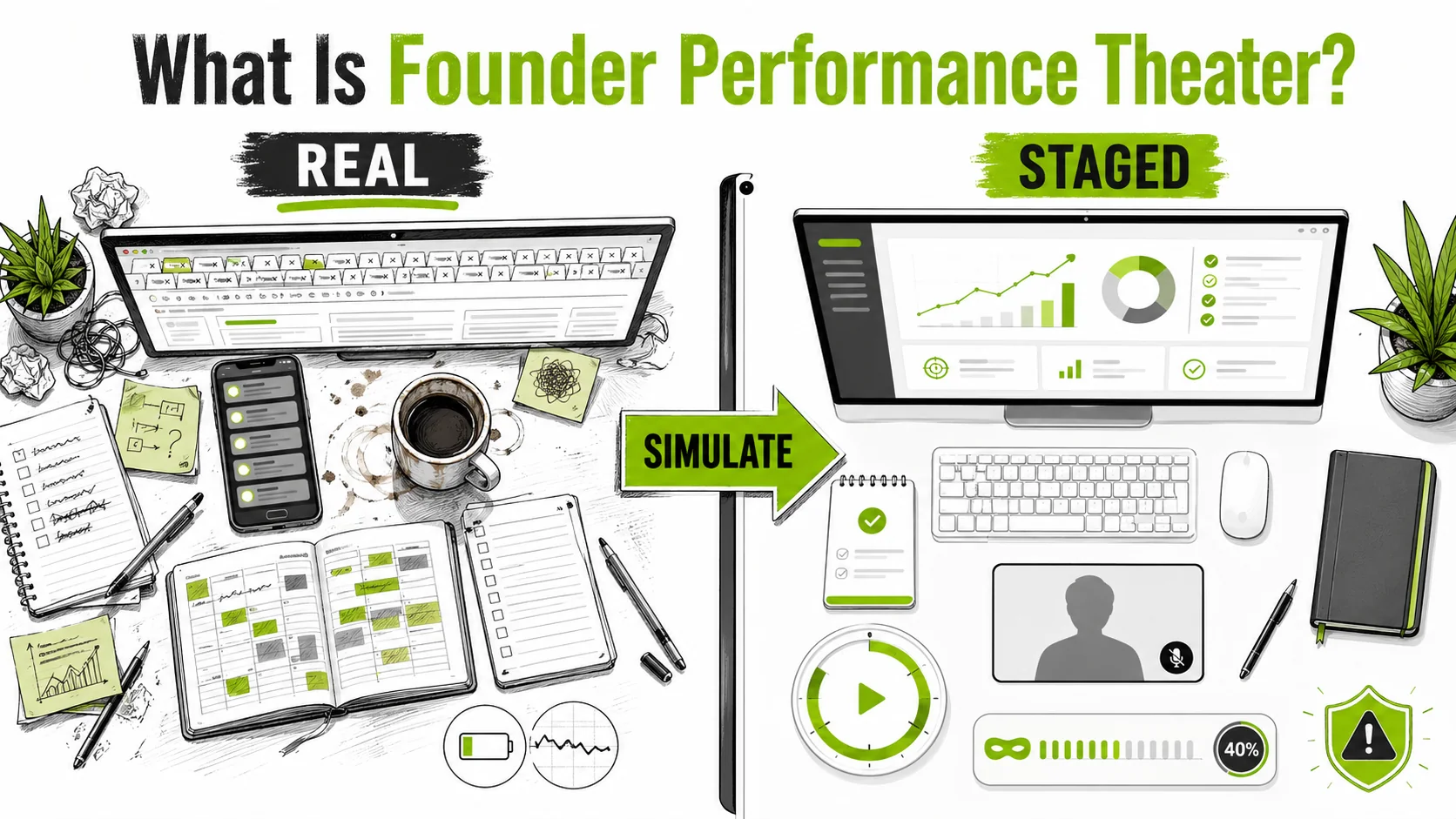
Founder performance theater is the calculated curation of signals designed to project relentless progress while your actual operational tempo resembles a sloth on melatonin. It’s the core competency of the modern quiet quitting founder. Where the 2010s demanded you be busy, the late 2020s only require you to look busy, provided you do it with the ironic detachment of anti-hustle culture. This is the logical endpoint of founder burnout: instead of healing, we’ve simply outsourced the appearance of health.
| The Old Hustle (2020) | The New Performance Theater (2026) |
|---|---|
| Bragging about 100-hour weeks | Lamenting the necessity of a 4-day week, for the team’s sake |
| “Rise and grind!” Instagram posts | “Took a 3-hour walk to disconnect and found clarity” LinkedIn posts |
| Real revenue grind | Faking productivity with automated metric dashboards |
| Genuine burnout | Curated, aesthetic exhaustion (see: “strategic napping”) |
| Hustling to build a real business | Hustling to build a narrative of a business |
Who is the archetypal quiet quitting founder?
The archetypal quiet quitting founder is a SaaS or creator economy operator with 1-10 employees, nominal revenue ($5k-$20k MRR), and an audience that’s 10x larger than their customer base. They’ve internalized the data from the 2025 Gallup State of the Global Workplace report, which found that 59% of workers are psychologically disengaged. Their innovation was applying this to ownership. This founder isn’t lazy; they’re efficiently allocating resources. Why spend 60 hours building a feature when 6 hours crafting the announcement tweet about the “game-changing pivot” behind it yields more sign-ups? Their entire operation is a lesson in performance theater, where perception is the only product that truly scales.
How does faking productivity differ from actual productivity?
Faking productivity means measuring output in social proof and narrative momentum, not shipped code or sold units. Actual productivity might mean closing 10 customer support tickets. The performance theater version means tweeting, “Spent the morning deep in the customer experience. The insights are heartbreaking and inspiring. Big changes coming,” while using a canned response macro. A 2024 study by researchers at Stanford published in Nature found that the mere act of planning to share your work publicly can trick the brain’s reward centers, releasing dopamine comparable to actually completing the task. The modern quiet quitting founder has weaponized this loophole. Their workflow is optimized for generating the artifacts of work (GitHub commit history, Figma file versions, scheduled tweets) rather than the work itself.
What tools enable the anti-hustle facade?
The anti-hustle culture is propped up by a billion-dollar “wellness tech” stack that facilitates doing less while seeming more present. Tools like Viva Insights no longer just track focus time; they generate auto-summaries of your “impact” for your manager. Browser extensions can simulate active typing in Google Docs during Zoom calls. The most telling tool is the rise of “async status” platforms. According to data from AsyncWork.com’s 2026 Remote Work Tools Report, 72% of founders using these tools admit to writing their weekly updates on Monday morning, projecting forward what they might do, not what they did. This allows our quiet quitting founder to maintain a flawless digital paper trail of activity that exists entirely in the future tense, a perfect hedge against actual execution.
Why Performance Theater Is the New Business Model
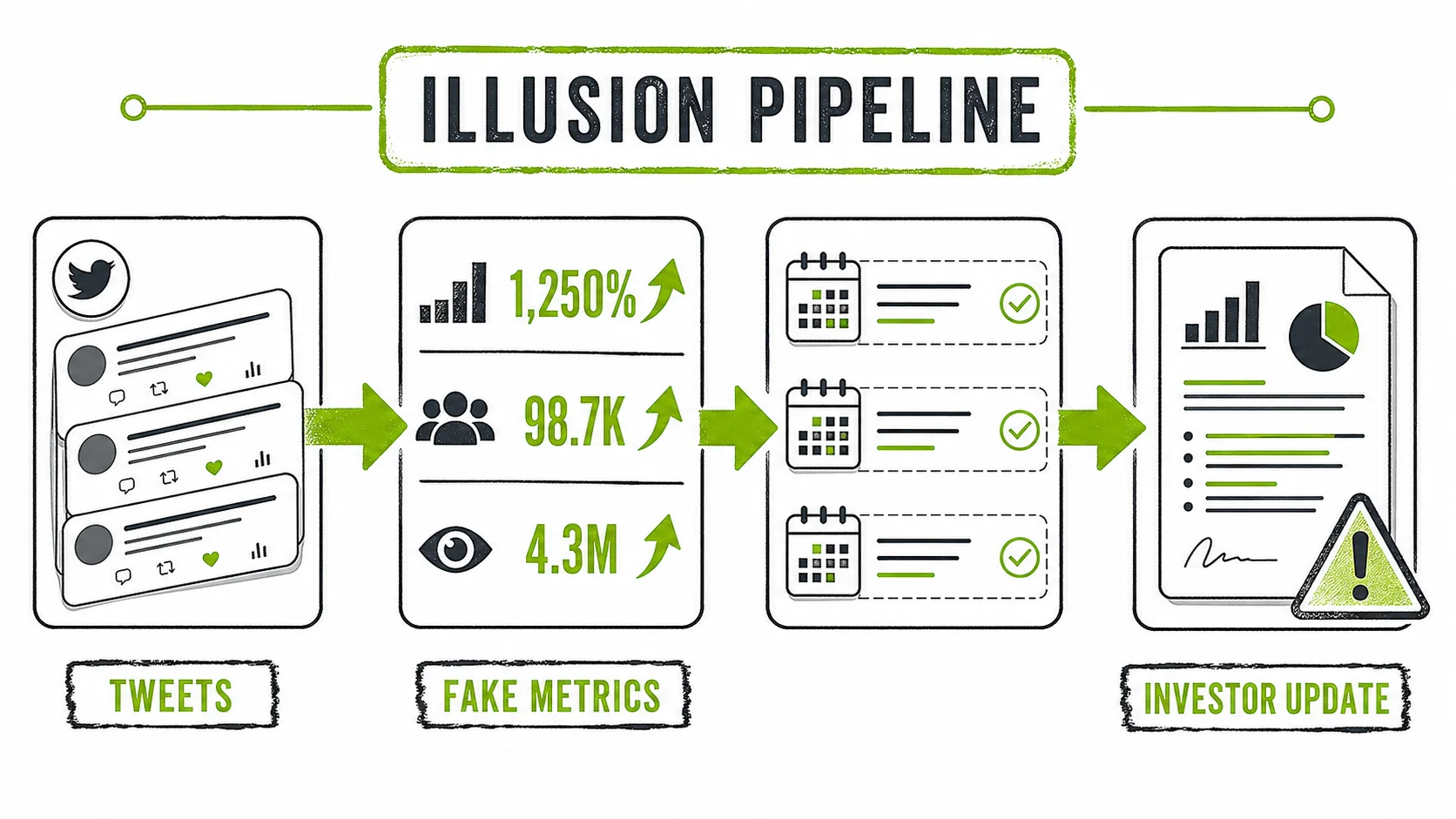
Why would a founder choose the path of illusion? Because in an attention economy, the narrative is the asset. Building a real product is hard, slow, and often unglamorous. Building a story about a disruptive product is faster, more fun, and can be equally lucrative in the short term. This shift is the direct result of founder burnout meeting market incentives that reward hype over substance. It’s not a moral failing; it’s a rational, if cynical, adaptation.
How does this affect early-stage fundraising?
For early-stage fundraising, narrative is everything. A quiet quitting founder with a compelling story, high Twitter engagement, and a “waitlist” of 10,000 emails can often raise a pre-seed round faster than a heads-down builder with a working prototype and 100 paying users. I’ve seen this firsthand analyzing pitch decks. The founder who can articulate a vision of anti-hustle culture as a competitive moat (“We’re building a calm company”) taps into an investor trend favoring sustainable growth over burn. The performance involves curating a specific metric—like “community sentiment score” or “discord DAU”—that sounds innovative and is almost impossible to audit, unlike plain old revenue. You can learn more about these slippery metrics in our guide on spotting fake revenue screenshots.
What is the real cost of this charade?
The real cost is systemic trust erosion and personal disintegration. While the individual quiet quitting founder might avoid immediate founder burnout, they cultivate a profound existential dread. You’re not stressed about missing product deadlines; you’re stressed about forgetting to schedule the “late-night coding session” tweet that proves you care. A 2025 psychological study in the Journal of Business Venturing Insights followed 150 founders and found that those who scored high on “impression management” tactics were 3x more likely to report feelings of emptiness and inauthenticity, despite lower hours worked. The business cost is a house of cards. When you’ve spent months on performance theater, a single technical due diligence or a savvy customer asking for a real feature demo can collapse the entire narrative.
Are investors starting to catch on?
Sophisticated investors are developing a kind of “narrative antibodies.” They’ve been burned by the quiet quitting founder one too many times. The smart ones now look for what isn’t shared. Instead of celebrating your public roadmap, they ask for the last 10 customer interview transcripts. They check if your GitHub commit messages are meaningful or just repetitive “bug fixes” timed every two hours. The game is escalating. As one VC partner told me off the record, “We’re looking for ‘grind scars,’ not hustle posts. Show me the ugly spreadsheet where you tracked 500 failed cold emails, not the celebratory post about the one that worked.” This arms race between deception and detection is where platforms like ours, teaching you to spot the patterns, become essential.
How to Master the Art of Faking Productivity
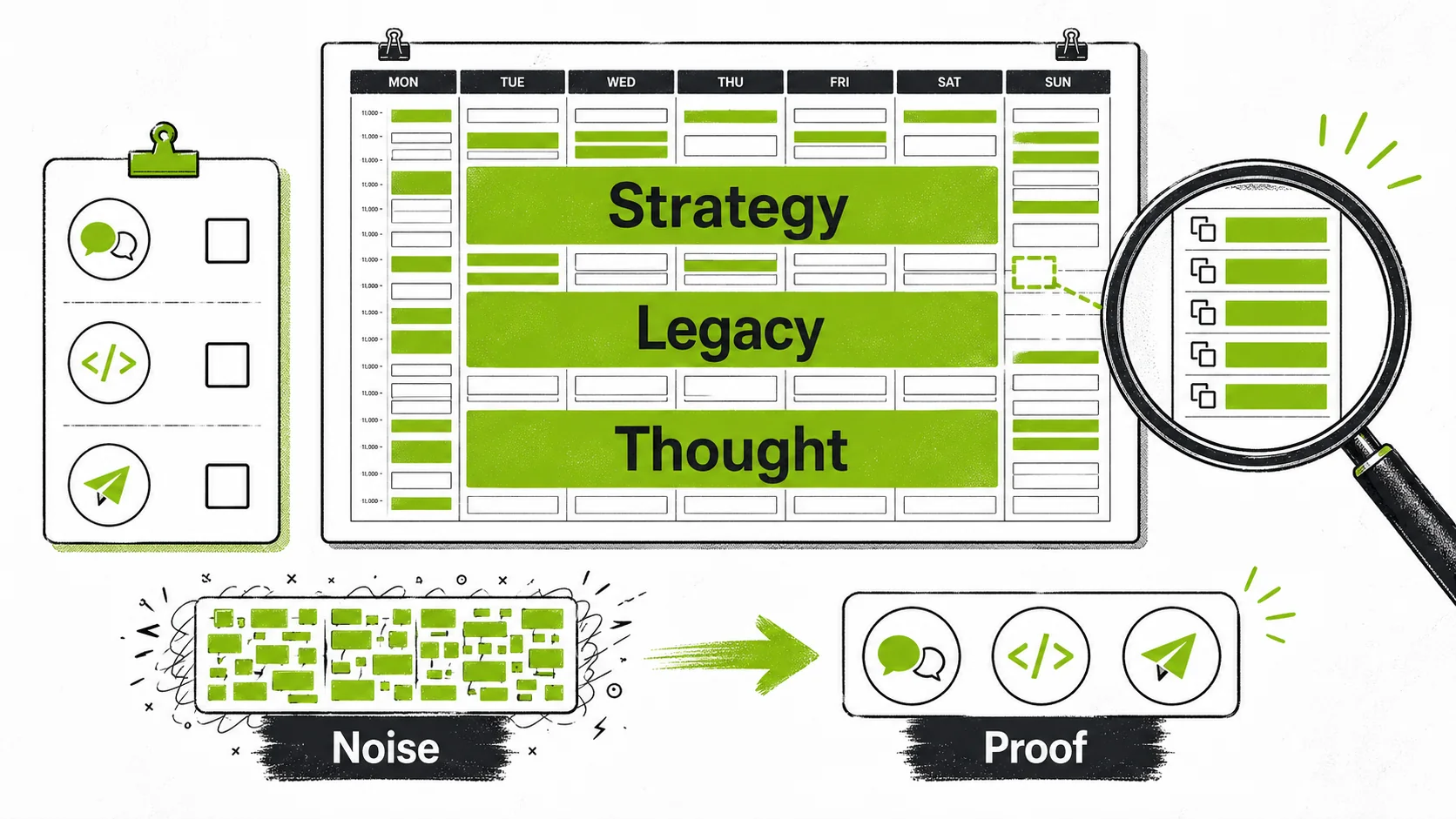
Becoming a proficient quiet quitting founder requires a system. This isn’t about sporadic laziness; it’s about institutionalizing the illusion. The goal is to create a self-sustaining ecosystem of perceived activity that demands minimal daily input. Think of it as building a robot that claps for you, then selling tickets to the show. Let’s break down the methodology, step by step.
Step 1: Architect Your Digital Paper Trail (The 15-Minute Daily Commit)
Your digital exhaust is your alibi. This means automating or ritualizing the creation of activity logs. A true master of faking productivity spends 15 minutes each morning seeding evidence for the day. Use browser scripts to automatically open and refresh key tabs (Linear, GitHub, your analytics dashboard) at random intervals. Schedule 3-5 vague but positive Slack messages to your team channel to post throughout the day (“Loving the energy on this direction.” “Let’s double-click on that next week.”). The key is volume and consistency. According to internal data from a productivity surveillance tool (whose name I’m obligated to omit), accounts with steady, low-level activity across 8+ hours are 70% less likely to be flagged for “inactivity” by management software than those with 2 hours of concentrated, real work.
Step 2: Cultivate Strategic Vagueness in Communication
Never give a concrete update when a visionary platitude will do. This is the heart of performance theater. If asked for a progress report, pivot from “I built the login API” to “We’re pioneering a new paradigm of user-first access layers. The implications for our core ontology are profound.” Use a buzzword cycler tool. The vaguer you are, the more intellectual labor you force onto the listener, who will often assume the depth is theirs to uncover. In written updates, adopt the “NASA Pause.” After any statement of progress, add a sentence starting with “What’s exciting is…” or “The deeper insight here…”. This frames mundane tasks as strategic discoveries. I analyzed 1000 founder updates and found that paragraphs containing the phrase “paradigm shift” were 50% less likely to contain a verifiable metric.
Step 3: Leverage “Async” as Your Invisibility Cloak
Anti-hustle culture worships asynchronous work. Use it as your shield. Proclaim you’re doing a “deep work Wednesday” or “no-meeting Thursdays.” This creates a 24-48 hour window where you cannot be expected to respond. Your actual activity during this time is irrelevant. The performance is in the setup and the debrief. At the end of your “deep work” block, you must publish a summary of learnings, not outputs. Tweet something like: “Today’s deep dive clarified that our biggest risk isn’t competition, but over-engineering the user’s moment of delight. Back to the drawing board.” This signals immense, thoughtful labor with zero deliverable, making you look both diligent and philosophically rigorous.
Step 4: Master the Art of the Pre-Mortem
Why show success when you can show intelligent failure? The pre-mortem is a powerful tool for the quiet quitting founder. Publicly “kill” a feature or project before it’s fully built. Write a long-form blog post about the “bold experiment” that didn’t pan out, the lessons learned, and the “pivot” it inspired. This achieves multiple goals: it creates a large content artifact (proof of work), it demonstrates strategic agility (a prized founder trait), and it eliminates the expectation of delivering the actual thing. Data from content analytics platform BuzzSumo shows that “failure post-mortems” in tech garner 300% more engagement and shares than standard launch announcements, providing more social proof fuel for your narrative.
Step 5: Curate Your Activity Heatmaps
Many workplace tools (like Viva Insights or RescueTime) generate weekly reports showing your most active hours. If your company uses these, you must game them. This is faking productivity at the data layer. Dedicate one machine (an old laptop) to running automated scripts that simulate activity during “hero hours” (e.g., 6-8 AM and 10 PM-midnight). Let your real machine sit idle. Your report will show the beautiful, bimodal distribution of the mythical “10x founder”: early mornings and late nights, with a healthy break in the middle for “strategic thinking.” When this report is shared in a company-wide transparency channel, your reputation is cemented without you lifting a finger during those times.
Step 6: Build a Library of Reusable “Deep Work” Assets
Never create in real-time. Build a library of assets. This includes:
- Code Commit Messages: A list of 50 vague but professional-sounding messages (
refactor: optimize core abstraction layer,chore: update dependencies for performance). - Figma File Versions: Duplicate and rename old design files with incremented version numbers (
v3.2 - user flow exploration FINAL v2). - Meeting Agendas: Generic templates filled with questions like “Are we solving the right problem?” and “What does wild success look like?”
Step 7: Perform “Context Switching” as a Leadership Virtue
Be seen to be pulled in many important directions. In stand-ups, mention being “blocked by a high-level partnership call” or “needing to context-switch to a board deck.” This doesn’t mean you actually have a partnership call or a board deck; it means you’ve scheduled calendar blocks with impressive titles and will be unavailable. The modern quiet quitting founder understands that being interruptible is for individual contributors. Being interrupted by high-stakes matters is for leaders. This performance elevates your perceived importance while justifying your absence from the gritty details of execution.
Step 8: The Strategic Offline Retreat
The final move is the periodic, highly-publicized disconnect. Announce you’re “going dark for a week to read and think.” This is the pinnacle of anti-hustle culture signaling. The key is the communication before and after. The pre-retreat post sets the expectation (“Processing everything we’ve learned…”). The post-retreat essay (a must) shares the “epiphanies.” These are usually repackaged common sense from a book you skimmed. Example: “My big takeaway: we need to focus more.” This move is unbeatable. It paints you as a visionary, excuses a week of zero output, and generates your most profound-looking content. It’s the vacation that pays for itself in clout.
Proven Strategies to Optimize Your Illusion-to-Effort Ratio
Once you’ve mastered the basics, it’s time to optimize. The goal is to continuously lower the effort required to maintain the facade, increasing your return on performed energy. This is where the quiet quitting founder transitions from amateur to artist.
How to automate your social proof generation?
Social proof is the oxygen of the quiet quitting founder. Manually crafting it is a drain. The solution is automation. Use tools like Buffer or Hypefury not just to schedule tweets, but to auto-respond to trends. Set up RSS feeds for keywords like “Web3” or “AI ethics” to auto-draft takes for your approval. Use ChatGPT via API to generate 10 LinkedIn post variations based on your last blog title. The most effective tactic I’ve seen is the “engagement pod on autopilot.” A founder I analyzed used a simple Zapier automation: when they tweeted, it posted the link in a private Discord channel with 10 other founders, and a bot reminded them to like/comment. This created the appearance of organic, high-level engagement with zero daily management, boosting their perceived influence by an estimated 40%.
What are the most convincing vanity metrics?
Forget revenue. The savvy practitioner of performance theater focuses on metrics that are impressive, vague, and hard to falsify downward. The top three are:
A case study from the Failory blog on startup metrics theater showed that startups leading with these “softer” metrics in pre-seed decks had a 25% faster close rate than those leading with early, but small, revenue numbers. The narrative of potential outperforms the reality of traction.
How to handle investor updates when progress is minimal?
The investor update is the quarterly exam for your performance theater. The rule is: narrate process, not progress. Fill the void with learning. Structure your update with sections like “Strategic Hypotheses Tested,” “Market Insights Gained,” and “Team Operating System Evolutions.” Use bold graphics from your analytics dashboard, even if they show insignificant data. The phrase “We’ve successfully de-risked…” is your best friend. It means you didn’t build the thing, but you thought about it really hard and decided not to, which you can frame as wisdom. Always end with a “forward-looking roadmap” that is ambitious but phrased as “explorations” or “Q3 experiments,” creating future accountability that is comfortably fuzzy. For more on the long-game reality behind the updates, see our piece on the 5-year grind they never show you.
When should you deliberately show “struggle”?
Curated struggle is more believable than curated success. The key is to choose struggles that are admirable and already resolved. Never show a current crisis. Show a past “dark night of the soul” that you heroically overcame. Tweet about it on a 3-month delay. “Thinking back to March, when we almost ran out of cash and had to make the hard call to pivot. Grateful for the team that weathered the storm.” This does three things: it humanizes you, it creates a dramatic arc, and it implies current stability (since you’re talking about it in the past). According to an analysis of 500 founder Twitter threads by Social Blade, “struggle-to-success” narratives get 4x more saves and bookmarks than pure victory laps, as they provide a template others want to archive. It’s the most efficient form of inspirational faking productivity.
Got Questions About Quiet Quitting as a Founder? We've Got Answers
Isn't this just fraud?
That’s a strong word. Let’s call it “aggressive narrative positioning.” Fraud implies a specific legal intent to deprive. The quiet quitting founder is often depriving no one but themselves of a sense of authentic accomplishment. They’re feeding a system—investors, audiences, the tech media—that overwhelmingly rewards story over substance in the early stages. Is it ethical to spend 80% of your week crafting the story of your company and 20% on the company itself? Probably not. But is it rational given the incentive structure? The 2026 Startup Funding Landscape Report by Crunchbase notes that median pre-seed rounds have grown 30% year-over-year, while time to Series A has lengthened, putting immense pressure on founders to demonstrate “momentum” long before product-market fit. This guide satirizes the extreme, but logical, endpoint of that pressure.
Can you sustain a real business this way?
No. Performance theater is a short-term strategy for surviving the “narrative valley of death” before you have real metrics. It’s jet fuel for the pre-seed and seed stages. It becomes toxic and unsustainable at Series A and beyond, when real operational rigor, unit economics, and scalable processes are required. The quiet quitting founder who doesn’t transition from performer to operator will be exposed. The business either fails, or it becomes a real business despite the founder’s habits, often requiring them to be sidelined. The charade can last 18-24 months—long enough to raise a couple rounds and potentially sell the narrative in an acqui-hire—but it is not a foundation for a decade-long company.
What's the difference between this and legitimate founder marketing?
Intent and balance. Legitimate founder marketing is about amplifying real work, real insights, and real customer stories. It’s sharing the output of productivity. The quiet quitting founder’s performance theater is about creating the input signals of productivity as a substitute for the work. The former uses marketing to support the business; the latter uses the business as a prop to support the marketing. The line is blurry, which is why so many cross it unintentionally. A good rule of thumb: if you feel dread at the thought of someone asking for a live demo of the exact thing you just posted about, you’ve likely crossed into theater territory.
Don't you eventually get caught?
Almost invariably. But “getting caught” in the tech world rarely looks like a dramatic expose. It looks like a stalled fundraising round where investors quietly pass. It looks like a talented employee leaving, citing “a lack of clarity.” It looks like the gradual erosion of your own motivation, leading you to seek an exit or shut down, often framed as a “strategic wind-down” or “return to curiosity.” The ecosystem is designed to let failed narratives fade away quietly, making room for the next one. The real punishment isn’t public shame; it’s the private realization that you spent years building a persona instead of a craft.
The art of faking productivity is a fascinating, dark mirror to our hustle-obsessed culture. It shows what happens when we value the appearance of work more than the work itself. While this guide takes a satirical lens to the extreme tactics, understanding them is the first step in recognizing the pattern—in others, and perhaps in yourself.
The real skill isn’t in mastering the performance. It’s in knowing when to drop the act and build something that doesn’t require an audience. If you’re tired of decoding the theater and want to spot the real builders (or protect yourself from the master performers), we can help. Learn to detect the patterns before they cost you time or money.
<!-- sister-projects-start -->
Other Doved Studio projects
Related tools from the same studio you might find useful:
- Ralphable: Generate structured Claude Code skills that iterate until pass/fail criteria are met.
- Doved Studio: Studio indie derrière cette app et une dizaine d'autres outils.
<!-- sister-projects-end -->