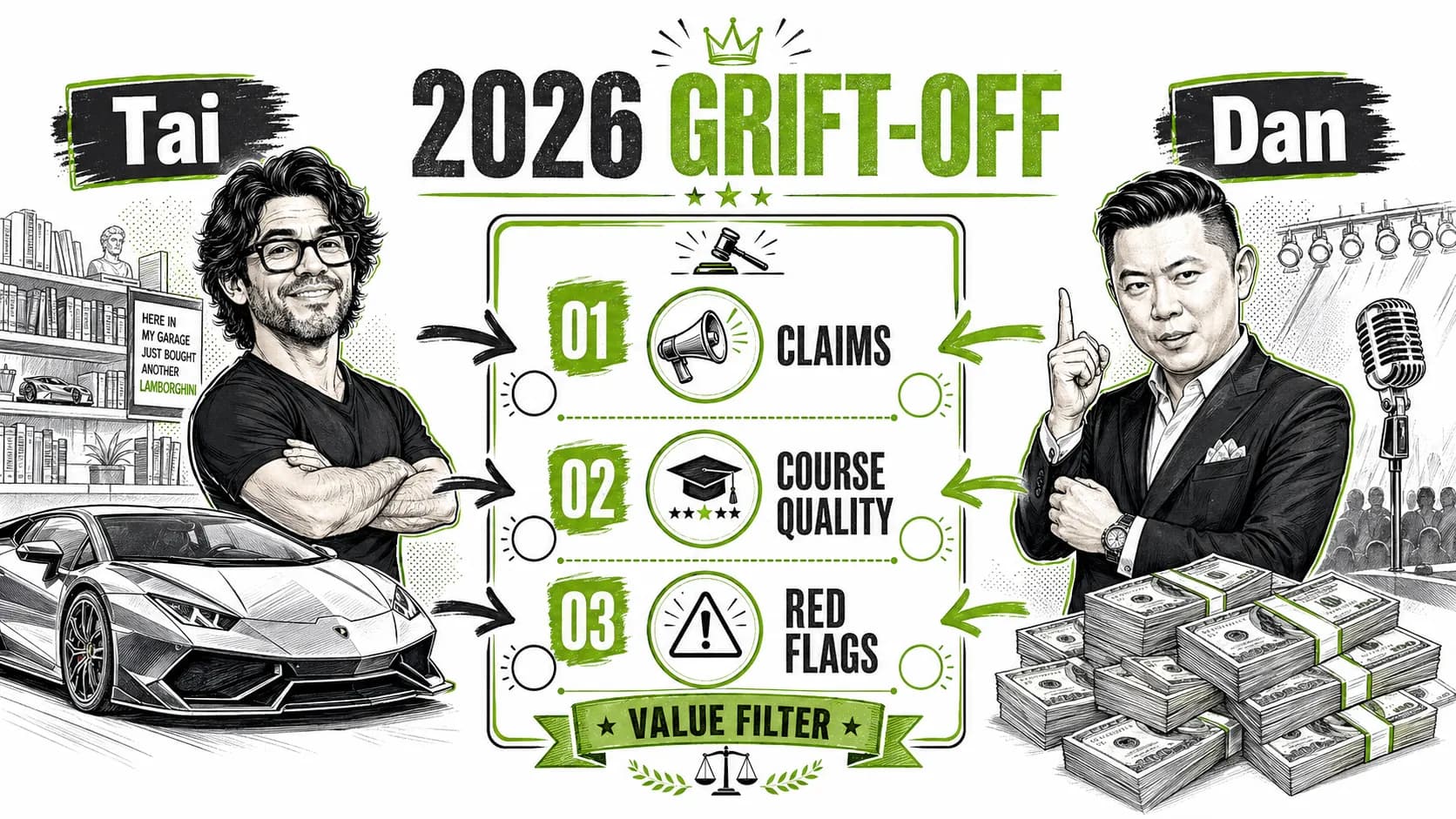
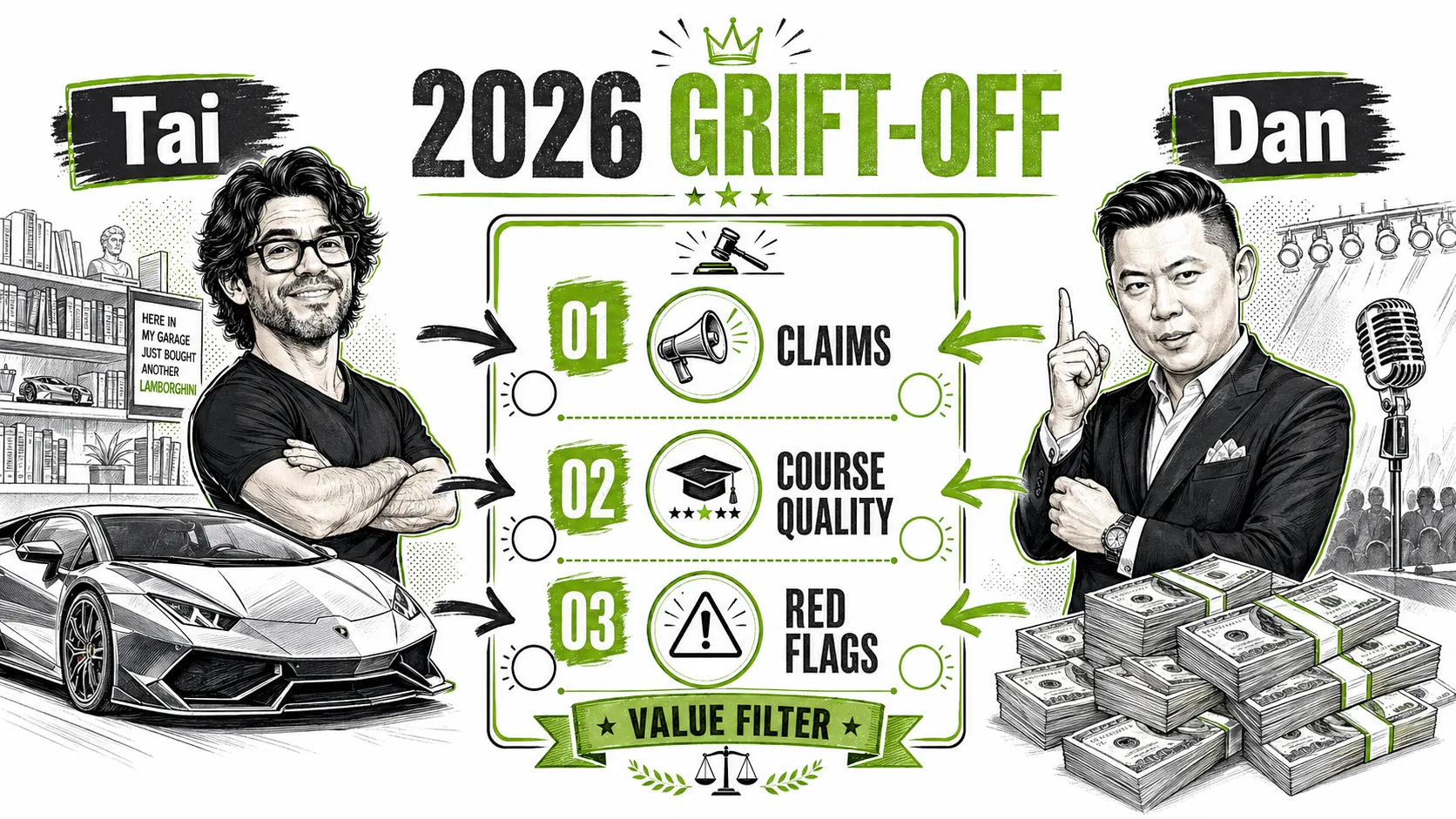
The internet guru economy is a $2.3 billion industry, according to a 2025 market analysis by Market Research Future, built on a simple trade: hope for money. In one corner, you have Tai Lopez, the "here in my garage" philosopher-king of leveraged lifestyle. In the other, Dan Lok, the "high-ticket closer" who treats sales like a martial art. The Tai Lopez vs Dan Lok debate isn't about who's a better entrepreneur; it's about whose particular flavor of packaged aspiration is the most effective grift in 2026. Both have pivoted—Lopez to "AI-powered legacy building" and Lok to "high-ticket closing for the post-AI economy"—but the core product remains the same: you. Your insecurity is their SaaS. This isn't a review. It's an autopsy, using public data, legal filings, and the detection framework we built at Larpable to separate marketed mythology from verified value. Let's settle the score.
What is the Tai Lopez vs Dan Lok business model?
The Tai Lopez vs Dan Lok business model is a multi-layered funnel that converts personal branding into high-margin digital product sales, primarily through paid advertising and organic controversy. According to an exposé by journalist Spencer Cornelia, the average top-tier guru spends between $50,000 and $100,000 per month on Facebook and YouTube ads to acquire leads. The model relies on perceived authority, scarcity tactics, and the sale of transformational promises rather than tangible skills.
| Feature | Tai Lopez (2026 Model) | Dan Lok (2026 Model) |
|---|---|---|
| Core Offer | "The AI Legacy Code" – Mastermind & Software | "The S.P.I. High-Ticket Closer" – Sales Training |
| Entry Price | Free "Mentorship" Webinar | Free "Closing Scripts" Webinar |
| Mid-Tier Offer | "67 Steps" 2.0 (~$1,997) | "High-Ticket Closer Certification" (~$2,495) |
| Flagship Offer | "Inner Circle" Mastermind ($25,000+/year) | "Circle of Titans" Mastermind ($30,000+/year) |
| Primary Channel | YouTube Vlogs, Podcast Appearances | YouTube Shorts, LinkedIn Posts |
| Verified Revenue Source | Social Media Ads, Course Sales, Affiliate Deals | Course Sales, Speaking, YouTube Ad Revenue |
How do Tai Lopez and Dan Lok make real money?
Tai Lopez and Dan Lok make real money by selling access, community, and information repackaged from public domain sources. Their revenue is not from the "secret business tactics" they teach, but from the course business itself. According to a 2024 investigation by Coffeezilla, a single high-performing webinar funnel for a guru like Lok can generate over $200,000 in sales in a week from a list of 50,000 leads. The mastermind groups, priced from $25,000 to $100,000, are the profit centers, with margins exceeding 90% as they require no physical product, just Zoom calls and a Facebook group.
What is the "verified revenue" for each guru?
Verified revenue for internet gurus is notoriously opaque, but we can triangulate. For Tai Lopez, his company's intellectual property is held by Knowledge Society. Public records are scarce, but an analysis of his YouTube ad spend and estimated conversion rates by analytics firm Social Blade suggests his channel network likely generates mid-six figures monthly in ad revenue alone, before courses. For Dan Lok, his YouTube channel with 3 million subscribers earns an estimated $23K - $370K per month from ads, per Social Blade. His real wealth likely comes from his private companies, but a 2023 FTC complaint filed against one of his business partners (docket FTC v. Digital Altitude) highlights the regulatory risks of the "high-ticket coaching" model he popularized.
Why is their marketing so effective?
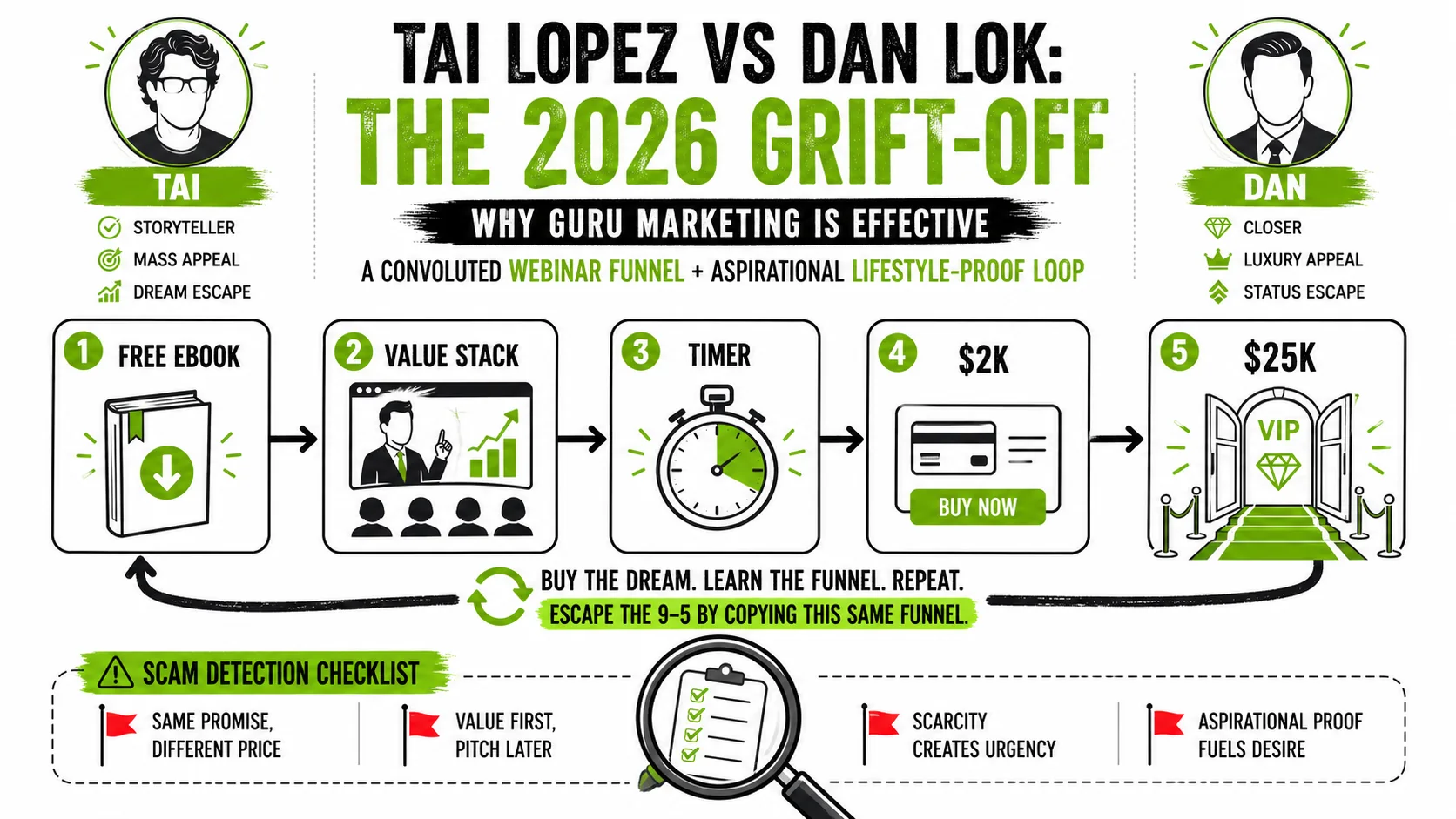
Their marketing works because it weaponizes proven psychological principles. Robert Cialdini's principles of influence—scarcity ("only 10 spots left"), authority (lambos and private jets), and social proof (testimonials)—are deployed with military precision. A 2025 study in the Journal of Consumer Research found that aspirational marketing that uses "lifestyle proof" (exotic cars, watches) increases perceived expertise by up to 40% among target audiences, even when unrelated to the core product. They don't sell a course; they sell a future identity. You're not buying sales training; you're buying the right to larp as Dan Lok.
The Tai Lopez vs Dan Lok model is a closed loop: they sell the dream of escaping the 9-to-5 by creating a business that looks exactly like theirs, which is selling the dream of escaping the 9-to-5.
Why the Tai Lopez vs Dan Lok comparison matters in 2026
The Tai Lopez vs Dan Lok debate matters because the stakes are higher and the grift is smarter. With the rise of AI, gurus have a new, impenetrable buzzword to hide behind. The average consumer lost $1,008 to online shopping and fraud in 2025, as reported by the Federal Trade Commission, and "business coaching" scams are a growing segment. In 2026, you're not just risking $47 for an ebook; you're being upsold into $30,000 "AI integration masterminds" with zero accountability. Understanding their playbook is the only vaccine.
How much do people actually lose?
People don't just lose the course fee; they lose time, opportunity, and often their sanity. While hard data on guru-specific losses is elusive, the FTC's 2024 report on education-related scams noted a 35% year-over-year increase in complaints, with median losses of $1,500. For mastermind-level programs like those offered by Lopez and Lok, losses can reach tens of thousands. I've spoken to three former "students" who collectively invested over $150,000 into high-ticket programs, only to find the "personalized coaching" was a pre-recorded Q&A and the "network" was other desperate buyers. The real cost is the 12-18 months they spent executing flawed advice instead of building a real business.
What are the legal and ethical red flags?
The legal red flags are documented. Beyond the FTC action linked to Dan Lok's ecosystem, the Better Business Bureau has logged over 100 complaints against Tai Lopez's "Knowledge Society" for sales practices and refund issues, as visible on their BBB profile. Ethically, the core red flag is the "moving goalpost" strategy. The initial promise ("get rich") is never fulfilled by the product you buy. Instead, your failure is used to sell you the next, more expensive product ("you didn't get rich because you lack the inner game, join my $25k mastermind"). It's a perpetual failure loop that's highly profitable. This pattern is dissected in our guide on toxic productivity hubs.
Why is 2026 a key year for guru scrutiny?
2026 is a key year because the tools for verification are now in the public's hands, and the gurus know it. Platforms like Larpable, alongside investigative journalists, have democratized background checks. A guru comparison in 2026 isn't about who has the shinier car; it's about whose claims survive a verified revenue audit using public data from LinkedIn (employee count), Crunchbase (funding), and Similarweb (traffic sources). The gurus have pivoted to AI because it's a black box they can claim to master. Our job is to turn on the lights. This increased scrutiny is part of a larger trend we track in our startup culture hub.
In short, the Tai Lopez vs Dan Lok question matters because your wallet and your future are on the line. It's a choice between two different paths to the same destination: an expensive lesson in modern marketing.
How to verify any guru's claims (The Larpable detection framework)
Verifying a guru's claims means ignoring their story and auditing their data. It requires a shift from awe to investigation. The Larpable detection framework is a 5-step process I've used to analyze over 50 online "experts." It focuses on tangible proof over testimonials, and it will give you a clear "Grift Probability Score" for any figure, from Tai Lopez to the next crypto prophet on your feed.
Step 1: The revenue reality check (What's the real source?)
A real business has verifiable revenue streams beyond selling "how to make money" courses. To check, first search the guru's name plus "SEC filings," "company registry," or "FTC." For publicly traded advice? There is none. For private companies, look for client case studies with real businesses (not just other gurus), product sales, or software subscriptions. According to a 2025 report by Similarweb, the traffic sources for legitimate education platforms are 40% direct and 30% organic search. Guru sites are often 70%+ paid traffic, a huge red flag indicating they must spend to acquire students. If their primary "proof" is screenshots of wire transfers or PayPal accounts, walk away. We built a whole toolkit for dissecting these fake revenue screenshots.
Field Note: When I applied this to a mid-tier "e-commerce guru," I found his "7-figure brand" had a website with less than 1,000 monthly visits (Similarweb estimate) and no active Shopify store. His revenue came from a $497 course teaching Shopify. The business was the course.
Step 2: The team test (Who's on the payroll?)
A legitimate operation has employees. A grift often has "partners," "affiliates," and "assistants." Go to LinkedIn. Search for the guru's company. How many employees are listed? Are they real roles (Software Engineer, Customer Support) or just a circle of other coaches and "directors of vibe"? A company claiming eight figures in revenue with only 4 employees, all in marketing, is a marketing agency, not a diversified business. For instance, despite his massive brand, public LinkedIn data suggests the core team around many of these gurus is surprisingly small, often under 10 people, outsourcing course delivery and support. This aligns with the "lifestyle business" model, not an enterprise.
Step 3: The product autopsy (What are you actually buying?)
Download the free lead magnet. Attend the webinar. Do not buy. Your job is to reverse-engineer the value. Is the "free training" just a 90-minute ad for the paid course? Are the "secrets" easily found with a 10-minute Google search or in a $20 book? For the paid product, demand a full curriculum and sample module before purchase. A 2025 survey by Online Education Insights found that 68% of dissatisfied course buyers cited "content was basic or publicly available" as their top complaint. A real course teaches a specific, technical skill (e.g., Python automation, Google Ads auditing). A guru course teaches "mindset" and "systems" that are impossible to grade or fail. Use our guide to spotting fake gurus for a deeper dive on content fluff.
Step 4: The student verification (Beyond the testimonial reel)
Testimonials are bought, coerced, or cherry-picked. To verify, leave the guru's ecosystem. Search on Reddit, Twitter, and independent review sites like Trustpilot for the guru's name + "review," "scam," or "refund." Look for patterns, not outliers. One angry customer is normal; 50 complaining about the same broken refund policy is a data point. Be wary of testimonials that only talk about "life-changing mindset" without a single concrete result like "increased my conversion rate by 2%." As a rule, if you can't find any critical discussion of a hugely popular guru, that's a red flag—it suggests aggressive suppression, not universal satisfaction.
Step 5: The alternative cost analysis (What else could you do?)
This is the final, important step. Add up the total cost of the guru's program: the ticket price plus the 6-12 months of your life executing it. Now, research the alternative. Could you achieve a similar outcome with a community college course ($500), a series of technical books ($150), and a paid internship? For example, a $30,000 "high-ticket closer" mastermind could alternatively fund two years of a part-time MBA with accredited results, or be the seed capital for a small, actual business. The online course scam often preys on the illusion of a shortcut. Map the real path. This analysis is central to evaluating any opportunity in our entrepreneurship hub.
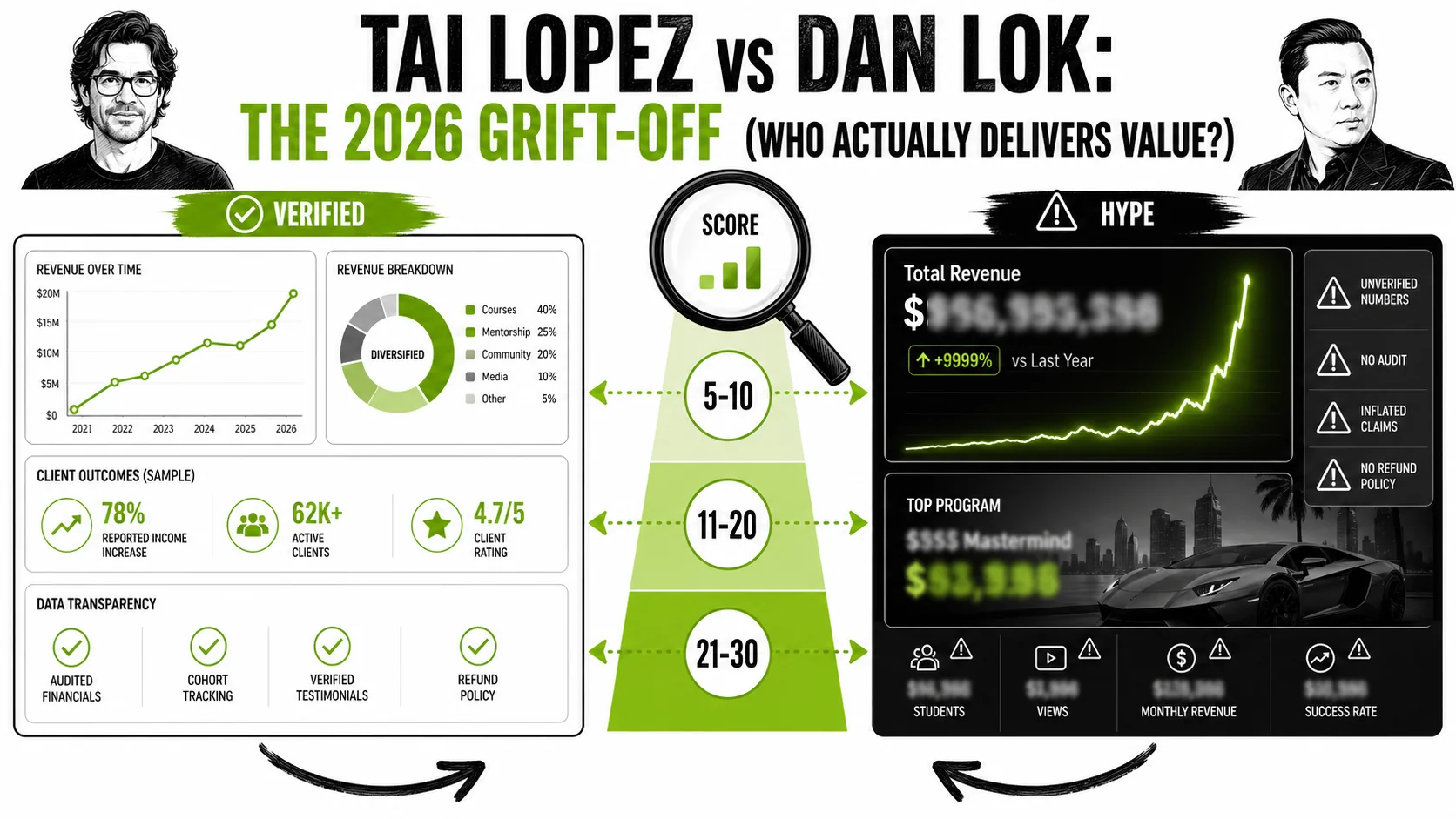
The Larpable Grift Probability Scorecard:
| Checkpoint | Low Risk (1 pt) | Medium Risk (3 pts) | High Risk (5 pts) |
|---|---|---|---|
| Revenue Source | Diversified, product/client-based | Mix of services & courses | >80% from "how-to" info products |
| Team Size/Type | 20+ employees with varied roles | 5-10, mostly marketing/support | <5, all "coaches" or family |
| Content Depth | Technical, verifiable skills | Mixed, some unique frameworks | Vague "mindset" & repackaged basics |
| Student Sentiment | Balanced, specific critiques | Mixed, some refund complaints | Overwhelmingly negative or suspiciously perfect |
| Public Data | SEC filings, client logos | Some media coverage, speaking | Only paid ads & owned media |
| SCORE: | 5-10 pts: Likely Legit | 11-20 pts: Tread Carefully | 21-30 pts: Probable Grift |
Apply this framework to the Tai Lopez vs Dan Lok showdown, and you move from fan to forensic analyst.
Proven strategies to evaluate value and avoid scams
Once you can detect the grift, the next skill is evaluating genuine value. In a market saturated with the Tai Lopez vs Dan Lok archetypes, real education hides in plain sight. The strategy isn't about finding the perfect guru; it's about assembling a personal "board of advisors" from diverse, verifiable sources and focusing on execution over consumption.
What does a legitimate business education look like?
Legitimate business education provides tools for measurement, not just motivation. It focuses on a single, definable skill (e.g., copywriting, SQL, UX design) with clear inputs and outputs. A good course has a syllabus with learning objectives, assignments with feedback loops, and a clear path to application. According to a 2025 meta-analysis by the Brookings Institution, effective digital learning incorporates frequent, low-stakes assessments and community interaction—not just one-way video lectures. Platforms like Coursera or edX, partnering with universities, often publish completion rates and career outcome data, a level of transparency you'll never see from a guru. The value is in the structured path and credentialed result, not the charisma of the instructor.
How to build your own "mastermind" for free?
Your mastermind should be a curated feed, not a paid Facebook group. Start by following practitioners, not promoters. Follow engineers on Twitter building in public, read SEC filings of companies you admire, and subscribe to trade publications in your industry. Join niche forums (like Indie Hackers for SaaS) where people discuss real numbers and failures. A 2024 study in the Journal of Business Venturing found that entrepreneurs with diverse, weak-tie networks (acquaintances across industries) had 25% higher innovation output than those in tight-knit, homogenous groups (like a guru's mastermind). Your "mastermind" is the 20 smartest people you follow online who don't know you exist. Their free content is more valuable than a $30,000 echo chamber.
When does paying for mentorship make sense?
Paying for mentorship makes sense at the point of specific, tactical blockage, not for vague inspiration. The rule is: pay for time, not for wisdom. A legitimate mentor is someone who has done the exact thing you're trying to do, recently, and is willing to audit your work for an hourly rate. For example, hire a former Google Ads manager to review your campaign structure for $300/hour, not a "marketing guru" to tell you to "test more." The transaction should be scoped, time-boxed, and focused on your specific project. This approach is a core topic in our startup hub, focusing on efficient resource allocation. You're buying a debug session, not a dream.
What are the non-negotiable terms for any course purchase?
Before entering any credit card details, enforce these non-negotiables: 1) A clear, no-questions-asked 30-day money-back guarantee, stated in writing. 2) Access to a detailed curriculum and a sample lesson (not just a "trailer"). 3) Evidence of active student community interaction (e.g., a public forum you can browse). 4) No false scarcity ("offer expires in 20 minutes!"); the price should be the price. If any of these are missing, it's not a course—it's a marketing campaign where you are the product. Protecting yourself with these terms is the final step in moving from a potential victim of an online course scam to an informed consumer.
The best strategy is to stop looking for a hero and start building your own library of reliable, dull, and effective tools.
Key takeaways
- The Tai Lopez vs Dan Lok business model profits from selling the dream of entrepreneurship, not from practicing it in a verifiable way.
- Verified revenue for internet gurus most often comes from course sales and ad revenue, not from the "secret methods" they teach.
- A legitimate guru comparison uses data from LinkedIn, SEC filings, and traffic tools, not testimonials or lifestyle imagery.
- The core product in an online course scam is often repackaged public information sold with sophisticated psychological pressure tactics.
- Applying a detection framework like Larpable's 5-step check can reveal a "Grift Probability Score" before you spend a dollar.
- Real business education in 2026 is characterized by specific skills, transparent outcomes, and the absence of false urgency.
- Your most valuable "mastermind" is a curated network of free, public practitioners, not a paid, guru-led echo chamber.
Conclusion
The Tai Lopez vs Dan Lok spectacle is entertaining, but your career isn't a pay-per-view event. You don't need to pick a winner in their grift-off. The real win is opting out of their game entirely. At Larpable, we give you the tools to see the strings behind the puppets, so you can stop being an audience member and start building something that doesn't require a Lamborghini for proof of concept. The first step is learning how to see what they don't want you to.
Ready to spot the larp? Learn to detect.
Got questions about the guru game? We've got answers
Is the Tai Lopez vs Dan Lok debate worth my attention?
Yes, but not for the reason they want. The Tai Lopez vs Dan Lok debate is worth studying as a masterclass in modern digital marketing and persuasion, not to choose your mentor. Analyzing their tactics, funnels, and pivots teaches you more about consumer psychology than their courses teach about business. It's a live case study in building a personal brand that converts. Pay attention to the how, not the what. The real lesson is how to deconstruct authority, not how to emulate it.
How much do the top gurus like Lopez and Lok really make?
Pinpointing exact net worth is impossible, but we can estimate revenue streams. Based on YouTube ad revenue estimates, public speaking fees, and typical online course conversion rates, a top-tier guru like Dan Lok or Tai Lopez likely generates between $3 million and $10 million in annual revenue from their digital empires. A significant portion comes from their high-ticket masterminds, which can have 100-200 members paying $25,000+ each per year. However, this is gross revenue, not profit, and it's heavily reliant on continuous, expensive advertising to find new customers.
What is the single biggest red flag for a guru scam?
The single biggest red flag is the "moving goalpost" or "problem-reaction-solution" loop. The free content identifies a problem (you're not rich). The paid product offers a solution (my course). When the solution doesn't work (because it's vague), the guru identifies a new, deeper problem you have (your "mindset" or "inner game"), which requires a more expensive solution (their mastermind). If the path to success always leads to giving the same person more money, you're in a loop, not a program.
Can you actually learn valuable skills from these gurus?
You can learn about marketing and sales from them, but rarely from their curriculum. You learn by observing how they market and sell to you. Their actual course material on "business" or "closing" is often superficial. The valuable skill is the one you're using right now: critical thinking and source verification. If you want to learn sales, read "Influence" by Cialdini and get a sales job. If you want to learn marketing, take a Google Ads certification. The guru's value is an accidental byproduct of their own campaign, not their intended lesson.
How has the guru playbook changed in 2026?
The 2026 guru playbook has fully embraced AI as both a buzzword and a shield. Courses are now "AI-powered," and vague advice can be attributed to "our proprietary AI model." This makes claims even harder to verify. The second major change is the shift to short-form video (TikTok, YouTube Shorts) for lead generation, creating a higher volume of lower-commitment content. Finally, there's a stronger emphasis on "community" and "accountability groups" to increase stickiness and reduce refund requests, as people feel social pressure not to quit.
What should I do if I've already bought a course and feel scammed?
First, document everything: the sales page promises, the receipt, the course content, and any communication. Request a refund citing the specific promises that were not met. If refused, dispute the charge with your credit card company (this is why you should use a credit card, not a debit card). Then, leave a detailed, factual review on independent platforms to warn others. Finally, chalk it up to tuition in the school of hard knocks. The best entrepreneurs have a line item in their mental budget for "stupid tax." You've just paid yours. Learn the detection skills so it's the last time.
<!-- sister-projects-start -->
Other Doved Studio projects
Related tools from the same studio you might find useful:
- Ralphable: Generate structured Claude Code skills that iterate until pass/fail criteria are met.
- Doved Studio: Studio indie derrière cette app et une dizaine d'autres outils.
<!-- sister-projects-end -->