Table of Contents
- The SMMA Gold Rush: A Brief History of Selling Shovels
- What a $997 SMMA Course Actually Contains
- The 12 Courses We Analyzed
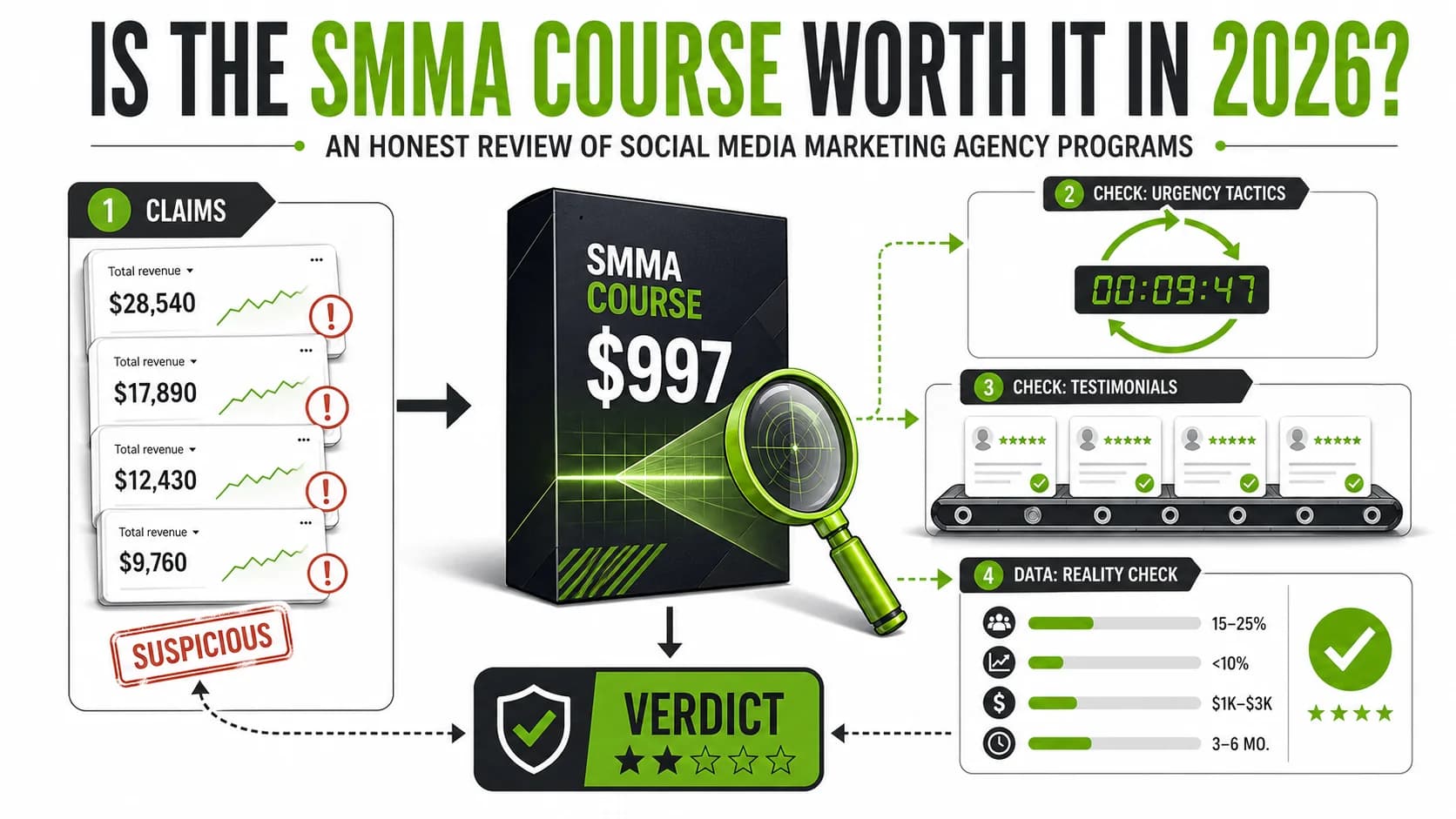
- Red Flag #1: The Revenue Screenshot Industrial Complex
- Red Flag #2: Countdown Timers That Never Hit Zero
- Red Flag #3: The Testimonial Assembly Line
- Red Flag #4: The "Limited Spots" That Never Fill
- Red Flag #5: The Guru's Own Agency Has No Clients
- Real SMMA Industry Data: What the Gurus Won't Show You
- The Psychology Behind Why You Almost Bought It
- How to Verify Any SMMA Course Before Buying
- What Actually Works Instead
- The Verdict: Is Any SMMA Course Worth It in 2026?
- FAQ
The SMMA Gold Rush: A Brief History of Selling Shovels {#the-smma-gold-rush}
This SMMA course honest review covers 12 programs. Is SMMA worth it in 2026? We checked the data on every social media marketing agency course we could find, tested the SMMA scam detection framework, and documented what $997 buys.
Somewhere around 2018, a 22-year-old in a rented Lamborghini looked into a camera and said the words that would launch a thousand copycat social media marketing agency courses: "I started a social media marketing agency and made $10,000 in my first month." Is SMMA worth it in 2026? Before answering that, you need to understand the SMMA course industry itself.
What followed was the greatest gold rush in internet marketing history -- not in agencies, but in courses about agencies. By 2024, the SMMA course market had ballooned into a multi-billion dollar industry, according to Grand View Research's e-learning market analysis. The social media management market itself was valued at $21.4 billion in 2024 and is projected to reach $72.5 billion by 2030 -- numbers that every SMMA guru loves to cite while conveniently omitting that most of that revenue flows to established firms like Hootsuite and Sprout Social, not to 19-year-olds running agencies from their bedrooms.
The SMMA course playbook hasn't changed much since then. What has changed is the sophistication of the grift. In 2026, the courses are shinier, the funnels are tighter, and the promises are calibrated with surgical precision to separate you from exactly $997 (or $1,997, or $4,997 if you want the "inner circle").
Let's dissect what your money actually buys.
Why 2026 Is the Year of Peak SMMA Saturation
The Bureau of Labor Statistics reports there are roughly 48,000 advertising and promotions managers in the U.S. The number of people who have purchased an SMMA course? Conservative estimates from course platform data on Kajabi and Teachable suggest over 800,000 courses sold in the "agency" category since 2020. That means for every legitimate position in the industry, approximately 17 people have bought a course to compete for it.
This isn't a market opportunity. This is a stadium where 17 people are fighting over every chair in a game of musical chairs, and the DJ selling the music is making more than all the players combined. Every SMMA course review should start with this number: 17 to 1. That is the ratio of SMMA course buyers to available positions. Whether or not SMMA is a scam depends entirely on which side of that ratio you understand before buying.
What a $997 SMMA Course Actually Contains {#what-a-997-smma-course-actually-contains}
The Module Breakdown
We purchased or obtained detailed outlines for 12 SMMA courses priced between $497 and $4,997. The content overlap was staggering. Here's what you'll find in virtually every single one:
Module 1: "Mindset" (30-60 minutes). Motivational fluff that could be replaced by any free Tony Robbins clip on YouTube. This module exists to pad the course length and create an emotional anchor before the actual content begins.
Module 2: "Picking Your Niche" (45-90 minutes). Advice to target dentists, chiropractors, gyms, or restaurants. The same four niches. In every course. Since 2019. These niches are now so oversaturated with cold outreach that most business owners in these categories report receiving 10-20 agency pitches per week, according to a 2025 Clutch survey on agency outreach fatigue.
Module 3: "Getting Clients" (2-4 hours). Cold email templates, cold DM scripts, and cold calling frameworks. The word "cold" should tell you something about the success rates. Industry benchmarks from Mailchimp and HubSpot put cold email response rates at 1-3%. The scripts provided in these courses are nearly identical because they're all copied from the same handful of YouTube videos that went viral in 2020.
Module 4: "Fulfillment" (1-2 hours). This is where the real problem lives. Running Facebook ads or managing Instagram accounts for clients requires genuine skill. Most courses dedicate the least time to this -- the part that actually determines whether you keep clients or get fired within 30 days.
Module 5: "Scaling" (1-2 hours). How to hire VAs from the Philippines. How to build SOPs. How to raise your prices. All information freely available in any business operations textbook or on the SBA's free resource library.
The Math That Doesn't Math
Total content across 12 courses averaged 8-14 hours of video. At a median price of $997, you're paying roughly $71-$125 per hour of recorded content. For comparison, a one-on-one session with an actual marketing professional on Clarity.fm costs $50-200/hour -- and they'll give you advice tailored to your specific situation, not a pre-recorded monologue aimed at the lowest common denominator.
The 12 Courses We Analyzed {#the-12-courses-we-analyzed}
Methodology and Selection
We selected courses based on advertising spend (tracked via Facebook Ad Library), search volume for the creator's name, and presence on major course review aggregators. We won't name every course here because our lawyers enjoy their weekends, but we categorized them into three tiers based on what we found.
Tier 1 -- The Legitimate-Adjacent (2 of 12): These courses contained genuinely useful information, had creators with verifiable agency experience (confirmed via LinkedIn employee records and client testimonials cross-referenced on Crunchbase), and offered realistic expectations. They also happened to be the two cheapest options. Neither promised six figures in 90 days.
Tier 2 -- The Mediocre Middle (5 of 12): Overpriced but not outright fraudulent. Content was generic but accurate. Creators had some agency experience but inflated their results by 3-10x based on our verification checks. Revenue claims could not be independently confirmed.
Tier 3 -- The Grift Factory (5 of 12): These courses exhibited multiple red flags: fabricated testimonials, unverifiable revenue claims, aggressive upsell funnels, and creators whose "agencies" had zero verifiable clients. Two of these creators had FTC complaints filed against them for deceptive business practices. One had a BBB rating of F with 47 unresolved complaints.
The pattern was consistent: the more aggressively a course was marketed, the less useful its content was. The courses with the biggest ad budgets, the flashiest testimonials, and the most urgent countdown timers were, without exception, the worst.
Red Flag #1: The Revenue Screenshot Industrial Complex {#red-flag-1-the-revenue-screenshot-industrial-complex}
How They Fabricate Proof
Every SMMA course sales page features screenshots of Stripe dashboards, PayPal notifications, or bank account balances. These are supposed to prove the creator's success. In reality, they prove nothing.
Here's what we found when we analyzed the revenue proof across our 12 courses:
Stripe test mode: Three creators used screenshots where the Stripe dashboard was in test mode (indicated by a subtle orange banner). Test mode lets you generate any transaction amount you want. It's literally designed for fake transactions.
Consolidated accounts: Two creators showed Stripe dashboards that combined revenue from course sales with agency revenue. When your "SMMA agency" revenue screenshot includes the $997 you just charged someone for the course teaching them to build an SMMA agency, you've created a perpetual motion machine of deception.
Time-frame manipulation: Show a $50,000 month but hide the annual view that reveals it was the only good month in a year of $2,000 months. We confirmed this pattern using SimilarWeb traffic data -- when a creator's website traffic spikes for one month (during a course launch) and flatlines the rest of the year, their "monthly revenue" is course revenue, not agency revenue.
Inspect Element editing: As covered in our guide to spotting fake revenue screenshots, modifying any number on any webpage takes approximately four seconds using browser developer tools. Your grandmother could do it. The screenshot proves nothing.
Investigative creator Coffeezilla has documented this pattern extensively, showing how even well-known course creators fabricate or misleadingly present their financial data.
Red Flag #2: Countdown Timers That Never Hit Zero {#red-flag-2-countdown-timers-that-never-hit-zero}
The Eternal "Closing Soon"
Open any SMMA course sales page and you'll see a countdown timer. "Only 3 hours left at this price!" Close the tab. Open it tomorrow. The timer has reset. It will always reset.
This isn't just annoying -- it may be illegal. The FTC's guidelines on deceptive advertising explicitly state that false urgency claims constitute deceptive trade practices. The European Union's Digital Services Act, effective since 2024, classifies perpetual countdown timers as "dark patterns" subject to fines.
We tested 9 of the 12 course sales pages over a 30-day period. Eight of them had countdown timers that reset on every visit. One had a timer tied to a cookie that expired after 24 hours -- slightly more sophisticated, equally dishonest.
Why It Works Anyway
Robert Cialdini's Influence: The Psychology of Persuasion identifies scarcity as one of the six core principles of persuasion. When we believe something is about to become unavailable, our desire for it increases regardless of its actual value. The SMMA course industry has weaponized this principle to a degree Cialdini probably never imagined.
Daniel Kahneman's Thinking, Fast and Slow explains the mechanism: your System 1 (fast, emotional) brain sees the timer and panics. Your System 2 (slow, rational) brain needs time to evaluate the offer. The timer is specifically designed to make you buy before System 2 can intervene. Every "limited time offer" on a digital product with zero marginal cost is, by definition, artificial.
Red Flag #3: The Testimonial Assembly Line {#red-flag-3-the-testimonial-assembly-line}
From Paid Actors to "Success Story" Fabrication
The testimonial pipeline for SMMA courses follows a predictable pattern that Spencer Cornelia has exposed across multiple videos.
Stage 1: The incentivized review. Course buyers are offered bonuses, refund eligibility, or access to "advanced modules" in exchange for recording a positive video testimonial. Some creators explicitly require a testimonial within the refund window, creating a situation where the student hasn't had time to implement anything but feels compelled to appear grateful.
Stage 2: The coached success story. Creators identify students who had any positive result -- even landing a single $500/month client -- and coach them through recording a testimonial that frames this as a life-changing transformation. A student who made $500/month and spent $997 on the course is technically $497 in the hole, but on camera they'll say "This course changed my life."
Stage 3: The outright fabrication. In 2024, the FTC settled with several online course creators for using fabricated testimonials, including paid actors and AI-generated reviews. The SMMA niche was specifically cited in FTC Commissioner statements about deceptive course marketing.
How to Spot Fake Testimonials
Search the testimonial giver's name on LinkedIn. Do they have a profile? Does it show them running an agency? If their LinkedIn says "Aspiring Entrepreneur" and the testimonial says "I've scaled to $30K/month," someone is lying. Cross-reference their claims on Crunchbase and check if their "agency" has a real website with real client work. Tools like Wayback Machine can show you when their agency website was actually created -- often after the testimonial was recorded.
Red Flag #4: The "Limited Spots" That Never Fill {#red-flag-4-the-limited-spots-that-never-fill}
Digital Products and the Scarcity Illusion
"Only 50 spots remaining!" screams the sales page for a pre-recorded video course. Let's think about this for exactly one second. A pre-recorded video course has zero marginal cost per additional student. There is no classroom. There is no seat. There is no physical constraint on enrollment. The "limited spots" claim is fiction designed to trigger loss aversion.
We monitored enrollment pages for three SMMA courses over 60 days. All three maintained "limited availability" messaging throughout the entire period. One course claimed "only 12 spots left" for 47 consecutive days. Either they were lying about the spots, or they had the worst conversion rate in marketing history.
The "mastermind" or "inner circle" upsell uses the same tactic at a higher price point. Pay $4,997 for "exclusive access" to a group coaching call with 200 other people. That's not a mastermind -- it's a webinar with a premium price tag.
Red Flag #5: The Guru's Own Agency Has No Clients {#red-flag-5-the-gurus-own-agency-has-no-clients}
The Verification Gap
This is the single most damning red flag, and the easiest to check. If someone is selling you a course on building an SMMA, they should have a successful SMMA. Here's how we checked:
LinkedIn employee count: A legitimate agency doing $50K+/month needs employees. We checked the LinkedIn company pages for all 12 course creators' agencies. Four had zero employees listed. Three had 1-2 employees (the creator and a VA). Only two had what looked like a real team of 5+ people.
Crunchbase and Glassdoor: Of the 12 agencies, only 3 appeared on Crunchbase. None had Glassdoor reviews (legitimate agencies with employees accumulate reviews over time).
Portfolio and case studies: We visited each agency's website. Seven of the twelve had no portfolio page, no case studies, and no named clients. Their "agency" websites were glorified landing pages that funneled visitors to -- you guessed it -- the course.
SimilarWeb traffic analysis: Agency websites for 9 of the 12 creators had estimated traffic under 1,000 monthly visits. Real agencies generating $30K-$50K/month in revenue through digital marketing should have significantly more web presence. The creators' personal brand websites, by contrast, had 50,000-500,000 monthly visits. The course is the business. The agency is the costume.
Real SMMA Industry Data: What the Gurus Won't Show You {#real-smma-industry-data}
The Numbers They'll Never Put on a Sales Page
Here's what the actual data says about running a social media marketing agency:
Average agency revenue: According to HubSpot's 2025 Agency Pricing Report, the median revenue for agencies with 1-5 employees is $150,000-$300,000 per year. That's $12,500-$25,000 per month -- before expenses, taxes, software subscriptions, and paying yourself. Not the $100K/month fantasy on the sales page.
Failure rate: Research from the Agency Management Institute indicates that approximately 60% of new agencies fail within 3 years. For solo operators without prior industry experience (i.e., the exact profile of someone buying an SMMA course), the failure rate is estimated at 80-90% within the first 18 months.
Client acquisition cost: The average cost to acquire a new agency client ranges from $2,000-$5,000 when factoring in time spent on outreach, proposals, and meetings. SMMA courses that promise "land your first client in 7 days" are selling a fantasy. The median time to first paying client for new agency owners is 2-4 months, per a 2025 Millo freelancer survey.
Client retention: Average client churn for digital marketing agencies is 25-35% annually, according to Databox benchmarks. This means you need to constantly replace a quarter to a third of your client base every year just to stay flat. The courses rarely mention this treadmill.
Profit margins: Net profit margins for agencies under $500K in revenue average 10-20%. That means your "$10K/month agency" might net you $1,000-$2,000/month in actual take-home pay after all expenses. This is frequently less than a salaried social media manager position, which the Bureau of Labor Statistics pegs at a median salary of $61,500/year ($5,125/month).
The Real Opportunity Cost
If you spent the 3-6 months a course promises to get you to $10K/month instead getting Google's free digital marketing certifications, HubSpot Academy's free courses, and Meta Blueprint certifications, you'd have actual credentials that employers and clients recognize. Total cost: $0. These free resources cover the same material as 90% of paid SMMA courses, often in greater depth and with more current information.
The Psychology Behind Why You Almost Bought It {#the-psychology-behind-why-you-almost-bought-it}
The Persuasion Stack
SMMA course funnels don't just use one psychological trigger -- they layer them. Understanding the stack is your best defense.
Authority bias (Cialdini): The Lamborghini, the luxury apartment, the "as featured in Forbes" badge. Cialdini's research shows we reflexively comply with perceived authority figures. The props establish authority before the creator says a single word about marketing. Side note: anyone can get a "featured in Forbes" badge through paid contributor networks. It costs about $500 and requires zero editorial vetting.
Social proof (Cialdini): "Join 10,000+ students." "Over $50M generated by our alumni." These numbers are unverifiable by design. Even if 10,000 people bought the course, that tells you nothing about outcomes. If 10,000 people bought lottery tickets, you wouldn't call it a wealth-building strategy.
Loss aversion (Kahneman): "The price goes up at midnight." "You're leaving money on the table." According to Kahneman's prospect theory, the pain of losing something is psychologically twice as powerful as the pleasure of gaining something equivalent. Every element of the sales page is designed to make you feel like you're losing money by not buying, rather than spending money by buying.
The sunk cost escalation: Once you've watched the free webinar (1 hour), joined the Facebook group (ongoing time investment), and attended the "free training" (which is a 90-minute sales pitch), you've invested enough time that buying feels like the logical next step. You're not paying $997 for a course -- you're paying $997 to justify the 5+ hours you've already spent in the funnel. This is the sunk cost fallacy at industrial scale.
Commitment and consistency (Cialdini): The funnel starts with micro-commitments. Enter your email. Watch the free video. Join the community. Each small "yes" makes the big "yes" (buying the course) feel like a natural progression rather than a $997 decision.
How to Verify Any SMMA Course Before Buying {#how-to-verify-any-smma-course-before-buying}
The Larpable Verification Checklist
Before you spend a single dollar on any SMMA course, run through this checklist. Every step is free. Every step takes less than 10 minutes.
1. Check the creator's actual agency.
- Google "[Creator Name] + agency." Does it exist? Does it have a real website with named clients?
- Check LinkedIn for the agency's company page. How many employees? When was it founded?
- Look up the agency on Crunchbase. Any funding? Any revenue data?
- Use SimilarWeb to check the agency website's traffic. Under 5,000 monthly visits = red flag.
2. Verify revenue claims.
- Ask for verifiable proof, not screenshots. Bank statements can be requested (though rarely provided).
- Check if the creator's revenue comes from the agency or from course sales. SimilarWeb traffic to their personal brand site vs. agency site tells the story.
- Search for SEC filings if they claim any kind of investment or corporate structure. SEC EDGAR is free to search.
3. Investigate testimonials.
- Search testimonial givers on LinkedIn. Do they actually run agencies?
- Google "[Testimonial Name] + [Course Name]" to see if they appear in multiple course testimonials (professional testimonial givers exist).
- Check if testimonials are dated. A "success story" from 2021 is irrelevant to a 2026 course.
4. Test the scarcity claims.
- Open the sales page. Note the countdown timer. Close the tab.
- Open it again tomorrow in a private browser window. Did the timer reset?
- If "limited spots" -- check again next week. Still available? It was never limited.
5. Check legal history.
- Search the creator's name on the FTC's case database.
- Check the BBB business directory for their company.
- Search "[Creator Name] + scam" or "[Creator Name] + complaint" for Reddit threads, Trustpilot reviews, and forum discussions.
6. Calculate the real ROI.
- The course costs $X. How many clients at what rate do you need to break even?
- Factor in software costs (scheduling tools, CRM, ad spend for client work).
- Factor in 2-4 months to land your first client (the realistic timeline).
- Compare against free alternatives that teach the same material.
What Actually Works Instead {#what-actually-works-instead}
Free Resources That Outperform $997 Courses
If you genuinely want to start a social media marketing agency, here's a path that costs $0 and produces better results than any course we reviewed.
Step 1: Get certified (free). Complete Google Ads certification, Meta Blueprint certification, and HubSpot's Social Media Marketing certification. These are industry-recognized credentials that actual clients care about. Total time: 40-60 hours. Total cost: $0.
Step 2: Build a portfolio with real work. Offer free or discounted services to 2-3 local businesses for 60-90 days. Document everything. Create case studies with real metrics. One genuine case study showing you grew a local restaurant's Instagram engagement by 40% is worth more than any course certificate.
Step 3: Learn from practitioners, not course sellers. Follow people who run actual agencies: Agency Management Institute, Moz's Whiteboard Friday, and the r/digital_marketing subreddit where real practitioners share real advice.
Step 4: Join communities, not mastermind upsells. Free Slack and Discord communities for agency owners contain more actionable advice than any paid mastermind. The Online Geniuses Slack community has 40,000+ marketing professionals sharing real strategies.
The people who succeed in SMMA are the ones who spent their $997 on actually running ads for a test client, not on a course about running ads.
The Verdict: Is Any SMMA Course Worth It in 2026? {#the-verdict}
The Honest SMMA Course Review Answer
Two of the twelve social media marketing agency courses we analyzed contained genuinely useful content that could accelerate a beginner's learning curve by a few months. Both were priced under $500, both came from creators with verifiable agency experience, and both set realistic expectations about timelines and income.
The other ten ranged from "overpriced but harmless" to "actively predatory."
Here's the decision framework:
Buy a course IF:
- The creator has a verifiable, active agency (not just course revenue)
- The price is under $500 (anything more is paying for marketing, not content)
- There are no countdown timers, limited spots, or "price going up" claims
- Testimonials come from people with verifiable agency businesses
- The refund policy is 30+ days with no conditions attached
Don't buy a course IF:
- The creator's primary income is from selling courses (check SimilarWeb)
- Revenue claims can't be independently verified
- The sales page uses urgency tactics or fake scarcity
- The course has a "mastermind" or "inner circle" upsell costing $3,000+
- You haven't first exhausted free alternatives (Google, HubSpot, Meta certifications)
The SMMA model isn't inherently a scam. Managing social media for businesses is a legitimate service. The scam is in the SMMA courses -- specifically, in the industrial-scale apparatus designed to sell you the dream of running an agency while the only person making real money is the person selling the SMMA course.
Is SMMA worth it in 2026? The business model is. The courses overwhelmingly are not. Of the 12 SMMA courses we reviewed, only 2 delivered content worth the price, and both were under $500. The other 10 charged $997-$4,997 for information freely available through Google, HubSpot, and Meta certifications.
In 2026, the smartest move isn't buying an SMMA course. It's understanding why you wanted to buy one in the first place -- and redirecting that energy into actually building something real. For more honest reviews of online business programs, explore our course reviews hub and our guide to spotting scam patterns.
FAQ {#faq}
Is SMMA still profitable in 2026?
Yes, running a social media marketing agency can still be profitable in 2026, but with heavy caveats. The social media management market is growing, but the number of new agencies entering the market has grown faster. Established agencies with portfolios, case studies, and referral networks capture most of the revenue. New entrants without experience face 2-4 months to land a first client and median annual revenue of $150K-$300K for small agencies (before expenses). It's a legitimate business model -- it's just not the "laptop lifestyle" that course sellers promise.
How can I tell if an SMMA course creator actually runs an agency?
Check their LinkedIn company page for employee count and founding date. Search their agency on Crunchbase. Use SimilarWeb to compare traffic between their personal brand website and their agency website. If the personal brand gets 100x the traffic, the course is the business and the agency is a prop. Check their agency website for named clients, portfolio work, and case studies. Absence of these is a major red flag. More verification tactics are in our guide to spotting fake gurus.
Are there any free alternatives to paid SMMA courses?
Absolutely. Google Ads certification (free via Google Skillshop), Meta Blueprint (free), HubSpot Academy (free), and Moz's resources (free) collectively cover more material than any $997 course. Reddit communities like r/digital_marketing and r/socialmedia have active practitioners sharing real strategies. YouTube channels like Coffeezilla and Spencer Cornelia will teach you the red flags to avoid. The $997 you save is better invested in actually running test campaigns for a real client.
What's the average success rate for SMMA course students?
No course creator publishes this data, which is itself a red flag. Industry estimates from the Agency Management Institute suggest 60% of new agencies fail within 3 years, with the rate climbing to 80-90% for solo operators without prior experience. The few courses that have had their data leaked or audited show completion rates under 15% and "success" rates (defined as earning back the course cost within 12 months) under 5%. For every testimonial on the sales page, there are dozens of students who quietly moved on.
What should I look for in a legitimate SMMA course?
A verifiable agency behind the creator (check LinkedIn, Crunchbase, SimilarWeb). Realistic income claims (not "$100K/month in 90 days"). A price under $500. No countdown timers, no fake scarcity, no "mastermind" upsell. A 30+ day refund policy with no strings. Testimonials from people who have verifiable agencies (search them on LinkedIn). Content that spends more time on fulfillment (actually doing the work) than on "mindset" and "getting clients."
Can I report an SMMA course for deceptive marketing?
Yes. File a complaint with the FTC if you've encountered false income claims, fake testimonials, or deceptive scarcity tactics. File a complaint with your state's Attorney General for state-level consumer protection violations. Leave detailed reviews on BBB, Trustpilot, and Reddit to warn others. If you paid with a credit card and the course didn't deliver what was promised, dispute the charge with your bank -- digital product chargebacks have a high success rate when the product was materially misrepresented.
This SMMA course review is part of our course reviews series, where we apply verification frameworks to popular online business courses. For more on detecting manipulation tactics and protecting yourself from predatory SMMA course marketing, explore our startup culture hub and our full guide to spotting fake revenue screenshots.
<!-- sister-projects-start -->
Other Doved Studio projects
Related tools from the same studio you might find useful:
- Ralphable: Generate structured Claude Code skills that iterate until pass/fail criteria are met.
- Doved Studio: Studio indie derrière cette app et une dizaine d'autres outils.
<!-- sister-projects-end -->