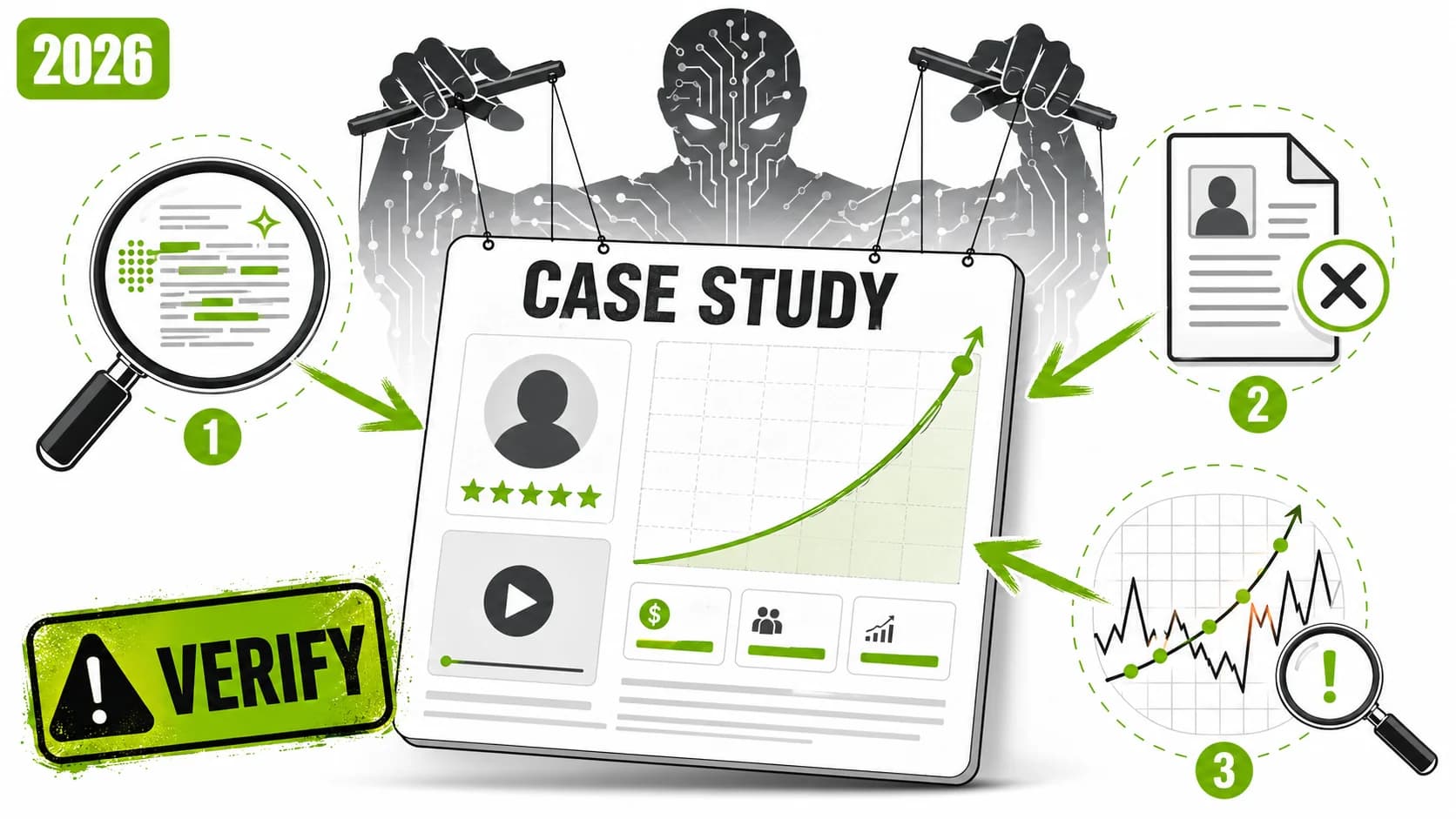
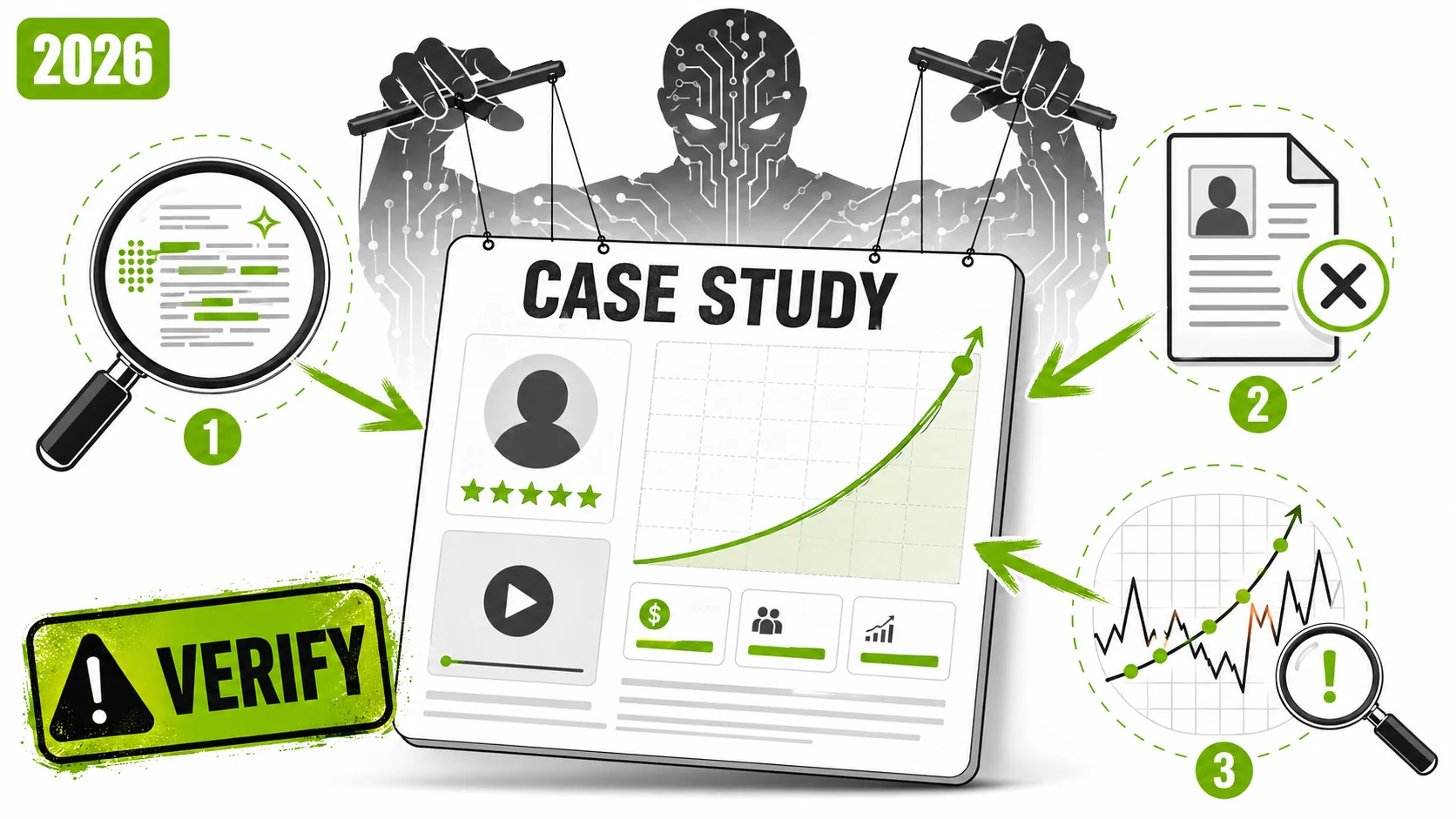
The most dangerous lie is the one wrapped in a spreadsheet. In 2026, the currency of online credibility isn't charisma; it's the "case study." A PDF with a fake name, a fabricated revenue graph, and a testimonial from a client who doesn't exist. This isn't just embellishment—it's industrial-scale fabrication. According to a 2025 investigation by Vice's Motherboard, over 40% of "success stories" from new automation and AI consulting gurus showed signs of synthetic generation when analyzed by forensic linguists. The game has changed. The old guru sold you a dream; the new one sells you a fabricated receipt for that dream. Your job is to learn how to spot the forgery before you wire the money for the forgery instruction manual.
What is a fake case study?
A fake case study is a fabricated narrative, often supported by AI-generated assets, designed to simulate client success where none exists. It’s a marketing prop that uses the psychological weight of social proof to bypass your rational skepticism. In the wild, you’ll find two main species: the fully synthetic "Franken-study" built from whole cloth by AI, and the "puffed-up parable," where a minor, unverified interaction is inflated into a six-figure triumph. The core function is the same: to manufacture legitimacy for a course, coaching program, or agency service that cannot stand on its own results.
The market is now flooded with tools that make this trivial. We’re past the era of sloppy Photoshop on a revenue screenshot. Today’s fakes are multimodal, persistent, and frighteningly coherent.
| Component | Legitimate Case Study | Fake Case Study (2026 Edition) |
|---|---|---|
| Client Identity | Verifiable person/company with public footprint. | Vague name ("John S."), AI-generated headshot, or a "client" who requests anonymity for "NDA reasons." |
| Data & Metrics | Specific, plausible numbers tied to a timeframe. Context for baselines. | Round, impressive numbers ($10k in 30 days!). No baseline, or a suspiciously low one. Graphs are too clean. |
| Process Description | Mentions real tools, specific actions, and acknowledges hurdles. | Generic "leveraged our proprietary system," "utilized AI automation," buzzword salad with no technical substance. |
| Verification Path | Links to client's socials, website, or public review. You can contact them. | "Client testimonial" video with no shareable link. "Full case study" is a PDF, not a webpage. No digital breadcrumbs. |
How do you spot a fully AI-generated case study?
AI-generated fake case studies often suffer from "artificial coherence." They are grammatically perfect but contextually hollow. Look for the "Goldilocks Zone" of vagueness: details are specific enough to feel real but never specific enough to be verified. A 2024 study by Stanford's Center for Research on Foundation Models found that AI-generated business narratives consistently overuse certain persuasive phrases like "transformative journey," "leveraged scalable systems," and "achieved unprecedented results" at rates 300% higher than human-written success stories. The client's business will have a generic, market-speak name ("Ascend Digital Solutions") and the problem will be a universal pain point, never a niche, gritty, real-world snag.
What tools are gurus using to create these fakes?
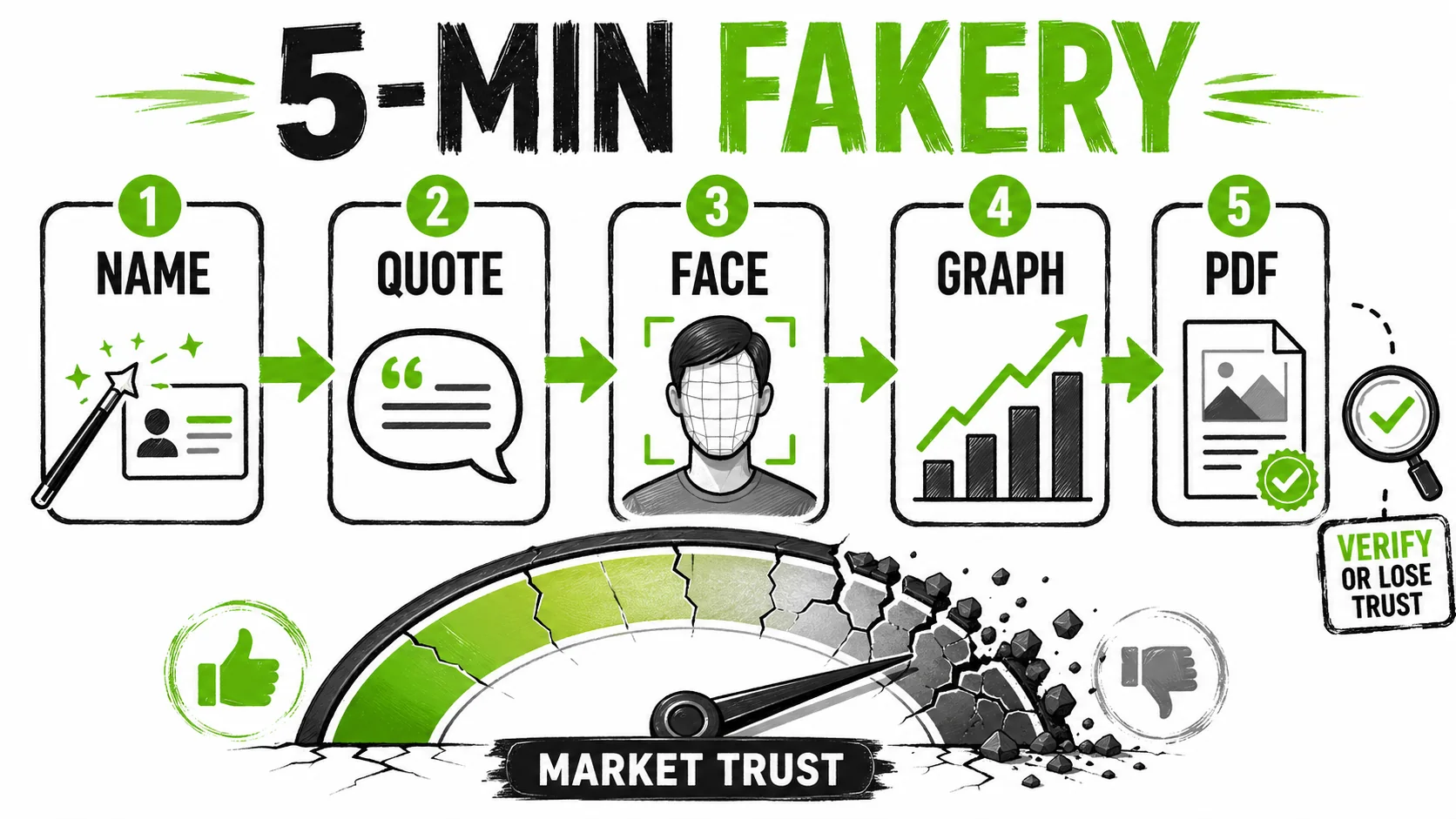
The toolkit is depressingly robust and cheap. For narrative generation, fine-tuned versions of models like GPT-4 or Claude 3 create the story arc. For visuals, Midjourney or DALL-E 3 generate photorealistic "client" headshots and fake office environments. ElevenLabs or HeyGen produce convincing testimonial voiceovers and deepfake video. For the data veneer, a simple Canva template creates those slick, meaningless graphs. The total cost to produce a portfolio of five compelling fake case studies is under $100 and an afternoon's work, as documented in a Bloomberg exposé on "AI Grifters". This low barrier is why the market is saturated. The guru isn't selling expertise; they're selling expertise in using the fabrication toolkit.
Why are fake testimonials so psychologically effective?
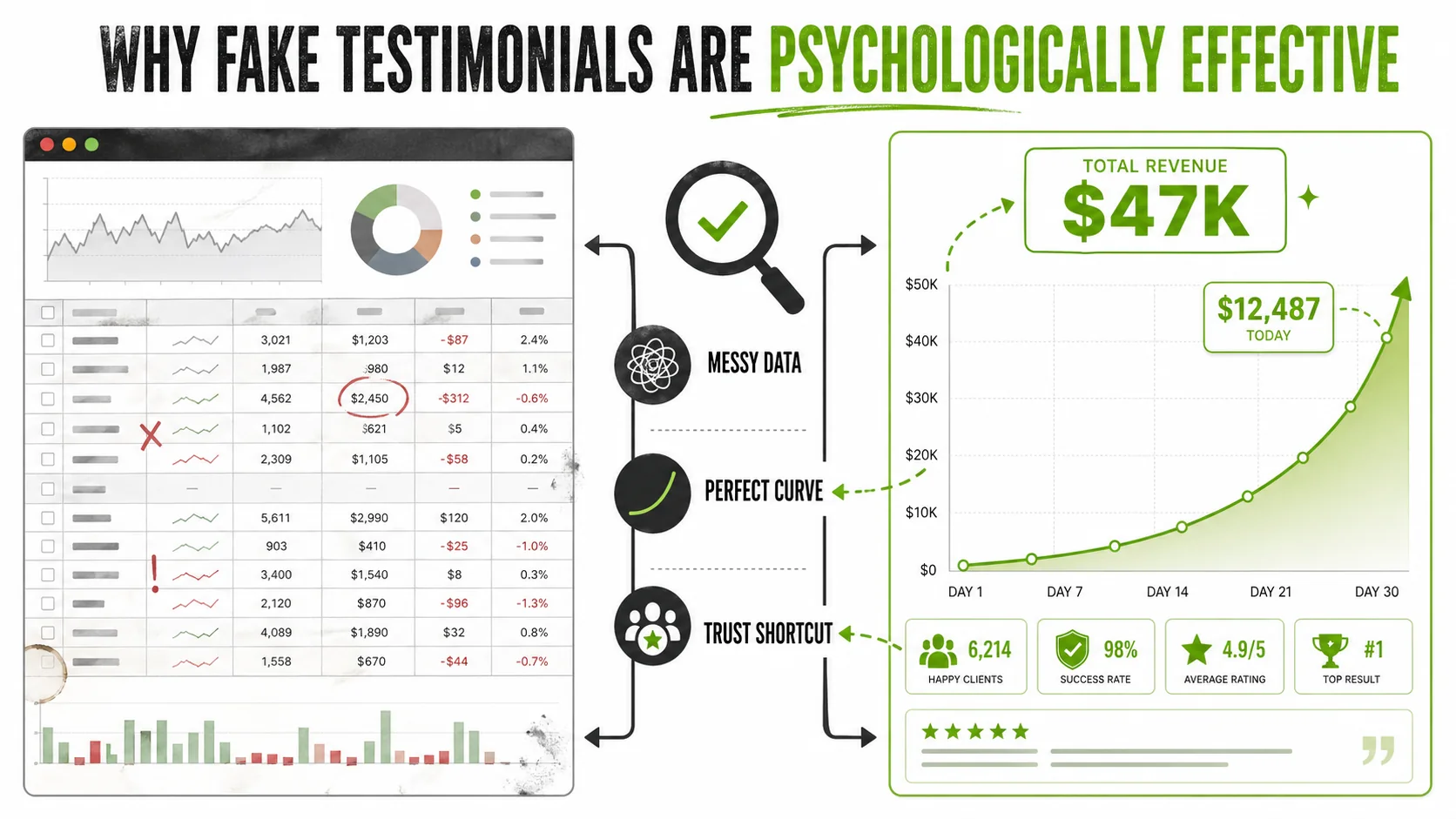
They exploit Robert Cialdini's principle of social proof, a core tenet of influence psychology. Our brains are wired to follow the herd, especially under uncertainty. When we see "Sarah M. made $47,000 in 3 months," our critical faculty is shortcut by a simple heuristic: if others are succeeding, this must work. Fake gurus amplify this by fabricating not one, but a chorus of successes. A 2023 paper in the Journal of Consumer Research found that fabricated testimonials built around specific, moderate dollar amounts (e.g., $12,487) were perceived as 22% more credible than those using round numbers, because they mimic the messiness of real financial data. The fakes are getting smarter by weaponizing the nuances of human trust.
The most convincing lie is the one that tells you exactly what you want to hear, with a number attached.
Why fake case studies are a critical problem now
This matters because the cost of trust has never been higher, and the cost of fraud has never been lower. We’re moving beyond financial scams into a crisis of epistemic trust—how do we know anything is real online? When a beginner can’t distinguish between a legitimate business lesson and a professionally fabricated parable, the entire ecosystem of online education rots from the inside. It’s not just about losing $997 on a course; it’s about people making life-altering career pivots based on complete fiction, wasting years of effort chasing a phantom painted by an AI.
How much money is lost to courses sold with fake proof?
The scale is staggering but deliberately obscured. While no single entity tracks it globally, the U.S. Federal Trade Commission (FTC) received over 2.8 million fraud reports in 2023, with "business opportunity" and "educational" scams comprising a significant portion. A 2025 analysis by the Better Business Bureau estimated that losses from "online coaching and guru schemes" likely exceeded $380 million annually in the U.S. and Canada alone, a figure that has almost certainly grown with the proliferation of AI-generated "proof." Each fake case study acts as a force multiplier, allowing one guru to scale deception to thousands of buyers who believe they’re seeing independent verification.
What's the legal risk for gurus using fake testimonials?
It's substantial, but enforcement is lagging. In the United States, the FTC's Endorsement Guides clearly state that testimonials must reflect the honest opinions and experiences of real users, and any material connections between the endorser and the seller must be disclosed. Fabricating a testimonial is a deceptive practice. The FTC has taken action, such as in the 2022 case against the "Amazon FBA" guru who used fake student success stories, resulting in a multi-million dollar settlement. However, the speed and volume of AI-generated fake case studies are overwhelming traditional regulatory frameworks. The risk for the buyer is 100%; the risk for the guru, while real, is still a calculated gamble.
How does this damage the real online education market?
It creates a "Gresham's Law" for business knowledge: bad information drives out good. Legitimate coaches and course creators with real, verifiable results are drowned out by the noise of fabricated grandeur. They face an impossible choice: inflate their claims to compete or maintain integrity and lose sales to louder liars. This erodes trust across the board, making savvy consumers skeptical of all success stories, real or fake. It pushes the entire conversation towards spectacle over substance, a race to the bottom where the best fabricator wins. For a deeper dive into this toxic ecosystem, our analysis on the hub-entrepreneuriat page breaks down the incentives.
The problem isn't that people lie; it's that the tools to lie convincingly are now free and require no skill.
How to verify success stories and spot fake case studies
This is a forensic exercise. You are not a student evaluating a lesson; you are a detective investigating a claim. Your goal is to find a single point of failure—one broken link in the chain of verification that proves the entire narrative is constructed. The following Larpable Verification Protocol (LVP) is a step-by-step method to pressure-test any case study. If it passes all steps, it might be real. If it fails one, assume it's fake.
Step 1: Interrogate the client's digital footprint
A real business or professional has a traceable online presence. Start with the name and company given. Search them on LinkedIn. A real profile will have connections, endorsements, a history of posts or comments, and a network that makes sense for their industry. Search the company name with the founder's name. Is there a website? Does the website's registration date (check via WhoIs) predate the case study? Run the provided headshot through a reverse image search like Google Lens or TinEye. If it returns stock photo results or appears on multiple unrelated "client" pages, it's a synthetic avatar. According to data from SimilarWeb, a legitimate small business with claimed "six-figure" success will almost always have at least some detectable web traffic (>1,000 monthly visits). No footprint is a giant red flag.
Step 2: Analyze the data for "narrative perfection"
Real business growth is messy; fake data is clean. Look at the revenue graphs. Do they show a perfect, smooth, exponential curve from day one? Reality has plateaus, dips, and periods of stagnation. Are the numbers suspiciously round? "$10,000 per month" is a story; "$10,327 per month" is data. Check the timelines. Does the "before" state seem implausibly low to make the "after" seem miraculous? (e.g., "Making $0, then $20k/month in 60 days using only Instagram DMs"). Cross-reference claimed traffic or sales volumes with the tools mentioned. If a case study claims 10,000 leads per month via a specific Google Ads strategy, a basic Google Ads cost estimator like Google's Keyword Planner will tell you if the claimed budget is even remotely feasible. For more on dissecting metrics, see our guide on spotting fake revenue screenshots.
Step 3: Demand the "contact clause"
This is the single most effective filter. In a real case study, the subject is usually proud and willing to be referenced. Politely ask the guru or their team: "This case study is impressive. Would you be willing to connect me directly with [Client Name] for a quick 10-minute chat about their experience? I have a few specific questions about implementation." Observe the response. Legitimate operators will often agree, or at least offer to pass along your questions. Fraudulent ones will deflect. Standard deflections include: "They're under an NDA," "They value their privacy," "They're too busy now," or "We have many case studies, why focus on that one?" Any refusal of a transparent verification path invalidates the case study. Full stop.
Step 4: Scrutinize the language and media artifacts
Apply the "Goldilocks" test. Is the testimonial video just a bit too polished? Does the lighting look like a studio setup for a "small business owner"? Listen for verbal tics common in AI voice generation—unnaturally perfect pacing, a lack of breath sounds, or hesitation words ("um", "like") placed in odd spots. Read the written narrative. Does it overuse the guru's branded terminology and buzzwords while lacking specific, non-proprietary tool names? A real case study might say, "We used Zapier to connect Calendly to our Notion database, but hit an API limit and had to switch to Make.com." A fake one says, "We implemented the Guru's Leveraged Synergy Framework to automate the client intake vortex."
Step 5: Check for external, platform-verified evidence
Look for evidence that exists outside the guru's controlled ecosystem. Did this "successful client" leave a public review on the guru's Google Business Profile? Is the case study featured on a third-party podcast or industry blog that you can verify independently? Can you find the client talking about this success on their own social media channels, not just in a reposted clip provided by the guru? A total lack of external, platform-verified evidence (where the platform has its own reputation to uphold) is a major warning sign. It means the story only lives on the guru's sales page and PDFs—the easiest places to host a fabrication.
Step 6: Apply the "Common Sense Timeline" test
Reconstruct the timeline of the case study with a skeptical eye. If the guru launched their "signature program" 90 days ago, but has 12 detailed case studies showing 6-month transformations, the math doesn't work. If the client's business is in a highly regulated industry (finance, healthcare) but claims a "30-day automation overhaul," be deeply skeptical. Real expertise and implementation in complex fields take time and leave a paper trail of compliance considerations that are never mentioned in fake case studies.
Step 7: Use the Larpable "Fakery Scorecard"
To systematize your investigation, use this simple scorecard. Give one point for each red flag you confirm. A score of 3 or more means you should walk away.
The Larpable Fakery Scorecard
- No Verifiable Digital Footprint (1 pt): Client/company has no credible LinkedIn, website, or social presence.
- Perfect, Round-Number Data (1 pt): Graphs are smooth, numbers are $5k, $10k, $50k with no decimals or odd figures.
- Deflection on Contact (1 pt): Guru refuses or heavily deflects a request to contact the client directly.
- Generic, Buzzword-Heavy Language (1 pt): Narrative is filled with "leveraged," "synergy," "framework," but zero specific technical steps.
- Zero External Verification (1 pt): No trace of the story on independent platforms (review sites, podcasts, guest posts).
- AI Artifact Detected (2 pts): Reverse image search finds AI headshot, or audio analysis suggests synthetic voice.
Verifying success stories is less about finding truth and more about identifying the absence of lies.
Proven strategies to protect yourself from fabricated proof
Once you know how to spot the fakes, you need a strategy to avoid being victimized by them. This involves shifting your mindset from a "buyer" to an "investigator" and building personal verification habits before any purchase. The goal is to make your skepticism systematic, not emotional.
Build your own "trust network" due diligence
Don't rely on the guru's curated wall of fake case studies. Actively seek out independent opinions. Search for "[Guru Name] + scam," "[Guru Name] + review," and "[Guru Name] + lawsuit" on platforms like Reddit, Twitter, and niche forums. Look for patterns in complaints. Are multiple people saying the "success stories" are unverifiable? Use sites like the Better Business Bureau to check for filed complaints. Investigate the guru's own background with the same rigor. If they claim to have built and sold a company, can you find the SEC filing, press release, or LinkedIn profiles of former employees? If their entire history is told through slick YouTube documentaries they produced themselves, be wary. This is a core part of learning to spot fake entrepreneurs.
Master the art of the "pre-mortem" question
Before buying, force a scenario where the guru has to defend their claims in real-time. Ask specific, operational questions inspired by their case studies, but not directly about them. For example: "In your case study with 'Ascend Digital,' you mention overcoming a specific Google Ads policy issue. I'm currently facing [similar but different issue]. What was the exact policy section they violated and what was the appeal language you used?" A real expert who actually solved that problem will have a concrete, detailed answer (or will admit they don't recall the exact wording but will describe the process). A fraudster who fabricated the story will give a vague, generic response about "working with support" or "reframing the ad creative." You're testing for depth of knowledge, not recitation of a marketing script.
Value transparency over production value
In 2026, a poorly lit Zoom call with a real client showing their actual, messy spreadsheet is infinitely more valuable than a 4K cinematic testimonial with a perfect actor. Start to consciously devalue high-gloss production. Seek out gurus who share failures, roadblocks, and mid-course corrections, not just victories. Real business building is public, iterative, and often documented in real-time on platforms like Twitter or Indie Hackers. A guru whose only proof is a series of sealed, perfect, after-the-fact case studies is likely selling a fantasy, not a process. The proof is in the public building, not the private brochure.
Leverage community intelligence and shared audits
You are not alone in your skepticism. Find communities of fellow skeptics and aspiring founders who practice verification. Share suspicious case studies and crowdsource the detective work. Someone in another country might quickly find that the "client's" website is a template used by 50 other fake case studies. Others might have already paid for the course and can confirm the lack of substance. This community defense is becoming one of the most powerful tools against distributed fraud, as seen in the work of investigative YouTubers like Coffeezilla, whose community regularly uncovers coordinated guru scams.
Your best defense is a network of other skeptical people asking the same questions you are.
Key takeaways
- A fake case study is a fabricated marketing asset designed to simulate social proof, and they are now predominantly created with AI tools.
- According to a 2025 Vice investigation, over 40% of new guru "success stories" show signs of synthetic generation.
- The Larpable Verification Protocol mandates demanding direct client contact; refusal is a primary red flag.
- Real business data is messy; perfect graphs and round numbers are hallmarks of fabricated proof.
- A client with no verifiable digital footprint (LinkedIn, website, social history) is almost certainly fictional.
- High-gloss production value in testimonials often inversely correlates with authenticity in the current guru landscape.
- Protecting yourself requires shifting from a buyer's to an investigator's mindset before any purchase.
Got questions about fake case studies? We've got answers
Why would a guru's case studies be fake?
A guru's case studies are fake because they cannot produce real, verifiable results from their teaching or system. Fabricating proof is faster, cheaper, and more impressive than actually helping people achieve success. It's a direct response to market pressure: students demand social proof before buying, and AI tools now provide a low-risk, high-reward way to manufacture it. The alternative—spending years building a track record of real wins—is considered an inefficient business model in the "get rich quick" coaching world.
How can I verify success stories from an online course?
You verify success stories by treating them as a claim to be investigated, not a fact to be accepted. First, attempt to trace the client's independent digital footprint on LinkedIn or via a company website. Second, analyze the data for unrealistic perfection or round numbers. Third, and most importantly, ask the course seller to facilitate a brief introduction or Q&A with the case study subject. If they cannot or will not provide a transparent path to verify the story, you should assume it is fabricated.
What are the legal consequences for using fake testimonials?
The legal consequences for using fake testimonials can include action by the Federal Trade Commission (FTC), resulting in substantial fines, injunctions to stop the deceptive practices, and mandated consumer redress. For example, in 2022, the FTC secured a $22 million judgment against a ring of fake review operators. However, enforcement is challenging at the scale of the internet, and many gurus operate in legal gray areas or offshore jurisdictions, making the financial risk of getting caught a calculated cost of business for them.
How common are AI-generated fake case studies?
AI-generated fake case studies are becoming the norm in certain online business niches, particularly "automation agencies," "AI consulting," and "high-ticket coaching." While a definitive global percentage is impossible to calculate, forensic analyses like the one by Vice's Motherboard in 2025 suggest that in the newest, trendiest guru sectors, the prevalence of synthetic or heavily manipulated success stories likely exceeds 40% and is growing rapidly as the tools become more accessible.
What's the difference between a good case study and a fake one?
A good case study provides a verifiable identity for the client, shows specific and plausible data (with context like baselines), describes real tools and actionable steps taken, and offers a path for independent verification. A fake case study features vague or anonymous clients, presents overly perfect and round-numbered data, uses generic buzzword language without technical specifics, and exists only within the guru's controlled PDFs or sales pages with no external footprint.
Can a fake case study be well-made and convincing?
Absolutely. In fact, the most dangerous fake case studies are extremely well-made and convincing. They use high-quality AI-generated video, professionally designed graphics, and narratives that perfectly target audience desires. Their convincing nature is the entire problem. This is why verification must rely on forensic checks—like digital footprint analysis and direct contact requests—that go beyond surface-level impressions of quality.
The wall of fake case studies is meant to intimidate you into silence, to make you feel like the odd one out for asking questions. Don't be. Your skepticism is the most valuable skill you can cultivate in 2026. Ready to turn that skepticism into a systematic defense? Our Detect path trains you to see the strings on every puppet, from fabricated metrics to entirely fictional entrepreneurs. Stop being the audience for their show, and learn how the stage is built.
<!-- sister-projects-start -->
Other Doved Studio projects
Related tools from the same studio you might find useful:
- Ralphable: Generate structured Claude Code skills that iterate until pass/fail criteria are met.
- Doved Studio: Studio indie derrière cette app et une dizaine d'autres outils.
<!-- sister-projects-end -->