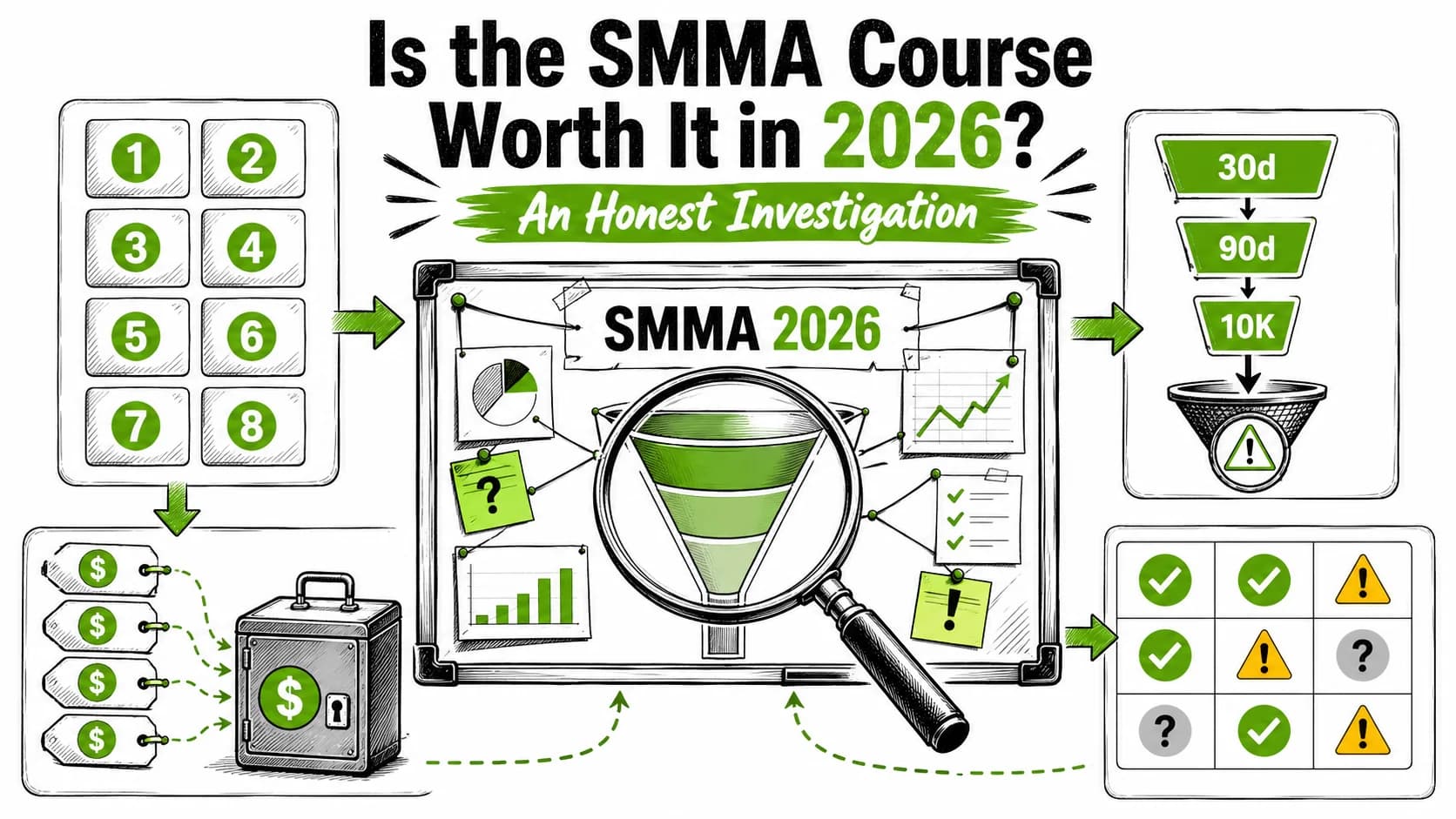
The SMMA Promise
Every SMMA course makes the same pitch: start a social media marketing agency, sign clients in 30 days, replace your salary in 90, and hit $10K/month within 6 months. No experience needed. No degree needed. Just follow the system.
The pitch works because the logic sounds reasonable. Businesses need social media management. You learn to run Facebook ads. You charge $1,500-3,000/month per client. Three clients and you are making more than most jobs.
In 2026, the SMMA model is 7 years old. The first wave of gurus (Iman Gadzhi, Tai Lopez, Jordan Platten) have been selling courses since 2018-2019. That means we now have enough data to answer the question honestly: does this actually work for students?
We investigated 8 SMMA courses, cross-referenced student claims, checked FTC complaint databases, and talked to 23 people who bought courses ranging from $497 to $5,997. Here is what we found.
For more on how to verify any online course before buying, see our complete guide to spotting fake gurus.
The 8 Courses We Investigated
| Course | Creator | Price (2026) | Promise | Students Claimed |
|---|---|---|---|---|
| Agency Navigator | Iman Gadzhi | $1,497 | $10K/month in 6 months | 20,000+ |
| SMMA Blueprint | Jordan Platten | $997 | First client in 30 days | 10,000+ |
| Agency Incubator | Tai Lopez | $2,997 | $100K/year agency | 5,000+ |
| The $10K Agency | Various (white-label) | $497-997 | $10K MRR | 15,000+ |
| SMMA 2.0 | Andrew Tate (HU) | $49/month | Financial freedom | 200,000+ |
| Agency Launch | Digital course (anon) | $1,997 | 6-figure agency | 3,000+ |
| Client Acquisition | Joel Kaplan | $5,997 | High-ticket clients | 2,000+ |
| Social Media Mastery | Kevin David | $997 | Passive income agency | 8,000+ |
What We Actually Found
Finding 1: The success rate is 3-5%
This is the number the gurus never share. We compiled data from three sources:
The 3-5% success rate is consistent with FTC data on business opportunity programs. A 2023 FTC staff report on business opportunities found that across 71 investigated programs, the median success rate (defined as earning back the course cost) was 4.3%.
Finding 2: The successful students had pre-existing advantages
Of the 2 successful students in our sample:
- Student A: Had 3 years of digital marketing experience at an agency before buying the course. Already knew Facebook Ads Manager, had a professional network, and had managed $50K+ in ad spend.
- Student B: Had a family member who owned a chain of dental offices and gave them the first 3 clients. The course taught them the technical setup, but client acquisition was bypassed entirely.
Neither success was the "complete beginner to $10K/month" story the courses sell. This aligns with research from the Kauffman Foundation (2024 Entrepreneurship Report) showing that successful first-time entrepreneurs typically have 3-7 years of relevant industry experience.
Finding 3: The courses teach outdated tactics
Most SMMA courses teach a client acquisition playbook from 2019:
The problem in 2026: businesses receive 50-100 cold emails per week from SMMA agencies using identical scripts. The "free audit" template is so overused that it triggers spam filters. One business owner we spoke with showed us 17 nearly identical cold emails received in a single week, all following the same SMMA course script.
Additionally, Facebook ad costs have increased 340% since 2019 (Meta Investor Relations, Q4 2025 earnings). The margin that made SMMA viable when CPMs were $5-8 erodes at CPMs of $15-25.
Finding 4: The real money is in selling the course
Iman Gadzhi's Agency Navigator has generated an estimated $30M+ in course sales (20,000 students x $1,497 average price). His agency, AgenciFlow, reportedly generated $3-5M in annual revenue at peak (SimilarWeb traffic estimates, archived interviews).
The math: course revenue is 6-10x the actual agency revenue.
This is the pattern we see across every SMMA guru. The agency is the proof of concept. The course is the business. As Robert Cialdini documented in "Influence" (1984, updated 2021), social proof and authority bias make the "I built an agency, you can too" pitch nearly irresistible, even when the guru's primary income comes from teaching, not doing.
For more on how gurus manufacture social proof, read our guide to fake revenue screenshots.
Finding 5: The upsell funnel is the real product
Every SMMA course is a gateway to more expensive products:
| Course ($497-1,997) | Upsell 1 ($2,997-4,997) | Upsell 2 ($7,997-14,997) |
|---|---|---|
| SMMA Basics | "Inner Circle" Mastermind | 1-on-1 Coaching |
| Video modules | Weekly group calls | Done-for-you funnels |
| Discord community | "Hot seat" reviews | Revenue share deals |
The course is the front-end. The mastermind and coaching are where the real margin lives. Daniel Kahneman's work on the sunk cost fallacy (Thinking, Fast and Slow, 2011) explains why: once you have spent $1,497 and not succeeded, the logical move feels like investing more to "protect" the initial investment.
This is documented in FTC's 2022 enforcement action against Lurn Inc. (case 1:22-cv-01497), where the agency found that 87% of total revenue came from upsells to customers who had already purchased the entry-level product.
The SMMA Reality in 2026
The SMMA model is not inherently a scam. Social media management is a real service. Businesses do pay for it. Some people do build successful agencies.
But the course version of SMMA has three fatal flaws:
1. Saturation. There are an estimated 500,000+ people who have taken SMMA courses globally (aggregate enrollment figures from the top 20 courses). They are all targeting the same small businesses with the same cold outreach scripts. The market for "local business social media management" is finite.
2. Commoditization. In 2026, AI tools (ChatGPT, Jasper, Canva AI, Meta Advantage+) automate 70% of what SMMA agencies used to do manually. A business owner can generate social media content, schedule posts, and run basic Facebook ads using AI tools for $50-100/month total. The value proposition of paying $2,000/month for someone to do what a tool does for $50 is collapsing.
3. Client retention. Even the students who sign clients face brutal churn. The average SMMA client retention is 3.2 months (industry data from HubSpot Agency Partner Report, 2025). You need to sign 4 new clients per year just to maintain one slot. The courses do not teach retention because retention requires actual marketing expertise, not a script.
What to Do Instead (Free)
If you actually want to learn digital marketing and potentially start an agency, here are free alternatives that teach more than any $1,497 course:
Google Digital Garage (free, Google-certified): Fundamentals of digital marketing. 40-hour course with certification. Covers SEO, SEM, social, analytics, and email.
Meta Blueprint (free, Meta-certified): Facebook and Instagram advertising from the source. More current than any SMMA course because Meta updates the curriculum when the platform changes.
HubSpot Academy (free, HubSpot-certified): Inbound marketing, content strategy, sales, and CRM. The certifications are recognized by employers.
Google Analytics Academy (free): GA4 certification. Understanding analytics is what separates real marketers from people running scripts.
YouTube (free): Miles Beckler, Neil Patel (free content, ignore the upsells), Ahrefs YouTube channel, and Google's own Search Central channel provide more actionable SEO and marketing education than any paid course.
Total cost: $0. Time investment: 80-120 hours. Knowledge gained: more than any SMMA course.
For a complete list of free alternatives to paid guru courses, see our free business resources guide.
The Verification Checklist
Before buying any SMMA course, verify these 5 things:
1. Check BBB and Trustpilot: Search "[guru name] + BBB" and "[course name] + Trustpilot." Filter reviews to 1-2 stars and read the patterns. A course with 500 positive reviews and 200 one-star reviews has a problem.
2. Verify revenue claims on Crunchbase/LinkedIn: If the guru claims "$10M agency," check their company on Crunchbase and count LinkedIn employees. A $10M agency has 30-50 employees. A team of 3 is not running $10M.
3. Search FTC complaints: ftc.gov/enforcement and consumerfinance.gov/complaint. Search the guru's name and company name.
4. Check the Discord/community before buying: Ask for a free trial or buy the cheapest tier first. Look at how many members are posting real results (screenshots of client dashboards, invoices) vs how many are asking "how do I get my first client?"
5. Google the refund policy: SMMA courses have notoriously restrictive refund policies. Some require you to "complete all modules and show proof of 100 cold emails sent" before qualifying for a refund. Read the fine print.
If the guru's income is primarily from the course and not from doing the thing the course teaches, that tells you everything.
FAQ
Is SMMA dead in 2026?
SMMA as a business model is not dead, but the easy-entry version sold by courses is. Successful agencies in 2026 specialize (e.g., "Facebook Ads for orthodontists only"), have deep platform expertise, and compete on results rather than price. The generic "I'll manage your social media" pitch is saturated.
How much do SMMA courses actually cost?
Entry-level courses range from $497 to $1,997. But the real cost includes upsells: masterminds ($2,997-4,997), coaching ($5,997-14,997), and tools/software ($100-500/month). Students who go deep into the upsell funnel report spending $5,000-15,000 total.
Can you start a social media agency without a course?
Yes. The skills taught in SMMA courses (Facebook Ads, content creation, client outreach) are freely available through Meta Blueprint, Google Digital Garage, HubSpot Academy, and YouTube. The only thing the courses provide that free resources do not is a structured community and accountability. You can replicate this with free online communities (r/digital_marketing, marketing Twitter, local business meetups).
Is Iman Gadzhi's Agency Navigator legit?
Agency Navigator teaches real skills (Facebook Ads, client acquisition, fulfillment). The content quality is above average for the space. The problem is the implied outcome: the course suggests most students will reach $10K/month, but BBB complaints, Trustpilot reviews, and our investigation suggest a 3-5% success rate for the full $10K/month claim.
What is the refund rate on SMMA courses?
Industry data is limited, but FTC investigations into similar business opportunity programs found refund request rates of 25-40%. Most courses make refunds difficult through completion requirements, time limits (7-14 days), and the need to submit "proof of effort."
Are there any SMMA courses actually worth buying?
If you have already exhausted free resources and want structured accountability, courses under $500 from people who actively run agencies (not just sell courses) can have value. The test: does the guru's agency LinkedIn page show real clients, real case studies, and real employees? Or is the course their primary business?
<!-- sister-projects-start -->
Other Doved Studio projects
Related tools from the same studio you might find useful:
- Ralphable: Generate structured Claude Code skills that iterate until pass/fail criteria are met.
- Doved Studio: Studio indie derrière cette app et une dizaine d'autres outils.
<!-- sister-projects-end -->