The "AI Agency" Goldrush: Why 90% of These "Done-For-You" AI Services Are Repackaged Templates
There are now more "AI agencies" than there are real problems being solved by AI. That sentence sounds like hyperbole until you spend a week on LinkedIn in March 2026, where every third post is some freshly minted "AI Solutions Architect" promising to "transform your business with custom AI." Their proof? A Canva carousel and a Calendly link.
The AI agency goldrush has officially overtaken the dropshipping era, the crypto consulting era, and the NFT marketing agency era as the lowest-barrier, highest-markup hustle in tech history. And unlike those previous waves, the AI agency grift is harder to detect — because the underlying technology actually works. ChatGPT is real. Claude is real. Automation tools are real. The scam isn't that AI doesn't work. The scam is that these agencies didn't build anything.
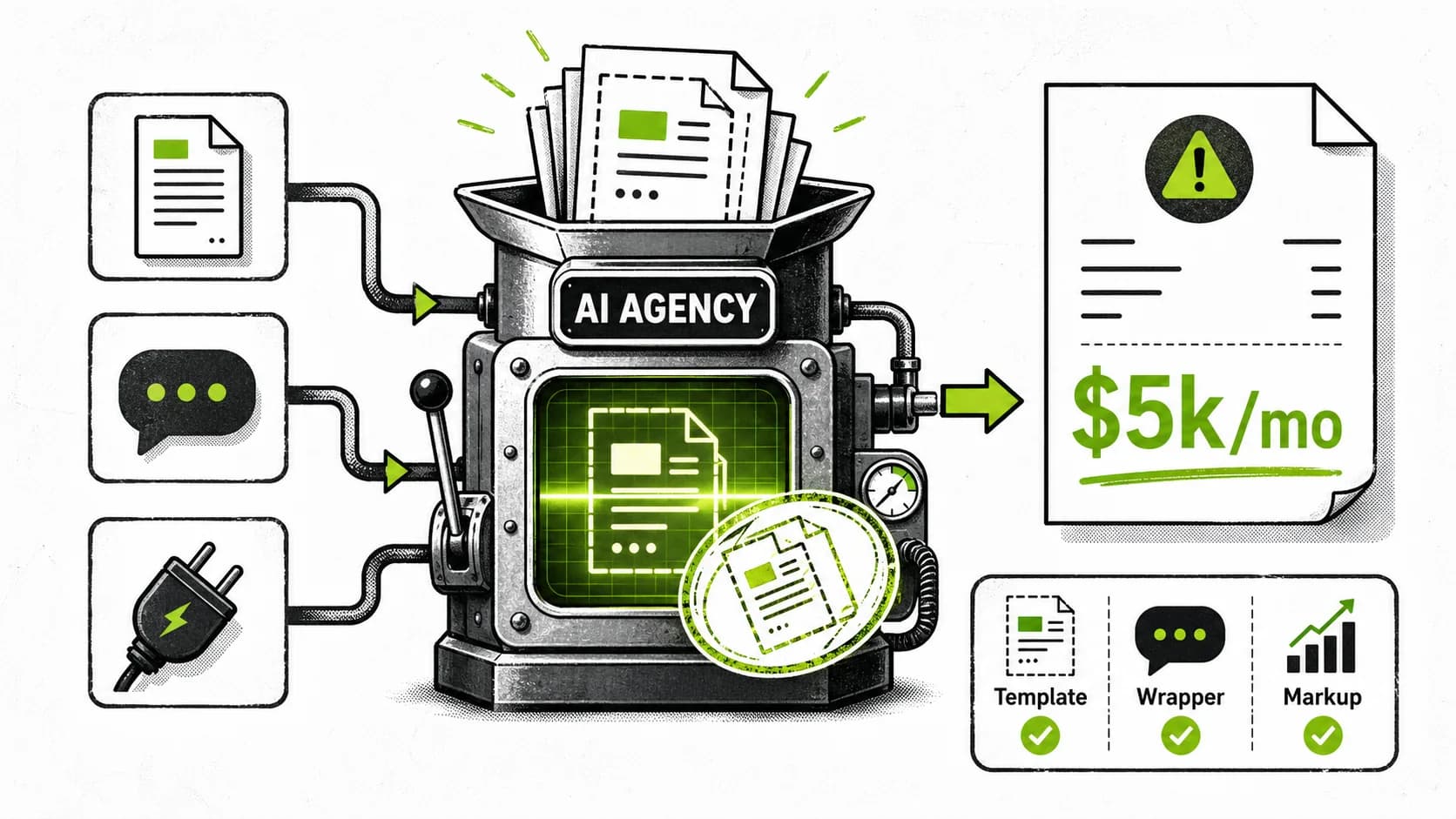
They bought a template. They renamed it. They charge you $5,000/month for it.
Let's pull this apart.
The Anatomy of a Fake AI Agency Landing Page
You've seen the landing page. You've probably already been retargeted by one. Let's deconstruct the standard-issue "AI agency" website that launched last Tuesday and claims three years of experience.
The hero section features a dark background with floating gradient orbs or a neural network animation (purchased from ThemeForest for $49). The headline reads something like "We Build Custom AI Solutions That Scale Your Business" — vague enough to mean nothing and broad enough to attract anyone with a credit card and a fear of being left behind.
The services section lists four to six offerings: "Custom AI Chatbots," "AI-Powered Workflow Automation," "Intelligent Document Processing," "AI Strategy Consulting," and the obligatory "Custom GPT Development." Each one links to the same contact form.
The case studies are suspiciously generic. "We helped a Fortune 500 company reduce support tickets by 40%." No company name. No link to verify. No screenshot of the actual product. The metrics are always round numbers — 40%, 3x, 60% reduction. Real metrics are messy. Real metrics are 37.2% and come with caveats.
The team section features headshots that are either AI-generated (check the earlobes — StyleGAN still can't do earlobes consistently in 2026) or stock photos. The titles are always inflated: "Chief AI Officer," "Head of Machine Learning," "Director of AI Strategy." A two-person operation doesn't have a C-suite.
The tech stack section — if it exists — name-drops everything: "We work with GPT-4, Claude, Gemini, LLaMA, Stable Diffusion, TensorFlow, PyTorch, LangChain, and proprietary models." No real agency works with all of these simultaneously. This is a keyword dump designed to rank in search, not a reflection of actual capability.
If you've encountered even three of these patterns on a single website, you're looking at a template merchant.
The "Custom AI Solution" That's Actually a Zapier Template
Here's where the grift gets specific. You hire the agency. They schedule a "discovery call" (30 minutes of them asking what you do, which they should already know if they researched you before the call). Then they disappear for two weeks and come back with a "custom AI solution."
What they actually built during those two weeks:
Step 1: They opened Make.com (formerly Integromat) or Zapier. They connected your Gmail to a ChatGPT API call. They connected the output to a Google Sheet. Total build time: 45 minutes.
Step 2: They wrapped the ChatGPT API call in a system prompt that says "You are a helpful assistant for [YOUR COMPANY NAME]. Respond professionally." This is the "custom AI model" they mentioned in the proposal.
Step 3: They embedded a Botpress or Voiceflow chatbot on your website using a pre-built template. They changed the colors to match your brand. They uploaded your FAQ page as the knowledge base. This is the "intelligent customer support agent" they quoted you $8,000 for.
Step 4: They set up a Notion database that automatically populates from a form using Zapier. They connected it to a ChatGPT API call that summarizes the form submissions. This is the "AI-powered lead qualification system."
The entire "custom AI ecosystem" is a stack of no-code tools connected by webhooks, running on default API calls with minimal prompt engineering. You could build the same thing by watching three YouTube tutorials and spending $50/month on subscriptions.
But they charged you $15,000 for the initial build and $3,000/month for "maintenance and optimization" — which means they occasionally check if the Zapier workflows are still running.
8 Red Flags to Spot a Template Merchant
Before you sign that proposal, run through this checklist. Any three of these together should trigger a full stop.
1. They Can't Explain Their Architecture Without Buzzwords
Ask them: "Walk me through exactly how the data flows from input to output in the solution you're proposing." If the answer involves more than two acronyms and zero specific technical details, they don't know what they're building. A legitimate AI developer will say something like: "Your customer emails hit an endpoint that parses the body text, runs it through a classification model we fine-tuned on your historical ticket categories, routes it to the appropriate queue, and generates a draft response using RAG against your knowledge base." A template merchant will say: "We leverage advanced AI and machine learning to intelligently process and automate your workflow."
2. Their "Portfolio" Has No Verifiable Details
Every case study is anonymized. Every metric is a round number. No client will go on record. No project is publicly visible. Legitimate agencies are proud of their work and have clients who will vouch for them. If every project is under NDA — all of them, with no exceptions — that's not confidentiality. That's fabrication.
3. They Quote a Fixed Price Before Understanding Your Data
AI solutions are fundamentally dependent on data quality, volume, and structure. Any agency that quotes you a firm price on the first call, before seeing your data, before understanding your existing systems, and before scoping integration requirements, is selling you a pre-built package. They know the price because it's always the same price. The template doesn't change; only the logo does.
4. The Deliverable Timeline Is Suspiciously Fast
"We'll have your custom AI solution deployed in two weeks." Real AI projects — ones involving actual model training, data pipeline construction, testing, and integration — take months. Even a well-scoped RAG implementation against a custom knowledge base needs four to six weeks minimum for a competent team: data cleaning, chunking strategy, embedding model selection, retrieval tuning, evaluation, and deployment. Two weeks gets you a Zapier flow and a ChatGPT wrapper.
5. They Don't Ask About Your Data
This is the single biggest tell. A legitimate AI consultancy will spend 60% of the discovery process asking about your data: Where is it? What format? How clean is it? How much history do you have? What are the edge cases? Who labels it? A template merchant asks about your budget and your timeline. They don't care about your data because they're not going to use it in any meaningful way. The ChatGPT API doesn't need your proprietary data to generate generic responses.
6. Their Team Has No Public Technical Footprint
Check LinkedIn. Check GitHub. Check conference talks. Check technical blog posts. Do the people who will actually build your solution have any evidence of building things before? Not sales content. Not thought leadership. Actual code, actual research, actual technical writing. If the "Head of ML" has no GitHub repos, no papers, no technical posts, and their entire LinkedIn history is sales roles rebranded as "AI" roles, you're dealing with a salesperson who learned the vocabulary, not the skill.
7. They Propose the Same Solution to Different Problems
This one requires a bit of detective work. If you can connect with other clients or find multiple proposals from the same agency (sometimes they recycle pitch decks and forget to change the company name — it happens more than you think), check whether they proposed the same architecture to a healthcare company, a real estate firm, and an e-commerce brand. Different industries have fundamentally different data structures, compliance requirements, and use cases. A one-size-fits-all solution is, by definition, a template.
8. The Contract Locks You Into Their Infrastructure
Read the contract carefully. Who owns the IP? Where is the solution hosted? Can you export it? Many template agencies deploy your "custom solution" on their own infrastructure, meaning you're locked in. If you leave, you lose everything. Legitimate vendors build on your infrastructure or at minimum provide full export capability and documentation. If the contract says they own the models, the prompts, and the deployment — and you're paying for it — you're renting, not buying. And you're renting something that costs them $20/month to run.
The Real Tech Stack vs. What They Claim
Here's a side-by-side breakdown of what template agencies actually use versus what they tell you they use.
What they claim: "Proprietary AI model fine-tuned on your industry data."
What they use: OpenAI API with a system prompt that says "You are an expert in [industry]." No fine-tuning. No custom training. Just a $20/month API key.
What they claim: "Custom-built automation pipeline."
What they use: Zapier or Make.com with pre-built connectors. The "pipeline" is five nodes in a visual flow builder that any intern could set up.
What they claim: "AI-powered knowledge base with semantic search."
What they use: A Notion database or Google Drive folder plugged into a Botpress chatbot using their default RAG template. The "semantic search" is whatever embedding model Botpress ships by default.
What they claim: "Multi-agent AI system for complex workflow orchestration."
What they use: Three separate ChatGPT API calls chained in Make.com, each with a different system prompt. The "agents" don't communicate or share state in any meaningful way. It's sequential prompting with extra steps.
What they claim: "Continuous learning system that improves over time."
What they use: Nothing. There is no feedback loop. There is no retraining pipeline. The system performs identically on day one and day three hundred. "Continuous learning" means they'll manually update the system prompt if you complain enough.
What they claim: "Enterprise-grade security and compliance."
What they use: Default API security from whatever platform they're on. No SOC 2. No HIPAA compliance. No data processing agreements. Your customer data flows through five third-party services, each with their own data retention policies that nobody read.
The markup on this stack is staggering. The total monthly cost of running a Zapier-to-ChatGPT pipeline with a Botpress chatbot is roughly $100-$300/month depending on volume. These agencies charge $2,000-$5,000/month for "management" of this stack. That's a 10-50x markup on commodity infrastructure.
Real Costs vs. What They Charge
Let's get specific about numbers.
A template agency's typical proposal for a "comprehensive AI automation package" comes in around $10,000-$25,000 for initial setup and $2,000-$5,000/month ongoing. Here's what the actual costs look like:
Chatbot (Botpress/Voiceflow template): $0-$300/month depending on plan. Setup time: 2-4 hours including knowledge base upload. Actual cost to agency: under $500 including labor for initial setup.
Workflow automation (Zapier/Make): $20-$200/month. Setup time: 4-8 hours for a typical flow. Actual cost to agency: under $800 including labor.
API calls (OpenAI/Anthropic): $50-$500/month depending on volume. No setup cost beyond writing a system prompt, which takes about 30 minutes. Actual cost to agency: maybe $200 for the first month including prompt writing.
Total real cost of a typical "AI agency" deliverable: $1,500-$3,000 in labor, $100-$1,000/month in running costs.
What they charge: $10,000-$25,000 setup, $2,000-$5,000/month.
That's not a margin. That's a heist.
Now, legitimate AI consulting does cost serious money. A real ML engineer costs $150-$300/hour. Fine-tuning a model, building a proper data pipeline, implementing robust evaluation — these are expensive and time-consuming. A genuine custom AI solution for a mid-size business can reasonably cost $50,000-$200,000 and take three to six months. The difference is that you get something actually custom, something that uses your data, something you own, and something that solves a problem no template can address.
The template merchants have learned to price themselves just below the threshold where a buyer would demand the same rigor as a real enterprise AI project, but just above the threshold where the buyer feels like they're getting something "premium." It's the pricing sweet spot of perceived sophistication — expensive enough to seem real, cheap enough to not trigger due diligence.
How to Verify Claims: Ask These 5 Questions
Before you sign anything, ask these questions. In writing. On the record. A legitimate agency will answer all five without hesitation. A template merchant will deflect, generalize, or get defensive.
Question 1: "Can I see the exact technical architecture of what you're proposing — including every third-party service involved?"
You want a diagram. Boxes and arrows. Every API, every database, every platform. If they can't produce this, they haven't designed anything yet. If they produce it and it's just "Your Data → Our AI → Results," that's a marketing slide, not an architecture document.
Question 2: "What happens to my data? Where is it stored, who processes it, and can I get a complete data flow audit?"
This question terrifies template merchants because the honest answer is: "Your data goes through Zapier's servers, then to OpenAI's API, then gets stored in a Google Sheet, and we don't have DPAs with any of them." A legitimate vendor has this mapped out, has the appropriate agreements in place, and can hand you documentation.
Question 3: "Can I speak to a current client whose use case is similar to mine?"
Not a testimonial. Not a quote on their website. A live conversation with a real person who is currently using the solution and can answer technical questions. If every client is under NDA and unavailable, that's your answer.
Question 4: "If I cancel, what do I keep? Can I export the entire solution and run it independently?"
This separates vendors from landlords. If the answer is "the solution runs on our infrastructure and can't be exported," you're not buying a product. You're renting access to a Zapier account. A legitimate deliverable comes with documentation, source code (if applicable), export capability, and knowledge transfer.
Question 5: "What is the evaluation methodology? How will we measure whether this AI solution is actually performing better than the baseline?"
This is the question that makes template merchants visibly uncomfortable. They don't have evaluation methodology because there's nothing to evaluate. The ChatGPT API performs however it performs. A real AI project has defined metrics, baseline measurements, A/B testing frameworks, and ongoing evaluation pipelines. If their answer to "how do we know this works" is "you'll see the results," walk away.
What Legitimate AI Consulting Actually Looks Like
The existence of template merchants doesn't mean all AI agencies are fraudulent. Legitimate AI consulting exists and delivers genuine value. Here's what it actually looks like, so you can calibrate your expectations.
Discovery takes weeks, not hours. A real engagement starts with deep data analysis. The consulting team needs to understand your data formats, volumes, quality issues, edge cases, compliance requirements, and existing infrastructure. This phase alone typically costs $5,000-$15,000 and results in a detailed feasibility assessment — not a sales proposal.
They tell you when AI isn't the answer. The most reliable signal of a legitimate consultancy is their willingness to say "you don't need AI for this." A rules-based system, a better database query, or a redesigned workflow might solve your problem faster and cheaper. Template merchants never say this because they have one tool and every problem is a nail.
They show you their work in progress. Legitimate teams do weekly demos, share code repositories, explain their decisions, and invite your team into the process. There's nothing proprietary about a Jupyter notebook and a confused look at your data cleaning challenges. Transparency is the norm, not a premium add-on.
The team has domain expertise, not just AI buzzwords. A good AI consultancy working on healthcare projects has people who understand HIPAA, HL7 FHIR, clinical workflows, and the specific challenges of medical NLP. They're not generalists claiming to serve every industry with the same approach.
They build evaluation into the project from day one. Before a single model is trained, the team defines success metrics, establishes baselines, and creates evaluation datasets. This is how you know the solution actually works — not from a case study PDF, but from measured, reproducible results against your own data.
They plan for their own departure. The goal of a legitimate engagement is to make the client self-sufficient. That means documentation, knowledge transfer, training for your internal team, and architecture that your own engineers can maintain. If the agency's business model depends on you never being able to run the solution without them, their incentives are misaligned with yours.
The Bottom Line
The AI agency goldrush of 2026 is not going to self-correct. There's too much money flowing in and too little technical literacy among buyers. The gap between what AI can actually do and what most people understand about AI is the exact gap these template merchants exploit.
Here's the uncomfortable truth: the tools these agencies use — ChatGPT, Zapier, Botpress, Make.com — are genuinely useful. The scam isn't that the tools are bad. The scam is the markup, the misrepresentation, and the manufactured complexity. They take a $100/month stack, add a logo and a deck, and charge you $5,000/month for something you could learn to manage yourself in a weekend.
If you're a business evaluating AI agencies in 2026, do yourself three favors:
First, spend one afternoon building something yourself. Go to Make.com, connect ChatGPT to your email, and build a basic automation. It'll take you two hours. The goal isn't to replace the agency — it's to understand the floor. Once you know that the basic version takes two hours and costs $30/month, you can evaluate whether what an agency proposes is genuinely more sophisticated or just the same thing with better typography.
Second, require technical specificity in every proposal. No more "leveraging AI to drive outcomes." Demand architecture diagrams, named technologies, data flow documentation, and evaluation criteria. If the proposal reads like a LinkedIn post, it was written like one.
Third, verify everything. Check the team's GitHub. Call the references. Google the case studies. Reverse-image search the headshots. Audit the contract for lock-in clauses. The five minutes of due diligence you do now saves you the five months of regret later.
The legitimate AI industry is doing extraordinary work. Custom models are solving problems that seemed impossible two years ago. But for every real AI company quietly shipping value, there are ten template merchants loudly promising the same thing from a WeWork desk and a Canva subscription.
Don't be the customer who can't tell the difference.
<!-- sister-projects-start -->
Other Doved Studio projects
Related tools from the same studio you might find useful:
- Ralphable: Generate structured Claude Code skills that iterate until pass/fail criteria are met.
- Doved Studio: Studio indie derrière cette app et une dizaine d'autres outils.
<!-- sister-projects-end -->