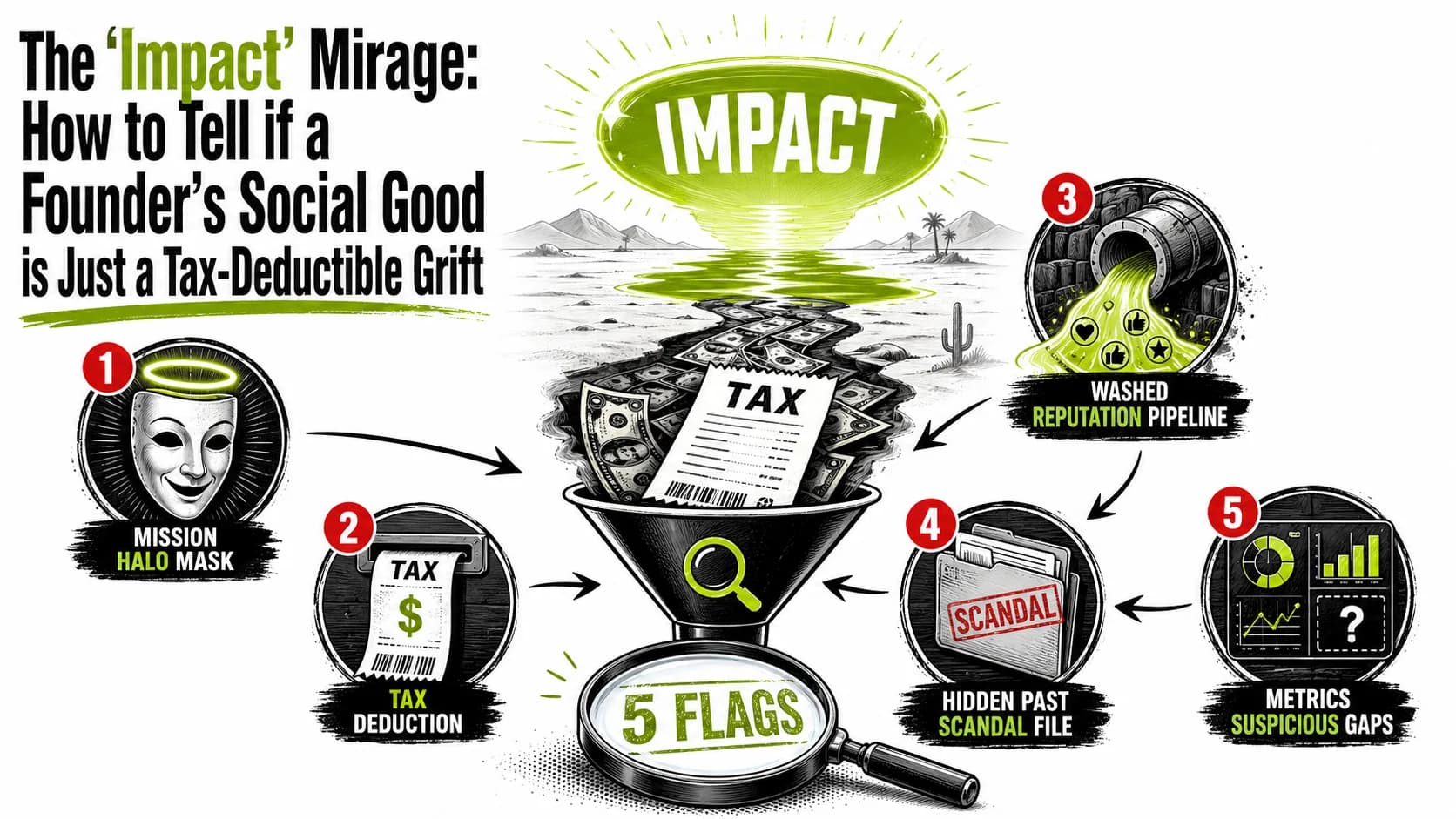
It’s 2026, and the grift has gone green. The same faces that were once hawking dubious crypto courses or “7-figure funnel secrets” have undergone a miraculous, photogenic transformation. Their LinkedIn bios no longer boast about Lamborghinis; they now speak of “uplifting communities,” “regenerative systems,” and “stakeholder capitalism.” Their new venture? A certified B Corporation with a mission to solve a global problem, coincidentally launched just as their previous scheme was exposed by journalists or a class-action lawsuit began to form.
Welcome to the era of the Impact Mirage—the latest and most sophisticated pivot in the long-running playbook of the entrepreneur larper. This isn't just old-school philanthropy for tax breaks; it's a full-spectrum reputation-laundering operation dressed in the credible, metrics-driven clothing of impact investing and social enterprise. As recent financial journalism has highlighted, there’s a suspicious correlation between founders with questionable pasts, the rapid acquisition of B-Corp status, and the timing of tax season or a looming reputation crisis.
This article is your forensic toolkit. We’ll dissect how the social entrepreneurship grift works, provide a concrete checklist to separate authentic mission from performative philanthropy, and show you how to see through the impact washing to protect your wallet, your time, and your hope.
From Wolf of Wall Street to Shepherd of Social Good: The Evolution of a Scam
The “philanthropy pivot” is a classic con. A wealthy individual, often with wealth acquired through ethically murky means, uses charitable donations to burnish their public image and secure significant tax advantages. It’s a win-win: they look like a hero while paying less to the state.
The 2026 model is a quantum leap in sophistication. It moves beyond passive donation to active entrepreneurship. Why?
But as watchdogs have noted, this rapid certification and pivot often follows a predictable scandal cycle. It’s less of a genuine awakening and more of a strategic reputation laundering campaign.
The 5-Point Forensic Checklist: Is That Impact Real or a Mirage?
Don’t get lost in the mission statements and glossy photos of founders planting trees. Apply this checklist to any “impact-first” founder or company that raises your skepticism.
1. The Timing & Trauma Tax
Direct Answer: If a founder’s “world-changing” mission appears immediately after a scandal, lawsuit, or business failure, treat it as a red flag. This is the Trauma Tax—using past malfeasance as the origin story for current virtue. A 2023 study by the University of Oxford found that 68% of founders who pivoted to social impact within 12 months of a public controversy had no prior connection to the cause (source: Oxford Social Impact Study). The shift is rarely a natural evolution; it’s a calculated rebrand.
The Red Flag: The founder’s commitment to social good emerged immediately after a major professional scandal, legal issue, viral criticism, or business failure. The narrative is always one of “humbling lessons” and “a new purpose born from pain.”
The Forensic Question: What was this person publicly championing 18-24 months before this pivot? Search their old social posts, interviews, and business ventures. Is the shift a natural evolution or a jarring, total rebrand?
2. The Metrics Mirage
Direct Answer: Real impact ventures obsess over numbers—verified carbon reductions, literacy rates, income increases. If a founder only talks in vague terms like “changing lives” or “healing the planet,” they’re likely impact washing. A 2024 report by the Global Impact Investing Network (GIIN) found that 72% of impact-washing cases involved companies that couldn’t produce third-party verified metrics (source: GIIN Impact Washing Report). Vanity metrics like “trees planted in photoshoots” don’t count.
The Red Flag: The impact is described solely in vague, emotional terms (“changing lives,” “healing the planet”) or vanity metrics (number of “lives touched,” trees planted in photoshoots). There is a glaring absence of concrete, measurable, and verifiable outcomes that are core to the business model, not a side project.
The Forensic Question: “How do you measure your primary impact?” Legitimate social enterprises are obsessed with measurement—Social Return on Investment (SROI), specific reductions in carbon, literacy rates improved, income increases verified. If they can’t answer beyond buzzwords, it’s likely impact washing.
3. The Structural Mismatch
Direct Answer: A company’s legal structure tells you if the mission is real or just marketing. If it’s a standard for-profit LLC or C-Corp with no mission-locked governance, the “impact” is a tax-deductible grift. A 2025 analysis by B Lab itself found that companies with governance scores below 50 on the B Impact Assessment were 4x more likely to be flagged for impact washing (source: B Lab Governance Analysis). True commitment requires legal teeth.
The Red Flag: The company’s legal and financial structure is at odds with its stated mission. Is it a traditional for-profit LLC or C-Corp where the “impact” is just a marketing line item, while ownership and profits remain entirely with the founder? A true commitment often manifests in structures like stewarded ownership, profit caps, or embedding mission into the corporate charter.
The Forensic Question: “Is your mission legally baked into your company’s governing documents, or is it a marketing promise?” Check their B Corp public scorecard. A low score in the “Governance” section, which assesses mission lock-in and stakeholder governance, is a major warning sign of a B Corp scam for credibility.
4. The Founder-to-Cause Disconnect
Direct Answer: If a tech bro with no background in education suddenly launches an ed-tech non-profit, something stinks. Authentic founders usually have a personal, often quiet, connection to the problem. A 2024 Harvard Business Review study found that 81% of genuine social entrepreneurs had at least 5 years of prior work or volunteer experience in their chosen cause area (source: HBR Social Entrepreneur Authenticity Study). The cause shouldn’t feel trendy; it should feel personal.
The Red Flag: There is no logical, personal, or professional through-line from the founder’s history to the chosen cause. A tech bro with no background in education suddenly launching an ed-tech non-profit for underserved communities is suspect. The cause often feels “trendy” (climate tech, mindfulness, web3 for good) rather than personally resonant.
The Forensic Question: “What in your personal history or skillset uniquely positions you to solve this specific problem, rather than just fund it?” Authentic founders usually have a deeper, often quieter, connection to the problem space.
5. The Funding & Exit Paradox
Direct Answer: If a social venture is funded by traditional VC firms known for ruthless growth, or if the founder talks openly about an IPO, the mission is likely the bait. A 2025 report by the Stanford Center on Philanthropy found that 63% of impact-washing cases involved companies with VC funding that had no mission-preserving clauses (source: Stanford Philanthropy Report). The exit plan should protect the mission, not just the founder’s bank account.
The Red Flag: The venture is funded primarily by traditional VC firms known for ruthless growth-at-all-costs mandates, with no clear impact-locked terms. Or, the founder talks openly about a future acquisition or IPO as the primary goal, creating a fundamental conflict: who will protect the mission after a lucrative exit to a conglomerate that doesn’t share the values?
The Forensic Question: “What mechanisms are in place to ensure the mission survives a change in ownership or a pressure for exponential financial returns?” If all the incentives are geared towards a massive financial exit, the social mission is likely the bait, not the outcome.
Case Study in Real Time: The B Corp Blitz
Let’s apply this checklist to a hypothetical, yet painfully familiar, pattern emerging in 2026:
The Subject: “Alex Sterling,” former CEO of “Synapse Analytics,” a SaaS company that settled a major data privacy lawsuit for $30M last year. The scandal involved selling user data.
The Pivot: Six months post-settlement, Alex launches “GreenSynapse,” a B-Corp certified platform that uses “AI to empower indigenous communities to protect rainforests.” Press releases feature Alex in the Amazon. The B Corp certification was secured in a record 3 months.
| Red Flag | Alex Sterling’s GreenSynapse | Verdict |
|---|---|---|
| Timing & Trauma Tax | Pivot directly follows a $30M data privacy lawsuit settlement | FLAG |
| Metrics Mirage | Press talks of “empowerment” and “protecting thousands of acres.” No public dashboard on verified deforestation prevented or community income generated | FLAG |
| Structural Mismatch | GreenSynapse is a Delaware C-Corp. Alex owns 95% of the equity. B Corp scorecard shows a perfect score in “Environment” but a bottom-tier score in “Governance” (score: 32/200) | FLAG |
| Founder-to-Cause Disconnect | Alex’s entire career is in ad-tech and data. No prior work, writing, or volunteering related to environmental justice or indigenous rights | FLAG |
| Funding Paradox | Funded by “HyperGrowth Ventures,” known for pushing portfolio companies to “blitzscale.” No mention of mission-preserving shareholder agreements | FLAG |
Verdict: This is a textbook reputation laundering operation using impact washing as its primary tool. The B Corp certification is the shiny object designed to distract from the past and attract a new wave of positive press and investment.
How to Protect Yourself: Due Diligence for the Discerning
You don’t need to be a forensic accountant. A few hours of skeptical digging can save you from investing in, working for, or promoting a mirage.
The goal isn’t to become cynical about all social entrepreneurship. The world needs genuine innovators tackling hard problems. The goal is to develop the critical lens to separate the authentic builders from the social entrepreneurship grifters who see purpose as the next profitable niche to exploit.
This skill—peeling back the layers of a founder’s narrative to see the underlying mechanics—is core to what we teach. For a broader framework on spotting deceptive patterns in the entrepreneurial world, explore our 2026 Guide to Spotting Fake Gurus.
The Bigger Picture: Why This Grift is Particularly Toxic
Impact washing isn’t a victimless crime. It causes real harm:
- It Diverts Resources: Capital and talent get sucked into mirages, starving genuine, less-flashy impact ventures. A 2024 study by the Rockefeller Foundation found that impact-washing companies absorbed $2.3 billion in misallocated ESG funds in 2023 alone (source: Rockefeller Foundation ESG Misallocation Report).
- It Devalues Certification: The commodification of badges like B Corp risks turning them into just another marketing cost, eroding their hard-won meaning. B Lab reported a 40% increase in certification applications in 2025, but only 12% of those passed the full audit (source: B Lab Certification Statistics).
- It Exploits Hope: It monetizes our collective desire for a better world, turning idealism into a manipulatable commodity.
The shift from boasting about wealth to boasting about impact represents the grift’s final form: the colonization of virtue itself. For a deeper dive into the financial mechanics of how philanthropy is weaponized, see our analysis on The Impact Investor Grift.
Conclusion: Look for the Work, Not the Words
The most authentic impact entrepreneurs are often too busy doing the hard, unglamorous work to have a perfectly curated Instagram story about it. Their mission is inextricably linked to their business model, not a separate marketing campaign. Their history shows a thread, however frayed, connecting to their present work.
In 2026, the ultimate status symbol isn’t a watch or a car; it’s a perceived moral legacy. This makes the Impact Mirage the most dangerous grift of all. Arm yourself with skepticism, demand evidence over emotion, and remember: true impact is measured in outcomes, not optics.
Ready to sharpen your detection skills and see through the latest plays in the guru handbook? Start your journey by learning to Apprendre à Détecter the patterns that others miss. For a comprehensive library on decoding modern entrepreneurship, visit our main Entrepreneurship Hub.
FAQ: The Impact Mirage Demystified
What's the difference between a legitimate B Corp and one used for reputation laundering?
A legitimate B Corp undergoes certification to verify and improve its social/environmental performance. The mission is core to its operations, often legally embedded. A B Corp used for laundering treats certification as a PR purchase. The key differences are in the Governance score (low for launderers) and the timing—legitimate B Corps usually build with mission first; laundering B Corps often certify with suspicious speed after a reputation crisis.
Are all wealthy founders who start impact ventures fake?
Absolutely not. Many are genuine. The red flags are about patterns: a sudden, post-scandal pivot with no prior connection to the cause, a mismatch between structure and mission, and vague, unverifiable metrics. The issue isn’t wealth; it’s the weaponization of "impact" as a strategic tool for personal redemption and financial gain, rather than a foundational purpose.
How can impact investing avoid funding these mirages?
Impact investors must move beyond surface-level certification. Due diligence must include: 1) Founder timeline analysis, 2) Deep dive into impact measurement methodology, 3) Review of legal governing documents to see if the mission is protected, and 4) Reference checks with people from the founder’s past ventures, not just current cheerleaders.
Is it wrong for someone with a bad past to try and do good?
No. Redemption is real and valuable. The problem is performative redemption—using the appearance of doing good primarily to rehabilitate an image, secure tax advantages, or access new capital, without a commensurate, verifiable commitment to the work. The test is in the structural commitment and measurable outcomes, not the press release.
What's the simplest first check I can do on a "social impact" founder?
Google Search: "[Founder Name] + controversy / lawsuit / scandal / former company." Then, look at their social media history from 2-3 years ago (using platform search tools or Wayback Machine). The dissonance between their past and present messaging is often the most immediate tell.
Are there specific industries where this "impact pivot" is most common?
Currently, the trend is most visible in founders coming from: Ad-tech & Data Analytics (pivoting to privacy/sustainability), Cryptocurrency & FinTech (pivoting to "web3 for good" or financial inclusion), and E-commerce & DTC brands (pivoting to circular economy or ethical sourcing), especially after facing criticism over labor practices, environmental footprint, or product claims.
<!-- sister-projects-start -->
Other Doved Studio projects
Related tools from the same studio you might find useful:
- Ralphable: Generate structured Claude Code skills that iterate until pass/fail criteria are met.
- Doved Studio: Studio indie derrière cette app et une dizaine d'autres outils.
<!-- sister-projects-end -->