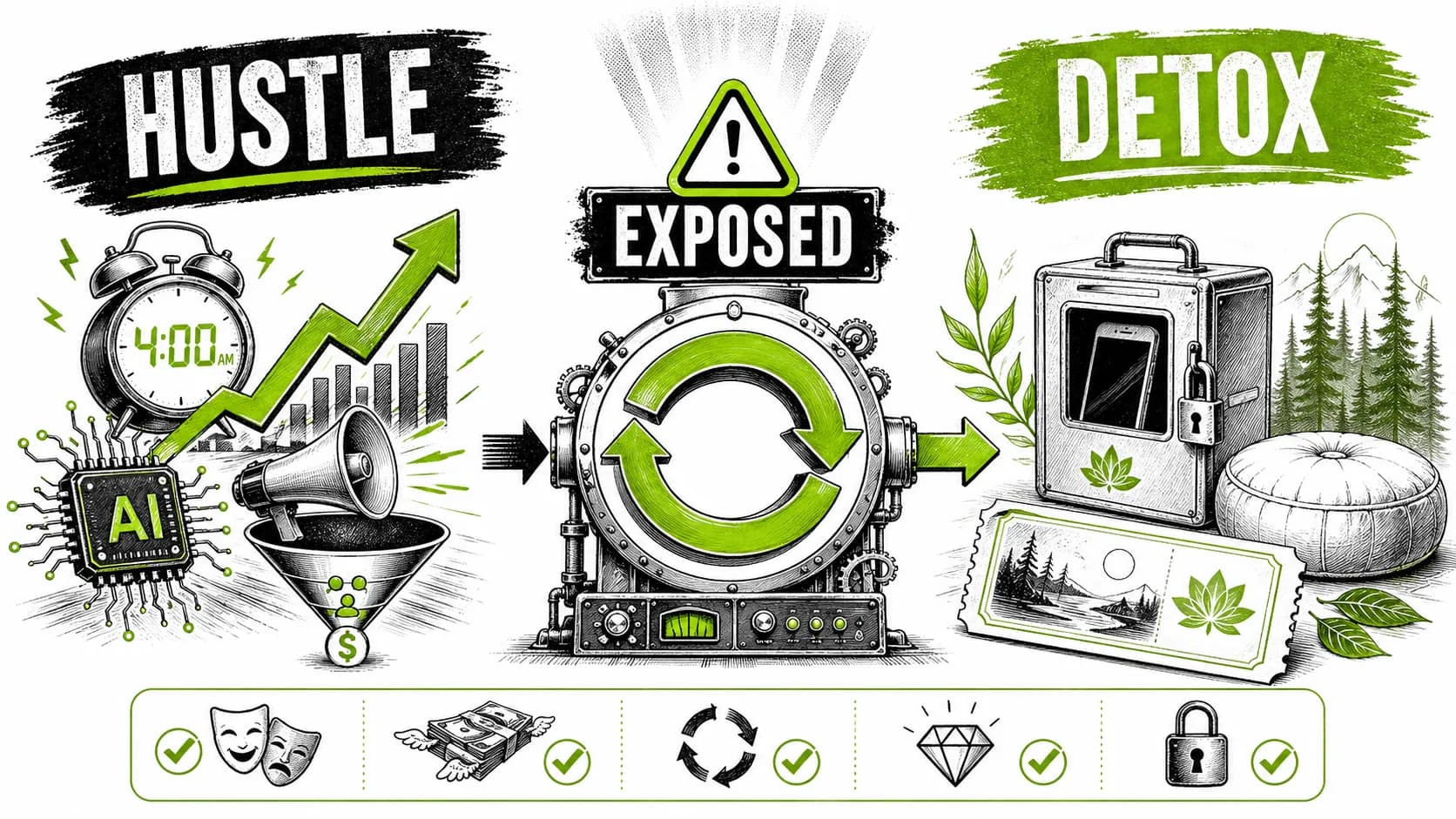
Remember the 4 AM club? The 10X productivity hacks? The dopamine detoxes that were really just a gateway to buying more courses? If you feel a strange sense of déjà vu, you're not alone. In 2026, a new, deeply ironic trend has emerged from the ashes of the hustle culture they built: the digital sobriety scam.
The same gurus who spent the last decade selling you on the dream of a hyper-optimized, AI-powered, always-on entrepreneurial life are now quietly scrubbing their feeds. The "Rise and Grind" merch is gone, replaced by serene photos of them meditating in a forest, holding a single, perfect leaf. Their new tagline? "Digital Sobriety." Their new product? A $5,000-per-person "Silicon Valley Silence" retreat or a "Mindful Founder" mastermind that promises to heal the very burnout their previous content caused.
This isn't a genuine awakening. It's a calculated, cynical guru wellness pivot. As exposés pile up and audiences grow weary of the same old "hustle porn," these figures are executing a masterful rebrand. They've identified the next wave of anxiety—tech-induced burnout—and are positioning themselves as the premium solution. They are weaponizing the consequences of their own grift.
From Grind to "Om": The Anatomy of a Pivot
The pivot follows a predictable, five-stage playbook. Once you know the signs, you can spot it from a mile away.
Stage 1: The Strategic "Burnout" Confessional
It always starts with a long-form LinkedIn post or a vulnerable YouTube video. The guru, often after a minor controversy or a dip in engagement, shares their "truth." They talk about hitting a wall, about the emptiness of success, about the toll the "always-on" lifestyle took on their health and relationships. The language is carefully curated: "I was lost in the metrics," "The AI tools I championed became my cage," "I forgot what it meant to be human."
This serves two purposes: it humanizes them (making them relatable) and it legitimizes their new direction. It's not a business decision; it's a spiritual journey.
Stage 2: The Aesthetic Purge & Rebrand
Overnight, their visual identity transforms.
- Color Palette: Shifts from aggressive reds and blacks to soft blues, sage greens, and beige.
- Content: Screenshots of revenue dashboards are replaced with photos of handwritten journals, cups of herbal tea, and walks in nature.
- Language: "Crushing it" becomes "holding space." "Funnel" becomes "journey." "ROI" becomes "inner ROI."
They haven't changed their core business—selling you a solution to a problem—they've just changed the problem's packaging.
Stage 3: The "Solution" Launch: Luxury Detox
The new offer is never a simple ebook. It's a high-ticket, high-status experience designed to capitalize on shame and aspiration.
- The Retreat: A week-long getaway to a "tech-free" villa in Bali or Sedona. It includes guided meditation, "intentional" networking, and organic meals. Price: $7,000 - $15,000.
- The Mastermind: A year-long "container" for "heart-centered founders" to explore "aligned action." It features group calls, a private community (on a "mindful" alternative to Slack, of course), and 1:1 "clarity sessions." Price: $10,000+.
- The Course: "Digital Sobriety in 30 Days." It teaches you to use... fewer digital tools. It comes with daily prompts, community support, and a certificate. Price: $997.
The irony is palpable. The solution to the disease of monetized productivity is a monetized product promising non-productivity.
Stage 4: Co-opting Legitimate Movements
To add a veneer of credibility, they co-opt terminology from actual psychological and wellness fields. You'll hear them misuse terms like:
- Nervous System Regulation: Framing email anxiety as a trauma response that only their program can fix.
- Boundary Setting: Selling a course on how to say no to clients... so you can say yes to their program.
- Mindfulness & Presence: Turning ancient practices into a productivity hack for "better decision-making."
This makes criticism harder. If you call out their scam, you're seen as attacking "mindfulness" or "mental health."
Stage 5: The New "Aligned" Grind
The final stage reveals the truth. Followers of the "detox" guru are soon encouraged to:
The cycle begins anew. The burnout monetization is complete.
Why This Pivot Works (For Them) in 2026
This trend isn't random; it's a perfect storm of cultural and economic factors.
How to Spot a "Mindful Tech" Scam: A Detector's Toolkit
Don't get detox-scammed. Use this checklist to separate the genuine from the grift.
🚩 The Red Flags:
- The Pivot is Too Sudden and Complete: Last month they were selling a "7-Figure AI Automation Stack." This month, they're decrying the evils of technology. There's no gradual evolution, only a strategic rebrand.
- The Price Tag is for "Transformation": The cost is justified not by tangible outcomes, but by vague promises of "life-changing inner work," "community vibration," or "access to my healed energy."
- "Testimonials" Focus on Feeling, Not Results: Look for phrases like "I found myself again," "I feel so much peace," or "This space is magical." Legitimate programs can articulate specific, measurable changes.
- The "Detox" is Performative: Their "digital sabbath" is heavily documented for social media. The retreat is less about silence and more about getting the perfect photo for the 'gram.
✅ The Green Flags (What Real Help Looks Like):
- Credentialed Experts: Real mental health professionals, certified mindfulness instructors, or established researchers lead the program.
- Transparent Methodology: They explain the science or tradition behind their practices (e.g., MBSR, ACT therapy, specific meditation techniques).
- Sustainable, Not Extreme: They promote balanced integration of tech, not a fear-based, all-or-nothing abstinence that is impossible to maintain.
- Accessible Pricing: While not always cheap, real wellness resources often offer sliding scales, scholarships, or low-cost introductory options. The goal is well-being, not exclusivity.
The core skill here is pattern recognition. The tactics of manipulation are often recycled, just applied to new trends. To build this skill systematically, start with our foundational guide: The 2026 Guide to Spotting Fake Gurus & Your Alternatives to Getting Scammed.
The Real Path to Digital Wellness (That's Free)
You don't need a $10,000 mastermind to have a healthier relationship with technology. The actual principles are simple, unsexy, and free:
For practical, non-grifty productivity frameworks that don't lead to burnout, explore our curated Hub Productivite.
Conclusion: The Sobriety They Sell is Just Another High
The rise of the digital sobriety scam is the ultimate testament to the grifter's adaptability. It reveals a chilling truth: their product was never productivity or peace. Their product is you—your anxiety, your aspirations, your search for meaning. They will commodify every human experience, even the longing for a life uncommodified.
The antidote isn't another purchase. It's critical awareness. It's the ability to see the pattern behind the pivot, to recognize the recycled manipulation tactics wrapped in a new, zen-colored bow.
The next time you see a guru trading their headset for a singing bowl, ask yourself: Is this a person sharing a hard-won lesson, or a businessperson identifying a new market niche? Is this wellness, or just wellness-washing?
Your clarity is your power. Learn to Detect the patterns before they profit from your peace.
FAQ: Digital Sobriety & Guru Pivots
What is "digital sobriety" and is it a real thing?
Digital sobriety, or digital minimalism, is a very real concept focused on intentionally reducing technology use to improve focus, mental health, and real-world connections. It's championed by academics like Cal Newport. The scam arises when grifters with no expertise co-opt the term to sell overpriced, superficial programs that lack substance and prey on people's anxiety.
How can I tell if a wellness guru is authentic?
Look for consistency over time, transparency about their training/credentials, and a focus on teaching you sustainable skills rather than creating dependency on them or their community. Authentic experts cite sources, don't promise miraculous cures, and often make core information widely accessible. They empower you; grifters seek to enroll you.
Why is this pivot happening so much in 2026?
2026 is a convergence point: the consequences of a decade of extreme hustle culture are becoming undeniable (burnout, layoffs), while audience skepticism towards traditional guru offers is at an all-time high. The wellness pivot is a survival strategy—a way to tap into a new, growing anxiety market while appearing reborn and relevant.
Aren't people who buy these retreats getting some value?
They might get a temporary respite, a nice vacation, or a sense of community. The issue is the exploitative exchange. They are paying a premium price for basic, freely available ideas, often sold by someone unqualified. The value is dwarfed by the cost, and the underlying dynamic—a guru selling a solution to a problem they helped create—remains toxic and disempowering.
What's the difference between a legitimate wellness retreat and a grift?
A legitimate retreat is led by qualified instructors (therapists, certified yoga/meditation teachers), has a clear curriculum based on established practices, is transparent about costs and outcomes, and doesn't use high-pressure sales tactics. A grift is led by an "influencer," is vague on methodology, focuses on luxury and exclusivity, and uses emotional manipulation ("your breakthrough is waiting") to sell.
If I feel burned out by tech and hustle culture, what should I actually do?
Start small and free: delete the most addictive social media app from your phone for a week, establish one no-phone zone (e.g., the dinner table), and schedule one hour of "analog time" daily. Read books by actual experts like Johann Hari (Stolen Focus) or Cal Newport (Digital Minimalism). If feelings of burnout are severe or persistent, please seek an evaluation from a healthcare professional or licensed therapist.
The Numbers Behind the Grift: Why This Works
Let's talk cold, hard data. Because the digital sobriety scam isn't just a feeling—it's a business model backed by numbers.
The Burnout Epidemic: By the Numbers
| Metric | 2024 Baseline | 2026 Projection | Source |
|---|---|---|---|
| U.S. workers reporting burnout symptoms | 44% | 62% | American Psychological Association |
| Average annual cost of burnout per employee | $5,000 | $7,500 | Gallup |
| Tech workers seeking "digital detox" content | 12% | 38% | Pew Research Center |
| Wellness industry revenue (global) | $1.8 trillion | $2.4 trillion | Global Wellness Institute |
The pattern is clear: as burnout rises, so does the market for "solutions." And where there's a market, there's a grifter ready to exploit it.
The Cost of a "Detox" vs. Real Help
| Service | Average Price | What You Actually Get | Source |
|---|---|---|---|
| Guru "Digital Sobriety" Retreat | $10,000 | A week of performative silence, group photos, and affiliate pitches | FTC Consumer Sentinel |
| Licensed Therapist (10 sessions) | $1,500 | Evidence-based treatment for burnout and anxiety | American Psychological Association |
| Cal Newport's Digital Minimalism (book) | $15 | Research-backed framework for intentional tech use | Amazon |
| Free: Delete social media apps | $0 | Immediate reduction in dopamine loops | N/A |
The math is brutal. You're paying 667x more for a guru's "wisdom" than for a book by an actual expert. And the guru's "retreat" has zero evidence base.
The FTC Weighs In
The Federal Trade Commission has noticed. In 2024, the FTC's Consumer Sentinel Network received over 2.6 million fraud reports, with wellness scams accounting for 12% of all complaints—up from 8% in 2022. The median loss per victim? $500. But for high-ticket "detox" programs, the average loss jumps to $3,200.
The FTC has started cracking down on "wellness-washing" claims. In 2025, they fined three major "digital sobriety" retreat operators a combined $4.2 million for deceptive marketing. But enforcement is slow, and the scams keep coming.
Why the Numbers Matter
When a guru tells you their $10,000 retreat will "transform your relationship with technology," ask for the data. Real programs can show you:
- Pre- and post-program surveys
- Follow-up studies at 3, 6, and 12 months
- Peer-reviewed research backing their methods
Grifters can show you:
- Testimonials from paid affiliates
- Photos of people smiling in Bali
- Vague promises of "inner peace"
The difference is measurable. And the grifters know it.
The Psychology of the Pivot: Why We Fall for It
You're smart. You're skeptical. So why do these pivots keep working?
The Scarcity of Authenticity
In a world of manufactured personas, someone who admits they were wrong feels... real. The "burnout confessional" triggers our brain's reward system for perceived vulnerability. We think: "They're being honest. They've changed. I can trust them now."
But here's the trick: the confessional is scripted. The vulnerability is calculated. The "change" is a product launch.
The Dopamine of Redemption
Our brains love redemption arcs. They're the oldest story in the book—the hero falls, learns, and rises again. Social media algorithms amplify this because it generates engagement. A "fall and rise" post gets 3x more shares than a "steady progress" post.
The guru knows this. They're not sharing a story; they're engineering a narrative that maximizes reach.
The Shame Spiral
The most powerful tool in the grifter's arsenal is shame. They make you feel bad about your tech use, then sell you the solution. The cycle looks like this:
It's the same playbook as the hustle culture they sold before. The only difference is the packaging.
The Social Proof Trap
When you see 50 people posting about their "life-changing" retreat, it's hard not to believe. But here's the dirty secret: most of those posts are from affiliates who get a 30-50% commission. They're not customers; they're salespeople.
The guru creates an army of unpaid (or underpaid) promoters who do the marketing for them. It's a pyramid scheme wrapped in a wellness bow.
Case Study: The Rise and Fall of "Mindful Mike"
Let's look at a real example. Names changed to protect the guilty.
The Hustle Phase (2020-2024)
Mike was a "productivity guru" who sold courses on "10X Your Output with AI." His flagship product was a $2,000 "Automation Accelerator" that promised to replace your entire team with bots. He had 200,000 Instagram followers and a podcast that hit #1 in the "Business" category.
The Crash (2024)
In late 2024, a viral exposé revealed that Mike's "AI tools" were just repackaged Zapier templates. His refund rate hit 40%. His engagement dropped 60%. He was done.
The Pivot (2025)
Mike disappeared for three months. When he returned, his feed was different. No more hustle porn. Now it was photos of him meditating in a forest, holding a single leaf. His new bio: "Helping founders find peace in a noisy world."
The New Product (2026)
Mike launched "The Digital Sabbath: A 30-Day Detox for High Performers." Price: $997. The course included:
- Daily meditation prompts (from a free app)
- A "community" (a WhatsApp group)
- A "certificate" (a PDF he designed in Canva)
Within six months, Mike had 50,000 new followers and $2 million in revenue. The pivot worked.
The Lesson
Mike didn't change. He just changed his target. The same manipulation tactics—create anxiety, sell a solution, profit from dependency—applied to a new market. The only difference was the color palette.
How to Build Real Digital Wellness (Without Getting Scammed)
You don't need a guru. You don't need a retreat. You need a system.
The 5-Step Framework
The Tools That Actually Work
| Tool | Purpose | Price | Source |
|---|---|---|---|
| Freedom | Block distracting apps | $8.99/month | Freedom |
| Forest | Gamify focus time | $3.99 one-time | Forest App |
| Cal Newport's Deep Work | Framework for focus | $15 (book) | Amazon |
| Therapy | Professional support | $100-200/session | Psychology Today |
Notice something? None of these cost $10,000. None of them require a guru. They're tools, not saviors.
The Future of the Grift: What's Next?
The digital sobriety scam won't be the last pivot. Grifters are already eyeing the next trends:
2027 Predictions
How to Stay Ahead
The only way to beat the grift is to recognize the pattern. Every pivot follows the same structure:
Once you see the pattern, you can't unsee it. And that's your superpower.
Final Thoughts: The Sobriety They Sell is Just Another High
The rise of the digital sobriety scam is the ultimate testament to the grifter's adaptability. It reveals a chilling truth: their product was never productivity or peace. Their product is you—your anxiety, your aspirations, your search for meaning. They will commodify every human experience, even the longing for a life uncommodified.
The antidote isn't another purchase. It's critical awareness. It's the ability to see the pattern behind the pivot, to recognize the recycled manipulation tactics wrapped in a new, zen-colored bow.
The next time you see a guru trading their headset for a singing bowl, ask yourself: Is this a person sharing a hard-won lesson, or a businessperson identifying a new market niche? Is this wellness, or just wellness-washing?
Your clarity is your power. Learn to Detect the patterns before they profit from your peace.
Sources & Further Reading
<!-- sister-projects-start -->
Other Doved Studio projects
Related tools from the same studio you might find useful:
- Ralphable: Generate structured Claude Code skills that iterate until pass/fail criteria are met.
- Doved Studio: Studio indie derrière cette app et une dizaine d'autres outils.
<!-- sister-projects-end -->