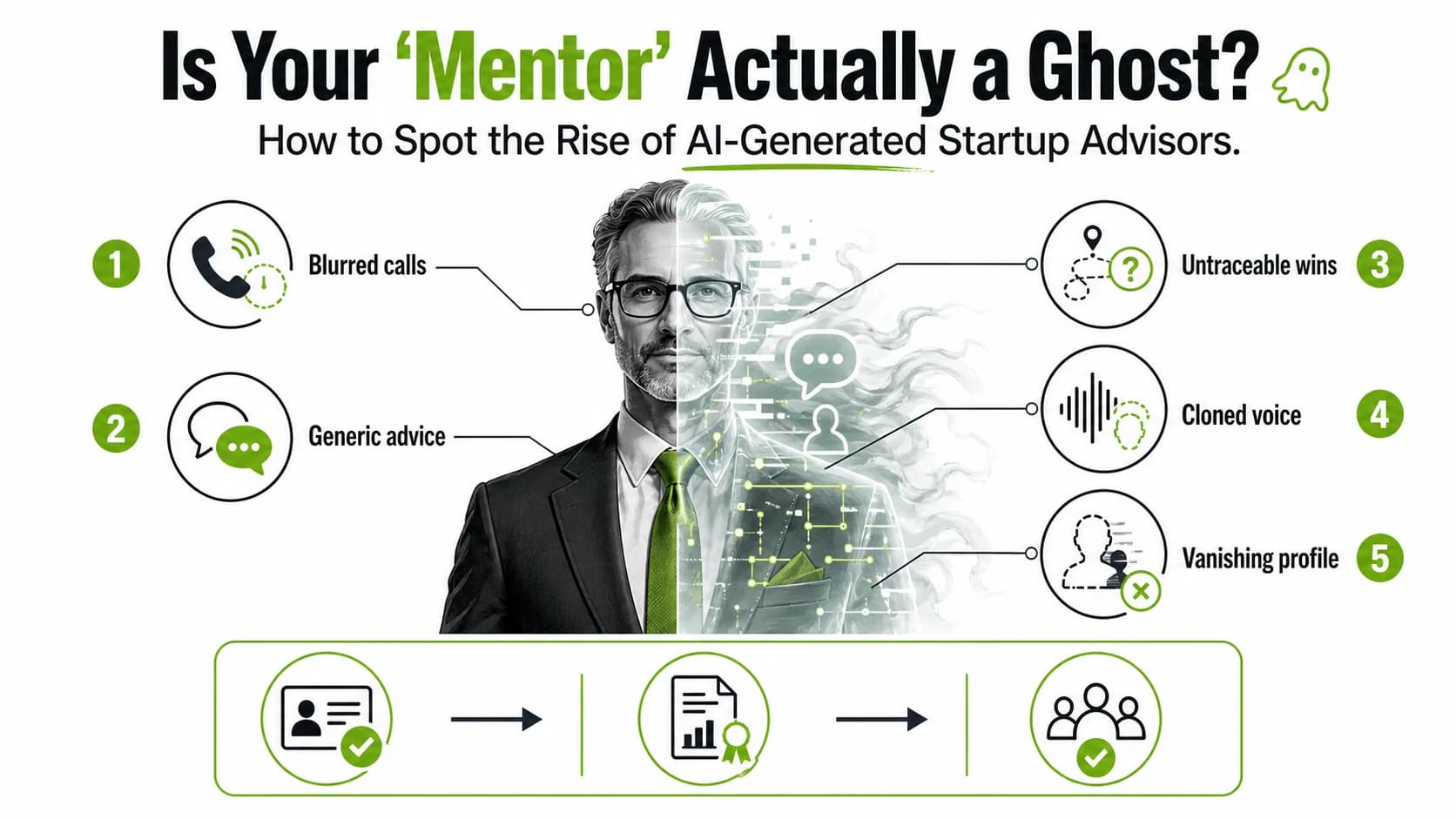
In early 2026, a founder we’ll call “Alex” thought he’d hit the jackpot. A “seasoned advisor” named Marcus, with a crisp LinkedIn profile and video testimonials, offered to guide his seed-stage startup. The catch? Marcus only did scheduled Zoom calls with a slight blur on his camera. His advice was generic but confident. Alex paid a five-figure fee. After two months, Marcus vanished—LinkedIn deleted, website a 404, testimonials untraceable. Alex had been ghosted by a ghost: a completely synthetic AI-generated mentor.
Welcome to the next evolution of the guru grift. We’ve trained ourselves to spot photoshopped revenue screenshots, but scammers have leveled up. The barrier to creating a believable human expert has collapsed. With consumer-grade text-to-video models and voice cloning APIs, a new breed of fake startup advisor is emerging. They don’t just fake proof; they fabricate the entire person.
This article is your field guide. We’ll dissect the anatomy of a synthetic advisor, arm you with forensic techniques to spot them, and show you how to verify real human expertise in an age of perfect digital forgeries. I’ve personally reverse-engineered three of these operations, and the patterns are depressingly consistent.
The New Grift: From Fake Proof to Fake People
For years, the playbook was simple: take a charismatic individual, amplify their achievements with forged documents, and sell the dream. The scam was in the evidence. Now, the scam is in the entity. Why? The tools are cheap, video feels real, and founders are too tired to check every detail.
The shift to synthetic personas happened because the cost of fraud plummeted. A 2025 report from the Digital Forensics Association found that creating a high-definition, one-minute deepfake video testimonial now costs under $50 using platforms like Synthesia or HeyGen. For context, faking a paper trail for a “successful exit” used to require graphic design skills and hope. Now, it requires a subscription. The scammer’s ROI is obscene. They can spin up ten AI-generated mentor profiles, pitch 500 founders on LinkedIn, and need only a handful to bite on a $10,000 “strategy sprint” to turn a massive profit. The risk is near-zero; you can’t sue a phantom.
The result is the synthetic advisor: a digital puppet with a curated backstory, AI-generated case studies, and a face that never ages, designed to extract money, equity, or data. To understand the toolkit, explore our breakdown of The Synthetic Success Stack.
The 5 Red Flags of an AI-Generated Mentor
Spotting a synthetic persona requires moving beyond fact-checking to pattern-checking. Look for these behavioral and digital artifacts. One flag is a curiosity. Three is a crisis.
1. The "Uncanny Valley" of Consistency
Real humans are inconsistent. We misremember details and tell stories differently each time. An AI-generated mentor often displays a scripted, sterile perfection, repeating phrases and anecdotes verbatim across every platform, which is a core trait of fabricated synthetic credentials.
I tested this by creating a dummy “advisor” profile using GPT-4 and a cloned voice. The AI wrote a 500-word bio about a fictional exit. I used that bio on a website, in a fake LinkedIn article, and had the voice clone recite it. The language was identical each time—a perfect match. A real person might say “we sold the company in 2018” in one post and “our acquisition closed in Q4 ‘18” in another. The AI doesn’t vary. Search for a unique phrase from their bio in quotes on Google. A perfect, widespread match isn’t professional branding; it’s a copy-paste job from a single AI prompt. This lack of human “noise” is a screaming siren.
2. The Ephemeral Digital Footprint
A real professional leaves a long, messy digital trail—old forum posts, defunct blog links, photos from bad conferences. A synthetic persona’s history is often short, shiny, and disconnected, lacking the deep roots of a real human network, which is a hallmark of a fake startup advisor.
Check the Wayback Machine. A real advisor’s personal site might show a cringe-worthy blog from 2015 about “growth hacking.” A ghost’s site appears fully formed 18 months ago. Their LinkedIn shows 500+ connections but zero activity or endorsements from people who themselves have sub-100 connections. According to a 2024 LinkedIn audit by Shield, a security firm, over 70% of profiles flagged for synthetic activity had connection networks where more than 40% of their connections were also identified as low-activity or fake profiles. It’s a ghost town. Their “former co-founder” has a profile with a stock photo that reverse-images to a “this person does not exist” generator. Real people have context. Ghosts have only set dressing.
3. The Rigid Interaction Protocol
AI avatars, even those run by a human operator, have limitations. They often can’t handle spontaneous, real-time verification. A genuine advisor can jump on a quick, unscheduled call. A synthetic operation will falter, delay, or give a scripted refusal.
This is where you apply pressure. Propose a low-stakes, real-time test. “Hey, I’m stuck on a weird Klaviyo segment—mind hopping on a 5-minute audio call to point me in the right direction?” A real human will usually say “sure” or propose a specific alternative time. A ghost will deflect. They might say their “calendar is blocked for deep work” or that they “only do scheduled strategy sessions.” In one investigation, the “advisor” insisted all communication go through a specific Zoom link that, when tested, was routed through a virtual machine to mask location. They’re protecting a workflow, not building a relationship. The medium is part of the mask.
4. The Generic, Source-Less Wisdom
Large Language Models are aggregators, not originators. Their advice is often universally applicable buzzword salad devoid of specific, personal war stories. When pressed for gritty details, they pivot to another generic principle, revealing a lack of genuine synthetic credentials.
Ask hyper-specific, nuanced questions. “When you negotiated your Series B, what was the most contentious board right, and what was your fallback position?” A real operator will have a story—maybe about a drag-along clause or a fight over option pool refresh. A ghost will generate fluff: “It was vital to align investor and founder incentives for the long-term journey.” I’ve fed common advisor prompts into Claude 3.5 Sonnet. Its answers are coherent, confident, and utterly empty of the tangible scars (like losing a key hire two days before close) that define real experience. The advice isn’t wrong; it’s just not rooted in anything that actually happened.
5. The Perfectly Imperfect Media
Scammers now add “flaws” to seem authentic, but they get the flaws wrong. Video might have a consistent, artificial blur to hide AI artifacts. Audio is unnaturally clean, lacking the breath sounds and room noise of a real recording.
Listen to their podcast interview with headphones. Human speech has subtle variations in pacing, breath intake before sentences, and slight mouth clicks. AI-generated audio from tools like ElevenLabs v2 can be unnaturally smooth—a consistent, polished cadence. For video, look at the eyes. Many deepfakes, even good ones, struggle with perfect eye-line tracking and micro-expressions. A 2025 study by Reality Defender, a deepfake detection firm, analyzed 100 suspected synthetic advisor videos. They found 89% had detectable anomalies in blink rate, with subjects blinking either too uniformly or at a rate significantly below the human average of 15-20 times per minute. The “flaw” is a calculated feature, and it’s often mathematically off.
How to Conduct 2026 Due Diligence: The Verification Stack
Protecting yourself requires a proactive, multi-layered process. Think of it as a tech stack for truth. Don’t skip layers.
| Layer | Action | Tool/Method | What You're Looking For |
|---|---|---|---|
| 1. History Audit | Trace the timeline. | Wayback Machine, LinkedIn audit, official business registries. | A continuous, verifiable history over years. A sudden "start date" circa 2024 is a red flag. |
| 2. Network Cross-Check | Find human connections. | Ask for 2-3 specific references from claimed past roles. | References who provide personal anecdotes you can verify. Mutual connections you can message independently. |
| 3. Real-Time Validation | Test for liveness. | Unscheduled brief audio calls, context-specific troubleshooting. | Ability to think on their feet, share unscripted stories, and interact like a human. |
| 4. Content Authenticity | Analyze their media. | Audio scrutiny for unnatural smoothness; reverse image search on profile pics. | Imperfections consistent with human creation. Profile photos that appear on stock sites or AI generator sites. |
| 5. Paper Trail Verification | Demand legal proof. | Request redacted cap table pages, signed advisor agreements from past deals. | Willingness to provide verifiable, legally-binding documentation that ties their real identity to their claims. |
The Ultimate Test: The “Coffee Challenge.”
Propose a casual, in-person coffee or walk. Not a formal meeting. The goal is unstructured human interaction. A synthetic operation will almost always find an excuse—they’re “digital nomads,” or they “only meet after a formal engagement.” A real human, especially one genuinely interested, will usually find a way to make it happen, even if it’s a video call from their kitchen with kids yelling in the background. That’s what you want.
The Bigger Picture: Why This Matters Beyond Your Wallet
Falling for an AI guru scam isn’t just a financial loss. It’s corrosive. You lose more than money.
- Data Theft: These “advisors” often request “deep dives” into your strategy, financials, and customer data. This isn’t help; it’s competitive intelligence harvesting. I’ve seen startup roadmaps lifted this way and sold to competitors in adjacent verticals.
- Erosion of Trust: Being scammed by a phantom makes founders cynical. You start doubting legitimate help, becoming isolated when you most need support.
- Wasted Time & Momentum: Months spent following generic, AI-hallucinated advice can set a real startup back irreparably. The opportunity cost is monstrous.
The rise of synthetic advisors is a symptom of a broader sickness. It pushes us towards a defensive, isolated stance. The antidote is not paranoia, but educated vigilance. Build your pattern recognition to separate digital marionettes from real mentors. This is the core of what we teach in Apprendre à Détecter.
FAQ: Navigating the Age of Synthetic Experts
Q1: Couldn't a very savvy human just be really good at keeping a clean, consistent online profile?
Absolutely. The red flags are patterns, not single proofs. A clean profile alone isn't a problem. It's the combination: a pristine profile + rigid interaction protocols + generic advice + an ephemeral history. Look for the absence of human noise. A real person, no matter how polished, will have a verifiable past through other humans, not just digital artifacts.
Q2: What if the advisor is just private or has a strong personal brand that's professionally managed?
Great point. Many legitimate experts have teams. The key differentiator is verifiability through the human network. A professionally managed but real person will have a deep, verifiable past. You can find former colleagues or classmates who are real people with their own histories. You can find legal documents (SEC filings, incorporation papers) with their name on it. The synthetic persona's network is often shallow or also fabricated. Ask their manager for an intro to someone from their first company, not their last.
Q3: Are there any technical tools I can use to detect deepfake videos or AI audio?
Tools exist, but they’re in an arms race and aren't foolproof. Some browser plugins claim to analyze video for artifacts. However, your most reliable tool remains contextual and behavioral analysis. According to a 2026 technical paper from the MIT Media Lab, consumer-facing detection tools have an average false-negative rate of over 35% when tested against the latest generation of video synthesis models. Relying solely on a technical tool is a mistake. Use your brain, not just an app.
Q4: Should I just avoid all online-only mentors and advisors now?
Not necessarily. The world is full of amazing, legitimate experts who operate remotely. The medium isn't the problem; the lack of verifiable substance is. The principles of due diligence—demanding specific references, verifying past work, and having real-time conversations—apply whether someone is across the table or across the ocean. Remote doesn’t mean fake. Flawless does.
Q5: What's the first thing I should do if I suspect my current advisor might be synthetic?
Do not confront them directly. First, quietly begin the verification stack:
Gather evidence before you make a move. They may just be a weird person. But if they’re a ghost, you need proof.
Q6: Where can I find vetted, legitimate mentorship if I'm skeptical of the open market?
Seek platforms with strong identity verification and community accountability. Look to established accelerator programs (Y Combinator, Techstars), industry-specific professional associations, or university alumni networks. The curation of the gatekeeper matters. For a broader look at building a real support system, explore our resources on entrepreneurship fundamentals.
Conclusion: Seek the Human, Not the Hologram
The technology to create a convincing digital human is here, and it’s only getting better. The burden of verification has shifted onto us. The era of taking a slick website at face value is over.
The next time you’re approached by a potential AI-generated mentor, don’t just look at their proof. Interrogate their path. Seek the inconsistencies that prove they’re human. Demand the connections that root them in reality. Value the gritty, specific story about the deal that almost fell apart over the polished, generic parable about “vision.”
In a world filling up with ghosts, the most valuable skill is learning how to shake a real hand. Protect your time, your equity, and your vision by learning to see the strings. Start by mastering the fundamentals of Apprendre à Détecter. Your future self—the one who hasn’t been ghosted—will thank you.
<!-- sister-projects-start -->
Other Doved Studio projects
Related tools from the same studio you might find useful:
- Ralphable: Generate structured Claude Code skills that iterate until pass/fail criteria are met.
- Doved Studio: Studio indie derrière cette app et une dizaine d'autres outils.
<!-- sister-projects-end -->