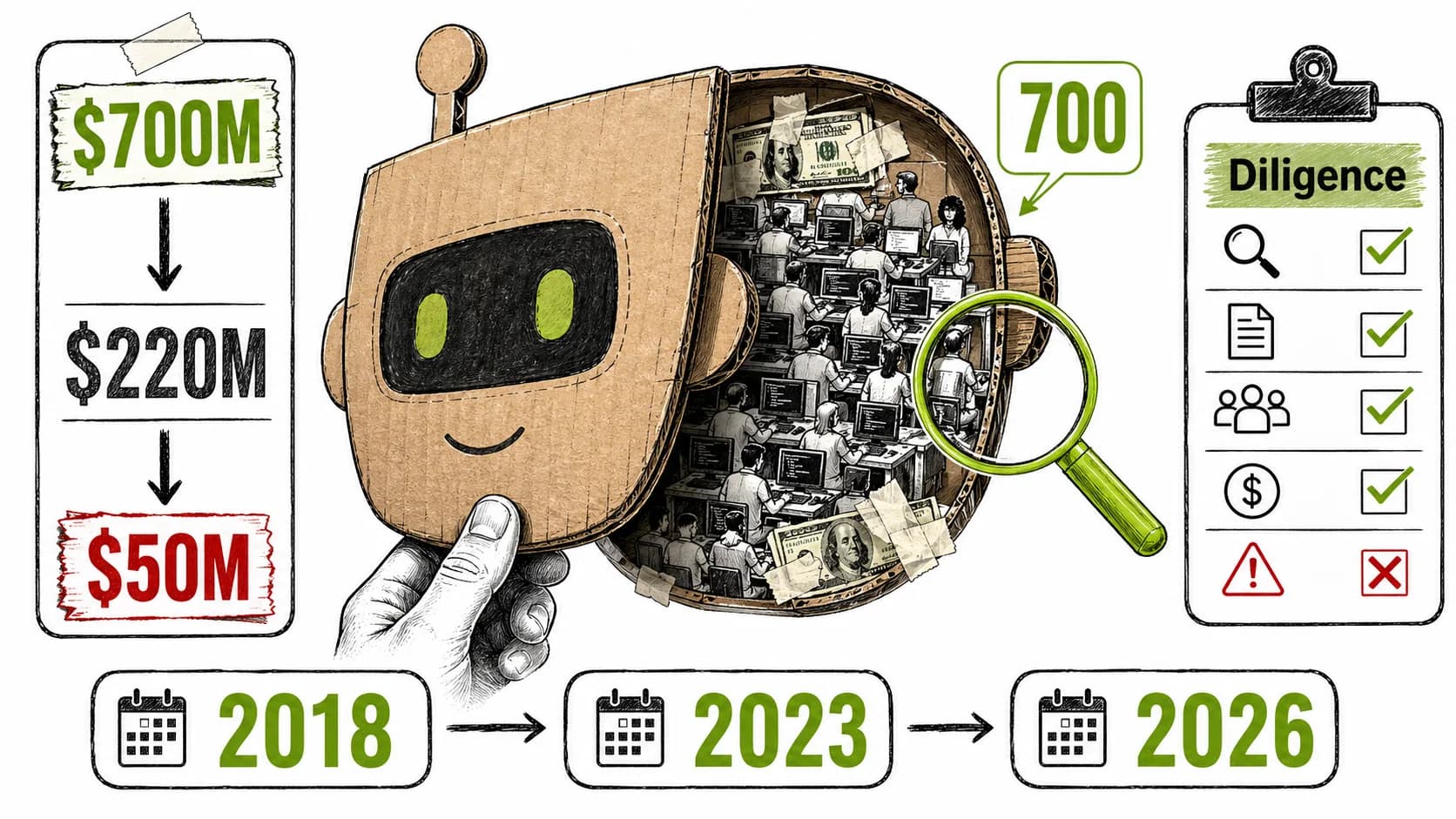
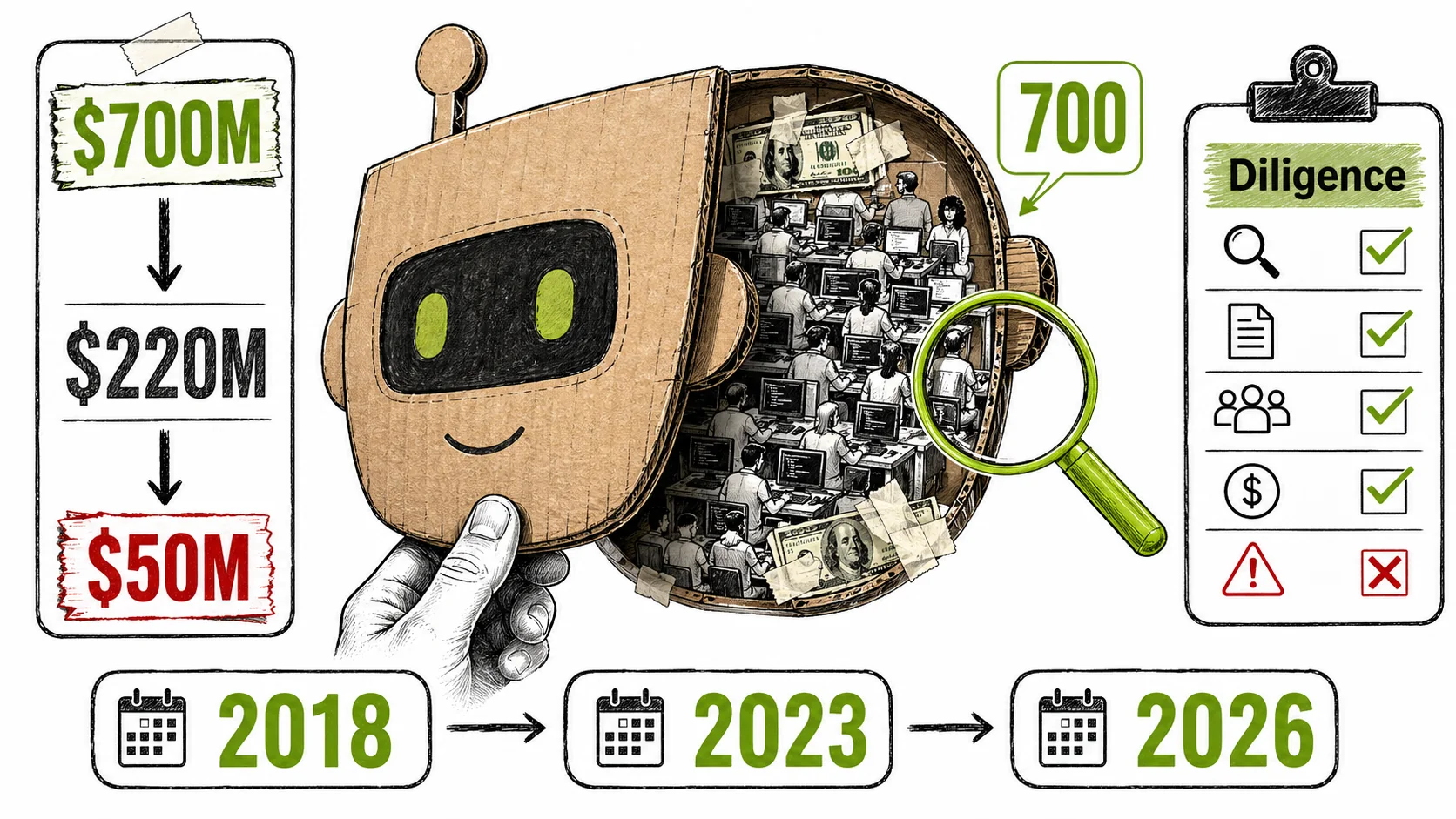
For eight years, Builder.ai sold a fairy tale. The protagonist was a friendly AI named Natasha. Customers would describe an app idea in plain English, Natasha would do the engineering, and a real product would appear like room service. The pitch deck called it "human-assisted AI." The press releases called it "the future of software development." Investors called it a $1.5 billion company. The 700 engineers in Bengaluru typing the actual code at 2 a.m. called it Tuesday.
Then, in May 2025, the music stopped. Builder.ai filed for insolvency in London after burning through most of the roughly $700 million it had raised from SoftBank, the Qatar Investment Authority, IFC, Insight Partners, and a Microsoft Azure partnership treated like a halo blessing. Internal documents reviewed by Bloomberg and The Pragmatic Engineer showed claimed annual revenue of $220 million sat on top of an actual $50 million. Roughly $180 million of the gap was allegedly produced by round-tripped invoices with VerSe Innovation, a Mumbai content app maker. The SEC, the Serious Fraud Office, and a bankruptcy trustee are now arguing over the carcass.
This is not a story about AI failing. AI was never in the building. This is a story about how an entire venture ecosystem agreed to look at a cardboard mask, decide it was a person, and write checks for eight years. Below is the post-mortem, the receipts, and the field guide for not falling for the next one.
What was Builder.ai actually selling?
Builder.ai was selling labor with a chatbot wrapper. Customers paid a fixed fee for an app. Natasha, the on-screen "AI product manager," collected requirements through a chat interface. After that, the prompt was routed to a project manager in London or Los Angeles, who handed a specification to a contract engineering team in India, primarily through a subsidiary called Builder Studio. The team built the app. Natasha then took credit on the way out the door.
The technical fiction was that Builder.ai had a "Building Blocks" library of pre-built modules that Natasha could assemble. Reporting in The Information and former-employee lawsuits filed in California cite internal architecture diagrams that confirmed the library existed but was tiny, mostly hand-curated boilerplate, and used inconsistently. There was no large language model orchestration. There was no neural code generation. There were a few rules-based macros and a Confluence page of approved snippets.
Sachin Dev Duggal, the founder, gave a 2022 interview to TechCrunch where he described Natasha as "the AI that codes." In 2024, an internal training deck obtained by Bloomberg referred to the same component as "the chat front end." Both descriptions were technically true. Only one of them was investable.
How big was the human team behind the curtain?
At its peak in late 2023, Builder.ai had roughly 770 employees of record and somewhere between 600 and 900 contract engineers, depending on the month, billed through Builder Studio and a network of Indian and Eastern European staffing agencies. Internal Slack channels surfaced in the Pragmatic Engineer report show project managers routinely assigning tickets to humans with messages like "this one is urgent, do not let Natasha touch it," which is a remarkable thing to type if Natasha is software.
The cost stack was inverted from a real AI company. A genuine 2024 AI startup at $200M ARR would spend tens of millions on cloud GPUs and have at least a hundred ML engineers. Builder.ai's cloud bill, per a leaked 2023 finance memo, was about $11 million annually, almost entirely CPU instances and storage. Its ML headcount was four. Its non-ML headcount was 770. The ratio was the receipt.
What did the customers actually receive?
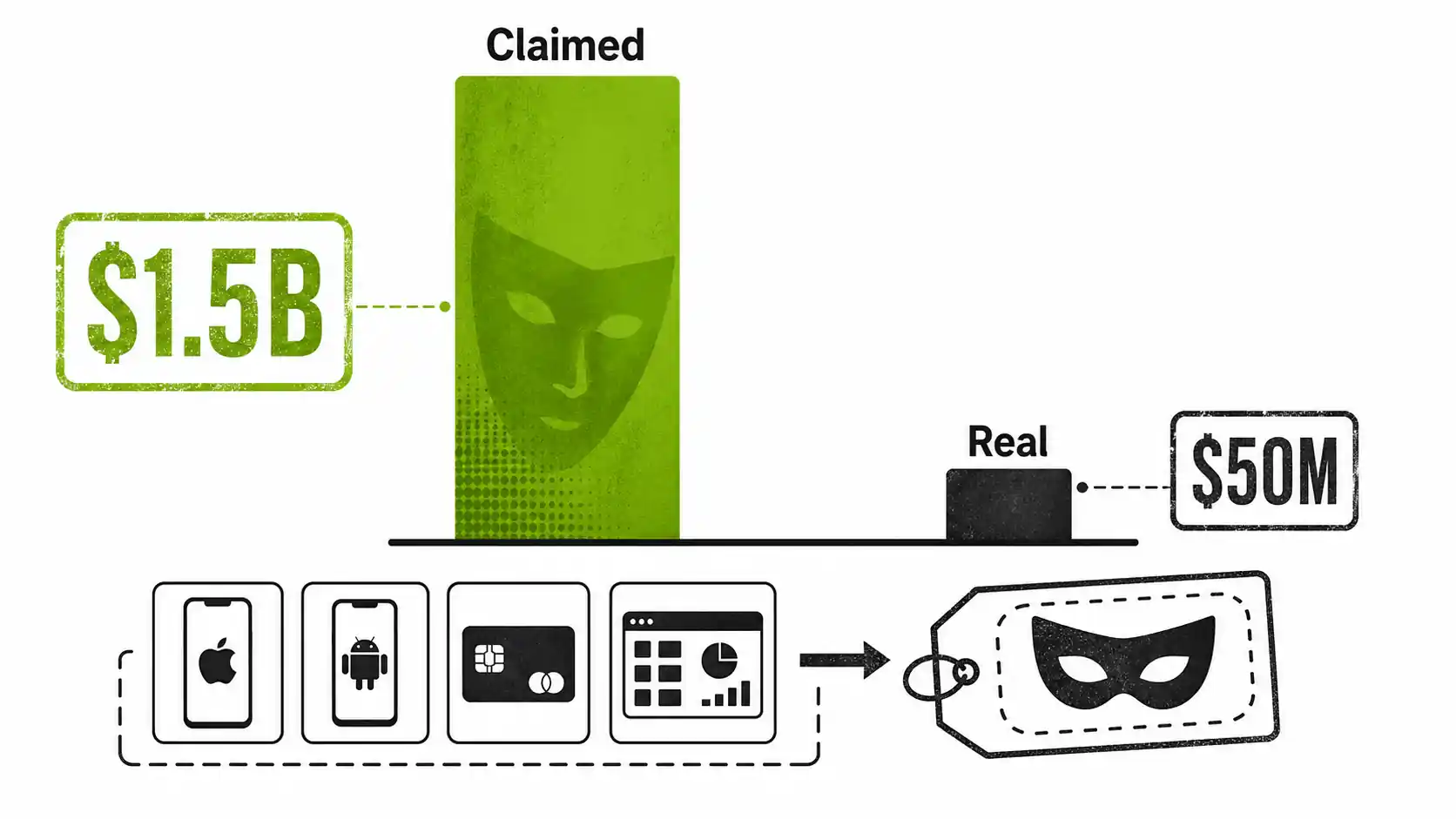
Customers received apps. That is the dark joke of the entire saga. The work was real. Real iOS builds, real Android builds, real Stripe integrations, real CRUD dashboards. They were just built by humans who had been told to call themselves an AI. The fraud was not in the deliverable. The fraud was in the price tag attached to "AI margins" that did not exist, the funding raised on the premise of those margins, and the inflated revenue used to justify the next round.
A useful frame: Builder.ai was a perfectly fine outsourced dev shop wearing a $1.5 billion mask. The mask was the only thing investors were buying.
The mask is always the only thing investors are buying.
How did the financial larp work?
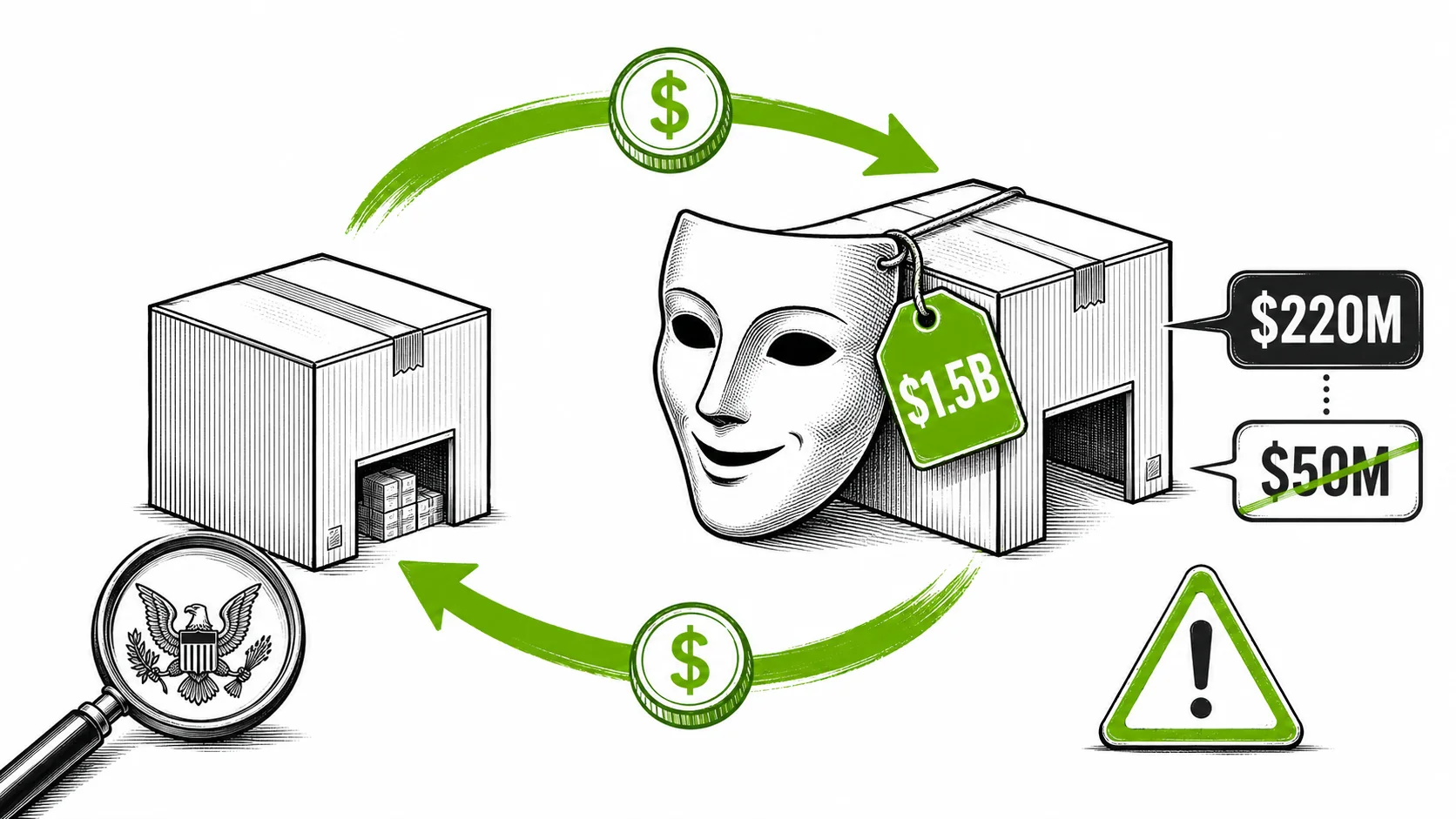
The most damaging part of the collapse was not the AI fiction. It was the round-tripping. The pattern, as alleged in the SEC complaint excerpts published by Reuters and detailed in the bankruptcy trustee filings, follows a textbook circular revenue scheme.
Between 2021 and 2024, Builder.ai and VerSe Innovation, an Indian content app holding company, allegedly billed each other for services neither party fully delivered. Builder.ai invoiced VerSe for "platform licensing" and "AI integration." VerSe invoiced Builder.ai for "marketing distribution" and "user acquisition." The amounts roughly netted out across the relationship, but each side booked the gross inbound figure as revenue.
Per Bloomberg's reconstruction of the bank ledgers, around $180 million flowed in this loop over four years. On Builder.ai's books, that revenue was indistinguishable from real customer money. Combined with genuine Builder Studio revenue of roughly $50 million, the result was the $220 million ARR figure repeatedly cited in fundraising decks and at industry events.
Why did auditors not catch this?
Two reasons. First, the auditors changed. Builder.ai used three different audit firms between 2018 and 2024. Auditor switching is one of the oldest red flags in finance, and per Harvard Business Review, companies that change auditors more than once in five years are 4x more likely to later be subject to a restatement. Investors saw the changes. They did not flag them.
Second, the round-tripping crossed jurisdictions. VerSe is Indian. Builder.ai is British, with a Delaware holding entity. A single auditor reviewing one side of the loop only saw inbound invoices that looked legitimate. Without consolidated visibility across both companies, the circle was invisible from any single seat. This is the core mechanic of circular revenue: it is only fraud if you stand far enough back to see the loop.
The SEC's 2024 enforcement guidance on AI-related disclosures explicitly warned about exactly this pattern, citing two earlier cases where AI startups had used cross-border affiliated transactions to inflate top-line revenue. Builder.ai's investors had this guidance for over a year before the company filed.
Where did the $700 million in raised capital go?
Per court filings cited by the Financial Times, of the roughly $700 million raised, approximately:
- $310 million went to contract engineering payroll, mostly through Builder Studio.
- $180 million went to sales, marketing, and a brand campaign that included Premier League sponsorship.
- $95 million went to office leases in London, Los Angeles, Dubai, and Singapore. The Dubai office, opened in 2022, employed 14 people.
- $60 million went to executive compensation, including bonuses tied to revenue targets that were partially round-tripped.
- $55 million remained at filing, of which an estimated $40 million was reserved for litigation and severance.
The Microsoft Azure credits, valued at roughly $30 million, were used. There is no allegation that Microsoft was complicit in the fraud. There is, however, a question worth asking: how does a company close a strategic partnership with a hyperscaler without that hyperscaler asking for a single architecture diagram of the AI? That question is the entire field of AI due diligence in one sentence.
A logo on a slide is not a technical reference.
Why did so many smart investors miss it?
The temptation is to call this a SoftBank story. SoftBank invested $250 million across two rounds, the largest single check, and SoftBank has a long catalog of post-mortems. But the cap table also includes the Qatar Investment Authority, IFC (the World Bank's private sector arm), Insight Partners, Lakestar, Iconiq, and Microsoft. These are not amateurs. They missed it anyway. The reasons are structural, and they are still active in 2026.
Reason one: the AI hype premium suspended skepticism
Between 2022 and 2024, any company with "AI" in the deck commanded a 4x to 8x revenue multiple uplift compared to a non-AI peer, per PitchBook's 2024 enterprise software report. For a fund partner, the upside math meant the cost of being wrong was small relative to the cost of missing the next OpenAI. Skepticism became expensive. So nobody asked.
Builder.ai's pitch deck for the 2023 round, leaked in the TechCrunch coverage, used the word "AI" 47 times across 22 slides. The word "engineers" appeared twice, both times in reference to "AI engineers" as a competitive moat. There is no slide showing the contract workforce. There is no slide showing GPU spend. There is one slide showing a screenshot of Natasha's chat interface, which is a UI, not a technology stack.
Reason two: the warnings were inside, not outside
Multiple ex-employees filed wrongful termination suits between 2019 and 2023 alleging they had been retaliated against for reporting that "Natasha is not AI." The first such case, filed in California in 2020, was sealed and settled. The second, filed in 2022 by a former product manager, named SoftBank's representatives as having been notified. Court filings cited in The Pragmatic Engineer post-mortem indicate the SoftBank operating partner forwarded the complaint to Builder.ai's general counsel, who closed it as "founder narrative dispute."
A 2023 due diligence memo prepared by an independent technical consultant for an LP in the Series D, also surfaced in the same post-mortem, included the line: "We were unable to identify model training infrastructure or hosted inference of any kind." The memo was attached to the data room. It was not the deciding factor.
This is the most corrosive lesson. The information was there. The institutional incentives to ignore it were stronger.
Reason three: customer references were curated, not random
Per the Financial Times, Builder.ai's standard reference list across rounds contained 18 customers. Of those, at least 12 were existing partners with revenue-sharing arrangements that gave them upside in Builder.ai's valuation. Investors who called the references received uniformly glowing accounts. Investors who tried to call other customers were politely told that "for confidentiality reasons" the reference list was the reference list.
A real customer audit, as we walk through in our 2026 Founder's Guide to Verifying Real Revenue, randomly samples the customer base. Builder.ai never offered a random sample. No investor demanded one. The references were the references.
The investor ecosystem rewards the path of least resistance.
What does AI washing look like in 2026?
Builder.ai is the most expensive AI washing case to date. It is not the only one. The SEC has charged at least 14 firms with AI-related disclosure fraud since 2024. The Federal Trade Commission has a separate "Operation AI Comply" sweep targeting consumer-facing AI claims. The Builder.ai pattern shows up in scaled-down form across the funded ecosystem, particularly in vertical SaaS, customer service automation, legal tech, and recruiting.
The 2026 due diligence playbook for spotting AI washing has six concrete probes. Each one of these would have caught Builder.ai in under a week.
Probe one: ask for the GPU bill
Real AI companies spend serious money on inference and training. As a rough order of magnitude, a SaaS company at $50M ARR with genuine LLM-based features will run $3M to $8M annually in cloud GPU spend, per a16z's 2024 cost-of-AI breakdown. If the GPU spend is under $500k at scale, the AI is doing very little work. If the company refuses to share aggregate cloud cost by category, that is the answer.
Builder.ai's 2023 cloud bill was $11M, almost entirely CPU. The ratio of CPU to GPU spend was a billboard.
Probe two: ask for the model registry
Any AI company building real models will have a model registry, usually in MLflow, Weights and Biases, SageMaker Model Registry, or Vertex. Ask for an export. Real registries have version histories, training run logs, eval scores, and deployment timestamps. Fake registries do not exist. A founder who replies "we use proprietary tooling" without demonstrating the tooling is telling you the tooling does not exist.
Probe three: count ML headcount against product claims
If a company claims to have invented a foundation model, it should have at least 25 ML engineers and researchers. If it claims to have trained a vertical fine-tune, it should have 5 to 10. If it claims to be "AI-powered" through a wrapped API call, it should have at least one prompt engineer who can explain the prompts. According to LinkedIn's 2025 AI talent report, the median seed-to-Series-A AI startup has 38% ML headcount. Builder.ai's was 0.5%.
Probe four: ask for the architecture diagram with named models
A real architecture diagram for an AI feature names the model. "GPT-4o-mini for classification, Claude Sonnet 3.5 for generation, internal embedding model based on bge-large." Vague boxes labeled "AI Engine" or "Proprietary Model" are not diagrams. They are concept art. If the founder draws the diagram on a whiteboard in the meeting and it has named models with token budgets and latency targets, the AI is real. If it has a single box with a robot icon, it is not.
Probe five: do a customer technical demo
Ask a real customer to share their screen and use the product live. Watch the response time. Watch the failure modes. Real LLM-based features have characteristic latency curves and characteristic hallucination patterns. Human-in-the-loop systems have characteristic delays measured in minutes or hours, not seconds. Builder.ai's "AI" had a turnaround time of two to six weeks per app, which is a human turnaround time, not a model turnaround time.
For a more general framework, our guide to verifying a founder's LinkedIn network in 2026 walks through the org-chart side of the same audit.
Probe six: search the wrongful termination filings
Public court records are free. PACER for US filings, Companies House for UK, the equivalent registries elsewhere. Search the company name plus the founder names. Wrongful termination filings often contain the most candid description of internal operations available outside an NDA. If three former employees in three years have alleged that the AI is not AI, the AI is not AI.
The Builder.ai filings were public. Nobody read them.
The 2026 due diligence checklist
Below is a compressed checklist a non-technical investor or partner can run before signing on with any AI-positioned vendor or startup. It is not exhaustive. It is the version that would have caught Builder.ai.
| Check | Green flag | Red flag |
|---|---|---|
| GPU spend | $1M+ annual at $20M ARR | $100k or less, mostly CPU |
| Model registry | Live export with versioned runs | "Proprietary tooling" with no demo |
| ML headcount | 15%+ of engineering | Under 5%, no titles like ML Engineer or Research Scientist |
| Architecture diagram | Named models with latency budgets | Single box labeled "AI" |
| Customer audit | Random sample of 5+ customers, live demos | Curated reference list, no live walkthroughs |
| Court records | Clean, no allegations of misrepresentation | Multiple sealed wrongful termination cases |
| Auditor stability | Same audit firm 3+ years | Three or more auditor changes in five years |
| Affiliate revenue | Under 10% of revenue | Round-trippable invoices with related entities |
If a target fails three or more of these, the AI is decoration. The business may still be a fine business. The AI premium is not yours to pay.
What happens to Builder.ai in 2026?
The bankruptcy proceedings will run into 2027. Per the most recent trustee filing, creditors will recover an estimated 14 cents on the dollar. The 700-plus contract engineers in Bengaluru, who were the actual product, were paid through April 2025 and then released. Many were hired by the dev shops Builder.ai used to compete with, which is the closest thing to a happy ending in the entire story.
Sachin Dev Duggal stepped down as CEO in March 2024, before the collapse, and remains a director. The SEC investigation is ongoing. The Serious Fraud Office in the UK opened a parallel inquiry in October 2025. VerSe Innovation has denied any knowing participation in round-tripping and is suing Builder.ai's estate for outstanding invoices, which is an entertaining legal posture given the public allegations.
SoftBank has written down the position to zero. The Qatar Investment Authority declined to comment. Microsoft removed Builder.ai from its public partner directory in June 2025. Insight Partners issued a statement noting that "due diligence in AI categories has become uniquely difficult," which is true and also the most polite phrasing imaginable for "we did not check."
Key takeaways
- Builder.ai raised approximately $700M and reached a $1.5B valuation while running a contract engineering shop with a chat front end labeled as AI.
- Roughly $180M of the claimed $220M annual revenue is alleged to have come from circular invoicing with VerSe Innovation, leaving about $50M of real revenue.
- The fraud was visible in the cloud bill, the headcount mix, the auditor turnover, and the wrongful termination filings. None of those signals were acted on.
- AI washing is not unique to Builder.ai. The SEC has charged at least 14 firms with similar disclosure fraud since 2024.
- The 2026 due diligence playbook requires GPU spend, model registry, ML headcount, architecture diagrams, random customer audits, and court record searches. Each one would have surfaced the truth in days.
- A logo on a slide, a hyperscaler partnership, and a blue-chip cap table validate marketing, not technology. Verify the model, the bill, and the org chart before you write a check.
- Builder.ai's actual customers received working apps. The fraud was the price, the multiple, and the story, not the deliverable. AI washing extracts a premium for a thing that was never there.
Frequently asked questions about the Builder.ai collapse
Was Builder.ai using any real AI at all?
A small amount. Internal documents cited by The Information confirm that Natasha used standard NLP for intent classification on incoming chat prompts and a basic recommender to suggest pre-built modules. None of this constituted code generation. The actual building was done by contract engineers. Calling Natasha "AI that codes" was a marketing claim that the underlying technology did not support.
Did Microsoft know Builder.ai was not really AI?
There is no public evidence that Microsoft knew. The Azure partnership was structured as a credits-and-co-marketing deal, not a technical integration that would have required architecture review. Per Bloomberg, Microsoft removed Builder.ai from its partner directory within weeks of the bankruptcy filing. The lesson is that a hyperscaler partnership is a commercial transaction, not a due diligence stamp.
What is round-tripping in startup finance?
Round-tripping is when two companies invoice each other for services that are not fully delivered, then each books the inbound invoice as revenue. The cash often returns to the original sender within months. To a casual reader of one company's books, the revenue looks real. To anyone with consolidated visibility across both companies, the loop is obvious. It is one of the classic red flags in SEC enforcement actions on revenue inflation.
How long did the Builder.ai fraud allegedly run?
The earliest internal slack messages cited in the Pragmatic Engineer post-mortem instructing project managers to assign work to humans and credit Natasha date to 2017. The round-tripping with VerSe is alleged to have started in 2021. The collapse occurred in May 2025. That is approximately eight years of mask-wearing.
Are there other Builder.ai-style cases active in 2026?
Yes. The FTC's Operation AI Comply has open investigations against multiple consumer AI companies as of early 2026. Industry analysts at Gartner's 2026 AI risk report estimate that 30% of self-described "AI-first" startups in the seed-to-Series-B range have material AI washing risk, meaning their core marketed AI capability is mostly or entirely human or rules-based. That is roughly 1,400 companies in the US alone.
What should I do if I suspect a portfolio company is AI washing?
Document quietly, then trigger a technical reference. Hire an independent ML engineer to review the architecture and a forensic accountant to review related-party transactions. Both checks together cost under $50,000 and will surface a Builder.ai-style problem in two weeks. If the founder refuses access to either, that is the conclusion.
Where can I read more on detecting fake startups?
Our archive has detailed guides on why your guru's real case studies are fake, the 2026 founder's guide to verifying real revenue, and the AI-powered due diligence scam. The pattern is the same across categories. The mask is always the only thing for sale.
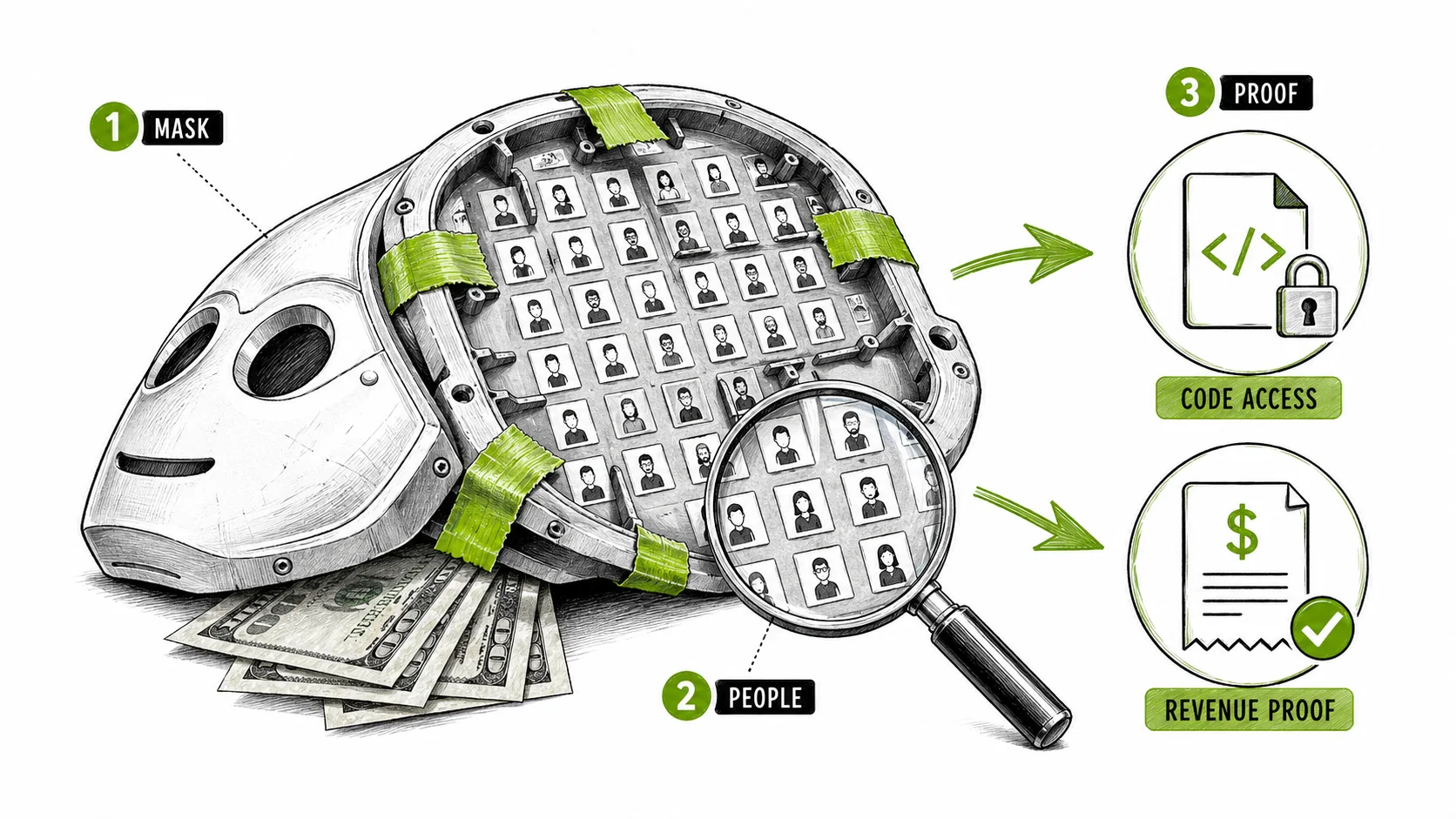
The most expensive lesson of the Builder.ai collapse is not that Sachin Dev Duggal lied. Founders lie. The expensive lesson is that the entire institutional infrastructure built to catch lies, the auditors, the lawyers, the operating partners, the technical consultants, the press, the customers, the employees, all saw the mask. Most chose not to call it a mask. The few who did were settled, sealed, or ignored.
In 2026, the next Builder.ai is already raising. It has a different founder, a different vertical, and a different chatbot name. The mask is the same. The only variable is whether the next investor reads the wrongful termination filings before signing the term sheet.
Ready to sharpen your AI due diligence? Learn the detection playbook before you write the check. For more frameworks on cutting through fabricated traction, see our tool education hub.
<!-- sister-projects-start -->
Other Doved Studio projects
Related tools from the same studio you might find useful:
- Ralphable: Generate structured Claude Code skills that iterate until pass/fail criteria are met.
- Doved Studio: Studio indie derrière cette app et une dizaine d'autres outils.
<!-- sister-projects-end -->