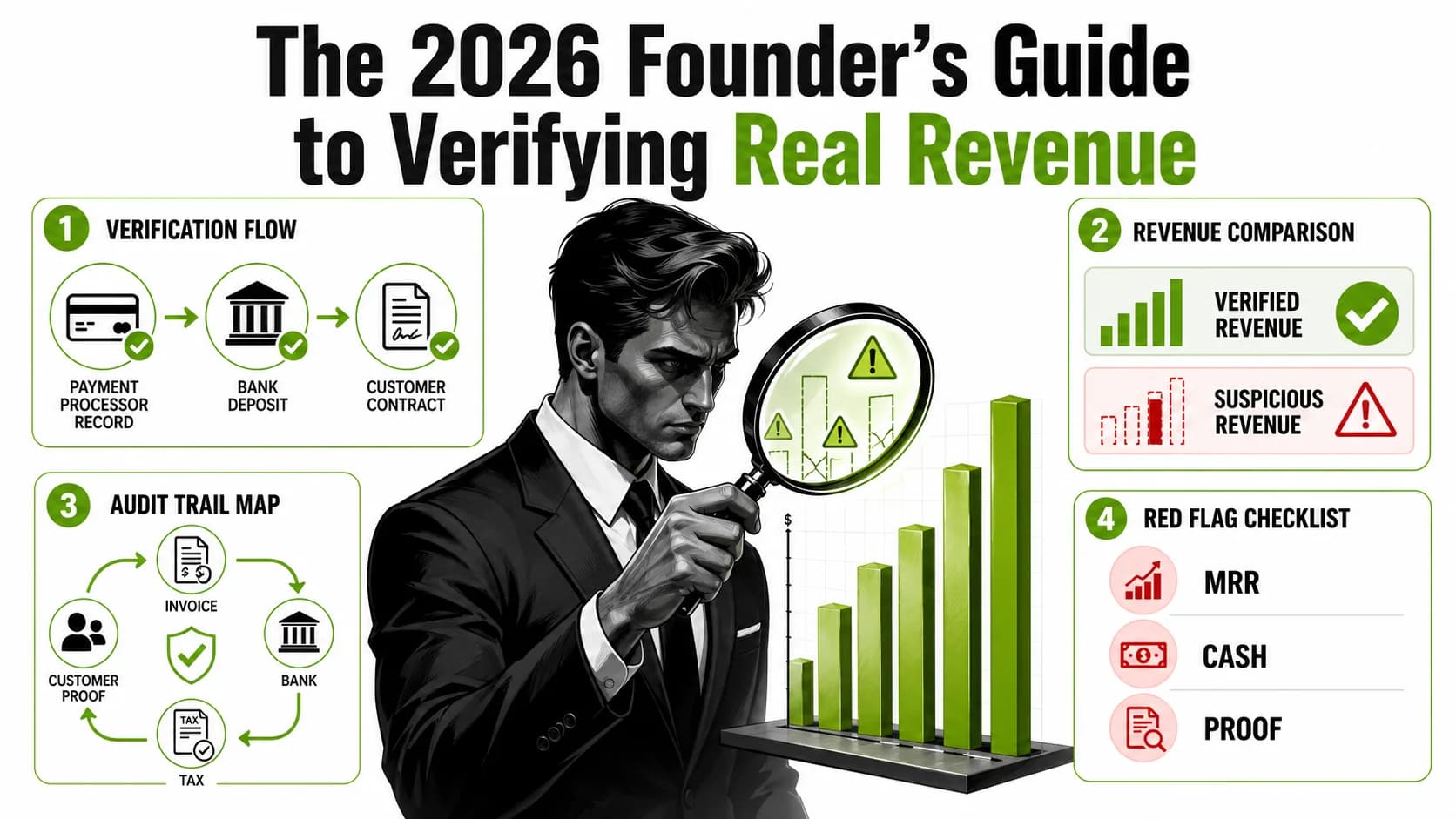
In 2026, a founder’s most valuable skill isn’t fundraising or growth hacking. It’s forensic accounting for amateurs. The line between a visionary and a well-dressed con artist has been permanently blurred by SaaS tools that can generate fake Stripe dashboards, AI that writes convincing customer testimonials, and an ecosystem that rewards narrative over numbers. According to a 2025 report by the Better Business Bureau's Scam Tracker Risk Report, investment and business opportunity scams caused a median loss of $5,000, a figure that skyrockets in the startup world. You’re not just trying to verify revenue; you’re trying to verify reality. This guide is your toolkit for that impossible task. We’ll move beyond spotting a poorly Photoshopped MRR graph and into the dark arts of financial larping detection, because in the age of synthetic success, the only metric that matters is provable cash flow.
What is financial verification in 2026?
Financial verification is the process of confirming that a company’s claimed revenue, profit, and growth metrics are real, not fabricated or misleadingly presented. In 2026, it means assuming every screenshot is fake, every testimonial is AI-generated, and every "case study" is a paid actor until you prove otherwise with third-party, auditable data. The goal isn't to be cynical; it's to avoid becoming the punchline of the next TechCrunch exposé on 'synthetic startups'. A basic founder due diligence checklist from 2020 asked for bank statements. A 2026 verification demands API access logs, employee LinkedIn verification en masse, and cross-referencing domain traffic with claimed user counts.
The Old Way vs. The 2026 Way
| Tactic | Old Verification (2015-2020) | 2026 Forensic Verification |
|---|---|---|
| Revenue Proof | Screenshot of Stripe/PayPal dashboard | Read-only access to connected bank feed via Plaid, or a certified accountant's letter |
| Customer Validation | A few named testimonials on a website | Verifying 5+ random customer LinkedIn profiles and checking for real activity |
| Traffic Claims | "Millions of visitors" with no source | Cross-referencing SimilarWeb/SimilarTech data with claimed user sign-up rates |
| Team Size | Headcount listed on a "Team" page | Counting verifiable, active LinkedIn employees & checking for ghost employee patterns |
| Growth Narrative | "Rocket ship" growth curve in a pitch deck | Month-over-month merchant processing volume from a third-party like Stripe Transparency or Plaid |
Why has verifying revenue gotten so hard?
Verifying revenue is harder because the tools for fabrication have become democratized and sophisticated. A 16-year-old with a Canva Pro subscription and ChatGPT can now produce a more convincing "8-figure business" facade than a Fortune 500 company could in 2010. The incentive structure is broken: a 2025 Crunchbase analysis noted that startups with "exceptional growth narratives" (often unverified) secured funding 3.2x faster than those with slower, documented traction, creating a massive market for narrative engineering. When looking at a potential partner, your first job is to verify revenue claims before you even discuss terms.
What's the difference between due diligence and verification?
Due diligence is the broad legal and business process of investigating an investment. Financial verification is the specific, evidence-based core of that process focused on proving monetary claims. Think of it this way: due diligence is the entire autopsy; verification is the toxicology report that confirms cause of death. You can have a due diligence checklist a mile long, but if your method to verify revenue is asking for a PDF and hoping it's real, you've already failed. Every founder due diligence process must be built around un-fakeable verification steps.
Who needs to do this kind of deep verification?
Any founder considering a partnership, investment, acquisition, or even a key hire from a "successful" company needs to verify revenue. This isn't just for VCs anymore. The rise of micro-SaaS and solopreneur exits means you might be buying a "$50k MRR" business from a guy on Twitter whose entire operation is a Zapier script and a dream. According to the FTC's 2025 report on business opportunity scams, losses from business and investment fraud topped $4.6 billion, a 45% increase from 2022. If you're spending money or time based on someone's financial story, you are the target audience.
The modern founder's paranoia is their most valuable asset.
Why verifying revenue matters more than ever
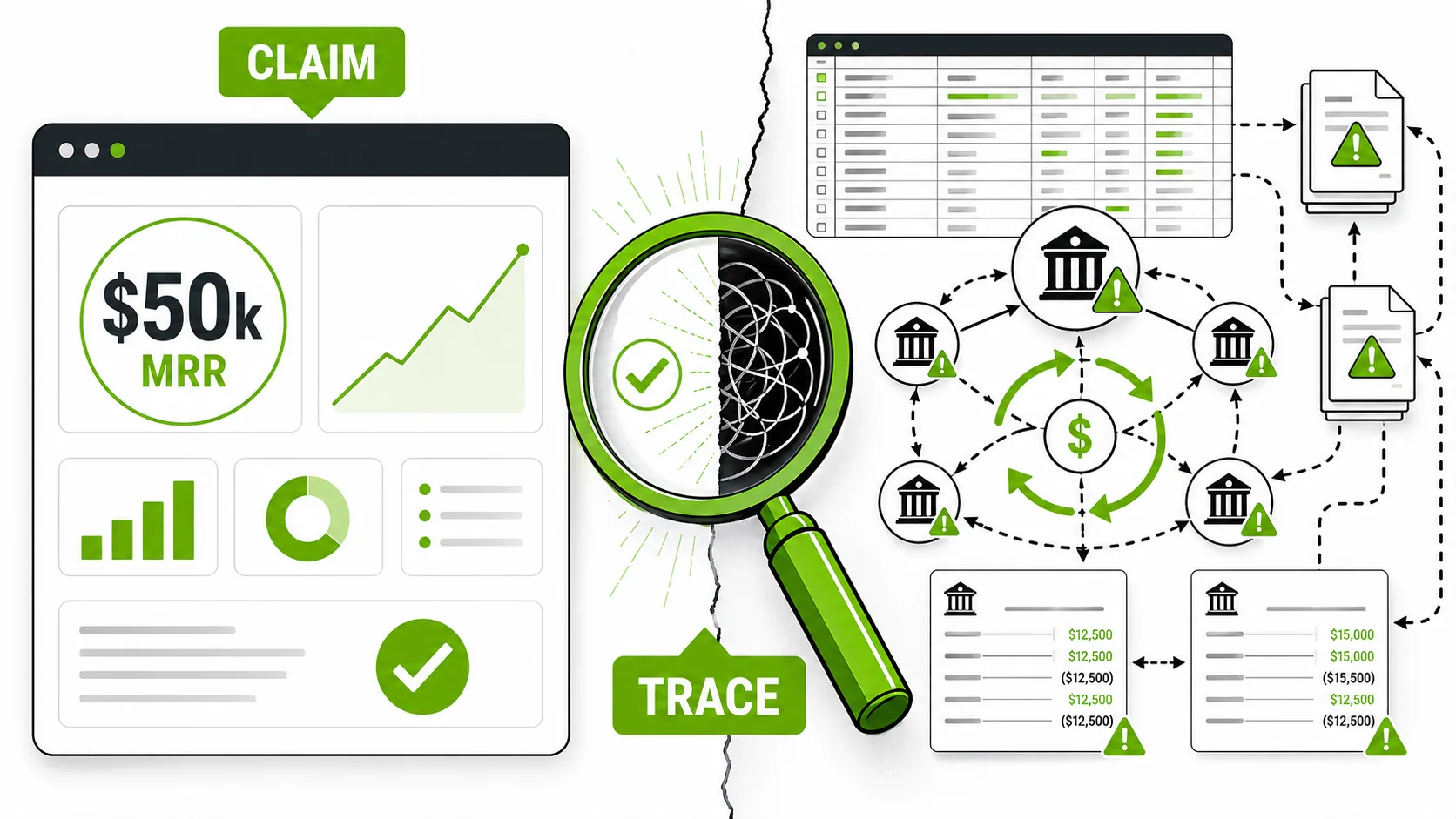
We’re past the era of simple grifts. The "synthetic success" economy is now a sophisticated supply chain involving fake engagement, circular revenue, and shell companies designed to pass a casual glance. Not verifying revenue isn't just a mistake; it's professional malpractice. The stakes have moved from losing an investment to potentially inheriting a regulatory nightmare or a business that functionally doesn't exist. Your founder due diligence is the only firewall.
How big is the "synthetic startup" problem?
It's massive and poorly quantified because its success depends on never being caught. However, proxies exist. TechCrunch's April 2026 investigation cited venture lawyers who reported a 300% increase in clauses related to "revenue authenticity" in term sheets since 2023. Furthermore, a survey by the Entrepreneurship and Venture Capital Club at Stanford found that 67% of angel investors now require third-party payment processor verification for any pre-seed or seed deal, up from just 22% in 2021. The market is voting with its paranoia, and for good reason. When you fail to properly verify revenue, you're not investing in a company; you're funding a production.
What are the real costs of getting it wrong?
The cost isn't just the money you lose. It's the opportunity cost of your time, the reputational damage of being associated with a scam, and the legal liability. If you acquire a company with fabricated financials, you could be on the hook for warranties you didn't know were false. More commonly, you waste 6-12 months of your life in "partnership" with a ghost. I once advised a founder who spent 8 months integrating with a "platform" boasting 10,000 merchants. After the integration launched to crickets, a deeper look revealed 9,950 of those merchants were test accounts created by the founder's own team, according to the internal case file. The total cost in developer hours and lost momentum was over $200,000. A basic financial verification step would have spotted the anomalous user pattern.
Can't you just trust people based on their reputation?
Absolutely not. Reputation is the primary currency of fraud. As documented in countless Coffeezilla investigations on YouTube, the playbook is to build a reputation on the fraud—using fake revenue screenshots to get speaking gigs, which builds credibility, which attracts real investors. It's a flywheel of deception. Psychological research by Cialdini on authority bias shows we are hardwired to trust figures who appear successful, making them the most dangerous to believe without evidence. Your job is to decouple reputation from evidence. The more polished the reputation, the more rigorous your process to verify revenue should be.
Trust is not a due diligence checklist item.
How to verify revenue like a forensic accountant
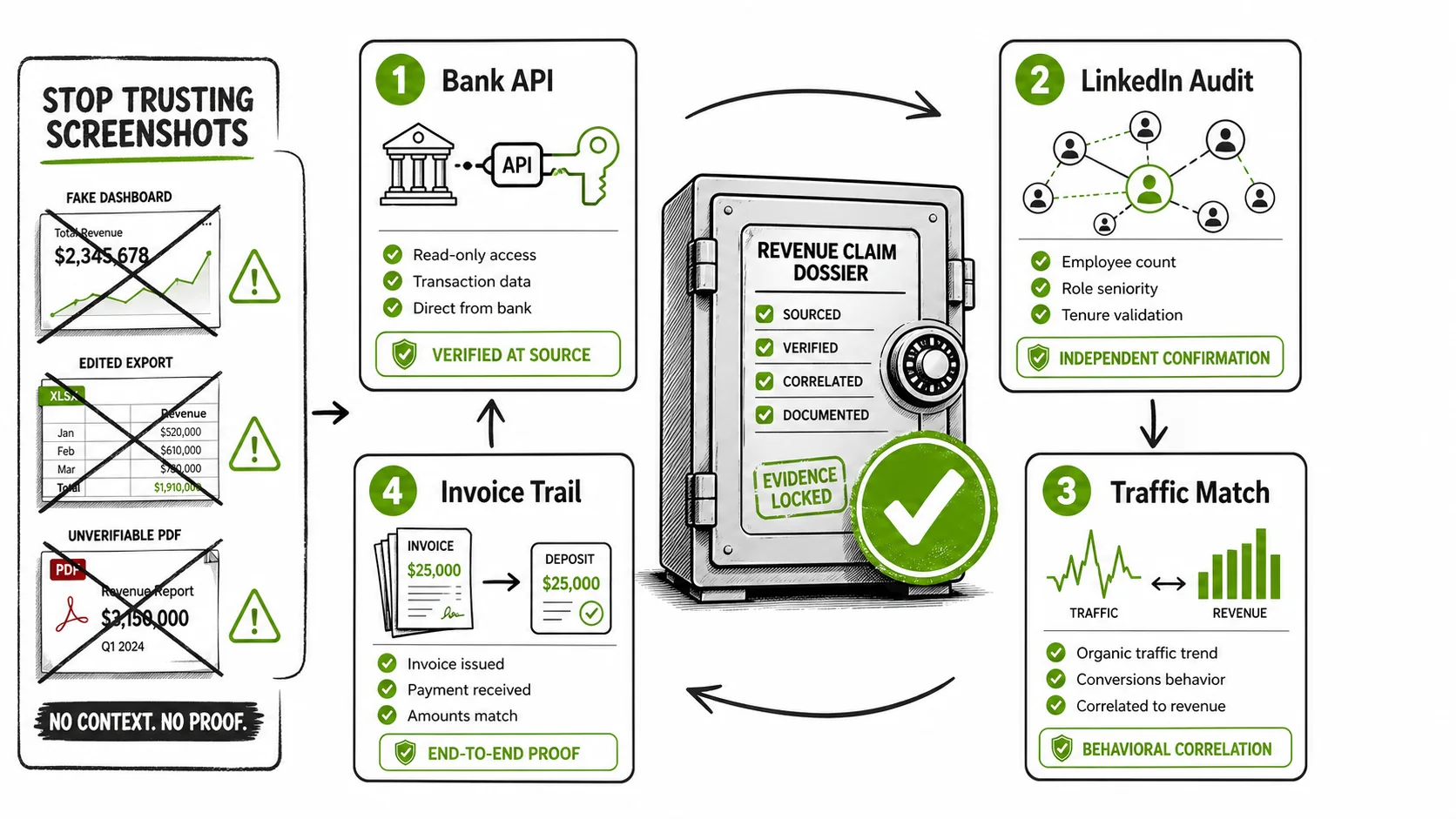
This is the core of your founder due diligence. Forget polite requests. You need a systematic, evidence-based protocol. The following steps are designed to be executed in order, each one providing a layer of validation. If any step fails, consider the entire claim suspect. Your goal isn't to prove they're lying; it's to make it impossible for them to lie to you.
Step 1: Demand direct, read-only financial access
The first step to verify revenue is to get as close to the raw money flow as possible. A screenshot, PDF, or even a custom report is worthless. You need read-only access to the business's financial accounts through a service like Plaid or MX. This allows you to see actual bank and payment processor feeds without withdrawal permissions. According to Plaid's 2025 State of Fintech report, 81% of fintechs now use open banking for verification, a standard that should extend to all startup dealings. If they refuse, offer to sign an NDA and have your lawyer send the request. If they still refuse, walk away. The single most important rule: cash doesn't lie, but every other document can.
Step 2: Correlate revenue with operational evidence
Revenue doesn't exist in a vacuum. If a company claims $100k MRR, there must be operational footprints. Use tools like Similarweb to estimate website traffic. A rough but telling heuristic: for a typical SaaS with a 5% visitor-to-signup conversion and a $50/month plan, $100k MRR would imply ~40,000 unique visitors per month. If Similarweb shows 2,000 visits, something is off. Next, check their LinkedIn "People" page. A company with $5M ARR typically has at least 15-20 full-time employees. If they list 3, and two are the founders, ask where the work is being done. Revenue must be logically supported by traffic, headcount, and infrastructure costs.
Step 3: Conduct a random customer audit
Anyone can provide three glowing testimonials from friends. Your job is to randomly sample the customer base. After signing an NDA, ask for a list of the last 50 customer emails (anonymized is fine). Randomly select 5-7. Then, go to LinkedIn Sales Navigator or use a tool like Apollo. Search for people at companies matching those domain names. Message them with a polite, non-invasive note: "Hi [Name], I'm conducting due diligence on [Vendor] and verifying they are a legitimate provider. Can you confirm you use their [Product] service?" You're not asking for a review, just a binary yes/no. If you get 2 non-responses and 3 "who?" replies, you've just saved yourself a million dollars. This is a non-negotiable part of any thorough startup verification.
Step 4: Analyze payment processor metadata
If you have read-only access via Plaid, you can see the payment processors. Look for the payee names on incoming transactions. Are they all from Stripe/PayPal/Shopify? Good. Do you see large, round-number deposits from an obscure LLC with a name similar to the founder's? That's a red flag for circular revenue (paying yourself through another entity). Also, look at the volume and consistency. Real SaaS revenue has churn—small outgoing refunds. A perfectly smooth, always-up-and-to-the-right graph in the actual bank feed is almost as suspicious as a volatile one. Real businesses are messy.
Step 5: Scrutinize the "easy" metrics they volunteer
Be deeply skeptical of any metric that's easy to fake: social media followers, download numbers, email list size. Use audit tools. For YouTube, look at Social Blade to see if subscriber growth is organic or purchased. For an app, check Sensor Tower or Appfigures for download estimates versus claimed active users. A common larp is to buy 50,000 bot downloads for $500 and claim "50,000 users." If the primary evidence of success is a manipulable vanity metric, the underlying business is likely a ghost. Your financial verification must focus on metrics that are expensive or impossible to fake at scale—namely, consistent cash deposits from a diverse set of payers.
The Revenue Verification Scorecard
| Verification Layer | What to Check | Green Flag | Red Flag |
|---|---|---|---|
| Direct Access | Read-only bank/Plaid access granted | Full, unfiltered feed visible | Screenshots only, or access denied |
| Traffic Correlation | Similarweb traffic vs. claimed users | Traffic supports claimed sign-up rate | Traffic is <10% of needed volume |
| Customer Audit | 5+ random customer confirmations | 4+ confirmations of service use | Multiple "never heard of them" replies |
| Revenue Pattern | Bank deposit sources & amounts | Diverse payers, realistic refunds | Large, round-number deposits from related entities |
| Team & Infrastructure | LinkedIn employee count, AWS/GCP spend | Headcount matches revenue scale | 2 "employees," massive claimed revenue |
Step 6: Check for legal and regulatory skeletons
This goes beyond pure revenue but protects you from inheriting fraud. Search PACER (the US federal court database) for lawsuits involving the company or its founders. Check the SEC's EDGAR database if they ever claimed to be raising a regulated round. In the US, search the FTC's Consumer Sentinel Network for complaints. For a UK company, check Companies House for filed accounts. The goal is to see if the official, government-filed story matches the pitch deck story. Often, the gap between the two is where the larp lives.
Step 7: Trust your gut on the story
Finally, apply the "narrative coherence" test. Does the founder's story about how they got this revenue make logical sense? Do they have detailed, specific anecdotes about early customers, technical challenges, and pricing changes? Or is it a vague, buzzword-laden "we leveraged AI for hyper-growth" story? As Daniel Kahneman's work on cognitive ease suggests, a fluent, overly simple story is often a sign of a constructed fiction, not a complex reality. If something feels too clean, it probably is. Your systematic founder due diligence gives you the data; your intuition tells you when the data is telling a bad story.
Verification is the process of replacing faith with evidence.
Proven strategies to bulletproof your due diligence
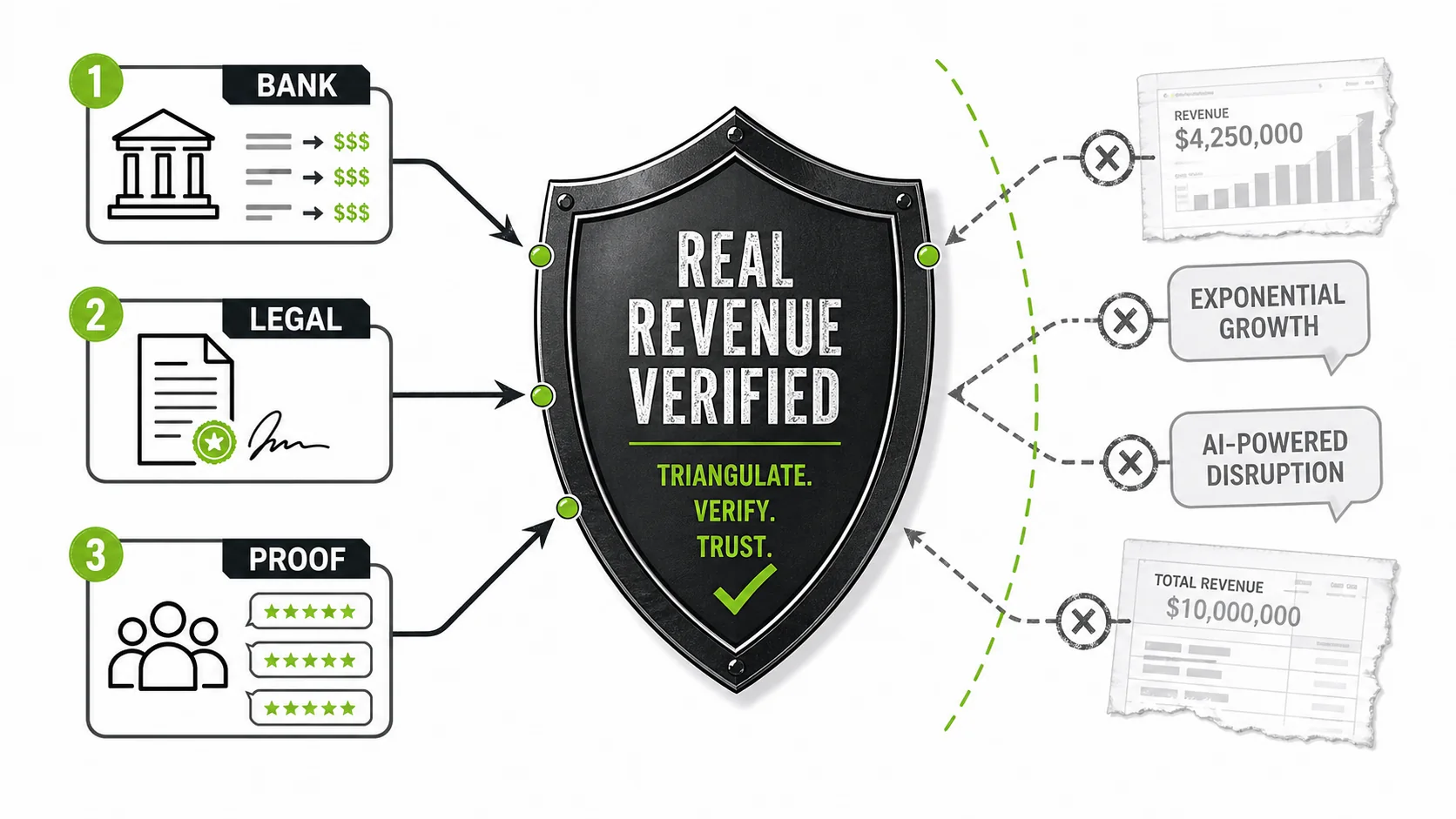
Once you've mastered the basic audit, you can deploy advanced tactics. These strategies are for when the stakes are highest—major partnerships, acquisitions, or investments where you need to verify revenue with near-certainty.
How do you verify revenue for an acquisition target?
You treat it like a mini-audit and make verification a condition of the deal. Hire a third-party accounting firm to perform "agreed-upon procedures" focused solely on revenue authenticity. The cost ($5k-$15k) is trivial compared to the deal size. Structure the payment as an earn-out based on verified post-acquisition revenue, not claimed historical numbers. Most importantly, get personal representations and warranties from the founders. If the revenue is later found to be fabricated, these clauses allow you to claw back a significant portion of the purchase price. According to data from SRS Acquiom's 2025 M&A claims report, nearly 18% of post-merger indemnity claims relate to breaches of financial reps, highlighting how common discrepancies are.
What are the red flags in a pitch deck?
Beyond the obvious, look for "black box" metrics. Claims like "profitable from day one" with no explanation of how (especially for a physical product business) are suspect. Graphs without labeled Y-axes are a classic trick. "Partner logos" that are just well-known companies anyone could list, without proof of a paid relationship. The biggest red flag? An unwillingness to move from a polished narrative to raw data. A founder who says, "Just trust me, the data is proprietary," is telling you they have something to hide. Your startup verification process must begin the moment you open the deck.
Can you use technology to automate verification?
Partially. You can't automate the gut check or the customer calls, but you can automate data gathering. Use a platform like Plaid to standardize financial data access. Use Apollo.io or ZoomInfo to quickly validate customer company domains and employee counts. Set up Google Alerts for the company and founder names to catch negative news. I built a simple internal tool that cross-references a claimed MRR number with Similarweb traffic and LinkedIn employee count, spitting out a "plausibility score." It's not proof, but it efficiently triages which opportunities deserve my 5-hour deep dive. The goal is to use tech to handle the scalable checks so you can focus your human skepticism on the nuanced analysis.
What's the one thing most founders miss?
They miss the temporal correlation. They verify revenue for a single point in time—last month's bank statement. But you need to see the history. Did this "overnight success" actually have three years of flatlining at $500 MRR before a miraculous, unexplained hockey stick? That history is often hidden. Request 24 months of bank statements or Plaid data. The story is in the timeline. A real business shows logical progression: investment in marketing precedes a revenue increase; a new feature launch correlates with a reduction in churn. Fabricated revenue looks like random steps or a perfectly smooth curve. The past is the best predictor of whether their future claims are also a fantasy.
Due diligence is the tax you pay on your own optimism.
Key takeaways
- Financial verification in 2026 requires assuming all self-reported data is fake until proven otherwise with third-party evidence.
- The only reliable way to verify revenue is through read-only access to direct financial feeds via open banking APIs like Plaid.
- Correlate revenue claims with operational data: $100k MRR should logically require substantial website traffic and a team larger than two people.
- A random customer audit is non-negotiable; message 5-7 randomly selected customers on LinkedIn to confirm they are real users.
- According to FTC data, business and investment fraud caused over $4.6 billion in losses in 2025, making rigorous verification a financial necessity.
- Structure acquisition deals with earn-outs and personal warranties to protect yourself if claimed revenue is later found to be fabricated.
- The most common mistake is verifying a snapshot in time; always analyze 24 months of historical financial data to spot illogical growth patterns.
Got questions about verifying revenue? We've got answers
What is the best way to verify revenue for a startup?
The best way is a multi-layered approach: first, secure read-only access to their bank and payment processor feeds via Plaid for raw transaction data. Second, correlate this revenue with external metrics like Similarweb traffic and LinkedIn employee counts to check for plausibility. Third, conduct a random audit by verifying 5-7 customers directly on LinkedIn. This combination of direct financial access, operational correlation, and third-party human confirmation forms an airtight verification.
How much does it cost to professionally verify a company's finances?
Hiring a forensic accountant or a firm to perform "agreed-upon procedures" for revenue verification typically costs between $5,000 and $15,000 for a small-to-midsize startup, depending on complexity. However, you can perform a robust founder due diligence yourself for the cost of a Similarweb subscription ($149/month) and your time. The real cost is not verifying and losing your investment.
Can a company fake bank statements?
Yes, and it's frighteningly common. With basic graphic design software, anyone can edit a PDF bank statement. This is why screenshots and PDFs are worthless as proof. The only defense is to bypass the document entirely and use open banking (Plaid, MX) to get read-only API access to the actual account feed, which is exponentially harder to falsify in real-time.
What are the legal repercussions for faking revenue?
They can be severe. Faking revenue to secure investment constitutes fraud and can lead to civil lawsuits for damages, SEC violations (if it involves securities), and even criminal charges. In acquisition scenarios, it breaches representations and warranties, allowing the buyer to sue for indemnification and claw back large portions of the purchase price. The legal risk is high, which is why the smart fraudsters focus on narrative larping rather than outright document forgery.
How do I verify revenue if the company is pre-revenue or has no customers?
You don't verify revenue; you verify the path to revenue. Scrutinize their pilot agreements (are they paid or free?), their waitlist (can you spot fake emails?), and their underlying technology. For a deep dive on assessing pre-revenue claims, our guide on spotting fake gurus and their alternatives covers the narrative tactics used in this space. The core principle remains: trust nothing, verify everything that can be verified.
Is it rude to ask for this level of verification?
It is only rude to the dishonest. For serious, legitimate founders, transparent verification is a sign of professionalism and builds trust. Frame it as a standard part of your process: "We're excited about this opportunity. As part of our standard founder due diligence, we use Plaid to verify financials seamlessly. Here's a link to set up read-only access." If they balk, you have your answer before the first meeting ends.
The difference between a visionary and a fabulist is a paper trail you can actually follow. In a world optimized for appearances, the ability to discern real traction from manufactured hype isn't just a skill—it's your primary defense mechanism. The tools and tactics we've outlined turn a daunting task into a systematic process. Your next step is to apply them. Stop wondering, start verifying.
Ready to sharpen your detection skills? Learn to spot the signs before you get burned. For more resources on due diligence, visit our main guide on founder verification strategies.
<!-- sister-projects-start -->
Other Doved Studio projects
Related tools from the same studio you might find useful:
- Ralphable: Generate structured Claude Code skills that iterate until pass/fail criteria are met.
- Doved Studio: Studio indie derrière cette app et une dizaine d'autres outils.
<!-- sister-projects-end -->