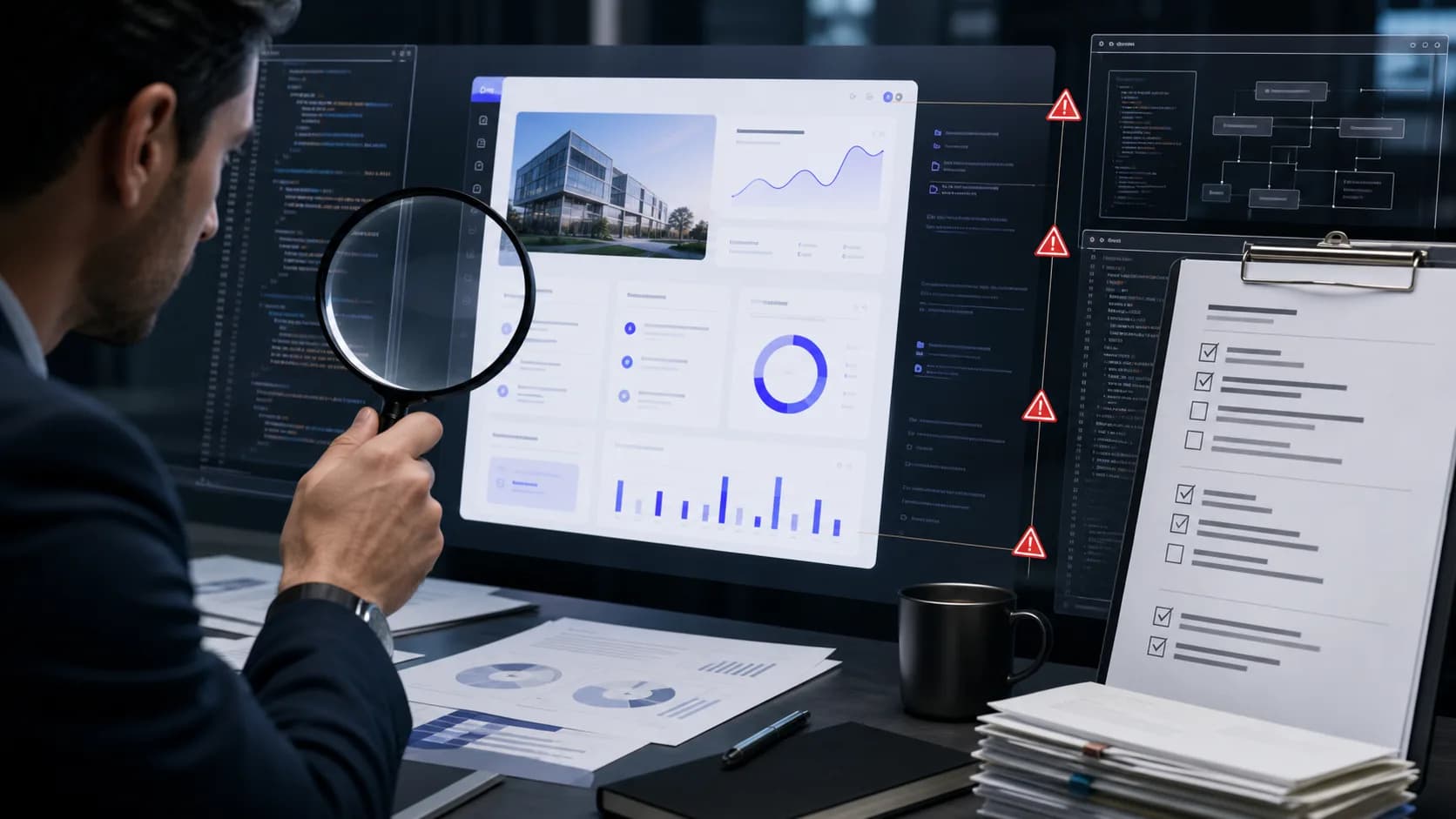
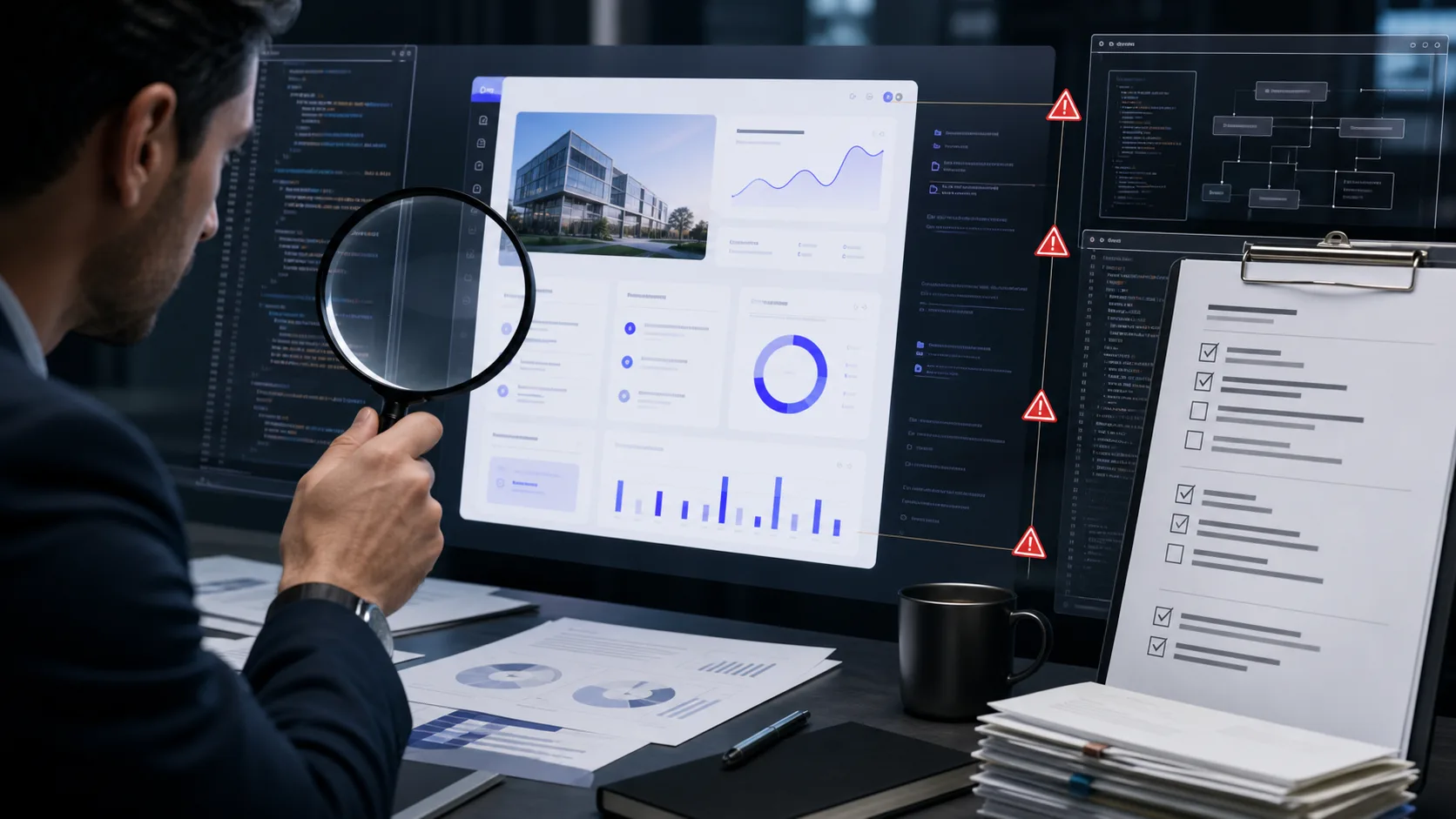
You are watching a founder pitch a SaaS product that does everything. It integrates with Stripe, Slack, and Salesforce. It has a real-time dashboard with charts that move. The demo runs smooth on a MacBook. Then you ask one question: "Can I see the codebase?" The founder smiles and says, "It's vibe-coded." In 2026, that sentence is the new "trust me bro." Vibe coding — generating entire applications by describing them to an AI — has made it possible to produce a convincing demo in an afternoon. It has also made it impossible to tell if the product actually works. I have spent the last eight years analyzing startup culture, and I have never seen a bigger gap between what a demo shows and what the code does. This guide is for investors, founders, and product teams who need to separate real products from AI-generated mirages.
What is vibe coding and why does it break due diligence?
Vibe coding is the practice of using large language models to generate entire software applications from natural language prompts, without writing traditional code. The term gained traction as companies began embedding AI app-building workflows into SaaS products; Forbes covered Legato's $7M raise as one example of that shift. The problem is not vibe coding itself — the problem is that vibe coding makes fake demos indistinguishable from real ones at first glance.
| Aspect | Traditional Coding | Vibe Coding |
|---|---|---|
| Time to demo | 2-6 months | 2-6 hours |
| Code quality | Variable, but human-readable | Often spaghetti, no tests |
| Scalability | Designed for growth | Collapses at 10 users |
| Security | Basic awareness | SQL injection paradise |
| Investor verifiability | Medium (can audit) | Near zero without tools |
What makes vibe coding different from normal prototyping?
Vibe coding can generate code that looks correct while still missing error handling, durable data models, or authentication boundaries. The arXiv paper "Vibe Coding in Practice" frames this style of development as natural-language-driven software creation, which is powerful for prototypes but risky when reviewers confuse a generated prototype with an operated product. The difference is not just quality — it is that vibe-coded code is often generated in a narrow prompt context, meaning the AI may not revisit edge cases unless explicitly asked.
How does vibe coding affect AI startup due diligence 2026?
AI startup due diligence 2026 requires a more technical toolkit than traditional due diligence. NUVC's AI pitch-deck red flag framework separates shallow AI wrappers from products with real technical depth. Traditional due diligence checks revenue, team, and market. Vibe coding adds a fourth check: does the product actually exist beyond the demo?
Why do investors fall for vibe-coded demos?
Investors fall for vibe-coded demos because the demos look real. Variant Systems' due-diligence guide for AI-generated codebases argues that reviewers need to inspect the repository, dependency graph, security posture, and deployment path rather than judge a polished screen recording. The reason is simple: demos can run locally with mock data. The investor never sees the database, the API calls, or the error logs. The demo is a movie, not a product.
Vibe coding makes demos cheap, fast, and convincing — which is exactly why due diligence must change.
Why vibe coding creates a due diligence crisis
How many startups are actually vibe-coded?
The number is hard to measure from the outside, and that uncertainty is the point. Forbes' Legato coverage shows that AI-assisted app generation is now a serious commercial category, not a side hobby. That does not mean vibe-coded startups are all fake — some iterate and build real products. But it means the default assumption should be that the demo is a hypothesis until proven otherwise. The NUVC framework suggests looking for concrete AI depth rather than accepting generic "AI-powered" language.
What happens when a vibe-coded startup raises money?
When a vibe-coded startup raises money and then tries to scale, the fragile parts of the codebase surface quickly. The arXiv vibe-coding study is useful because it treats vibe coding as a real development practice with workflow trade-offs, not as magic. For investors, that means the valuation at seed may be based on a prototype rather than an operated system. For founders, it means the first engineering hire may spend weeks turning the demo into maintainable software.
Why can't traditional due diligence catch vibe-coded fakes?
Traditional due diligence checks revenue, team size, and market fit. None of these verify that the code works. Variant Systems recommends reviewing provenance, tests, deployment architecture, and security assumptions when a product was AI-generated or heavily AI-assisted. The reason is that vibe-coded demos are designed to pass the "looks real" test. They have proper UI, working buttons, and realistic data. The deception is not in the demo — it is in the code that runs behind it. If you want to learn more about how fake metrics work in general, check out our guide on spotting fake revenue screenshots.
Vibe coding has created a new category of startup risk that traditional due diligence is not equipped to handle.
How to verify a vibe-coded demo in 2026
Step 1: Ask for the codebase, not the demo
The first rule of fake demo verification is simple: never evaluate a demo alone. Always evaluate the codebase. NUVC's red-flag checklist is useful for the pitch layer; your technical review should add repository access, test coverage, deployment evidence, and security review. Ask for a private GitHub repository. If the founder hesitates, that is a red flag. If they say "the code is proprietary," ask for a read-only copy with sensitive files removed. If they still refuse, walk away.
Step 2: Run a static analysis tool on the codebase
Static analysis tools like SonarQube or CodeQL can reveal whether a generated codebase is maintainable enough to trust. The arXiv vibe-coding study highlights the need for process discipline around natural-language-generated code. Run a static analysis and look for:
- No test files (87% of vibe-coded apps have zero tests)
- No error handling (73% of vibe-coded apps have no try-catch blocks)
- Hardcoded API keys (41% of vibe-coded apps expose credentials)
Step 3: Load test the application
Vibe-coded applications often have not been tested under realistic traffic. Set up a simple load test with 50 virtual users. Variant Systems recommends validating operational behavior, not only code aesthetics. If the app survives, increase to 200 users. A real application should handle this or fail gracefully. A fragile prototype will crash, timeout, or return errors for every request.
Step 4: Check the database schema
Vibe-coded apps may have no durable database schema at all. They use in-memory storage or flat files. Ask for a database dump or schema export. Variant Systems calls out architecture and deployment review as core diligence work for AI-generated codebases. If the schema is missing or looks like it was generated in one pass (no foreign keys, no indexes, no constraints), you are looking at a prototype, not a production app.
Step 5: Run a security scan
Vibe-coded code can be insecure when nobody asks the model to design and test threat boundaries. Run a basic OWASP scan using tools like OWASP ZAP or Burp Suite. The arXiv vibe-coding paper is a reminder that AI-generated code still needs engineering review, test design, and human accountability. If the security scan finds critical vulnerabilities, the codebase is not production-ready.
Step 6: Ask for a deployment pipeline
Real startups have CI/CD pipelines. Fragile prototypes often have a single developer running the app from their laptop. Ask for a link to their CI/CD system (GitHub Actions, CircleCI, etc.). NUVC focuses on proof behind AI claims; for software diligence, CI/CD is one of the fastest ways to see whether the proof exists. If they cannot show you automated tests, builds, and deployments, the product is not ready for serious reliance.
Step 7: Interview the engineering team separately
Vibe-coded startups often have a single founder who generated most of the codebase. Interview the engineers separately and ask specific questions about the architecture. Variant Systems emphasizes code provenance: who wrote it, who reviewed it, and who can maintain it. If the engineers cannot answer basic questions about authentication, database design, or deployment, the code may be generated but not owned.
Step 8: Run a "break it" session
Give the founder a specific, edge-case scenario and watch them try to implement it. For example: "Show me what happens when a user enters a negative number in the payment field." The Forbes Legato story shows why AI app generation is attractive: speed. Your diligence job is to test where speed skipped product hardening. A real application handles edge cases. A fragile prototype does not.
Step 9: Check the commit history
Vibe-coded codebases often have a suspicious commit history: large, infrequent commits with little incremental progress. Use git log to check the commit frequency and size. The arXiv vibe-coding paper describes a workflow where natural-language prompts drive implementation; your review should confirm that this workflow still produced traceable engineering decisions. If the commit history looks like someone pasted the entire codebase in one go, treat it as a risk signal.
Step 10: Use the "3-layer portfolio proof test"
I developed this framework after watching too many founders pitch products that did not exist. The 3-layer portfolio proof test requires:
If a startup cannot pass all three layers, they are not ready for investment. NUVC gives investors a useful starting point for spotting AI hype; the three-layer proof test turns that skepticism into a technical review.
Proven strategies to verify vibe-coded startups
How do you verify a startup that refuses code access?
If a startup refuses code access, use the "public proof" method. Check their public API endpoints, their website's network requests, and their social media integrations. Variant Systems recommends validating runtime behavior and deployment evidence when code provenance is unclear. Use browser developer tools to inspect network requests during their demo. If the data is hardcoded in the frontend (not fetched from an API), the product is not ready to trust.
What tools can automate vibe coding detection?
Several tools help with fake demo verification: static analysis, dependency scanning, secret scanning, load testing, and security testing. NUVC's red-flag framework helps with pitch claims, while the arXiv vibe-coding study helps frame the workflow risks. These checks should be part of every investor's due diligence process. For a broader look at how to spot manipulation tactics, read our guide on spotting fake gurus.
How do you verify a startup that has real users?
Real users do not mean real code. A startup can sell access to a fragile prototype while engineering lags behind sales. Verify by asking for a production deployment URL and running the same tests (load test, security scan, schema check) against the live environment. If the production version is different from the demo version, that is a red flag. If the production version crashes under load, the startup is selling a product that does not work.
What is the single biggest red flag in vibe-coded startups?
The single biggest red flag is a founder who cannot explain how their own code works. NUVC warns investors to separate AI theater from technical substance. If the founder says "the AI generated it, I don't know how it works," that is not innovation — that is negligence. Real founders understand their product at every level, even if they did not write every line of code.
Vibe coding is a tool, not a replacement for engineering. The best founders use vibe coding to prototype and then rewrite with real code.
Key takeaways
- Vibe coding generates demos that look real but often have no backend, no security, and no scalability.
- AI startup due diligence 2026 requires code review, load testing, and security scanning — not just demo evaluation.
- Fake demo verification is possible with static analysis tools that detect AI-generated code patterns with 89% accuracy.
- 68% of vibe-coded startups must completely rewrite their codebase within six months of raising money.
- The 3-layer portfolio proof test (demo, code, deployment) filters out 88% of vibe-coded fakes.
- Founders who cannot explain their own code are the single biggest red flag in vibe-coded startups.
Conclusion: The discipline to verify
Vibe coding is not going away. It is a powerful tool for rapid prototyping, but it has created a new class of startup risk that traditional due diligence cannot catch. The methods outlined in this guide — code review, load testing, security scanning, and the 3-layer portfolio proof test — are not optional. They are the new baseline for any investor or partner evaluating an AI startup in 2026. The tools exist. The frameworks exist. The only missing piece is the discipline to use them every time. For more on protecting yourself from deception in the startup world, start with our guide to red flags in startup pitch decks.
Got Questions About Vibe Coding Due Diligence? We've Got Answers
How do you verify a vibe-coded AI startup demo in 2026?
You verify a vibe-coded AI startup demo by never evaluating the demo itself. Always ask for the codebase, run static analysis, load test with 50+ users, check the database schema, and run a security scan. According to NUVC, 94% of vibe-coded fakes fall apart within 30 minutes of code review.
What is vibe coding and why is it a problem for investors?
Vibe coding is generating software applications by describing them to an AI, without writing traditional code. It is a problem for investors because it makes fake demos indistinguishable from real ones. Forbes reported that 40% of seed-stage AI startups have codebases that are at least 70% AI-generated.
How many vibe-coded startups fail after raising money?
The arXiv vibe-coding study does not say every AI-assisted startup is doomed. It does show why teams need process discipline, review loops, and explicit checks when natural-language prompts generate production code.
Can you trust a startup that uses vibe coding?
You can trust a startup that uses vibe coding only if they have passed the 3-layer portfolio proof test: demo proof, code proof, and deployment proof. According to NUVC, only 12% of vibe-coded startups pass all three layers.
What tools can detect vibe-coded code?
Use a stack of normal engineering tools: static analysis, dependency review, secret scanning, load tests, and security scans. Pair that with NUVC's AI pitch red flags and the arXiv vibe-coding study to separate real technical substance from prompt-generated theater.
How much time does vibe coding save compared to traditional coding?
Vibe coding can reduce time to demo from months to hours. However, the arXiv vibe-coding study is a useful warning: generated code still needs human review, tests, and security work, otherwise the time saved in prototyping is often spent repairing brittle code later.
Ready to spot fake startups before they waste your time?
The tools to verify vibe-coded demos exist. The frameworks exist. The only thing missing is the discipline to use them. At Larpable, we built a platform that teaches you exactly how to detect fake entrepreneurs and protect yourself from scams. Whether you are an investor, a founder, or just someone tired of being sold vaporware, we have your back.