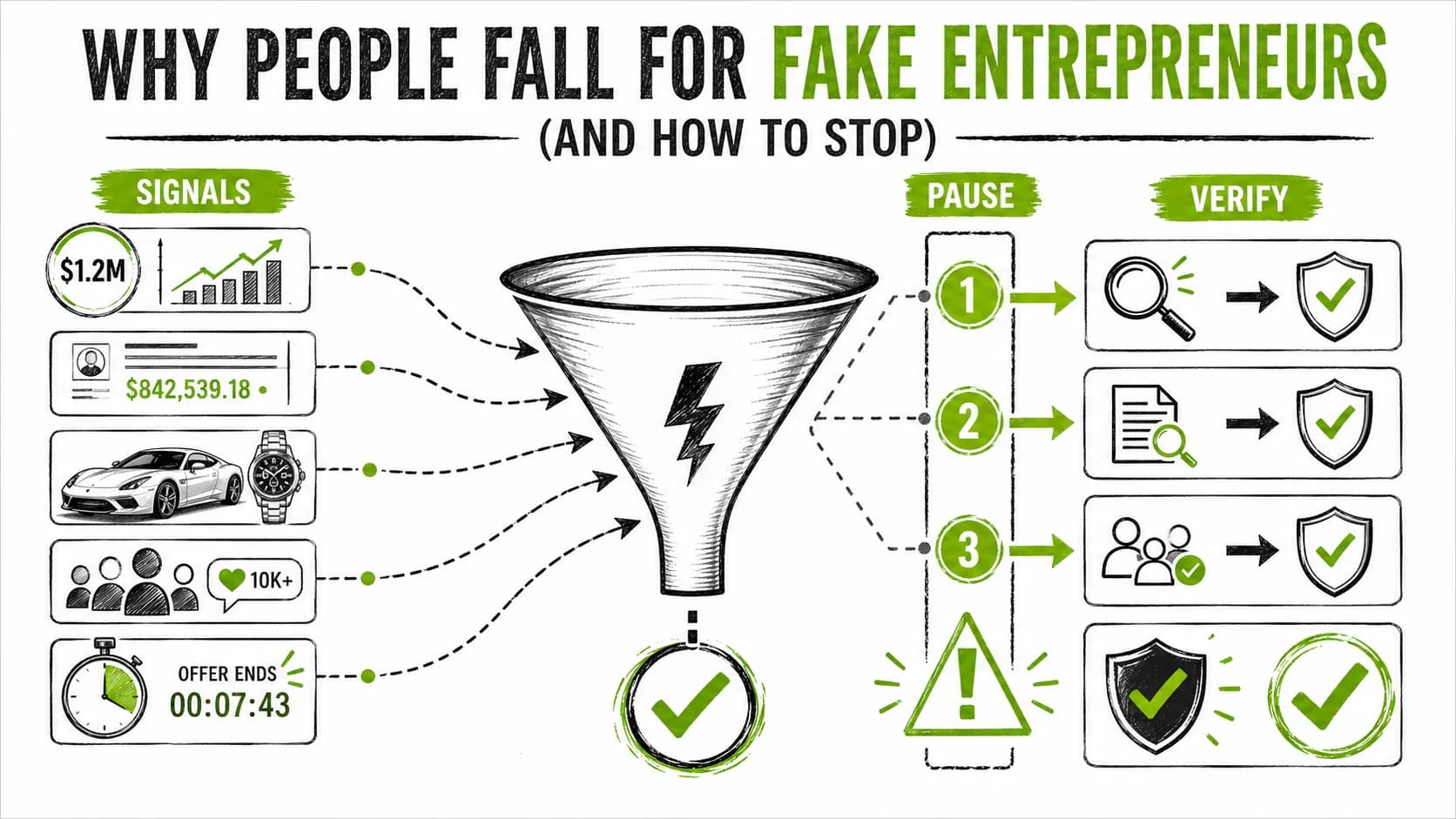
Why People Fall for Fake Entrepreneurs (And How to Stop)
The Uncomfortable Question
Stanford psychologist Robert Cialdini identified 7 principles of influence in 2021's updated Influence, and fake entrepreneurs systematically exploit all of them, from social proof to scarcity. Here's something that bothers skeptics: the fake entrepreneurs aren't hiding very well. The round numbers. The cropped screenshots. The recursive credentials. The obviously staged lifestyle photos. It's not subtle.
So why do intelligent, educated people fall for it?
The answer isn't "those people are stupid." The answer is that fake entrepreneurs exploit fundamental features of human cognition—features that helped us survive as a species but leave us vulnerable in the attention economy.
Understanding these vulnerabilities doesn't make you cynical. It makes you protected.
The Cognitive Toolkit Being Exploited
Daniel Kahneman's Nobel Prize-winning research on dual-process theory explains why: System 1 (fast, intuitive) processes guru marketing before System 2 (slow, analytical) can intervene.
1. Authority Heuristic
What it is: We're wired to defer to authority. For most of human history, this was adaptive—elders had survival knowledge; experts had verified skills.
How it's exploited: Fake entrepreneurs manufacture authority signals:
- Large follower counts (purchasable)
- Revenue screenshots (fabricable)
- Testimonials (tradeable)
- Professional aesthetics (learnable)
The signals look like authority. Our brains process them as authority. We defer before we verify.
The defense: Train yourself to ask: "What is this authority actually based on? Can I verify it independently?"
2. Social Proof Cascade
What it is: We look to others' behavior to determine appropriate action. If everyone's running from the building, we run too—even without seeing the fire.
How it's exploited: Engagement pods, purchased followers, and testimonial networks create the appearance of mass validation. "100,000 followers can't be wrong." "1,000 students can't all be lying."
But they can be bought. They can be fabricated. They can be trading testimonials among themselves.
The defense: Distinguish between quantity of social proof and quality. 100 engagement pod likes are worth less than 3 real customer testimonials from verifiable sources.
3. The Aspiration Gap
What it is: The psychological distance between where you are and where you want to be creates emotional pressure. This pressure makes us susceptible to anything that promises to close the gap.
How it's exploited: Every piece of guru content highlights the gap:
- "Here's my revenue" (you don't have this)
- "Here's my freedom" (you don't have this)
- "Here's my system" (you don't know this)
- "Here's how to get it" (for a price)
The content is designed to make the gap feel both painful and closable.
The defense: Recognize when content is engineered to highlight your inadequacy. Aspiration is healthy; manufactured inadequacy is manipulation.
4. Survivorship Bias
What it is: We see the winners; we don't see the losers. The successful startups get press; the 99% that fail are invisible.
How it's exploited: Gurus showcase their best outcomes:
- The 3 students who made money (not the 997 who didn't)
- The months of growth (not the months of loss)
- The wins (never the failures)
Your sample is systematically biased toward success.
The defense: Always ask: "What's the denominator? How many people tried this and failed?"
5. The Just-World Fallacy
What it is: We want to believe the world is fair—that success comes from deserving it, that poverty comes from fault.
How it's exploited: Gurus present their success as earned through methodology:
- "I followed these steps and succeeded"
- "Anyone can do this if they commit"
- "The information is all you need"
The implication: failure is your fault. You didn't try hard enough, believe enough, commit enough.
The defense: Recognize that outcomes are probabilistic, not deterministic. The same inputs can produce different outputs. Luck exists.
6. The Sunk Cost Trap
What it is: Once we've invested in something, we resist admitting the investment was wasted. We throw good money after bad.
How it's exploited: Gurus create escalating commitment:
- Free content → email list
- Email list → cheap product
- Cheap product → expensive course
- Expensive course → high-ticket coaching
At each stage, admitting you've been fooled means acknowledging all previous investments were wasted.
The defense: Practice asking: "Knowing what I know now, would I make this investment fresh?" Ignore what you've already spent.
7. The Narrative Fallacy
What it is: We're wired to understand the world through stories. Stories are how we make sense of complexity. But we prefer stories to statistics, even when statistics are more accurate.
How it's exploited: The guru's "journey" is a story:
- Struggle (relatability)
- Discovery (revelation)
- Triumph (proof of concept)
- Sharing (generosity)
The narrative bypasses analytical processing. You feel you understand, even when you haven't verified.
The defense: Train yourself to ask: "Is this a story or is this evidence? What would evidence actually look like?"
The Emotional Layer
A 2024 study published in the Journal of Consumer Psychology found that aspirational content increases purchase intent by 340% when the viewer is experiencing financial stress, explaining why guru tactics spike during economic downturns.
Cognitive biases don't work alone. They're amplified by emotional states.
Desperation
When you need money, need status, need proof of your own capability—you're vulnerable. Desperation compresses time horizons and inflates risk tolerance.
The exploitation: Urgency tactics, scarcity claims, "limited time" offers all amplify desperation.
Loneliness
Entrepreneurship is isolating. The guru community offers belonging.
The exploitation: "Join my community." "Be part of the inner circle." "We're all in this together."
Imposter Syndrome
Feeling like you don't belong makes you susceptible to anyone who seems to know the secret.
The exploitation: "You've been doing it wrong." "Here's what successful people know." "Let me show you the real way."
Hope
The most exploitable emotion. Hope makes the improbable feel possible.
The exploitation: Every testimonial, every success story, every "if I can do it, you can too" statement targets hope.
Why Smart People Aren't Immune
MIT Media Lab researcher Soroush Vosoughi's 2018 Science study showed that false information spreads 6x faster than truth on social platforms, and high-IQ individuals share misinformation at similar rates to others.
Intelligence doesn't protect you. Sometimes it makes you more vulnerable:
The fake entrepreneurs know this. That's why they include just enough sophistication to satisfy the intelligent buyer's need to feel smart about their purchase. This pattern plays out identically across the Info Product Guru and App Builder Larper archetypes we've documented.
The Information Environment
Eli Pariser's "filter bubble" concept, validated by a 2023 Pew Research Center study, shows that algorithm-curated feeds reduce content diversity by 40-60%, trapping users inside echo chambers of guru content.
Filter Bubbles
Social media shows you more of what you engage with. If you're interested in entrepreneurship, you'll see more guru content. The repetition creates the illusion of consensus.
Platform Incentives
Platforms profit from engagement, not truth. Aspirational content engages. Guru content performs. The algorithm promotes what works, regardless of veracity.
The Disappearing Negative
Negative reviews get suppressed:
- Community members attack critics
- Gurus block skeptics
- Refund policies have NDAs
- Failures leave quietly in shame
What survives is systematically biased toward the positive.
How to Stop Falling
Skepticism is a learnable skill, not a personality trait; the FTC, Consumer Financial Protection Bureau (CFPB), and Better Business Bureau all recommend structured verification checklists before any online purchase over $100.
1. Implement a Verification Protocol
Before acting on any claim:
- Can this be independently verified?
- Who profits if I believe this?
- What would falsification look like?
- Am I being asked to act before I can verify?
2. Practice Narrative Immunity
When you encounter a compelling story:
- What would this look like without the narrative framing?
- What information is being left out?
- Would I trust this if the storyteller weren't charismatic?
3. Seek Negative Evidence
Actively search for failure stories:
- "[Product name] refund"
- "[Guru name] scam"
- "Why [method name] doesn't work"
The existence or absence of negative evidence is data. Our MRR verification guide walks you through this in under 60 seconds.
4. Time-Box Decisions
Artificial urgency is a manipulation. Implement a rule: no purchase within 72 hours of first exposure. If the opportunity disappears, it wasn't real.
5. Find Disconfirming Sources
Seek out people who disagree. Not to become cynical—but to stress-test claims. If a claim can't survive scrutiny, it shouldn't survive your belief.
6. Check Your Emotional State
Before any decision:
- Am I feeling desperate?
- Am I feeling inadequate?
- Am I feeling isolated?
- Am I acting from hope or from analysis?
Emotional states are information—about your vulnerability, not the opportunity.
The Hardest Part
The hardest part of not falling for fake entrepreneurs isn't cognitive. It's accepting that:
Conclusion
Fake entrepreneurs succeed not because their victims are stupid, but because they've systematized the exploitation of universal cognitive vulnerabilities. Authority heuristics, social proof, narrative fallacy, aspiration gaps—these aren't character flaws. They're features of human cognition.
Understanding them is the first step. Implementing verification protocols is the second. Accepting that skepticism is a skill that requires practice is the third.
You can still be hopeful. You can still be ambitious. But you can be these things while also verifying before you trust.
For a broader economic analysis of how these tactics sustain an entire industry, read our deep dive into the Larp Economy.
Explore our FREE Pattern Recognition Guides for detailed protective frameworks. Share this article to help others understand why they're vulnerable—not stupid.
<!-- sister-projects-start -->
Other Doved Studio projects
Related tools from the same studio you might find useful:
- Ralphable: Generate structured Claude Code skills that iterate until pass/fail criteria are met.
- Doved Studio: Studio indie derrière cette app et une dizaine d'autres outils.
<!-- sister-projects-end -->