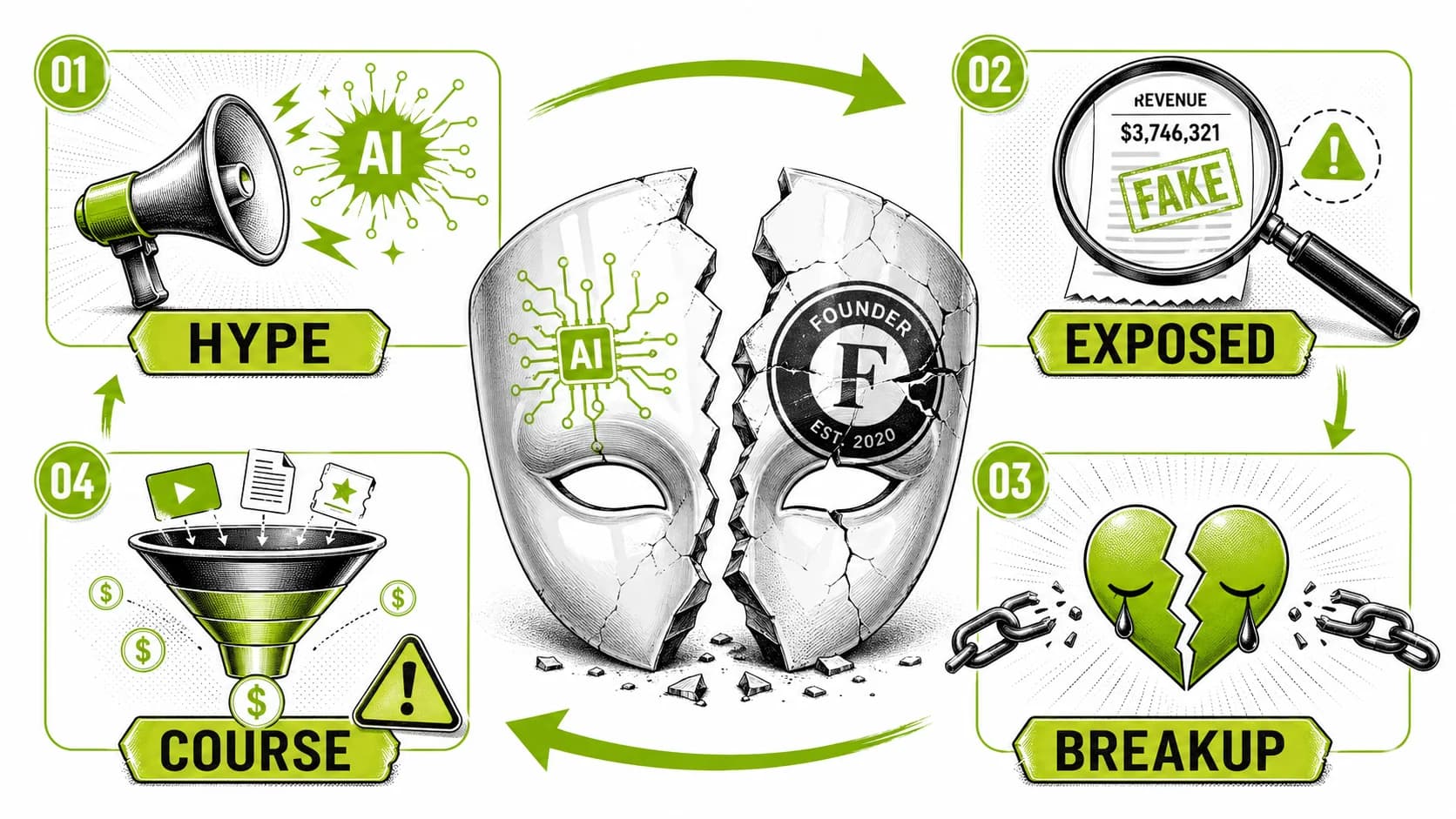
If you’ve scrolled through LinkedIn or Twitter in early 2026, you’ve witnessed the emotional spectacle. The tearful, black-and-white video. The long-form post about "betrayal," "broken trust," and "the hardest decision of my life." It’s not a celebrity marriage ending—it’s a founder breakup. More specifically, it’s the meticulously staged "personal brand divorce" of an AI guru whose agency was just exposed for being as real as a screenshotted million-dollar month.
Welcome to the latest, most cynical pivot in the grift economy. When the facade of a "7-figure AI automation agency" crumbles under the weight of fake client testimonials and photoshopped revenue screenshots, the modern guru doesn’t slink away in shame. He monetizes the collapse. He rebrands exposure as a strategic, emotionally resonant narrative arc: The Phoenix Rise. And he’s selling you the blueprint for your own comeback before the ashes of his last scam have even cooled.
This article is your decoder ring for the "Breakup-to-Business" grift. We’ll dissect the 5-act playbook of the "personal brand divorce," show you the red flags, and explain why this trend is the logical, soulless endpoint of guru culture. Because in 2026, failure isn’t just an option—it’s a premium-priced product.
The Anatomy of a Grift: From AI Hustle to Heartbreak Hustle
To understand the "brand divorce," we must first chart the lifecycle of the typical 2024-2025 AI guru. It follows a predictable, three-stage rocket to nowhere:
In the old days (circa 2023), this is where the story ended. The guru would delete his account or go silent. But 2026’s grifters are more sophisticated. They’ve studied narrative. They see exposure not as an end, but as a plot twist.
The 5-Act "Personal Brand Divorce" Playbook
When the walls close in, the exposed guru executes a flawless pivot into a new, more "vulnerable" grift. Here’s the standardized playbook, now running on repeat across the platform formerly known as Twitter.
Act 1: The Grievous Announcement
The first post is a masterpiece of misdirection. It’s never "I got caught lying." The language is carefully curated from therapy and self-help lexicons.
- The Medium: A somber, close-up video (often in black and white or muted tones) or a monumental LinkedIn post.
- The Narrative: "My co-founder and I have decided to part ways." "I’ve been betrayed by someone I considered a brother." "The vision was compromised."
- The Vibe: Solemn, wounded, but dignified. It’s designed to elicit sympathy and curiosity, immediately framing the guru as the victim, not the perpetrator.
Example Script (Paraphrased from real posts):
"The last 72 hours have been the most painful of my entrepreneurial journey. The business I built from my soul is no longer aligned with its core values due to actions taken by my inner circle. While I can’t go into details, trust was broken in a way that makes moving forward together impossible. This isn’t just a business breakup—it’s a personal heartbreak."
Act 2: The Strategic Vague-posting
In the days following the announcement, the guru engages in "vague-posting." This builds mystery and engages the audience’s detective instincts, distracting from the actual facts of the exposure.
- Tweets like: "When you realize some people were only ever in it for the money." or "Loyalty is the rarest currency."
- Purpose: To get followers commenting "What happened??" and "Stay strong king 👑," creating a bandwagon of support that buries any critical comments questioning the original scam.
Act 3: The "Raw" Reveal (The Pivot)
About a week later, the "truth" drops. This is where the narrative is skillfully steered away from fraud and towards interpersonal drama.
- The Confession (Partial): He may admit to a small, relatable "mistake"—"I trusted too much," "I delegated the finances blindly," "I was so focused on growth I ignored the red flags."
- The Villain: The "toxic co-founder," the "jealous partner," or the "greedy investor" is introduced as the source of all ethical failures. The guru’s own role is minimized to one of naive trust.
- The New Mission: This is the crucial pivot. He announces he’s taking time to "heal" and "rebuild"—but not before hinting at a powerful new lesson learned. "I’m seeing now that true success isn’t about revenue, it’s about authenticity."
Act 4: The Monetization of "The Fall"
The sympathy capital is now converted to financial capital. The "lesson learned" from the "betrayal" is packaged.
- The Product Launch: Meet "Brand Phoenix: Rebuild Your Identity After a Public Fall." Or "The Comeback Code: Turning Betrayal into Your Biggest Advantage."
- The Audience: This targets two groups: 1) His existing, sympathetic followers, and 2) A new audience of people who’ve faced professional setbacks and are vulnerable to a "rebirth" story.
Act 5: The "Redemption" Arc & The Cycle Repeats
With the new course selling, the guru’s content shifts entirely. He is now a "resilience expert" or a "personal brand crisis consultant."
- New Content Theme: Posts about vulnerability, mental health, the "journey over the destination," and critiques of the "hustle culture" he so recently embodied.
- The Irony: He uses his platform, built on a lie, to lecture others on authenticity. He critiques the guru playbook he just executed, positioning himself as the reformed insider.
- The Endgame: This new, "wiser" persona lays the foundation for the next grift, now armored with a compelling backstory of "overcoming adversity."
Why This Grift Is So Effective (The Dark Psychology)
The "brand divorce" works because it hijacks powerful psychological triggers:
- Narrative Bias: Humans love a story, especially a dramatic arc of fall and redemption. This playbook provides a ready-made, emotionally engaging story that overshadows dry, factual evidence of fraud.
- The "Underdog" Effect: By framing himself as the victim of betrayal, the guru taps into our natural inclination to root for the underdog. Criticizing him starts to feel like kicking someone when they’re down.
- Vulnerability as Currency: In an age of curated perfection, staged "vulnerability" is incredibly persuasive. It creates a false sense of intimacy and trust, making the audience feel they are seeing the "real" person.
- Preys on Universal Fear: The fear of public failure, betrayal, and reputational damage is almost universal. The guru sells the antidote to the very poison he (indirectly) represents.
How to Spot a "Brand Divorce" Grift in Progress: Your 2026 Red Flag Checklist
Don’t get swept up in the drama. Use this checklist to analyze any dramatic "founder breakup" story.
| Red Flag | What It Looks Like | The Reality Check |
|---|---|---|
| Vagueness Over Specifics | "Values were misaligned," "Trust was broken," but zero concrete details about what actually happened (e.g., "They lied to clients about X"). | A real business breakup involves actionable issues: breach of contract, theft of IP, fraud. Vagueness is a shield. |
| The Sudden Pivot to "Healing" | The content shifts from revenue screenshots to quotes about meditation and resilience immediately after controversy emerges. | This is a calculated rebrand, not a genuine journey. The timeline is too neat. |
| The Missing Villain's Voice | The "toxic" co-founder is completely silent, doesn’t tell their side, or has a tiny, inactive online presence. | In a real dispute, both sides typically speak. A silent villain is often a narrative convenience. |
| Monetization at Speed | A new, high-ticket course about "rebuilding" is launched within 2-4 weeks of the "breakup." | Genuine recovery takes time. Immediate monetization reveals the entire arc as a product launch strategy. |
| Re-writing History | Downplaying their previous "hustle" content as a "mistake" or "phase," rather than taking accountability for its deceptive nature. | "I was lost in the grind" is not an apology for scamming people. |
If you see 3 or more of these flags, you are likely witnessing a performance, not a personal tragedy. It’s time to sharpen your detection skills. Consider it part of your essential entrepreneurial education in the digital age.
The Bigger Picture: What This Trend Reveals About Guru Culture
The "brand divorce" is the final stage of the guru lifecycle because it represents the complete commodification of the self. Nothing is off-limits:
- Relationships are Productized: Partnerships become plot devices for future content.
- Failure is a Feature: Moral and professional collapse is not a bug but a designed element of the "hero's journey" they are selling.
- Authenticity is a Aesthetic: Real vulnerability is messy, slow, and private. What’s being sold is "vulnerability aesthetic"—a clean, packaged, and profitable imitation.
It signals a market so saturated with "get rich" schemes that the grift has evolved to sell the solution to the damage caused by… the grift. It’s a perpetual motion machine of exploitation.
How to Protect Yourself: Be a Detective, Not a Fan
Your best defense is a combination of skepticism and strategic observation.
r/Entrepreneur is a good start), or critical commentary. The truth is often in the replies and the forgotten threads.The ultimate skill for the modern internet user is learning to Apprendre à Détecter—to separate manipulative performance from genuine human experience. It’s the only way to navigate a landscape where your sympathy is the target of a sales funnel.
FAQ: Your "Brand Divorce" Grift Questions, Answered
What’s the difference between a genuine founder breakup and this grift?
A genuine breakup is messy, legally complex, and often private or explained with specific business reasons (e.g., "We disagreed on the funding strategy," "One partner violated the non-compete"). The focus is on the business outcome. The grift is characterized by high-public emotional performance, vague language about "betrayal," and an unnervingly quick pivot to selling a solution to the pain being displayed.
Are all "personal brand comeback" stories fake?
No. People do recover from genuine, public failures. The key differentiators are time and accountability. A real comeback involves a significant period of quiet reflection, tangible amends (if others were harmed), and a return to work that speaks for itself. The grift bypasses all this for a rapid, story-first product launch.
Why do people fall for this?
The playbook is psychologically sophisticated. It combines the dopamine hit of drama with the powerful hope of redemption. For the buyer, purchasing the "comeback course" isn't just about information; it's about buying a piece of a compelling story and the hope that they, too, can transform their pain. The grift sells hope wrapped in a Netflix-worthy narrative.
What should I do if I’ve already bought a course from someone who then pulls a "brand divorce"?
First, conduct the "Red Flag Checklist" above. If it aligns, you’ve likely been grifted twice: once on the original promise and once on the failure narrative. Request a refund citing the change in circumstances and the deceptive narrative. Document everything. Most importantly, use it as a (free) lesson in the importance of due diligence. Your experience is the best detector for next time.
Is this trend specific to the "AI guru" niche?
It’s most visible there because that’s where the most recent cycle of hype, over-promise, and exposure has occurred. However, the "brand divorce" playbook is a universal scam tactic. We’ve seen it in the wellness, crypto, and real estate coaching spaces. Any guru-centric niche built on hype and vague promises is fertile ground for this pivot.
How can I rebuild my personal brand authentically after a setback, without being seen as a grifter?
Focus on action, not narrative. Do the quiet work of rebuilding. Help others without immediately recording it. Let your work and changed behavior accumulate evidence over months. When you do speak about it, focus on the specific lessons you learned and the systems you changed, not just the emotional arc. Authenticity is demonstrated, not announced.
<!-- sister-projects-start -->
Other Doved Studio projects
Related tools from the same studio you might find useful:
- Ralphable: Generate structured Claude Code skills that iterate until pass/fail criteria are met.
- Doved Studio: Studio indie derrière cette app et une dizaine d'autres outils.
<!-- sister-projects-end -->