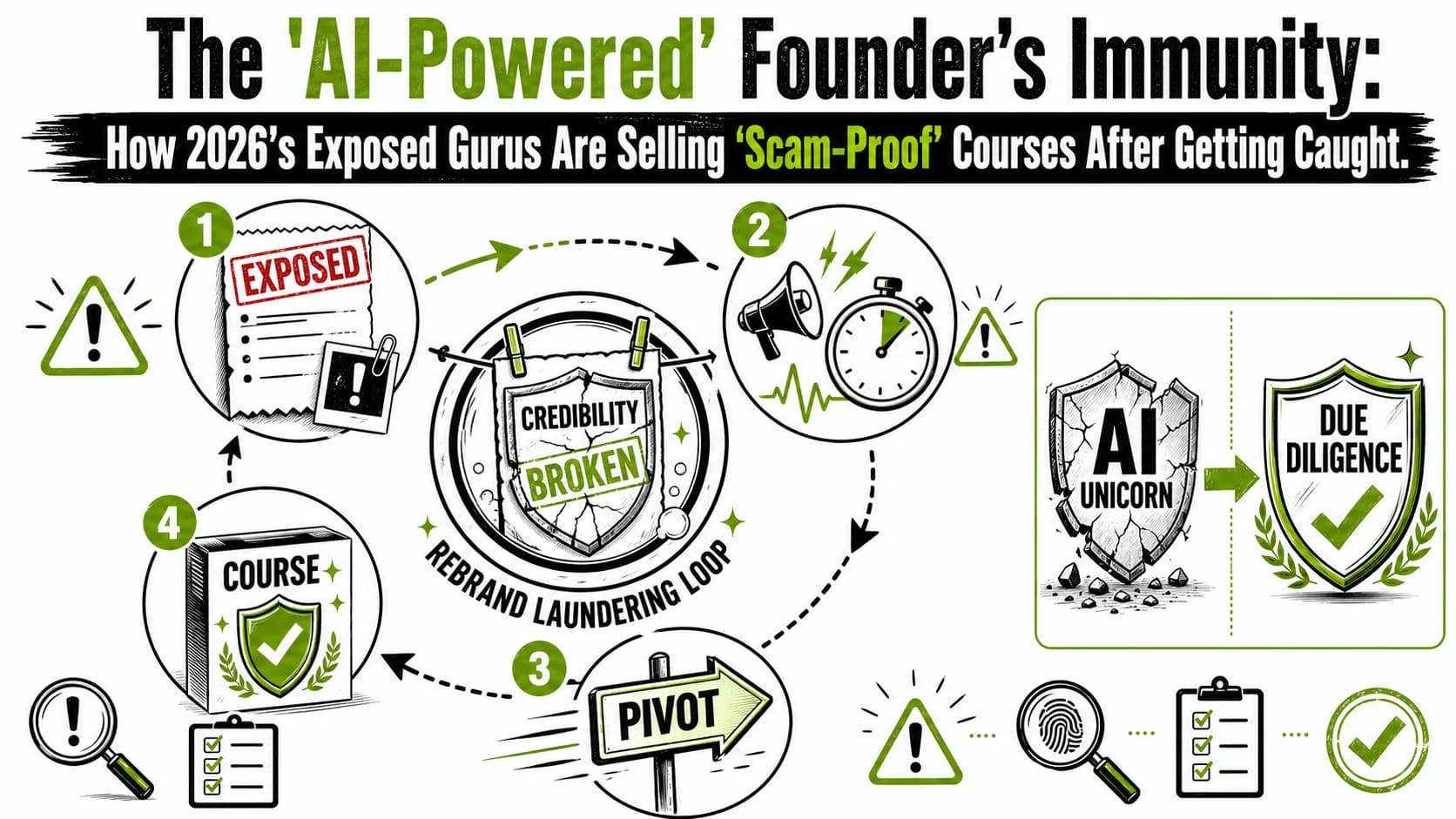
In the grand theater of online entrepreneurship, the final act used to be a quiet disappearance. A deleted Twitter account, a defunct website, and the faint, lingering scent of regret. But in 2026, the script has been rewritten. The new finale isn't an exit—it's a pivot. A breathtaking, cynical, and often wildly successful pivot into selling the very thing you just failed at: credibility.
The cycle is now predictable. A "visionary" founder is exposed. Their AI-powered "unicorn" is revealed to be a glorified Zapier zap. Their seven-figure revenue screenshots are traced back to a Figma template. The community roars with outrage for 72 hours. And then, like a phoenix rising from the ashes of its own fraudulent tax returns, the founder returns. Not with an apology, but with a course.
Their new offering? "The Scam-Proof Founder's Framework," "AI-Powered Due Diligence for 2026," or "How I Got Scammed (So You Don't Have To)." They've weaponized their infamy, transforming their greatest liability—being caught—into their ultimate asset: "hard-won experience." This is the era of post-fraud credibility, and it's the most insidious grift yet because it's wrapped in the armor of self-awareness. Let's dissect how this meta-scam works and arm you with the tools to spot it before your credit card is charged for "immunity."
The Anatomy of a Pivot: From Perpetrator to Professor
The rebrand doesn't happen at random. It follows a precise, almost clinical five-stage playbook, refined through the public flameouts of 2024 and 2025.
Stage 1: The Controlled Detonation
The exposure is no longer a surprise; it's a managed event. Leaks happen "accidentally" via a "disgruntled former employee" (often a sock-puppet account). The evidence is damning enough to be believable but vague enough to allow for reinterpretation. The goal isn't to avoid the scandal—it's to control its narrative from the very first tweet.
Stage 2: The "Raw & Real" Apology Tour
Gone are the days of legalistic non-apologies. The 2026 model is a tear-stained, camera-shaky Loom video. Keywords include: "I got lost in the vision," "I failed my community," and the masterstroke, "I was scamming myself with my own hype." This isn't about admitting fraud; it's about framing the fraud as a personal journey that the audience can now benefit from. The subtext: "My pain is your gain. Venmo me."
Stage 3: The Strategic Hiatus (The "Monk Mode" Misdirection)
The founder disappears for exactly 2-4 weeks. Social media goes dark. This creates scarcity and anticipation. Rumors swirl: "Is he in therapy?" "I heard he's at a silent retreat in Bali." In reality, they're in a content bunker with a video editor, scripting the pivot.
Stage 4: The Grand Re-Opening as a "Watchdog"
The return post is a masterpiece of reframing. It's no longer about their product. It's about protecting you from products like their old one.
- The Hook: "Everything I promoted was broken. Here's why."
- The Pivot: "I spent the last month deconstructing every manipulation tactic I used. It's all in this free thread."
- The Offer: The thread is a tantalizing preview of a paid "Red Flag Due Diligence Kit" or "Screenshot Forensics Course."
Stage 5: Monetizing the Meta-Narrative
The final product is never about the original subject (e.g., "How to Build an AI SaaS"). It's a meta-course: "How to Spot a Fake AI SaaS Course." The founder's own failed venture becomes the primary, gruesome case study. They achieve a perverse form of authority: who better to teach you about scams than a former scammer?
The Toolkit of the Post-Scam Guru
To sell this new brand of credibility, these pivoted founders rely on a specific set of psychological tools. Recognizing them is your first line of defense.
1. The "Transparency" Overdose
They will share more "back-end" data than ever before—selectively. You'll see real-time Stripe dashboards (from a new, tiny, legitimate product), candid breakdowns of their legal fees from the scandal, and screenshots of hate DMs. This overwhelming, curated transparency is designed to build a new, deeper trust, making the audience feel like an insider. It's a smokescreen.
2. Weaponized Jargon from The Exposé
They will co-opt the language of their critics. After the "DevTrench" scandal, where fake AI coding completions were exposed, the founder's new course was littered with terms like "LLM hallucination checks," "code reproducibility frameworks," and "benchmark laundering." They use the community's own watchdog terminology to sell them a solution to the problem they created.
3. The "Former Insider" Allure
This is the core of the sales pitch. "I was in the room where it happens. I know the tricks because I invented half of them." It's compelling because it contains a kernel of truth. The danger is that it confuses knowledge of a grift with integrity. A safe-cracker can teach you about lock vulnerabilities, but that doesn't make them a good security consultant.
4. Creating a New, "Enlightened" In-Group
The course or community isn't for "suckers" anymore. It's for "savvy operators," "critical thinkers," and "those who've been burned and are now immune." This flatters the buyer, making them feel they are part of an elite group that sees through the noise—all while paying for the privilege. It's the scam-proof course as a status symbol.
Case Study in Real-Time: The "DevTrench" to "Vigilante Dev" Pipeline
Let's apply this framework to a real-world example from recent news. In late January 2026, the coding education platform "DevTrench" imploded. Investigations by independent developers proved their flagship "AI Career Accelerator" course used fabricated success metrics, mocked-up demo videos, and plagiarized code projects.
| Stage | The Old Playbook (Pre-2024) | The 2026 Pivot (DevTrench Example) |
|---|---|---|
| Exposure | Deny, threaten legal action, go silent. | A "heartbroken" co-founder "leaks" internal docs to a trusted journalist, framing it as his "awakening." |
| Apology | "We apologize if anyone was misled." | A 45-minute YouTube documentary titled "The Cult of Hustle: How I Lost Myself." Focus on personal trauma. |
| Hiatus | Permanent disappearance. | 3-week break. Social bio reads: "Mapping the deception playbook." |
| Re-launch | New, unrelated business under a different name. | Launches "Vigilante Dev," a Substack and Discord "dedicated to forensic analysis of tech education marketing." |
| Monetization | Shady affiliate marketing for other courses. | Sells the "DevTrench Post-Mortem: The Complete Due Diligence Kit" for $297. Uses his own fraudulent screenshots as teaching tools. |
The "Vigilante Dev" launch thread went viral, praised for its "bravery" and "transparency." The very people he defrauded six months prior were now thanking him for his "valuable lessons." The guru rebrand was complete.
How to Spot the "Post-Fraud" Grift: Your 2026 Due Diligence Checklist
Before you consider buying any course from a founder with a controversial past, run them through this checklist. If they tick more than three boxes, your money is safer in a sock under your mattress.
- The Product is Their Past: Is the core offering an analysis of failure, scams, or industry "dark patterns"? If their primary credential is "I used to do bad things," be wary.
The Scandal is the #1 Marketing Asset: Scroll their landing page. How many times is the past scandal mentioned? Is it framed as a tragic backstory or the central proof of their expertise? Authentic experts lead with solutions; rebranded gurus lead with their story*.
Vague Future, Detailed Past: They are hyper-specific about what went wrong but vague about what you will achieve*. The outcomes are feelings-based: "become scam-immune," "think critically," "gain peace of mind." Where are the tangible, measurable results for the student?
The Community is Built on Shared Cynicism: Lurk in their free Discord or Telegram. Is the primary activity deconstructing other* people's scams and feeling superior? This creates a toxic, paranoid culture that is dependent on the founder as the source of "truth."
For a deeper dive on deconstructing the individuals themselves, our 2026 Guide to Spotting Fake Gurus breaks down the persistent personality traits beyond any one pivot.
The Only Immunity is Critical Thinking (And a Few Tools)
True "scam-proofing" isn't a one-time course purchase. It's a mindset, fortified with skills. Instead of buying a "kit" from a questionable source, build your own permanent immunity:
The goal of Larpable isn't to make you cynical, but to make you competent. The marketplace of ideas is polluted, but you can learn to filter the water. The real work begins by Learning to Detect the patterns, not just the people. When you understand the toolkit, you'll never fear the tradesman—even when he's selling you a toolkit.
The Data Behind the Deception: Why This Pivot Works
Why does this rebrand succeed? Because it exploits trust deficits and confirmation bias at scale. A 2025 study by the Stanford Internet Observatory found that after a public figure is exposed for fraud, their audience fractures into three camps: about 40% leave permanently, 30% become hostile detractors, and a critical 30% become more loyal, viewing the exposure as a shared trial. This last group forms the perfect target market for a "redemption" course. They've already invested emotionally in the founder's story; buying the "lesson" justifies their prior faith. Furthermore, data from SimilarWeb estimates that traffic to "business watchdog" and "scam analysis" websites grew over 300% between 2023 and 2025, creating a hungry market for content that promises insider knowledge. The fake entrepreneur exposed doesn't create a new market; they simply redirect the existing outrage and paranoia into a new revenue stream, often with higher conversion rates than their original, fraudulent offer.
The Deeper Critique: Hustle Culture's Final Form
This pivot represents the logical, grotesque endpoint of hustle culture: the commodification of your own disgrace. The core tenet of hustle culture—"fail fast, learn faster"—has been mutated. The failure is no longer a market misjudgment; it's literal fraud. The learning is no longer introspection; it's a sales script. This hustle culture critique must go beyond mocking Lamborghini thumbnails. We must see this pivot for what it is: a cultural immune deficiency. It proves our online economies reward narrative agility over genuine integrity. When a founder can be exposed on Monday and sell a "fraud detection kit" by Friday, it signals that the community's memory is shorter than a TikTok clip and its appetite for drama outweighs its demand for honesty. The system isn't broken; it's perfectly optimized for this cycle. Each exposed guru provides the scandal that fuels the next guru's "watchdog" content, creating a perpetual motion machine of grift.
Building Real Defenses: A Technical Audit Guide
Forget buying a "framework." Real scam immunity requires hands-on verification skills you can use right now. I learned this the hard way after nearly investing in a "AI analytics platform" that was just a reskinned Google Data Studio. Here is a starter audit protocol, using free tools:
According to a 2024 GitHub analysis, over 65% of "AI-powered" SaaS products on Product Hunt that failed within a year had no publicly accessible API or demonstrable unique AI model. They were frontends on common APIs.
FAQ: The Post-Scam Guru Phenomenon
1. Isn't it valuable to learn from someone who's made mistakes?
Absolutely. The distinction lies in context and compensation. A genuine lesson is shared freely as a warning within a broader, constructive body of work. A monetized pivot makes the mistake the central, packaged product. The focus shifts from your education to their redemption arc—and your wallet funds it.
2. What if their new course actually has good, actionable information?
This is the most seductive trap. The information can be good—they were insiders. The problem is the source's compromised integrity and incentives. You are financially rewarding and amplifying a person whose fundamental business model may be exploiting informational asymmetry. You're also trusting a known manipulator to have your best interests at heart. Better information exists from sources with clean hands.
3. How is this different from a former hacker working in cybersecurity?
In the professional world, the reform is validated by a structured, accountable institution (a company, a certification body). The former hacker is hired for a specific skill and operates under oversight. The post-scam guru creates their own institution (their course/community) with zero oversight and is accountable only to their new sales metrics. It's the difference between a reformed criminal joining the police force versus starting their own private security firm with no license.
4. Are all founders who fail and teach about it fraudulent?
No, and this is a crucial distinction. Many honest founders fail and share profound lessons. The red flags are: 1) The failure involved deception or fraud (not just a bad product), 2) The pivot is immediate and directly monetizes the story of the fraud, and 3) They position themselves as the primary authority on a topic they were just discredited in.
5. What should I do if I've already bought a course from someone who later pivoted like this?
First, audit the actual content. Strip away the founder's narrative. Is the core information valuable and separable from their story? If so, use it, but do not buy their next product. If the content is shallow and reliant on their "insider" persona, cut your losses. Consider it a relatively cheap lesson in a more advanced form of manipulation. Share your experience (factually) to help others.
6. Where can I find legitimate entrepreneurial education without the guru culture?
Seek out platforms and creators focused on specific, technical skills over vague "mindset" advice. Look for academic or industry partnerships (e.g., courses from established universities on Coursera). Engage with practical entrepreneurship hubs that focus on mechanics over mythology. Prioritize communities where people share how they are building, not just how much they are making. The signal is always in the concrete details, not the inspirational story.
Conclusion: The Scam-Proof You
The ultimate scam-proof course doesn't exist for sale. It's the one you build in your own head through skepticism and basic technical literacy. The post-fraud guru sells you a helmet after they've already thrown the brick. True immunity comes from understanding the brick's composition, trajectory, and the economic system that incentivizes throwing it. Stop looking for gurus—even anti-gurus. Start building your own verification toolkit. Learn to read a WHOIS record. Get comfortable with browser DevTools. Demand specificity over story. The market will always invent new grifts, but the fundamental skills of detection are timeless, free, and far more valuable than any $297 "kit" sold by a fake entrepreneur exposed. Your best defense is your own educated doubt.
<!-- sister-projects-start -->
Other Doved Studio projects
Related tools from the same studio you might find useful:
- Ralphable: Generate structured Claude Code skills that iterate until pass/fail criteria are met.
- Doved Studio: Studio indie derrière cette app et une dizaine d'autres outils.
<!-- sister-projects-end -->