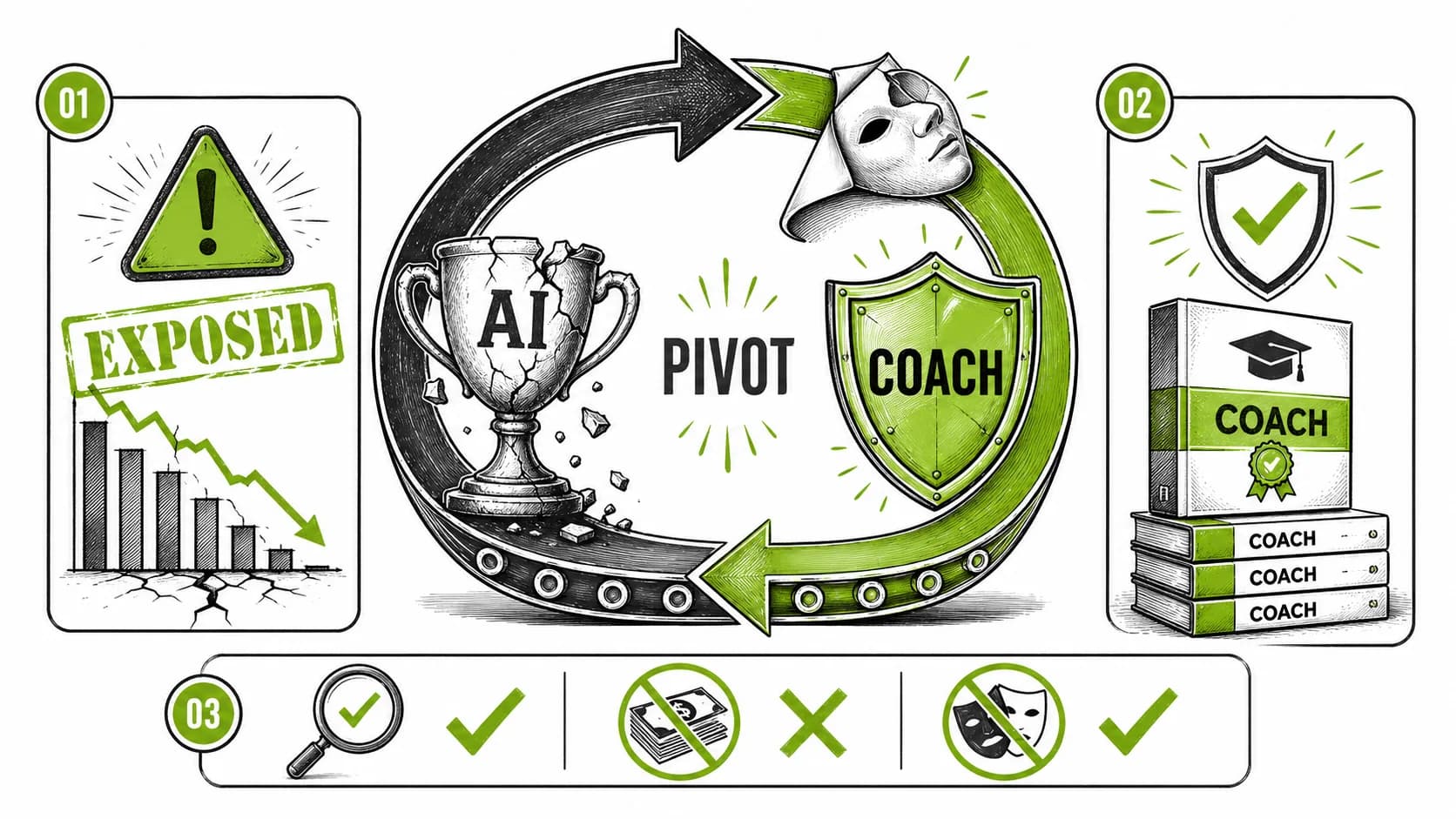
The digital graveyard of 2025 is littered with the carcasses of "AI-powered" agencies. You remember the headlines: "7-Figure AI Co-Founder Exposed for Using Stock Photos as Clients," "Automation Guru's 'Real' Case Studies Traced to Fiverr." The public shaming was swift, the deplatformings satisfying. For a brief, glorious moment, it felt like the grift was over.
But in the entrepreneurial ecosystem, nothing truly dies. It just… pivots.
Welcome to 2026, where the most brazen survival tactic has emerged from the ashes of exposed gurus: the scam coaching rebrand. The very individuals caught fabricating revenue, inventing clients, and selling vaporware are now launching "Scam-Proof Your Business" masterminds and "Detect the Grift" courses. They've weaponized their own infamy, transforming from the perpetrator into the professor of prevention. It’s the ultimate act of meta-grifting—selling you the antidote to the poison they just finished bottling.
This isn't a retreat; it's a strategic advance into a new, even more cynical market. Let's dissect how the fake entrepreneur exposed becomes the scam coaching guru, and what this tells us about the endlessly adaptable parasite of online guru culture.
From "Building in Public" to "Failing in Public" to "Coaching About Public Failure"
The playbook has evolved. The old model was simple: fake it till you make it, and if you get caught, disappear and rebrand under a new name. The 2026 model is more audacious. It follows a predictable, almost elegant, three-act structure.
Act I: The Grandiose Build
Our protagonist launches as an "AI Whisperer" or "No-Code Agency Founder." Their content is a firehose of "authentic" behind-the-scenes footage: blurred-out revenue dashboards hitting $50k MRR, Slack messages from "ecstatic clients," and screenshots of a Calendly book solid for months. They sell a course on "The System." For a detailed breakdown of how these fake revenue screenshots are crafted, our 2026 Guide to Spotting Fake Revenue Screenshots is essential reading.
Act II: The Inevitable Unraveling
A skeptical follower notices the same "client" logo in two different case studies is a stock image. A developer reverse-images a "team photo" to a Shutterstock page. The house of cards collapses on Twitter/X in real-time. The guru issues a non-apology ("I was optimizing for inspiration") and goes quiet for 4-6 weeks—the standard cocooning period.
Act III: The Phoenix (of Grift) Rises
This is where the new magic happens. The guru returns, not with their tail between their legs, but with a new, solemn mission.
The New Bio: "Former AI agency founder. Got burned by the hype. Now teaching founders how to navigate the landscape of bad actors and protect their time, money, and mental health."
The New Offer: "The Grift-Proof Framework™" – a $2,997 course that ironically teaches you to spot the exact tactics they were just using.
The New Hook: "I've been on the inside. I know all the tricks. Let me show you how they work so you'll never fall for them."
They haven't left the game; they've just switched teams mid-match and are now selling tickets to watch them play. The guru rebrand is complete.
The Toolkit of the Scam Coach: Recycling Your Own Bag of Tricks
What's inside these "scam-proofing" courses? A darkly humorous hall of mirrors. The content is often a repackaging of their old fraudulent playbook, framed as a cautionary tale.
| Their Old Tactic (As a Fake Guru) | Their New Framing (As a Scam Coach) |
|---|---|
| Fabricated Revenue Screenshots | "Module 3: Decoding the Fake MRR Dashboard – The 5 Telltale Signs of Photoshop." |
| Fake Testimonials & Case Studies | "Module 5: The Case Study Deep Dive – How to Verify Client Stories Aren't Fiction." |
| Creating Artificial Scarcity | "Live Workshop: How 'Limited-Time Offers' Are Engineered to Bypass Your Rational Mind." |
| The "Just One Simple System" | "Bonus: Deconstructing the 'Simple System' Myth – Why Over-Complexity Hides a Lack of Substance." |
The brilliance—and the utter cynicism—of this AI guru pivot is that it's almost critique-proof. If you call them out for their past, they nod sagely and say, "Exactly. I'm living proof of the danger. That's why you need my course." They've turned their greatest liability into their unique selling proposition.
It’s a masterclass in psychological jiu-jitsu, leveraging the very human tendency to believe that a reformed sinner has the deepest insight. As noted in a Harvard Business Review article on organizational trust, apologies and transparency can rebuild credibility. But these gurus skip the genuine apology and go straight to monetizing the "lesson."
Why This Pivot Works: The Psychology of Meta-Grifting
This trend isn't just a fluke; it's a symptom of a market ripe for exploitation. The scam coaching rebrand works because it taps into several powerful psychological currents.
This creates a perfect, self-sustaining meta-grifting loop. The existence of grifters creates fear, which creates a market for scam coaches, who are often just grifters who completed one cycle. It’s an ouroboros of bullshit, eating its own tail for eternity.
How to Spot a Scam Coach (Before They Charge You $3,000)
So, how do you avoid falling for the latest iteration of the grift? The principles of detection remain the same; you just need to apply them to this new wrapper. Here is your 2026 due diligence checklist:
- Audit the "Fall From Grace": Is their backstory vague? "I made some mistakes" isn't enough. A genuine reformer would likely link to the threads that exposed them, demonstrating true transparency. If they refuse to name their specific sins, they're likely sanitizing their past to sell you a fairy tale.
- Scrutinize the "Proof" of Reformation: What have they actually done to make amends? Did they refund customers from their previous scheme? Have they donated proceeds? Or did they simply wait for the heat to die down and launch a new landing page? Inaction speaks volumes.
- Analyze the New "Value": Is their new course content genuinely unique, or is it just a repackaging of common-sense advice you could find for free? Listen to their free content. If their primary "insight" is "I used to do bad things, trust me," you're being sold a story, not a skill.
Demand Verifiable, Current Results: If they're now a "legit" coach, where are the verifiable success stories from their new* venture? Not anonymous quotes, but people you can actually talk to. The shift from fake AI agency to scam coach is still a business—where is the real proof it works?
For a broader framework on vetting anyone in the online business space, our comprehensive 2026 Guide to Spotting Fake Gurus remains your best defense.
The Bigger Picture: What This Trend Reveals About "Expertise"
The rise of the scam coaching guru is the logical endpoint of a content economy that values narrative over substance and notoriety over expertise. It reveals a disturbing truth:
In the attention economy, being known for something (even something bad) is often more valuable than actually being good at something.
The traditional path to expertise—years of practice, documented success, peer recognition—has been shortcut. Now, you can achieve "expert" status simply by being a publicly documented case study of what not to do. This doesn't just pollute the pool of advice; it actively incentivizes failure and fraud as career stepping stones.
It creates a bizarre marketplace where the most reliable signal of "knowledge" is having been caught in a lie. This is why developing a keen eye for detection isn't just a nice-to-have skill; it's a fundamental literacy for operating in the modern digital world. If you want to build a real business, you need to learn to separate the signal from the noise, the builders from the performers. This is precisely why we built the tools at Larpable - Detect or Create—to give you the framework to see through the narrative and evaluate claims critically. Start by Learning to Detect the patterns before they cost you time and money.
Conclusion: Breaking the Cycle
The scam coaching pivot is ingenious, resilient, and utterly corrosive. It represents the grift's immune response to criticism, evolving to survive in a slightly more skeptical environment. It mocks the very concept of accountability by turning it into a marketing angle.
But its existence is also a sign of hope. It means public exposure is having an effect. The old playbook of "ghost and restart" is becoming less viable. The grift is being forced to innovate into ever-more-absurd contortions, which in turn makes it easier to spot for those who are paying attention.
The way to break the cycle isn't just to call out each new iteration, but to fundamentally change what we value and reward. Seek out quiet builders over loud storytellers. Value transparent processes over magical results. Pay for specific, actionable skills, not vague "insider access."
And most importantly, cultivate a mindset that is harder to grift. One that questions compelling narratives, seeks independent verification, and understands that in business—as in life—if someone's main credential is their dramatic past, you should probably just read the book, not buy the seminar.
The gurus will keep pivoting. Your best defense is to stop playing their game.
Frequently Asked Questions (FAQ)
1. What's the difference between a legitimate business coach who warns about scams and a "scam coach"?
A legitimate expert builds their authority on a track record of positive, verifiable outcomes for clients in a specific field. They teach how to do something well. A "scam coach" often builds their authority primarily on their negative past as a fraudster. Their core offering is teaching you how to avoid something, with their personal story as the main credential. Legitimate experts provide proof of success; scam coaches often use proof of past failure as their key selling point.
2. If these scam coaches are teaching real tactics to avoid, is there any value in their courses?
The information itself might sometimes be accurate (e.g., how to spot a fake screenshot), but the source and intent corrupt the value. Firstly, this information is widely available for free from ethical sources like investigative journalists, consumer protection agencies, and platforms like ours. Secondly, funding a former scammer incentivizes the very behavior you're trying to avoid. You're financially rewarding the cycle. It's better to get your information from those who have been exposing grifts, not perpetrating them.
3. Aren't some of these people genuinely reformed and trying to do good?
It's possible, but exceedingly rare and requires extraordinary evidence. Genuine reform involves public, specific accountability, making amends to those harmed, and a long period of quiet, non-monetized reflection. The immediate pivot to selling a high-ticket course based on their misdeeds is almost always a sign of a grift in a new costume. True redemption is a process, not a product launch.
4. How can I protect myself from this specific kind of meta-grift?
Apply the "Motive Test." Ask: What is this person's primary motive for telling me this story? Is it to build a narrative that makes them the essential guide, thereby creating a dependency so they can sell me something? Or is it to genuinely equip me with independent critical thinking skills? Be deeply skeptical of anyone whose central proof of expertise is their own prior unethical behavior.
5. Is this trend only happening in the "AI guru" space?
While the AI guru pivot is the most visible in 2026 due to the recent exposure wave, this pattern is endemic to all "get-rich-quick" adjacent online spaces—crypto, dropshipping, affiliate marketing, real estate "wholesaling." Any arena with low barriers to entry, high perceived rewards, and a culture of "game the system" is fertile ground for the failure-to-consultant pipeline. For more analysis across the entrepreneurial landscape, visit our Entrepreneurship Hub.
6. What should I do if I've already bought a course from someone who later rebranded as a scam coach?
First, don't blame yourself. These people are professional manipulators. Review the course material critically: separate any useful, generic information from the personal narrative used to sell it. Consider requesting a refund if the course was sold under demonstrably false pretenses regarding the instructor's background. Most importantly, use it as a learning experience to refine your own detection skills for the future.
<!-- sister-projects-start -->
Other Doved Studio projects
Related tools from the same studio you might find useful:
- Ralphable: Generate structured Claude Code skills that iterate until pass/fail criteria are met.
- Doved Studio: Studio indie derrière cette app et une dizaine d'autres outils.
<!-- sister-projects-end -->