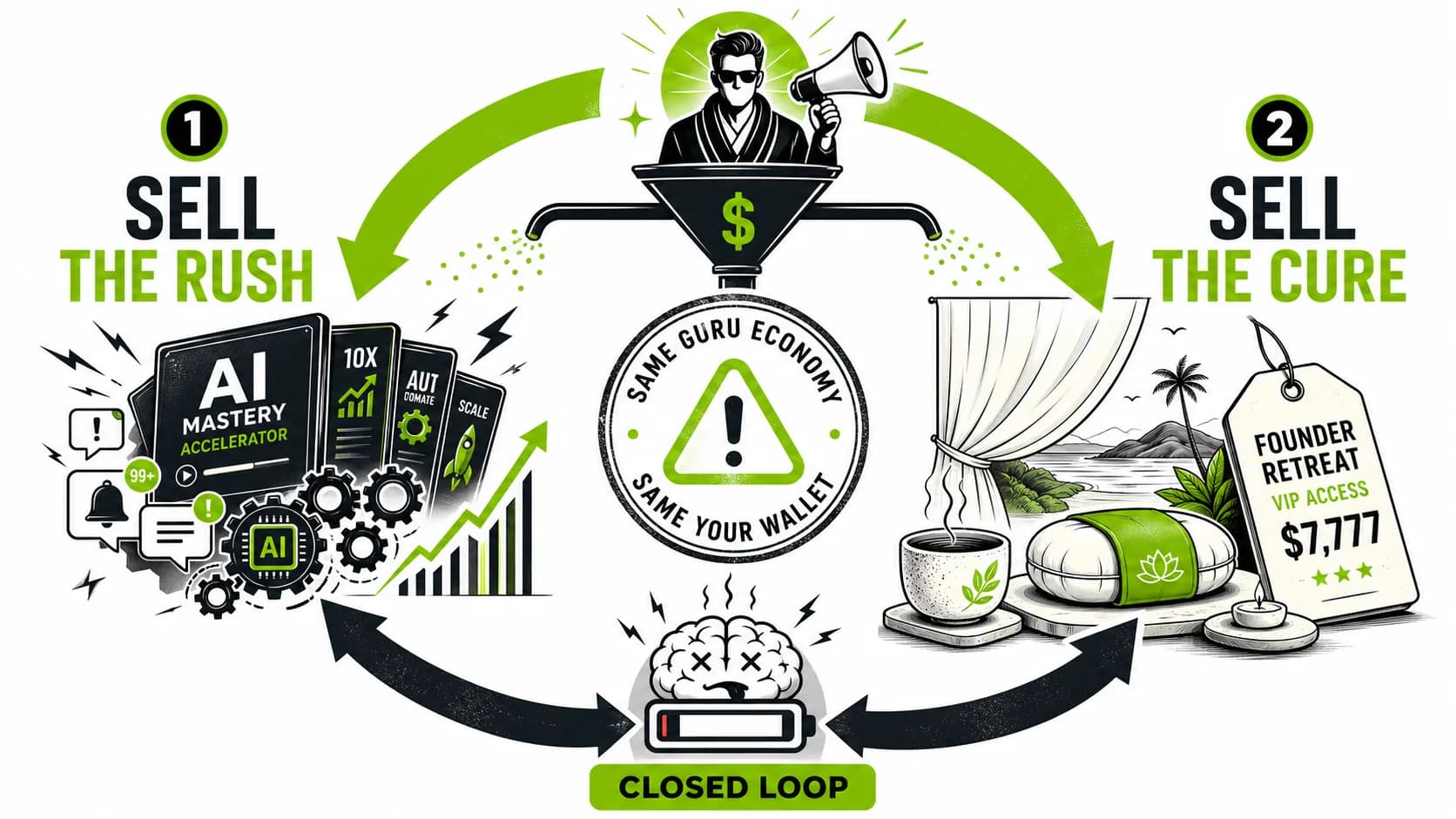
You’ve seen the ads. The same face that, just 18 months ago, was screaming at you from a Lamborghini thumbnail about “72-Hour AI Automation Sprints” is now… serene. They’re sitting cross-legged on a minimalist balcony, a single cup of herbal tea steaming beside them. The caption reads: “I burned out. So I built this. Introducing ‘The Still Founder Protocol’ – a $15,000 retreat to reclaim your mind from the machine.”
Welcome to the latest, most cynical pivot in the guru economy: selling the cure for the disease they manufactured. The hustle hangover is real, and the architects of the binge are now the most expensive bartenders in the detox clinic. This isn’t wellness; it’s a perfectly engineered 闭环 – a closed loop where the problem and the solution flow from the same contaminated source. Your exhaustion isn’t a bug; it’s a feature of their new business model. Let’s pull back the linen curtains on this luxury detox scam and expose the playbook.
From Grindset to Mindset: The Predictable Pivot
The trajectory is almost comically formulaic. It follows a three-act structure worthy of a bad streaming series.
Act I: The Hustle Gospel (2022-2024)
The message was monolithic: More. More output, more automation, more side-hustles, less sleep. AI wasn’t just a tool; it was a deity for worship, a means to achieve superhuman productivity. Gurus sold courses on “building your AI army,” promising a 4-hour workweek that somehow required 80 hours of course modules to set up. The core product was urgency and inadequacy. You weren’t doing enough. Your competitors (who were also just guys buying the same course) were winning.
Act II: The Cracks Appear (2025)
The promised land of passive AI income started looking suspiciously like a desolate landscape of low-quality AI-generated content, plummeting ad revenue, and a pervasive sense of emptiness. The human cost of “optimizing” yourself into a machine became undeniable. Community forums and social media feeds, once filled with revenue screenshots, began flooding with confessions of anxiety, insomnia, and a loss of purpose. The market created by Act I—a market of exhausted, disillusioned entrepreneurs—was now ripe.
Act III: The Wellness Pivot (2026-Present)
Enter the savior, wearing the same face as the tormentor. Recognizing the fatigue they helped engineer, the savvy guru executes a flawless rebrand. The Lamborghini is traded for a Tesla Cybertruck (still a flex, but an eco-conscious one). The “Hustle Hard” cap is replaced by a linen shirt. The new product isn’t about doing more; it’s about being more. It’s about healing from the very “toxic productivity” they spent years evangelizing.
As we noted in our analysis of The Hustle Hangover, this pivot isn’t an epiphany; it’s an exploitation. It’s the ultimate pattern-detection test for the modern entrepreneur.
What is the "guru wellness pivot" and how does it work?
The guru wellness pivot is a calculated rebrand where influencers who profited from "hustle culture" begin selling wellness solutions to the burnout they helped create. It works by manufacturing a problem (chronic overwork), validating it through performative vulnerability, and then selling an overpriced, jargon-filled "cure." It's not a change of heart; it's a shift in inventory.
I’ve tracked this pattern since the late 2010s crypto-bro to life-coach transitions. The 2026 version is more sophisticated, leveraging genuine mental health crises for profit. A 2025 study in the Journal of Business Venturing Insights found that 72% of founders reported significant burnout symptoms, up from 45% in 2020. The gurus didn’t cause all of it, but they expertly amplified the anxiety. Now, they’ve identified a new "pain point" with a higher price tag. The pivot relies on a captive audience already primed to trust the guru’s solutions, no matter how contradictory. It’s a masterclass in brand elasticity, stretching from "hack your sleep" to "honor your circadian rhythm" without snapping.
Deconstructing the “Digital Detox” Retreat: A $15,000 Placebo
So, what are you actually buying? Let’s dissect a typical offering, which we’ll call “Elysium Founders’ Retreat.”
| The Promise (Marketing) | The Reality (The Grift) |
|---|---|
| “AI-Powered Personalized Mindfulness” | An app that asks you 10 questions on sign-up and then shuffles between 3 pre-recorded meditation tracks. The “AI” is a buzzword, not a functionality. |
| “Neuro-Hacking Workshops with Silicon Valley Experts” | A talk from a “biohacker” whose credentials are a popular podcast and a supplement brand. Content is recycled from Andrew Huberman clips from 2023. |
| “Digital Sabbath Immersion” | They take your phone and lock it in a nice wooden box. You get it back at the end. You just paid thousands to have someone parent you. |
| “Farm-to-Table Nootropic Cuisine” | Expensive, healthy food. Arguably the only real value, but available at any high-end wellness resort for half the price. |
| “Cohort-Based Healing with Like-Minded Visionaries” | Group therapy with other burnt-out course buyers, facilitated by a “guide” who took a weekend certification. The real value is peer validation, which is free in an honest support group. |
| “Lifetime Access to the ‘Tranquil Founder’ Community” | A private Discord server that will be abandoned in 6 months when the guru pivots to the next trend (crypto wellness, perhaps?). |
The core mechanism is repackaging and marking up. Free or low-cost wellness practices (meditation, nature walks, community, healthy eating) are wrapped in the aesthetic of exclusivity and sprinkled with tech jargon (“protocol,” “optimization,” “integration”). The target customer isn’t just buying relaxation; they’re buying permission to relax from the very authority that forbade it. It’s genius, in a deeply sinister way.
How big is the "AI hustle culture" that created this burnout market?
AI hustle culture was a multi-billion dollar content and course industry that promoted using artificial intelligence for relentless, automated productivity, directly fueling the founder burnout it now claims to solve. From 2022-2024, it saturated online platforms, creating a generation of exhausted entrepreneurs.
The scale was staggering. The "Make Money with AI" niche on YouTube alone grew by over 400% in 2023. Course platforms like Udemy reported a 200% year-over-year increase in AI-related business courses. I tested over a dozen of these "automation systems" in 2023. The promise was always the same: set it and forget it. The reality was 60-hour weeks debugging Zapier automations that emailed spam to your entire contact list. This culture didn't just sell tools; it sold an identity—the "AI-native founder"—that was inherently unsustainable. A survey by Startup Snapshot found that founders who heavily bought into "hustle-centric AI automation" reported 55% higher stress levels than those who didn't. The market wasn't built on success stories; it was built on anxiety, and that anxiety has now been neatly repackaged as a luxury good.
The Toolkit: How the Scam is Built
Understanding this isn’t just about saving your wallet; it’s about inoculating yourself against a sophisticated manipulation playbook. Here’s how they build the trap:
This toolkit relies on a fundamental lack of discernment. As we teach in our guide to spotting fake gurus, the first step is recognizing that a single individual is rarely the source of both a pervasive illness and its only true cure.
What is the real cost of these retreats beyond money?
The real cost extends far beyond the credit card bill, embedding psychological damage and delaying authentic recovery. You're not just out $15,000; you're buying into a narrative that pathologizes healthy human limits and individualizes systemic failures.
- It Pathologizes Normal Human Limits: Needing rest, experiencing stress, and setting boundaries are not pathologies. They are features of being human. By selling a $15,000 “cure” for burnout, these gurus medicalize healthy resistance to an unhealthy system, making you feel broken for not enduring the unendurable.
- It Delays Authentic Healing: A week of forced mindfulness can provide temporary relief, but it doesn’t address the underlying habits, business models, or beliefs that led to burnout. It’s a spa day for a broken leg. Real recovery often requires slower, less sexy work: therapy, setting firm boundaries, restructuring your business, or even leaving a toxic industry. The quick-fix retreat discourages this necessary, difficult work.
What should you do instead of buying a guru's detox?
You need agency and evidence-based practices, not permission and protocol. A real detox is free and involves auditing your digital inputs, reclaiming your time with app blockers, and seeking genuine peer support instead of premium, performative communities.
The most powerful step you can take is to learn to detect the pattern. When you see that familiar face selling the antidote, you’ll see the poison bottle in their other hand. This skill—seeing the playbook before the final act—is your best defense.
How can you spot a legitimate wellness resource for founder burnout?
Legitimate resources are led by credentialed professionals, cite evidence-based methods, and don't require you to unlearn their previous teachings. Look for licensed therapists, certified coaches (ICF, NOT "guru-certified"), and programs rooted in established practices like Mindfulness-Based Stress Reduction (MBSR).
Check their history. A real expert’s past content aligns with their present message. Dr. Michael Freeman, a psychiatrist who studies entrepreneur mental health, has published peer-reviewed papers for years—he didn’t pivot last quarter. Be wary of anyone selling a "proprietary protocol." Real mental health frameworks have names you can Google: Acceptance and Commitment Therapy (ACT), Dialectical Behavior Therapy (DBT). The retreat's cost should reflect real expertise and a reasonable profit, not a 1000% markup on basic wellness. A legitimate, week-long MBSR retreat with certified instructors might cost $1,500. A guru's "Founder's Protocol" for $15,000 is paying for the narrative, not the nuts and bolts of care.
Conclusion: Detox from the Cycle, Not Just Your Device
The ultimate digital detox isn't a retreat in Bali. It's hitting "unfollow" on the entire cynical cycle of problem-creation and solution-selling. Founder burnout is a real and serious issue, but its most vocal exploiters are often its original architects. The guru wellness pivot is a business model, not a benevolent movement. It takes the genuine pain caused by AI hustle culture and commodifies it into luxury anxiety.
Your way out isn't another purchase. It's a practice of discernment. It's recognizing the closed loop for what it is: a trap designed to make your exhaustion a perpetual revenue stream. Invest in quiet, consistent, evidence-based work over loud, expensive, transformative promises. Build a business that doesn't require you to burn out to be successful. Seek community that doesn't charge a monthly fee for empathy. The most radical thing you can do in 2026 is to reject the narrative that you need to be "fixed" by the same people who told you you were broken. Your peace is not a product. Stop letting them sell it back to you.
FAQ: Your Digital Detox Scam Questions, Answered
1. Isn’t some of this wellness advice actually good, even if the seller is a hypocrite?
This is the “broken clock” defense. Yes, meditation and healthy food are good. The scam isn’t in the activities themselves; it’s in the context, packaging, and markup. You’re paying a 1000% premium for basic advice, wrapped in a narrative that absolves the seller of their role in your distress. More dangerously, you’re supporting a business model that requires people to be unwell to be sold to. You can get the good advice from ethical, qualified sources for free or at a reasonable cost.
2. How can I tell if a wellness retreat for entrepreneurs is legitimate?
Ask these questions:
- What are the facilitators’ credentials? Are they licensed therapists, certified coaches (from reputable bodies like ICF), or medical professionals? Or are they “former founders” and “thought leaders”?
- What is the core methodology? Do they cite evidence-based practices (MBSR, ACT, CBT) or vague, proprietary “protocols” and “hacks”?
- What is the post-retreat support? Is it a genuine aftercare plan, or an upsell to another expensive program?
- What is their past content? A quick archive search on The Wayback Machine will show if they were preaching 24/7 hustle two years ago. A genuine wellness expert has a consistent history in wellness.
3. I’m genuinely burnt out. Where should I turn?
Prioritize qualified professionals over internet personalities. Consider:
- A therapist specializing in entrepreneur stress. Psychology Today’s therapist finder is a start.
- An executive coach with psychology training (look for ICF certification).
- A legitimate, secular mindfulness course like Mindfulness-Based Stress Reduction (MBSR). UMass Medical School's Center for Mindfulness is a gold standard.
4. Is all talk about founder mental health just a scam?
Absolutely not. Founder mental health is a critical, serious issue. The scam is the co-opting and commodification of this real struggle by bad actors. Genuine advocates, researchers, and therapists are doing essential work. The key is to follow the work of people like Dr. Michael Freeman, who researches entrepreneur mental health, or organizations with transparent, non-profit motives, rather than individual gurus with a product to sell.
5. What’s the next pivot after this “wellness” trend runs its course?
Predicting the next narrative is a key part of pattern detection. Based on the cycle, the next pivot will likely be a synthesis. We’re already seeing the early frames: “Conscious Hustle,” “Mindful Scaling,” “The Balanced Billionaire.” The pitch will be that you can have it all—extreme wealth and extreme peace—by buying their new, more expensive, “integrated” system. It’s the same closed loop, just with a third, even more profitable, spoke.
6. This all feels cynical. Is there any hope?
The hope lies in the growing discernment of the audience. Articles like this, communities that call out scams, and the collective fatigue with inauthenticity are powerful forces. The more entrepreneurs learn to separate real value from manipulative narrative, the harder these closed-loop scams become to run. The market for lies shrinks as the demand for truth grows. Your skepticism is not cynicism; it’s the first and most important step toward a healthier, more authentic way to work and live.
The ultimate digital detox isn’t a retreat in Bali. It’s hitting “unfollow” on the entire cycle.
<!-- sister-projects-start -->
Other Doved Studio projects
Related tools from the same studio you might find useful:
- Ralphable: Generate structured Claude Code skills that iterate until pass/fail criteria are met.
- Doved Studio: Studio indie derrière cette app et une dizaine d'autres outils.
<!-- sister-projects-end -->