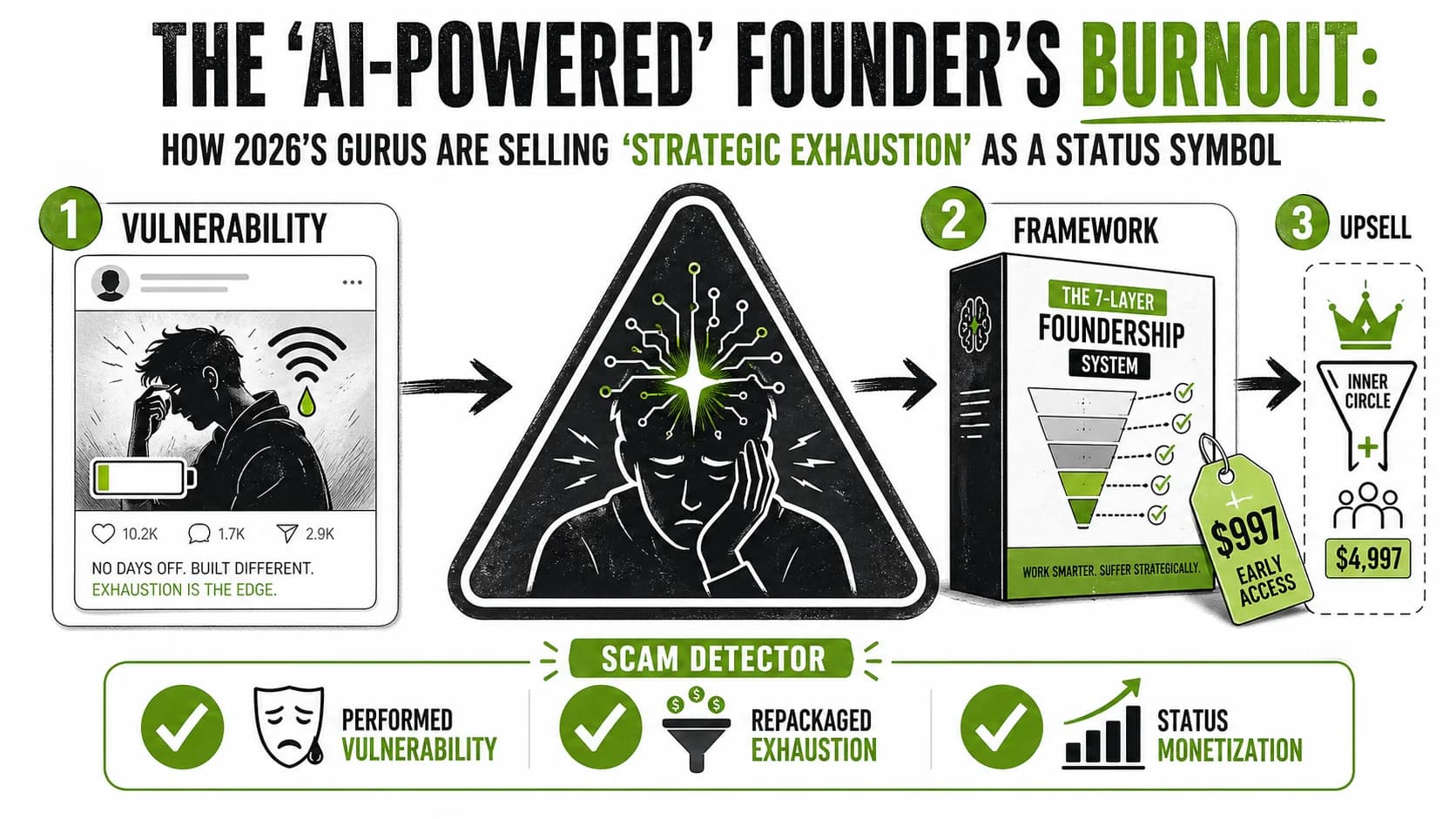
In early 2026, a new genre of founder content began to dominate social feeds. It wasn't the usual "I made $100K in 24 hours" flex. It was something more intimate, more vulnerable. A grainy, late-night video of a founder, eyes hollow, admitting they were "running on fumes." A long-form post detailing a "complete system collapse" after pushing for 18 months straight. The comments would flood in with support: "So brave," "Thank you for your transparency," "This is the real founder journey."
Then, like clockwork, the pivot. A week later, the same founder would announce a new offering: The Strategic Exhaustion Framework™, a $2,500 course on how to "engineer controlled burnout for maximum growth acceleration." The vulnerability wasn't a cry for help; it was a meticulously crafted lead magnet. Burnout, the very ailment the anti-hustle culture movement rallied against, had been rebranded, weaponized, and sold back to us as a premium feature. Welcome to the era of Strategic Exhaustion.
This article is your field guide to this insidious new grift. We'll dissect the playbook, expose the tactics, and arm you with the tools to see through the performance. Because in 2026, the most dangerous gurus aren't the ones selling you endless energy—they're the ones selling you the aesthetic of depletion as the ultimate status symbol.
From Pathology to Premium: The Rebranding of Burnout
For years, "burnout" was a dirty word in the entrepreneurial lexicon. It signaled weakness, poor planning, an unsustainable model. The wellness and mental health advocacy of the late 2010s and early 2020s fought hard to destigmatize it, framing it as a systemic issue, not a personal failing.
The guru industrial complex, ever adaptive, saw an opportunity. If burnout was now a recognized, almost universal experience among high-performers, why not claim mastery over it? Why not frame it not as a failure, but as a deliberate phase in a grand strategy?
Thus, Strategic Exhaustion was born. The core sales pitch is a masterclass in cognitive dissonance:
The linguistic shift is crucial. "Burnout" is passive, something that happens to you. "Strategic Exhaustion" is active, something you do to yourself. It transforms a victim into a visionary. It's hustle culture's final, most cynical evolution: monetizing the backlash against itself.
The Strategic Exhaustion Guru Playbook: A 5-Step Breakdown
How do you spot this grift in the wild? Let's break down the common playbook, step-by-step. Think of this as your decoder ring for the latest wave of entrepreneurial larping.
Step 1: The "Glamorous Breakdown" Content Pillar
The grift begins with content that mimics vulnerability but is staged for maximum impact. This isn't a private struggle; it's a public performance.
- The Aesthetic: Dim lighting, a single desk lamp, a half-empty glass of something that looks like whiskey (but is probably apple juice). The founder is unshaven or wearing yesterday's clothes. The video is slightly out of focus, conveying "I'm too exhausted for proper production value."
- The Script: They don't say "I need help." They say, "I've been pushing the envelope, and the envelope pushed back." They talk about "reaching the edge of my current operating system" and "intentionally depleting my cognitive reserves to force a rewrite."
- The Hook: The post always ends with a teaser: "I'm learning so much from this forced reset. Maybe I'll share the framework if there's interest." Cue hundreds of comments begging for the "framework."
Step 2: The "Philosopher of Pain" Persona Build
In the days following the breakdown post, the guru transitions into a philosopher of human limits. They share quotes from Stoicism, extreme athletes, and Silicon Valley lore.
- Content Themes: "What Navy SEALs teach us about deliberate suffering." "The J-curve of growth: why you must break down before you break through." They co-opt legitimate concepts like stress inoculation and hormesis (the idea that a little stress makes you stronger) and stretch them beyond recognition to justify working yourself into the ground.
- Jargon Deployment: They'll use phrases like "cognitive overclocking," "emotional debt cycles," and "strategic recovery windows." The goal is to sound like they've discovered a new branch of neuroscience, not that they ignored basic work-life balance.
Step 3: The "Proprietary Framework" Launch
This is the pay-off. The "interest" was gauged, and "due to overwhelming demand," they've hastily packaged their experience.
The Offer: A high-ticket course ($1,500-$5,000), often called a "Mastermind" or "Protocol." Titles include The Strategic Depletion Method, The Burnout Catalyst Course, or Controlled Exhaustion for Exponential Gains*.
- The "Science": The sales page will feature a ridiculous diagram—usually a cyclical graph with phases like "Aggressive Accumulation," "Planned Depletion," "Strategic Collapse," and "Quantum Recovery." It will be adorned with fake equations and references to non-existent studies. For a deeper dive into decoding these fake expert frameworks, see our 2026 Guide to Spotting Fake Gurus.
- The Testimonials: From "previous cycle participants" (who are often just other gurus in the same circle) saying things like, "I used to fear burnout. Now I schedule it quarterly. My revenue is up 300%."
Step 4: The "Recovery Performance"
After the launch, the guru must demonstrate the "recovery" phase of their own cycle. This is where the productivite porn returns, but with a new twist.
- The Narrative: "After my intentional depletion phase and applying my own Quantum Recovery protocols, I'm back—and operating at a level I didn't know was possible." They'll post screenshots of insane productivity (using tools often discussed in our /blog/hub-productivite section), but now it's "sustainable" and "cyclical."
Step 5: The Ecosystem Expansion
A single course isn't enough. Strategic Exhaustion becomes a brand.
- Upsells: A "Peak Depletion" retreat for $10,000. A "Recovery Optimization" supplement line (partnering with a shady wellness brand). A certification program so acolytes can teach the method themselves.
- Community: A private forum where members compete over who is more "strategically exhausted," sharing stories of all-nighters as badges of honor, now validated by the guru's philosophy.
The Real Cost: Why This Grift is Especially Toxic
This trend isn't just silly; it's socially dangerous. It actively sets back genuine mental health progress in the entrepreneurial world.
How to Spot a "Strategic Exhaustion" Grifter: Your Detection Toolkit
Arm yourself with skepticism. Here are the red flags:
- The Pivot is Predictable: Breakdown content → "I've learned so much" → product launch in under 10 days. Real recovery and integration take time and quiet. Monetizable insights that fast are scripted.
- They Glamorize the Low Point: Pay attention to the aesthetic. Is the "breakdown" shot like a moody indie film poster? That's a production, not a moment of despair.
- They Use Science as a Prop: Look for misapplied or pseudo-scientific terms. If they're talking about "neurochemical debt" or "cellular exhaustion cycles" without citing real, accessible research (like that from the American Psychological Association or Mayo Clinic), they're making it up.
- The Before/After is Extreme: Their "post-recovery" state isn't just "feeling better." It's "operating at a quantum level 10X beyond my old self!" This is a fantasy sold to make the painful "middle" seem worth it.
The single most important skill you can develop is the ability to Apprendre à Détecter the patterns. Separate the human experience from the sales funnel.
What to Do Instead: A Realist's Guide to Limits
Reject the binary of "hustle 24/7" or "engineered collapse." Embrace the boring, sustainable middle.
The greatest rebellion against the guru economy in 2026 isn't another course. It's the quiet, steadfast commitment to being a human being who works, rests, and thrives without turning their pain into a product. Don't buy the burnout. See through the performance.
FAQ: Strategic Exhaustion & The Guru Grift
What's the difference between someone genuinely sharing a burnout story and a "Strategic Exhaustion" grifter?
The key difference is intent and trajectory. A genuine story focuses on the experience, the lessons about personal limits, and often points to universal, accessible solutions (therapy, rest, setting boundaries). The narrative is about healing. A grifter's story is a narrative funnel. The burnout is framed as a unique, strategic event, the "lessons" are proprietary, and the story inevitably arcs toward selling you the exclusive solution to the problem they just dramatized. Watch the timeline: genuine recovery is slow and private; a grifter's "recovery" is fast and public, perfectly timed to a launch.
Are concepts like "stress inoculation" or "periodization" from sports science totally bogus?
No, that's what makes this grift pernicious—it hijacks real concepts. Stress inoculation (building resilience by managing increasing stress) and periodization (cycling training intensity) are valid in psychology and athletics. The grift misapplies them by removing all guardrails, context, and recovery emphasis. An athlete's "overreaching" phase is meticulously planned, monitored, and followed by mandated rest. A guru's "strategic exhaustion" is often just chronic overwork glorified with scientific jargon, with "recovery" sold as an optional upsell.
I'm feeling burned out. How do I know if I need real help vs. a "performance protocol"?
If you're asking this question, you almost certainly need real help, not a protocol. Here's a simple filter: Does the proposed solution address the root cause, or just the symptoms? A protocol will give you a new schedule, new biohacks, and a new mindset to "optimize" your exhaustion. Real help (therapy, coaching, medical advice) will ask why you got exhausted: unsustainable workload, poor boundaries, misplaced identity, lack of delegation. Treating burnout like a performance problem to be optimized is like trying to fix a broken leg by learning a new way to run. Address the break first.
Why is this trend popping up now in 2026?
The guru market is saturated with "get rich quick" and "build in public" advice. Audiences are increasingly skeptical. Vulnerability and "anti-hustle" narratives gained traction as a backlash. Adaptive grifters have simply co-opted the language of that backlash. Selling "exhaustion as strategy" is the ultimate pivot: it makes the critic (of hustle culture) into the customer, it seems counter-intuitive and therefore "advanced," and it taps into the very real, widespread pain of founders to create a new, premium solution. It's a market correction within the scam economy.
What are the real, non-monetized alternatives to dealing with founder stress?
Focus on fundamentals, not frameworks:
- Therapy/Counseling: Specifically with someone who understands entrepreneurial stress.
- Operational Fixes: Hiring, delegating, killing unprofitable projects, automating tasks. Often, burnout is a business model problem, not a personal one.
- Lifestyle Medicine: Prioritizing sleep, nutrition, and exercise not for "biohacking" but for basic health.
- Digital Detox: Literally scheduling time away from the very platforms where these grifts thrive.
How can I protect my team from falling for this or having it used to justify overwork?
Create a clear cultural firewall. State explicitly that burnout is a sign of systemic failure, not individual grit. Celebrate sustainable pacing and model it as leadership. If you hear jargon like "strategic depletion" or "planned exhaustion" in planning meetings, call it out: "That sounds like a fancy term for overworking. Let's talk about realistic timelines and resources instead." Protect your team's time and mental health as a core business priority, not as a phase in a growth cycle.
Summary: The Grift in One Table
| Genuine Burnout | Strategic Exhaustion Grift |
|---|---|
| Private struggle, slow recovery | Public performance, fast pivot to product |
| Solution: therapy, rest, boundaries | Solution: $2,500 course, proprietary framework |
| Narrative: "I need help" | Narrative: "I engineered this for growth" |
| Outcome: healing, sustainable change | Outcome: guru gets richer, you stay exhausted |
| Science: cited, accessible research | Science: fake equations, misapplied jargon |
The Bottom Line
Founder burnout is real. It's not a badge of honor. It's a signal that something is broken—in your business, your habits, or your support system. The guru monetization of this pain is the mental health grift of 2026. Don't fall for it. The most radical thing you can do is rest without selling the story.
<!-- sister-projects-start -->
Other Doved Studio projects
Related tools from the same studio you might find useful:
- Ralphable: Generate structured Claude Code skills that iterate until pass/fail criteria are met.
- Doved Studio: Studio indie derrière cette app et une dizaine d'autres outils.
<!-- sister-projects-end -->