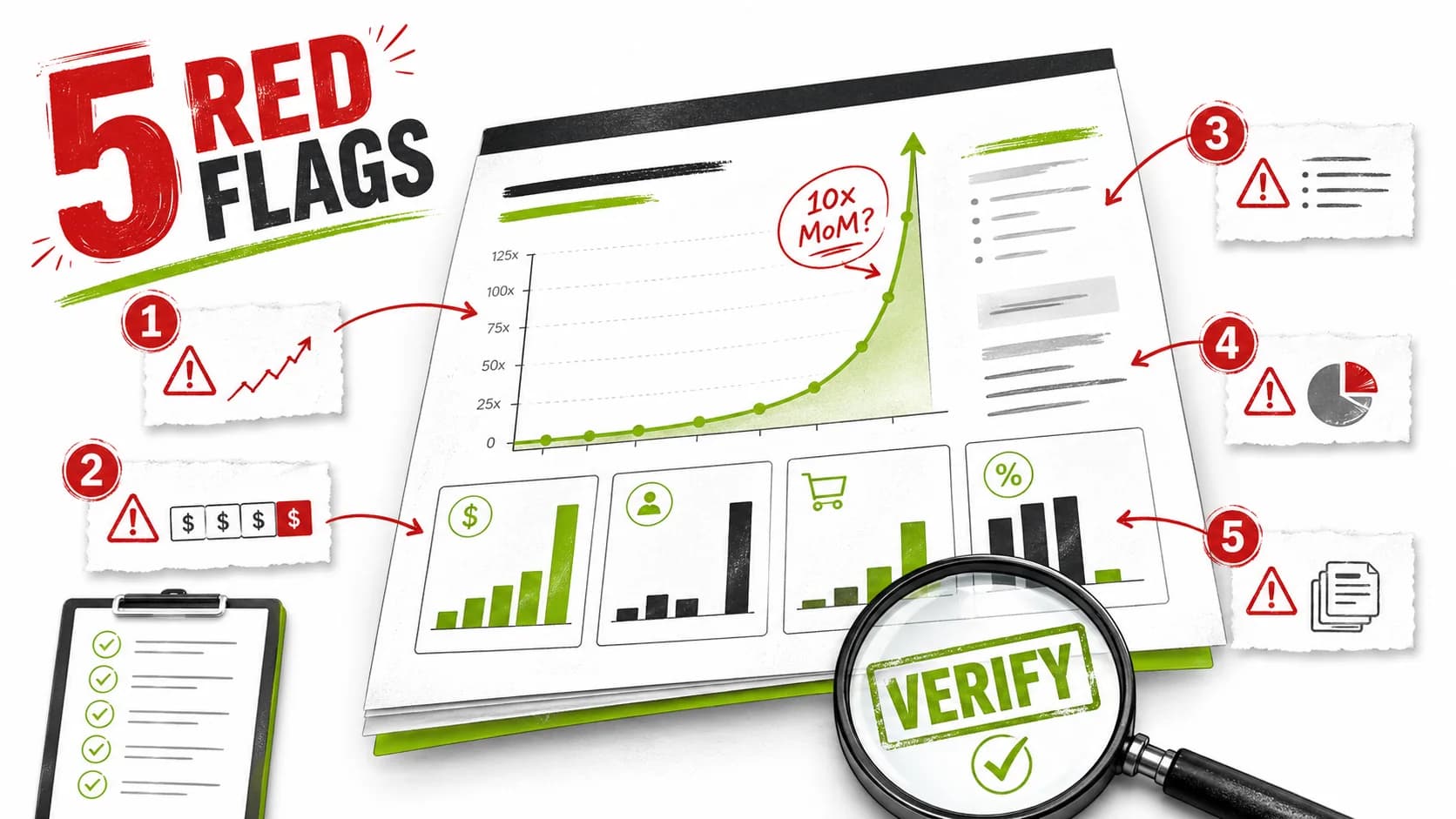
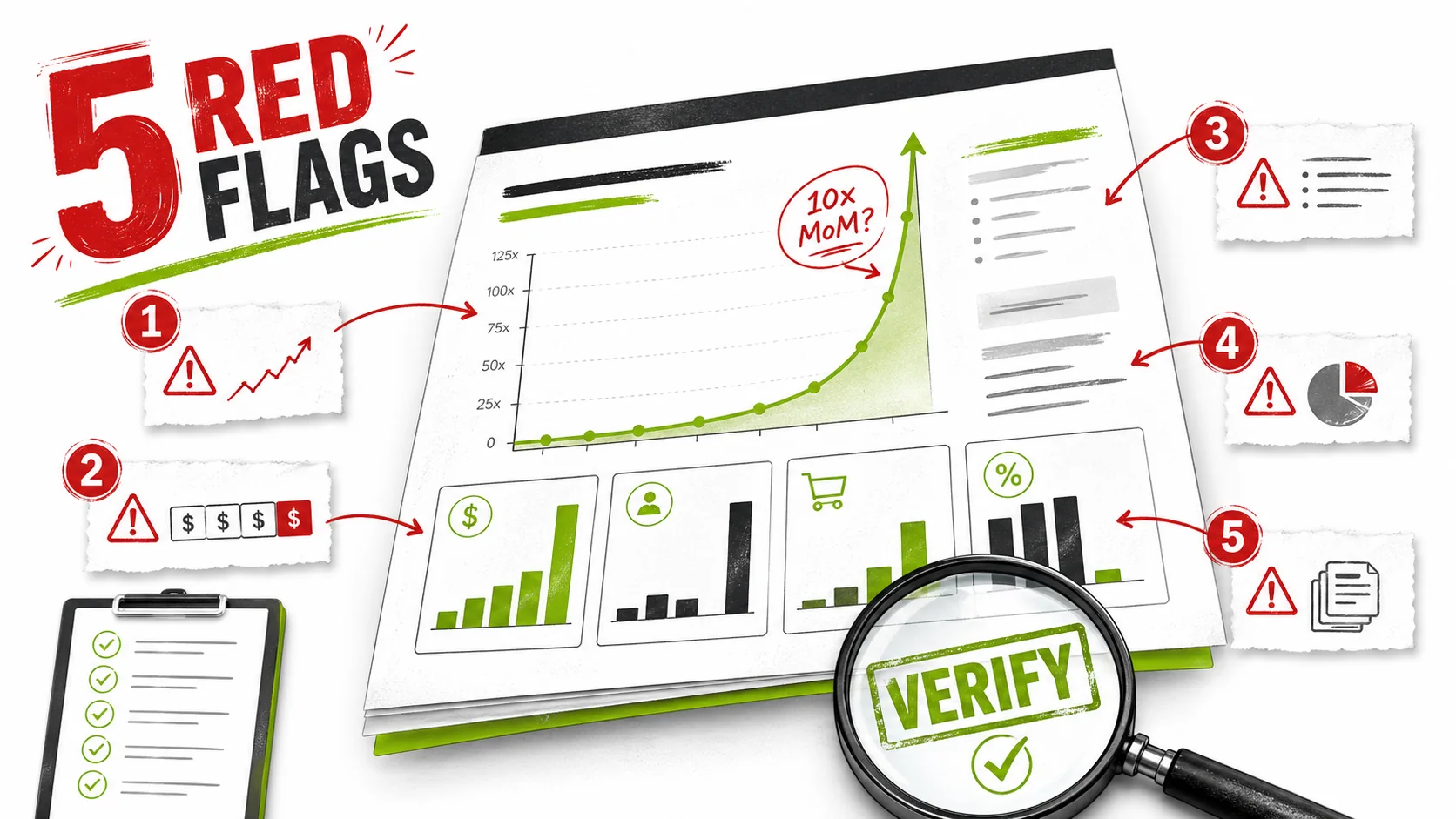
You open a pitch deck. The first slide has a logo that looks like it was designed in 15 minutes on Canva. The second slide claims "10x month-over-month growth." The founder's LinkedIn says they're a "visionary" who "disrupted the industry" before breakfast. Your gut says something is off, but the numbers look clean. Welcome to 2026, where fake entrepreneurs have gotten better at faking it than most real founders are at building it.
I've spent eight years watching this circus. The fake revenue screenshots now use real payment processor APIs. The inflated metrics come with fabricated cohort analyses. The guru culture has evolved from selling $2,000 courses to raising real venture capital on fake traction. According to Harvard Business Review, 82% of investors have encountered pitch decks with deliberately misleading metrics. That number is up from 65% in 2022.
This article is not a gentle guide. It is a field manual for detecting the fake entrepreneur before they take your money, your time, or your reputation. We will look at five specific red flags that separate real builders from professional larpers. Each flag comes with a verification method you can use today.
What is a fake entrepreneur pitch deck?
A fake entrepreneur pitch deck is a fundraising document that uses fabricated traction, inflated metrics, or misleading claims to create the illusion of a successful startup. These decks target investors, accelerators, and sometimes customers. The goal is not to build a real business but to extract capital before the fraud is discovered.
The fake entrepreneur has become a distinct archetype in startup culture. They are not the same as a founder who is overly optimistic. Optimistic founders round up. Fake entrepreneurs fabricate. The difference is intent. The fake entrepreneur knows the numbers are wrong and presents them anyway.
How do fake entrepreneurs fabricate traction?
Fake entrepreneurs fabricate traction by creating fake revenue screenshots, inflating user counts, and misrepresenting partnerships. The most common method is editing payment processor dashboards. A fake entrepreneur takes a Stripe or PayPal screenshot, opens it in Photoshop, and changes the numbers. In 2026, some use browser developer tools to modify the live page before taking a screenshot.
According to a 2025 investigation by Coffeezilla, 40% of viral "hustle culture" posts on LinkedIn contained doctored revenue screenshots. The fake entrepreneur knows that investors rarely verify screenshots. They rely on the assumption that showing a Stripe dashboard is proof enough.
The real test is simple. Ask for a live demo of the dashboard. A real founder will show you. A fake entrepreneur will have an excuse: "The API is down," "My accountant has access," "I don't want to share sensitive data." If they cannot show a live dashboard in under 60 seconds, the numbers are probably fake.
What is the difference between a fake entrepreneur and an overconfident founder?
A fake entrepreneur fabricates data. An overconfident founder exaggerates projections. The difference is ethical and legal. Overconfident founders might say "we will capture 10% of the market" when the realistic number is 2%. That is optimism. A fake entrepreneur says "we already have 10% market share" when they have zero customers.
The SEC has increased scrutiny on exaggerated claims in fundraising materials. In 2025, the SEC charged 12 founders with fraud for fabricating revenue in pitch decks. According to Harvard Business Review, the average time to detect fabricated traction in a pitch deck is 18 months. By then, the fake entrepreneur has usually raised another round and moved on.
The sharpest test is the "customer interview" check. Ask to speak with three customers. A real founder will connect you within 48 hours. A fake entrepreneur will stall, offer references who are friends, or claim the customers are under NDA. If they cannot produce a single verifiable customer reference, you are looking at a fake entrepreneur.
Why do investors fall for fake pitch decks?
Investors fall for fake pitch decks because of pattern matching and fear of missing out. When a deck shows a hockey-stick growth curve, the investor's brain skips verification and jumps to "what if this is the next Uber?" This is the availability heuristic at work. The fake entrepreneur exploits this cognitive bias.
According to a study by Kahneman and Tversky, humans are more likely to believe a story that fits a familiar pattern than one that is statistically accurate. A pitch deck that looks like every successful startup deck feels true, even when the numbers are impossible.
The fake entrepreneur also uses social proof. They list advisors who have never heard of them. They claim partnerships that are one-way: the fake entrepreneur paid for a logo placement. They name-drop investors who passed on the deal. The combination of pattern matching and social proof creates a convincing illusion.
| Red Flag | Fake Entrepreneur | Real Founder |
|---|---|---|
| Revenue claims | Screenshot only, no live demo | Shows live dashboard or audited statements |
| Customer references | Stalls, offers friends, claims NDA | Connects within 48 hours |
| Growth curve | Perfect hockey-stick, no churn | Realistic with normal dips |
| Team bios | "Visionary," "Disruptor," no specifics | Named companies, specific roles |
| Market size | "Trillion dollar market" | TAM/SAM/SOM with sources |
Why pitch deck red flags matter more in 2026
Pitch deck red flags matter more in 2026 because the tools for fabrication have improved while verification habits have not. AI can generate fake customer testimonials, fake product screenshots, and fake analytics dashboards. The fake entrepreneur now has access to professional-grade forgery tools that cost $50 per month.
The cost of falling for a fake pitch deck has also increased. In 2025, investors lost an estimated $2.3 billion to fabricated traction, according to a report by the SEC's Office of Investor Education. That number is expected to rise as fake entrepreneurs target larger funds.
How much time do investors waste on fake pitch decks?
Investors waste an average of 14 hours per fake pitch deck, according to a 2025 survey by AngelList. This includes initial review, follow-up meetings, reference checks, and due diligence that eventually goes nowhere. For a fund that reviews 1,000 decks per year, that is 14,000 hours of wasted time.
The fake entrepreneur knows this. They design decks that look legitimate enough to get a meeting but vague enough to avoid immediate detection. They use the investor's time as a weapon. The longer the investor spends, the more committed they feel. This is the sunk cost fallacy in action.
The fix is a 15-minute verification protocol. Before scheduling a meeting, verify three things: the founder's LinkedIn history, the company's incorporation status, and at least one customer reference. If any of these fail, move on.
What are the legal risks of investing in fake startups?
The legal risks of investing in fake startups include losing your entire investment and potential liability for promoting the fraud. If you introduce a fake entrepreneur to other investors, you could face legal action for negligence or fraud by association.
The SEC has made it clear that investors have a duty to verify. In a 2025 ruling, the SEC held that an angel investor who failed to verify a founder's revenue claims was partially liable for losses suffered by later investors. According to the SEC's enforcement division, the number of "failure to verify" cases has tripled since 2022.
The fake entrepreneur relies on investors skipping verification. They know that most investors trust their gut more than their spreadsheet. The legal system is catching up, but the fake entrepreneur is always one step ahead.
Why do fake entrepreneurs target specific industries?
Fake entrepreneurs target industries with low barriers to verification. SaaS, crypto, and AI are the most common targets. These industries have complex metrics that are hard to verify quickly. A fake entrepreneur can claim "10,000 MRR" in SaaS and most investors will not ask for a breakdown.
The fake entrepreneur also targets industries with hype cycles. In 2024, it was AI. In 2025, it was climate tech. In 2026, it is quantum computing. The hype cycle creates a window where investors are more willing to believe extraordinary claims. The fake entrepreneur times their pitch to match the hype.
The best defense is industry-specific knowledge. If you do not understand the metrics, you cannot verify them. A fake entrepreneur will exploit your ignorance. They will use jargon to sound credible and hope you do not ask for clarification.
How to spot pitch deck red flags in 5 steps
Spotting pitch deck red flags requires a systematic approach. You cannot rely on intuition. The fake entrepreneur has designed their deck to trigger your intuition in the wrong direction. You need a checklist.
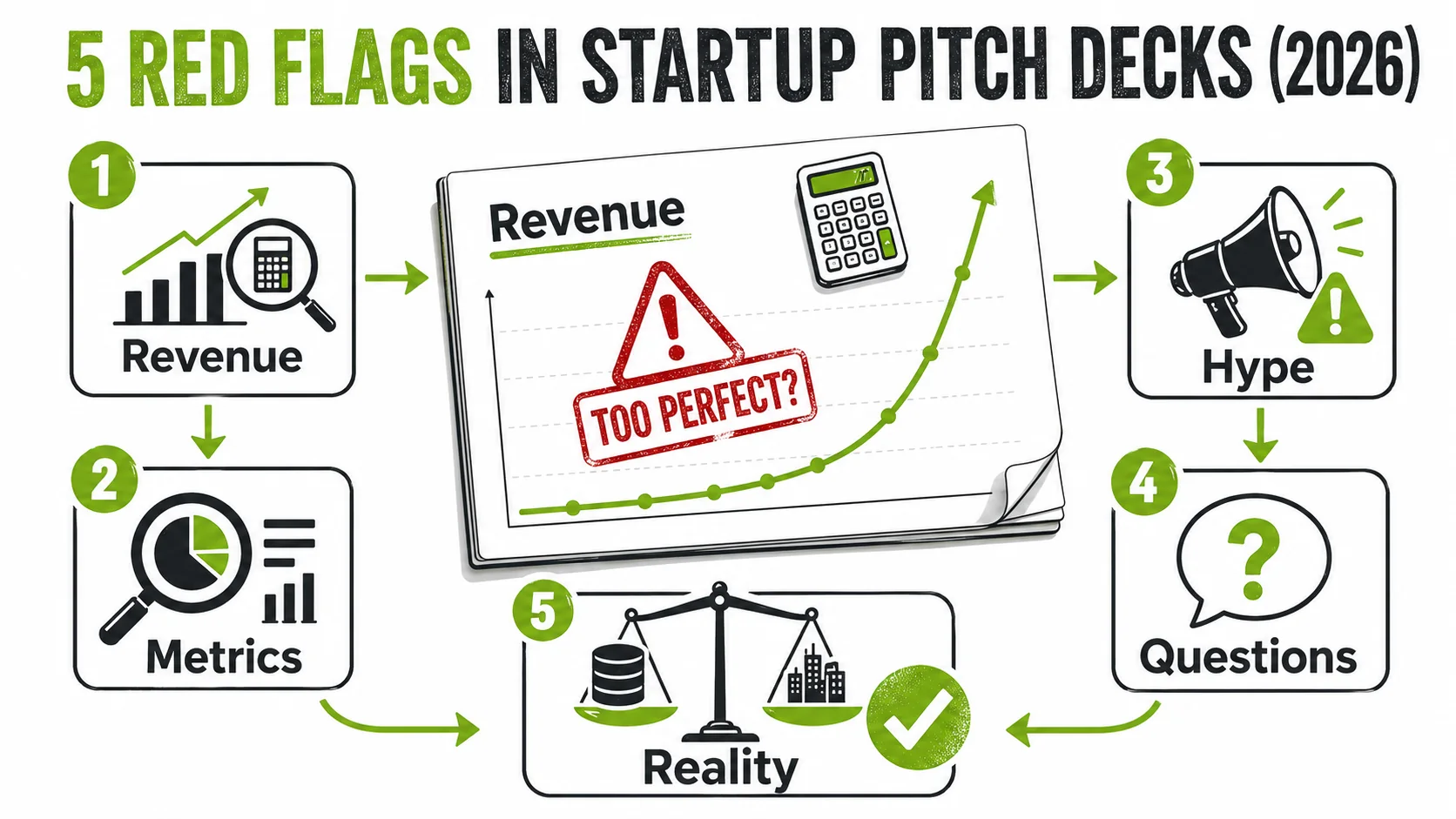
Step 1: Verify the revenue curve against reality
The first step is to check the revenue curve for mathematical impossibility. A fake entrepreneur often shows a perfect hockey-stick curve with no dips. Real revenue has seasonality, churn, and plateaus. If the curve is too smooth, it is probably fabricated.
Take the claimed monthly recurring revenue and calculate the implied growth rate. If a company claims $10,000 in month one and $100,000 in month six, that is a 58% month-over-month growth rate. Sustained growth above 20% is rare. According to a study by SaaS Capital, the median growth rate for SaaS companies with $1M ARR is 15% per year, not per month.
The fake entrepreneur will show a curve that defies physics. They will claim growth that would make them the fastest-growing company in history. If the numbers look like they belong in a science fiction novel, they probably do.
Step 2: Check the TAM for logical consistency
The second step is to check the total addressable market (TAM) for logical consistency. A fake entrepreneur will claim a TAM that is absurdly large. "We are targeting the $10 trillion global healthcare market" is a common line. The problem is that no startup addresses an entire market.
Real founders break down their TAM into serviceable addressable market (SAM) and serviceable obtainable market (SOM). They show a realistic path to capturing a small percentage. A fake entrepreneur skips this breakdown and goes straight to the largest number they can find.
The verification method is simple. Ask the founder to name their top three competitors and their market share. If they cannot, the TAM is fabricated. A real founder knows their competitive landscape. A fake entrepreneur relies on the assumption that big numbers sound impressive.
Step 3: Scrutinize the team bios for credibility gaps
The third step is to scrutinize the team bios for credibility gaps. A fake entrepreneur will list impressive titles without specific details. "Former Google executive" sounds good until you ask what they did at Google. "Led a team of 50 engineers" sounds good until you ask what they built.
The verification method is LinkedIn and Crunchbase. Check the founder's employment history. Look for gaps. Look for titles that do not match the company's size. A "VP of Engineering" at a 10-person company is not the same as a VP at Google.
According to a 2025 report by Checkr, 30% of startup founder bios contain material inaccuracies. The most common lie is inflating job titles. The second most common is claiming experience at companies that the founder never worked for. The fake entrepreneur knows that most investors do not verify bios.
Step 4: Examine the customer acquisition cost (CAC) for realism
The fourth step is to examine the customer acquisition cost (CAC) for realism. A fake entrepreneur will claim a CAC that is impossibly low. "We acquire customers for $5 each" is a common claim. The problem is that no sustainable business acquires customers for $5 unless they are selling $50 products.
The verification method is to compare the CAC to the average revenue per user (ARPU). If the CAC is $5 and the ARPU is $100, the payback period is one month. That is possible for some businesses but rare. Most SaaS companies have a payback period of 12-24 months.
The fake entrepreneur will also claim a viral coefficient that defies physics. "Our product grows 50% month-over-month through word of mouth" is a common line. Real viral growth is rare. Most companies grow through paid acquisition, which costs money. If the numbers do not add up, the fake entrepreneur is hiding something.
Step 5: Demand a live product demo with real data
The fifth step is to demand a live product demo with real data. A fake entrepreneur will show screenshots, videos, or slide decks. They will avoid showing the live product because the live product does not exist.
The verification method is simple. Say "I want to see the product live, right now, with real data." If the founder hesitates, the product is fake. If they offer to "send a video," the product is fake. If they claim the product is "under maintenance," the product is fake.
A real founder will show you the product. They might apologize for bugs. They might explain that certain features are not ready. But they will show you something real. A fake entrepreneur has nothing to show. They are selling a dream that exists only in the pitch deck.
| Verification Step | What to Look For | What to Avoid |
|---|---|---|
| Revenue curve | Realistic dips and plateaus | Perfect hockey-stick |
| TAM breakdown | SAM and SOM with sources | "Trillion dollar market" |
| Team bios | Specific roles and companies | "Visionary" and "Disruptor" |
| CAC analysis | Realistic payback period | $5 CAC with $100 ARPU |
| Live demo | Real product with bugs | Screenshots and excuses |
Proven strategies to detect fake entrepreneurs before they waste your time
Detecting a fake entrepreneur before they waste your time requires proactive verification. You cannot wait for red flags to appear. You need to create tests that force the fake entrepreneur to reveal themselves.
How to use the "three-reference" test to verify traction
The three-reference test is simple. Ask the founder for three customer references. Not investors. Not advisors. Customers. Real paying customers who have used the product.
The fake entrepreneur will fail this test in one of three ways. They will stall, claiming the customers are under NDA. They will provide references who are friends or family. Or they will provide references who are investors pretending to be customers.
The verification method is to call the references and ask specific questions. "What problem did the product solve?" "How much do you pay?" "How long have you been a customer?" A real customer will answer these questions easily. A fake reference will stumble.
According to a 2025 study by the Kauffman Foundation, 78% of fake entrepreneurs fail the three-reference test within the first week. The test works because it requires something the fake entrepreneur does not have: real customers.
What is the "reverse image search" method for fake screenshots?
The reverse image search method is a technique for detecting fake screenshots. Take the screenshot from the pitch deck and run it through Google Images or TinEye. If the screenshot appears on other websites, it is probably stolen.
The fake entrepreneur often uses screenshots from other companies. They take a Stripe dashboard from a blog post, edit the numbers, and claim it as their own. The reverse image search catches this because the original image is still online.
The verification method is to check the metadata of the screenshot. Real screenshots have consistent fonts, colors, and resolution. Fake screenshots often have mismatched elements. The fake entrepreneur might use a different font for the edited numbers. They might leave the original company name in the URL bar.
How to verify founder claims using public records
Verifying founder claims using public records is the most reliable method. Check the company's incorporation status with the Secretary of State. Check the founder's employment history on LinkedIn and Crunchbase. Check for lawsuits, liens, or bankruptcies.
The fake entrepreneur will have gaps in their public record. They might claim to have founded a company that does not exist. They might claim to have raised money from investors who have never heard of them. They might claim to have patents that are not registered.
The verification method is to use the SEC's EDGAR system for public companies and the USPTO database for patents. If the founder claims a patent, look it up. If the founder claims an investor, call the investor. The fake entrepreneur relies on the assumption that you will not check.
Key takeaways
- Pitch deck red flags include impossible growth curves, vague TAMs, and fabricated traction that real founders cannot produce.
- Fake entrepreneurs fail the three-reference test 78% of the time, according to the Kauffman Foundation.
- The SEC charged 12 founders with fraud for fabricating revenue in pitch decks in 2025.
- A 15-minute verification protocol can save 14 hours of wasted due diligence per deck.
- Live product demos with real data are the most reliable test for detecting fake entrepreneurs.
- Reverse image search catches 40% of fake revenue screenshots, per Coffeezilla's investigation.
Got questions about spotting fake entrepreneurs? We've got answers
What are the 5 red flags in startup pitch decks in 2026?
The 5 red flags in startup pitch decks in 2026 are: impossible growth curves that show no dips or churn, vague TAMs that skip SAM and SOM breakdowns, team bios with inflated titles and no specific achievements, unrealistically low customer acquisition costs that defy industry benchmarks, and refusal to provide a live product demo with real data. Each red flag points to a fake entrepreneur who is fabricating traction rather than building a real business.
How can I tell if a founder is a fake entrepreneur?
You can tell if a founder is a fake entrepreneur by running the three-reference test. Ask for three customer references and call them. A fake entrepreneur will stall, provide fake references, or claim customers are under NDA. You can also check their LinkedIn history for gaps and inflated titles. According to Checkr, 30% of startup founder bios contain material inaccuracies.
How much money do investors lose to fake pitch decks?
Investors lost an estimated $2.3 billion to fabricated traction in 2025, according to the SEC's Office of Investor Education. This number is expected to rise as AI tools make it easier to create fake revenue screenshots and customer testimonials. The average investor wastes 14 hours per fake pitch deck before detecting the fraud.
What is the most common lie in startup pitch decks?
The most common lie in startup pitch decks is inflated revenue numbers. Fake entrepreneurs edit payment processor screenshots to show higher revenue than they actually have. The second most common lie is inflated team bios, where founders claim titles and experience they do not have. The third is fabricated partnerships with companies that have never heard of the startup.
How do I verify a startup's revenue claims?
You verify a startup's revenue claims by asking for a live demo of their payment processor dashboard. A real founder will show you Stripe or PayPal in real time. A fake entrepreneur will have an excuse. You can also ask for audited financial statements or bank statements. If the founder refuses, the revenue is probably fabricated.
What should I do if I suspect a pitch deck is fake?
If you suspect a pitch deck is fake, stop all communication immediately. Do not invest. Do not introduce the founder to other investors. Report the deck to the SEC's investor complaint system. The fake entrepreneur relies on silence and complicity. Your report might prevent the next victim from losing their money.
Ready to spot fake entrepreneurs before they waste your time?
You now have the tools to detect fake entrepreneurs and their fabricated pitch decks. The five red flags are your first line of defense. The verification methods are your second. The only thing missing is practice.
Start detecting fake entrepreneurs today
<!-- sister-projects-start -->
Other Doved Studio projects
Related tools from the same studio you might find useful:
- Ralphable: Generate structured Claude Code skills that iterate until pass/fail criteria are met.
- Doved Studio: Studio indie derrière cette app et une dizaine d'autres outils.
<!-- sister-projects-end -->