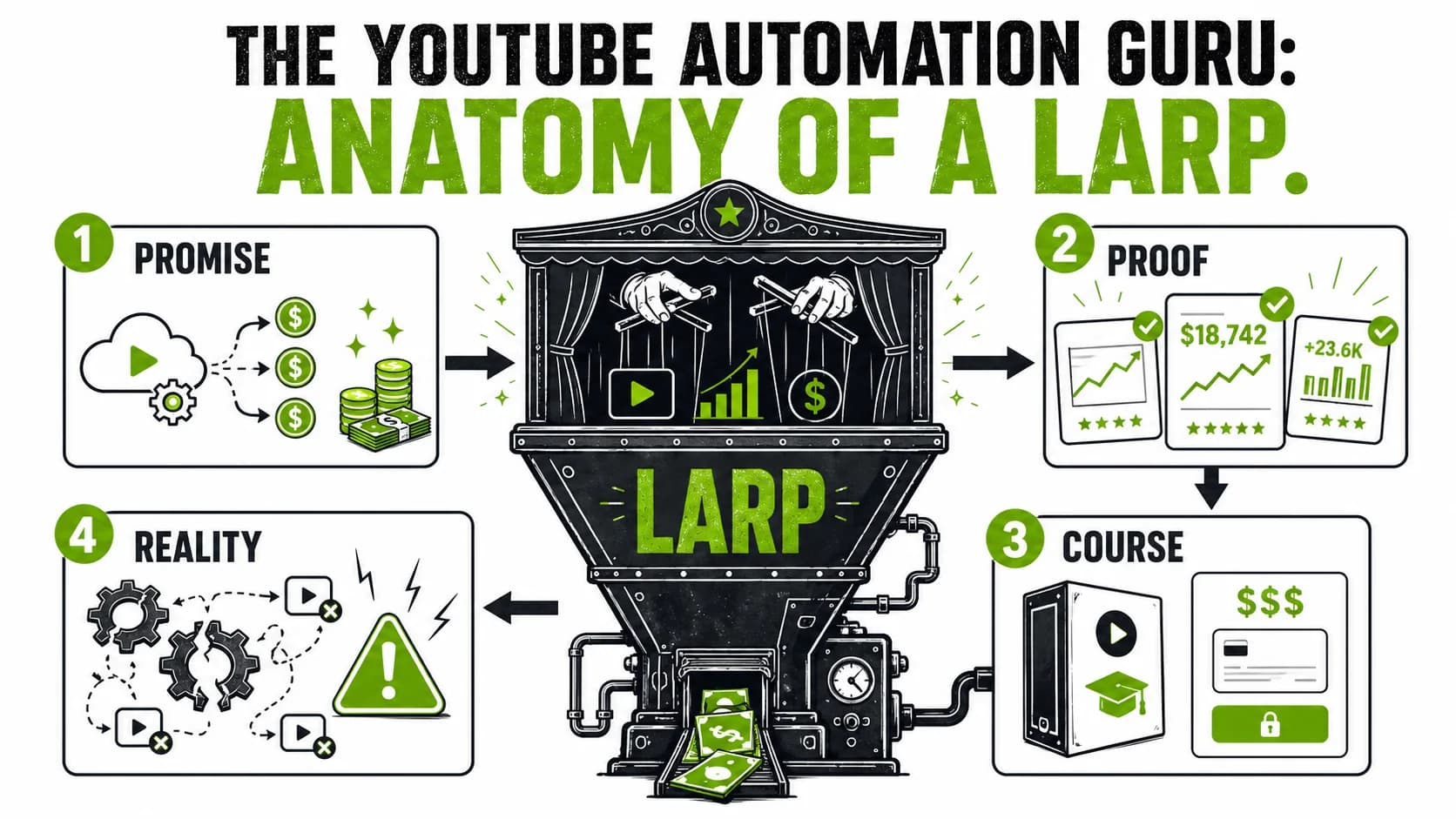
The YouTube Automation Guru: Anatomy of a Larp
Introduction
In the digital bazaar of get-rich-quick schemes, a new archetype has emerged, perfectly adapted to the algorithmic ecosystems of TikTok, Twitter, and YouTube itself: the YouTube Automation Guru. This persona peddles a tantalizing vision of the platform as a faceless, automated money-printing press. The promise is a siren song: build "cash cow" channels using outsourced labor and AI, then sit back while massive AdSense revenue flows in.
This narrative leverages the very real existence of faceless YouTube content. However, the Guru's pitch systematically distorts this reality into a myth of frictionless, scalable passive income. This educational profile dissects the YouTube Automation Guru as a modern larp—a performance where the primary product is not a successful YouTube channel, but the meticulously crafted story of having discovered the secret to creating one. Our purpose is to map the persona's tropes, deconstruct its deceptive business model, and identify the specific red flags so you can protect yourself and others from being misled.
The YouTube Automation Pitch (And Why It's Designed to Hook You)
The Irresistible Promise
The Guru's pitch is engineered for maximum virality and psychological appeal. Understanding its construction is key to recognizing the trap.
- The "True Passive Income" Fantasy: The cornerstone claim is that once the "system" is set up, the channel runs itself. This taps directly into the desire for effort-free wealth. The reality—managing freelancers and algorithms—is deliberately glossed over.
- "Cash Cow" as a Financial Asset: Channels are framed not as creative projects but as financial assets you can sell. This appeals to a business-minded, transactional worldview, making the dream feel more "legitimate" and investment-worthy.
- The "Great Equalizer" Narrative: You're told you don't need skills, charisma, or knowledge—just the "method." This promise of accessibility preys on the overwhelmed beginner, offering a shortcut that bypasses the need for genuine expertise.
The Hidden Reality
Behind the glossy promise lies a landscape the Guru's content avoids. Knowing this reality inoculates you against the fantasy.
- Actual Success Rates: While faceless channels can succeed, their success rate is abysmally low. YouTube's algorithm favors engagement, which is hard to achieve with generic, outsourced content. The vast majority of these automated channels earn nothing.
- "Automation" is a Misnomer: It describes the delegation of labor, not its elimination. It's the work of running a low-budget media agency—a far cry from passive income.
- The Economic Math Never Adds Up: YouTube's revenue share is roughly 55% to the creator. For faceless content, CPMs (revenue per thousand views) are typically very low ($0.50 to $3.00). To earn a claimed $10,000/month net, a channel needs millions of views per month, consistently. This is an extraordinary outlier, not a predictable outcome of a "system."
The Guru Persona Pattern (Learn to Spot the Character)
The YouTube Automation Guru is a highly optimized character. Recognizing the playbook strips away their credibility.
The Scripted Origin Story
Every Guru follows a strict three-act script. If you see this, you're watching a performance.
The Multi-Platform Funnel Playbook
The Guru operates a predictable content funnel designed to build trust before the pitch.
- Free "Value" Hooks: Short-form content with "secrets." "5 cash cow niches YouTube doesn't want you to know." It's just detailed enough to feel valuable but vague enough to be useless without buying something (in their original model).
- The 'I'm Giving It All Away' Thread: A long-form thread outlining the "entire process" as a simple checklist. It garners massive engagement ("Bookmarked!") which is used as social proof of the method's value.
- The DM Funnel: The bio reads "DM 'AUTOMATION' for my free guide." This creates a false sense of personal connection and exclusivity, making you more susceptible to a sales pitch.
The Suspicious Screenshot Patterns
Visual "proof" is their primary currency. Learn these patterns so you can immediately dismiss them.
- The Tight Crop: Screenshots of YouTube Analytics or AdSense are always tightly cropped. The channel name, full date range, and any verifiable context are omitted. A legitimate operator would blur sensitive info; the Guru removes all means of verification.
- The Round Numbers: AdSense screenshots often show suspiciously perfect, round numbers ($10,000.00). Real earnings are almost never so neat.
- 'Student Results' Galleries: This is survivorship bias as a marketing strategy. They highlight the tiny fraction who may have seen any success (with unverifiable claims) while ignoring the overwhelming majority who lost money and time. Every screenshot will lack a traceable link to a real, public channel.
The Actual Business Model (It's Not YouTube)
This is the most critical lesson. While the pitch is about building YouTube channels, the Guru's actual, proven business model is entirely different.
Red Flags: Your Educational Checklist
Use this checklist to analyze any "Guru" you encounter.
Red Flag 1: The Secretive "Operator"
- The Tell: They never show or name a public channel they personally own.
- The Excuse: "I can't reveal my niches due to competition."
- The Reality: A genuinely successful public channel is the best marketing tool imaginable. Secrecy is only necessary if the channels don't exist, are insignificant, or violate YouTube's policies. A Guru with no public proof is a performer, not a practitioner.
Red Flag 2: Proof Always Comes From "Students"
- The Survivorship Bias: The entire proof structure relies on unverifiable student testimonials. This is a statistical sleight of hand. If 1,000 people buy a course and 2 have modest success, those 2 become the marketing. The 998 who got no results are invisible. They never disclose overall success rates or refund percentages.
Red Flag 3: The Math Publicly Doesn't Work
- Do the Simple Math: They often use inflated CPM estimates. Do your own: To earn $10k/month with a realistic $2 CPM, a channel needs 5 million views per month. Ask yourself: have I ever seen a faceless "motivation" channel with 5M monthly views? The answer reveals the fantasy.
Red Flag 4: The Central Paradox
The Critical Question: If the method prints money so reliably and passively, why would you spend 40+ hours a week creating content, managing DMs, and selling the method? Scaling your actual* channel portfolio would be more profitable and less work.
- The Flimsy Defense: "I want to give back." This altruistic framing collapses when the "help" costs thousands of dollars and is marketed with the urgency of a limited-time offer.
Red Flag 5: The Lifestyle Pivot
- The Shift: When the Guru's content becomes less about YouTube tactics and more about luxury cars, Dubai skylines, and "mindset," the larp is in its final stage. The product is no longer information; it's the aspiration. This appeals directly to emotion, bypassing your critical thinking about the underlying business claims.
How to Protect Yourself & Verify Claims
Arm yourself with free tools and healthy skepticism.
- The Public Channel Test: Simply ask, "Can you link me to one public channel you personally built using this method that is currently earning over $1k/month?" The response (or lack thereof) is all you need to know.
- Understand the Patterns: Explore our FREE Pattern Recognition Guides to learn exactly how each fake entrepreneur archetype operates. Once you know the playbook, you'll never be fooled again.
FAQ
Q: Are all faceless YouTube channels scams?
A: No. Legitimate, successful faceless channels exist. They are, however, built on real editorial insight, quality, and effort—not a "set-and-forget" outsourced system sold by a Guru.
Q: Is it possible to outsource YouTube channel creation?
A: Yes, as part of a legitimate media business. However, it requires skilled management, quality control, editorial direction, and substantial upfront capital. It is a real business with real risks and high failure rates, not a passive income hack.
Q: What if a Guru shows a screenshot of getting monetized?
A: This is a low bar. Getting monetized (1,000 subscribers, 4,000 watch hours) is an achievement, but it is miles away from generating substantial, passive income. Earning $100 a month is a world apart from the $10,000/month dreams they're selling.
Q: Aren't they just selling education?
A: Selling education is legitimate. Selling a fantasy wrapped in false testimonials, fabricated proof, and impossible promises is deception. The line is crossed when the claims are designed to mislead.
Conclusion
The YouTube Automation Guru is a sophisticated digital deception. It is a performance that co-opts the language of entrepreneurship to sell a dream that dissolves upon contact with reality. The persona is a carefully crafted funnel, turning the desire for freedom into a revenue stream based on selling the dream itself.
The anatomy reveals a simple truth: those who have truly built substantial, automated media businesses are not spending their days creating TikTok clips about it. They are managing their businesses. The loudest voices in the "automation" space are, almost without exception, those for whom the performance is the business.
Protect Yourself and Others:
Try our FREE educational demo to see how easily "proof" can be faked. Share this guide to help others recognize the pattern. If you see a Guru using these tactics, submit the pattern to our free resource library to help us educate more potential victims.
<!-- sister-projects-start -->
Other Doved Studio projects
Related tools from the same studio you might find useful:
- Ralphable: Generate structured Claude Code skills that iterate until pass/fail criteria are met.
- Doved Studio: Studio indie derrière cette app et une dizaine d'autres outils.
<!-- sister-projects-end -->