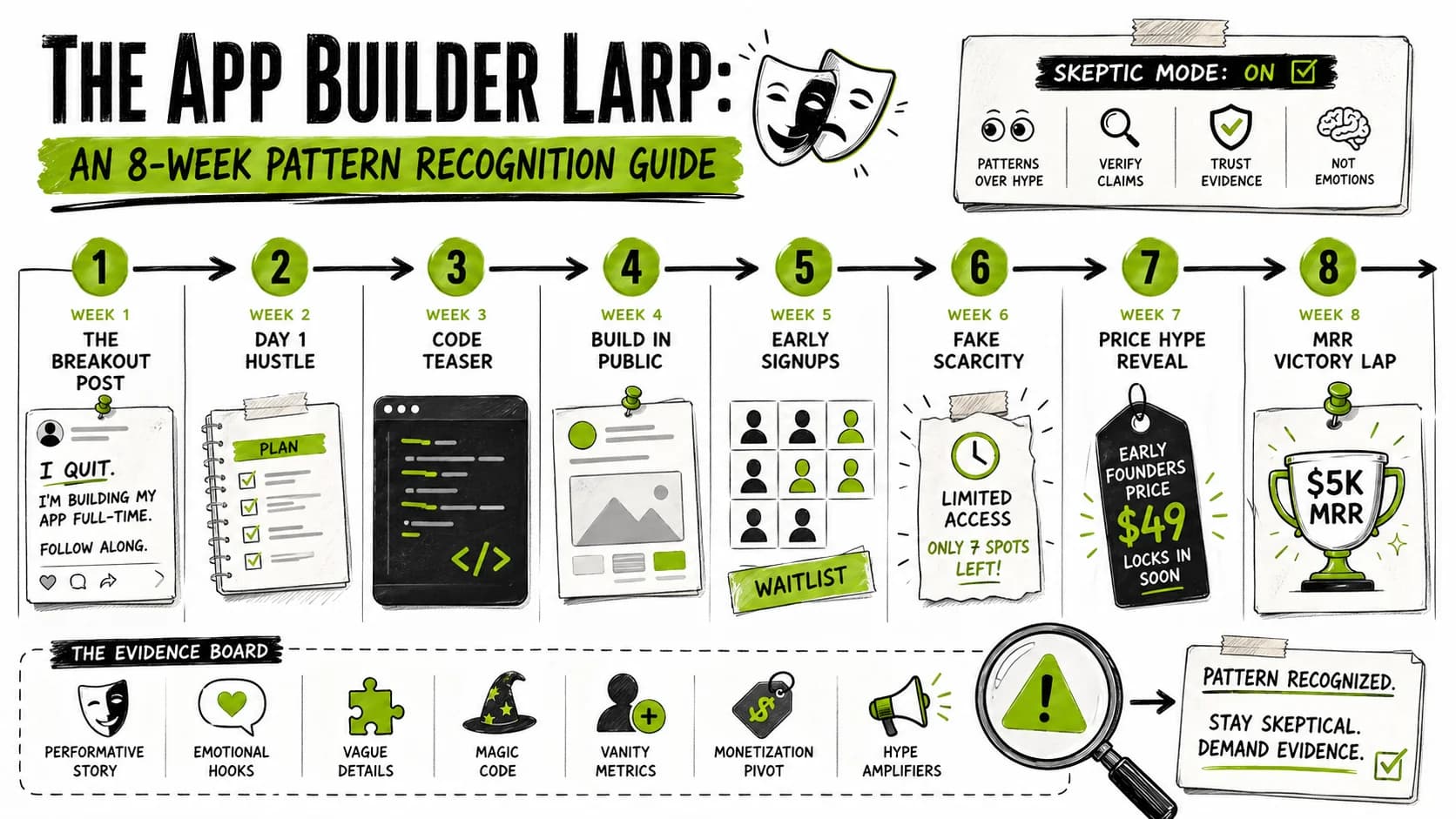
The App Builder Larp: An 8-Week Pattern Recognition Guide
Introduction
Ever feel a pang of skepticism scrolling through Tech Twitter? While you're seeing the highlights, others are posting sleek code snippets, announcing "life-changing" MRR milestones, and threading profound lessons from their 3-week-old SaaS. Their DMs are supposedly full of investor interest. Their followers hang on every update.
But what if there's no app? What if there's not even an idea? What if the primary skill isn't coding, but narrative crafting?
Introducing The App Builder Larp: An 8-Week Pattern Recognition Guide. This isn't a playbook for performers; it's a field guide for the audience. We've reverse-engineered the common "build in public" journey into a predictable narrative arc. By understanding the script, you can spot the performance from the first act. This guide is for the skeptic, the curious observer, and anyone who wants to navigate online entrepreneurship spaces with informed caution.
The educational premise is simple: We've cataloged the common tropes, timing, and emotional beats of a specific type of online persona. Why? So you can tell the difference between genuine creation and curated performance. This guide deconstructs the aesthetic of hustle, showing you the strings and mirrors behind the sweat, tears, and revenue graphs. It's the ultimate critical lens—a resource that helps you see the performance for what it is.
What This Guide Deconstructs
Think of this as your decoder ring for digital theater. We've done the analysis—scraping thousands of tweets, analyzing growth threads, and cataloging every cliché—so you can recognize the patterns.
The 8-Week Content Calendar (The Common Arc)
The predictable roadmap. Many larps follow a similar choreography of credibility. Each week has a designated theme and emotional beat designed to build a specific perception.
- Week-by-Week Pattern Breakdown: We show the common day-by-day themes. Notice how Monday is often for motivation, Wednesday for wisdom, Friday for wins. It's a formula.
- Common Tweet Themes & Timing: Learn to spot the scheduled "3 AM grind" tweet (often posted at peak engagement hours). Watch for the cyclical themes: "The Struggle," "The Breakthrough," "The Validation," and "The Ascension."
- Milestone Screenshot Schedule: A hallmark of the larp is the predictable reveal of metrics. There's often a suspiciously perfect progression from a $100 day to a $5k MRR month, building social proof on a timetable.
50+ Common Tweet Formulas (And How to Spot Them)
We show you the common templates so you can recognize filler content designed to mimic expertise and engagement.
- Pattern Categories:
* Revenue Milestone Posts: The social proof shots. Be wary of perfectly cropped, blurry screenshots. These are trivially easy to fabricate.
Platitude "Lessons Learned": Profound insights gleaned from trivial events. "Today I learned [OBVIOUS THING]. This changes everything about how I think about [BLANK]."* Often a sign of content for content's sake.
Engagement Bait: Questions and polls designed to spark conversation without requiring actual expertise. "Which is more important for early-stage: [A] or [B]? Debating with my co-founder."* Useful for boosting visibility without substance.
The Screenshot Pattern
The "visual proof" is often the weakest link. A graph can be fabricated in seconds.
- The Predictable Metric Timeline: Week 4 often shows a first $100. Week 6 needs a chart hitting $1k MRR. Real growth is rarely this photogenic or predictable.
- The "Realistic" Growth Curve: Larps often chart a perfect Goldilocks zone of impressive-yet-believable growth (e.g., 20-30% week-over-week). Real startups have messy, uneven graphs.
- The "Authentic Struggle" Ploy: Some mix in slight imperfections—a week of 8% growth, losing a customer. This is a narrative technique to make the final triumph more believable, not necessarily evidence of a real business.
Deflective Dialogue & Evasion Tactics
Every performer has scripts for skeptics. Recognizing these deflections is key.
- Standard Responses to Questions: Scripted replies for "Can I try the beta?", "What's your tech stack?", or "What problem does this solve?" often lack concrete answers.
- The 'Stealth Mode' Defense: The ultimate evasion card. When pressed for details, they claim to be "focused on users, not hype." It implies secret progress while revealing nothing.
Week-by-Week Pattern Breakdown (What to Look For)
Here's a deconstruction of the common character arc. Your goal is to spot the narrative beats, not follow them.
Week 1: The Origin Story Pattern
- The 'Finally Taking the Leap' Tweet: A grainy, "authentic" photo of a laptop in a coffee shop. The caption is a mix of fear and excitement. The hashtag is #buildinpublic. It's the opening scene.
- First "Code" Screenshot: Often just aesthetic—a terminal with logs or a colorful IDE theme. It looks complex but shows no identifiable project or function.
- Building Vague Anticipation: "Working on something that's been bugging me for years. If you're in [BLANK] industry, DM me." No product name or clear value proposition.
Week 2: The Performed Hustle Pattern
- 'Nights and Weekends' Content: Photos of empty office spaces at odd hours. The caption is about sacrifice. #grind. It's the "hard work" aesthetic.
- Problem/Solution Framing (Without Details): A thread. Part 1: "Here's why [EXISTING TOOL] sucks." Part 2: "We're approaching it differently." No technical or specific alternative is given.
- First "Interest" Signals: A screenshot of a flattering DM (easily faked). "Someone just offered to beta test. Fuel for the fire!" Creates social proof from an anonymous source.
Week 3: The Soft Launch Theater
- Beta User Excitement (Unverifiable): "Shaking. 50 people signed up for the waitlist in 2 hours." No link to a public waitlist counter or verifiable evidence.
- First Feedback (Always Glowing): A quoted testimonial from a non-existent or anonymous "beta user." "A beta user just said 'This is exactly what I needed.'"
- Landing Page Reveal: Often a sleek, static page built on a no-code tool like Carrd. The only call-to-action is "Join Waitlist," which may just collect emails for a non-existent product.
Week 4: The First "Revenue" Milestone
- The Magical First $100 Screenshot: The first Stripe screenshot. It's often blurry, "intimate." "Never thought I'd be so happy to see $100." This is a key moment to be skeptical. These screenshots are trivially easy to fabricate—anyone can create one in seconds.
- Vague Customer Story: "A small business in Iowa is using us to save 5 hours a week." No business name, no case study, no verifiable details.
- The Gratitude Thread: A thread thanking abstract concepts: Hustle, the Internet, Late Nights. It's emotional branding, not business reporting.
Week 5-6: The "Growth" Narrative
- Scheduled MRR Updates: The graphs become more frequent and show a smooth, upward trajectory: $500, $1k, $2k. The tone shifts from surprised to confidently expected.
- 'Lessons Learned' Threads (Platitude Edition): "10 things I learned hitting $1k MRR." The lessons are often generic business platitudes applicable to anything.
- Basic Feature Announcements: "Shipped dark mode." "Added export to CSV." The features are commodity-level, but the announcement is framed as a major engineering triumph.
Week 7-8: The Climax - Victory or Pivot
- The Victory Lap: Hitting a round-number milestone like $5k MRR. Accompanied by a life-altering reflection. #quitmyjob hints begin. The narrative arc concludes.
- The Strategic Pivot: If sustaining the app fiction is difficult, the pivot occurs. "Users keep asking how we did it. So, we're packaging our knowledge." The app builder persona segues into selling courses, coaching, or consultancy—monetizing the audience built on the initial larp.
Sample Patterns (Recognize These Templates)
Here are common formulas you'll encounter. Seeing the template removes its power.
Example Pattern: "Spent the day wrestling with [OBSCURE TECH] to make our [VAGUE FEATURE] 0.5s faster. The edge cases are brutal, but the user experience will be chef's kiss*. Stack: [BLANK]."
What to Ask:* What is the feature? Who requested it? Where's the benchmark? The lack of specifics is the tell.
Example Pattern:* "[ICON: CHART] A milestone worth celebrating. We just crossed $[AMOUNT] MRR. It's not a number, it's [NUMBER] people/businesses trusting us with their [VAGUE WORK]. Grateful. Onward."
What to Ask:* Can this be independently verified? Is the screenshot cropped? Real founders often share more context.
Example Pattern:* "Quick poll for my fellow builders: What's your biggest time-sink? A) Customer support B) Marketing C) Endless refactoring D) [FUNNY OPTION]"
What to Notice:* This creates activity and gathers data about an audience, but requires zero expertise from the poster. It's an audience-building tactic.
Example Pattern:* "We hit $[X] MRR. Here are 5 counter-intuitive things we did: (Thread) 1/ We ignored 80% of feature requests..."
What to Notice:* The lessons are often recycled, non-actionable, or contradictory. The thread is a format for visibility.
Example Pattern:* "Great Q! The deep dive is a bit too much for a tweet, but the high-level architecture leverages [TRENDY PATTERN] to handle [SCALING CONCERN]. I'll write a blog post soon!"
What to Notice:* The blog post never materializes. The answer uses buzzwords to avoid a concrete, testable explanation.
The Educational Purpose
Let's be clear. Why does this guide exist? Are we not just documenting the deception?
Precisely. That's the point. This guide exists in a state of educational satire. By showing you the common script for a fake journey, we are holding up a mirror to the "build in public" and "digital entrepreneurship" economy. The guide is protective. It functions as a critical lens. By understanding the playbook—the tropes, the timing, the emotional beats—you become immunized against it. You can spot the performance from a mile away.
We're not enabling performance; we're enabling literacy. Using this guide is like learning a magician's secrets. You don't become a magician; you become someone who can see the strings and the mirrors, and thus can no longer be fooled by the illusion. It's a deconstruction tool.
FAQ
Q: Is this guide teaching people how to larp?
A: Absolutely not. We explain the common patterns so you can recognize them. We remove the actionable "how-to" and replace it with "how to spot." The goal is to make you more skeptical, not more deceptive.
Q: Why create this? Isn't this cynical?
A: Protective, not cynical. In an age where personal branding can outpace product development, the most valuable skill is informed skepticism. We're satirists providing the ultimate satirical vaccine: awareness.
Q: Can this help me build a real business?
A: Only indirectly. It will not help you code or find customers. It will help you audit the advice you consume and recognize when you're being sold a narrative instead of substance. That can save you time, money, and inspiration.
How to Use This Knowledge & Our Free Tools
This 8-Week Pattern Recognition Guide is FREE.
With it, you learn to:
- Identify the common narrative arc of the "App Builder" larp.
- Recognize deflective language and evasion tactics.
- Question the authenticity of unsourced metrics and screenshots.
- Protect your time and attention from empty performance.
Ready to test your new skepticism?
[TRY THE FREE SCREENSHOT GENERATOR DEMO]
Use our purposefully watermarked tool to see how anyone can fake a Stripe dashboard, a glowing DM, or a growth chart in 30 seconds. The permanent watermark is a reminder: If it's this easy to make, it's that easy to fake.
Want to help others?
[SHARE THIS GUIDE TO PROTECT OTHERS]
Knowledge is the best defense. Help aspiring entrepreneurs and skeptics see the patterns.
Or, to see these patterns in the wild…
[VISIT THE PATTERN ARCHIVE] to see our curated, anonymized examples of these tropes deployed unironically across social media. Consider it your practical final exam.
Build in public. But trust only what you can verify in private.
<!-- sister-projects-start -->
Other Doved Studio projects
Related tools from the same studio you might find useful:
- Ralphable: Generate structured Claude Code skills that iterate until pass/fail criteria are met.
- Doved Studio: Studio indie derrière cette app et une dizaine d'autres outils.
<!-- sister-projects-end -->