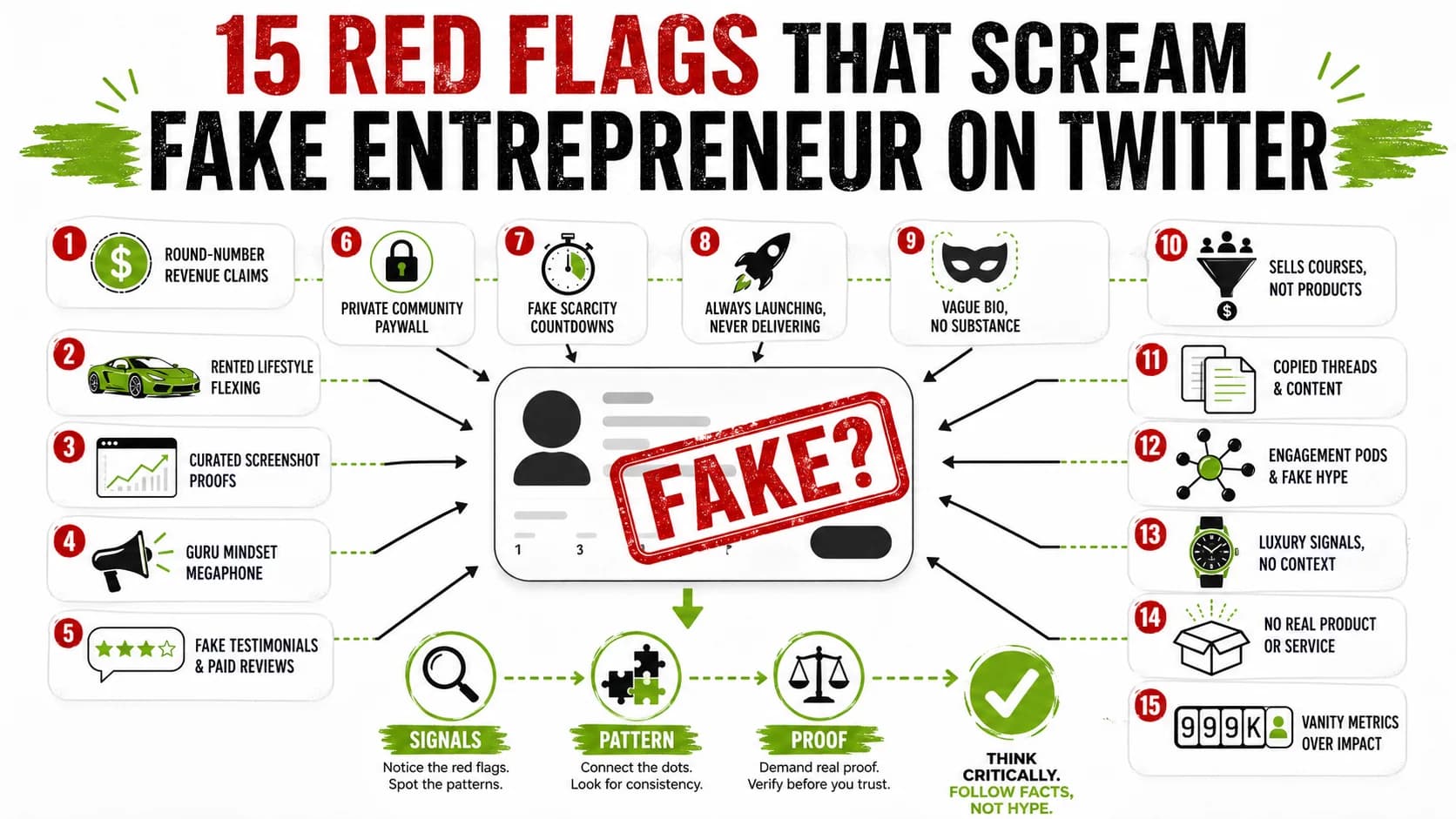
15 Red Flags That Scream 'Fake Entrepreneur' on Twitter
Introduction
Twitter/X has become a primary stage for "startup theater," a performative ecosystem where the appearance of success is often more valuable than its reality. This performance isn't harmless—it's used to build influence, sell false dreams, and scam aspiring entrepreneurs out of time and money.
This guide exists for one purpose: to arm you with critical observation skills. By learning the common patterns of deception, you can protect yourself from false gurus and develop a healthy skepticism towards online success stories. Recognizing these red flags is a form of digital self-defense.
The 15 Red Flags to Watch For
Red Flag 1: Revenue Always Ends in Round Numbers
Be highly skeptical of perfect, round revenue figures like $5K, $10K, or $100K MRR. Real business revenue is messy, affected by churn, refunds, and prorated amounts. Consistently round numbers are a narrative device, not a financial reality. They're designed to be easily digestible and symbolically powerful in a tweet, not to reflect an actual accounting system. When you see this, ask yourself: "Why is there never a cent out of place?"
Red Flag 2: Growth Is Always 'Up and to the Right'
Real business graphs look like earthquake readings—full of dips, plateaus, and corrections. A perpetually smooth, 45-degree ascent is a statistical fantasy. This "hockey stick" curve is a storytelling prop. It's meant to imply inevitable success, hiding the reality of market unpredictability, failed experiments, and periods of stagnation that every real business faces.
Red Flag 3: They Never Show the Actual Product
This is a major tell. An account may detail a "build in public" journey for months, yet the product remains a phantom. Links go to generic landing pages, the product name is never mentioned by real customers, and there's no tangible evidence of a functioning service. The business exists only as a narrative prop. The content is all about the story of building, with no verifiable thing that was built.
Red Flag 4: The Bio Is All Titles, No Links
Examine the bio closely. It will often be a stack of impressive, unverifiable titles: "7-Figure Founder | Exited 2023 | Helping 1000s Scale." Crucially, it omits the name of the company they founded, the company they exited to, or a direct link to a primary product. This creates a persona that floats free of any entity that can be fact-checked. The authority is self-assigned, not earned through a publicly verifiable venture.
Red Flag 5: Perfect Viral Thread Timing
Observe the industrial precision of their content. Major "reveal" threads drop at peak engagement times (Monday 9 AM EST) with clockwork reliability. More importantly, business milestones always precede a commercial offer by 48-72 hours. Hitting a revenue goal is immediately followed by a course launch. This isn't inspiration; it's a engineered sales funnel. The personal journey is a marketing calendar.
Red Flag 6: Engagement Doesn't Match the Claims
Notice the dissonance. An account with 100K followers might get only a dozen likes on a tweet announcing their "game-changing" product. Meanwhile, generic motivational quotes get thousands of retweets, often from accounts that look suspiciously like engagement pods or fake followers. This suggests the audience is there for the persona, not for a product, and that the follower count may be inflated for social proof.
Red Flag 7: They Sell 'The Method' Not the Product
The core business model often reveals itself: they're not making money from the product they talk about, but from teaching others how to allegedly build it. The original product (a SaaS, agency, etc.) is either non-existent or a minimal prop. The real product is the course, blueprint, or coaching program about success. It's a logical loop: they are a "successful founder" because they sell a course on how to be a successful founder.
Red Flag 8: Testimonials From Other Larpers
Social proof is curated within a closed, incestuous network. Testimonials come exclusively from other accounts that display these same red flags. It's a circle of mutual validation: Guru A praises Guru B, and Guru B returns the favor. The language is hyperbolic ("life-changing!") but vague. Clicking through reveals the testimonial-giver has a similar vague bio and no real product. It's an echo chamber, not customer validation.
Red Flag 9: The Overly Polished 'Quit My Job' Story Arc
The origin story is a polished, three-act play delivered on schedule. The soul-crushing job, the dramatic resignation letter (often a screenshot), the triumphant "first day of freedom" coffee shop photo. Real career transitions are messy, uncertain, and rarely make for a perfect tweet thread. This arc is a engagement-maximizing narrative device designed to make you invest emotionally in their "hero's journey."
Red Flag 10: Screenshots But No Customers
Evidence is limited to internally generated dashboard screenshots (Stripe, Google Analytics). There is a complete absence of external, third-party validation: no genuine customer reviews on independent sites (G2, Capterra), no unsolicited user tweets, no independent press. The proof of existence is a closed loop. The "customers" are pixels in a graph, not people with public voices.
Red Flag 11: They RT Every Compliment
Their timeline is a perpetual victory lap. Any compliment, however minor, is immediately retweeted or quote-tweeted for maximum visibility. This signals a need for continuous validation and an effort to manufacture social proof. A person genuinely busy running a business might "like" a compliment. Systematically amplifying all praise is a community-manipulation tactic to reinforce guru status for new visitors.
Red Flag 12: The Generic Guru Aesthetic
The visual branding is a uniform. The profile picture: arms crossed, direct smirk, sharp eye contact. The banner: mountain peaks, sunset balconies, minimalist desks. This isn't personal branding; it's putting on the costume of "The Online Visionary." It's designed to signal a role—authority, success, enlightenment—rather than to express an individual personality. It's the look of a character, not a person.
Red Flag 13: Lifestyle Before Product
Content prioritizes the outputs of success (beaches, luxury cars, hotel lobbies) over the inputs of work (code, customer emails, messy strategy sessions). The product, when mentioned, is secondary. The implied message is that the goal is the lifestyle, and the business is just a vehicle. For a real founder in the trenches, the product is the overwhelming focus; lifestyle shots are rare exceptions.
Red Flag 14: An Inconsistent or Scrubbed Timeline
A deep dive into their tweet history can reveal contradictions. They claim to be a "3x founder," but tweets from two years ago show them job hunting. They talk of "3 years of bootstrapping" for a project with a 1-year-old domain. Pivots are sudden and unexplained. Often, past tweets that contradict the current lore are deleted. Their history is a curated exhibit, not an honest archive.
Red Flag 15: Defensiveness Over Basic Questions
This is the ultimate behavioral tell. Ask a simple, clarifying question ("How does that feature work?") and you'll be met with defensiveness. Skepticism is framed as "negativity" or "hater energy." The block button is used liberally. A real builder is used to questions and criticism—it's part of the job. A persona protecting a narrative cannot tolerate scrutiny, as the facade is fragile. They attack the questioner to avoid the question.
What Real Builders Tend to Do (For Healthy Comparison)
To calibrate your skepticism, note how verifiable entrepreneurs often behave. They share non-linear progress, including failures and pivots. Their content is product- or problem-focused, not persona-focused. They have verifiable anchors: a company with a public team page, an app in a store, a GitHub repo, or reviews from identifiable people outside the Twitter guru sphere. The throughline is substance anchored in a real offering.
FAQ
Q: Isn't it possible they're just private?
A: True privacy advocates don't simultaneously build a massive public brand around being a "7-figure founder." That's a key contradiction. Public performance requires public evidence. If someone is performing success publicly while hiding all details of that success, it's a major warning sign.
Q: Are all people who sell courses scammers?
A: Absolutely not. Legitimate experts with documented, verifiable careers and results create excellent educational products. The red flag is when the course is the only visible business, and the success story it's based on lacks any external, checkable proof.
Q: Why does this matter?
A: Following false gurus can waste your time, money, and emotional energy. It sets unrealistic expectations and teaches you to prioritize performance over substance. This guide aims to protect you from that, helping you invest in legitimate learning and avoid predatory schemes.
Q: How can I learn more?
A: Explore our FREE Pattern Recognition Guides to see detailed breakdowns of each fake entrepreneur archetype. Understanding their 8-week playbooks, tweet templates, and deflection scripts is the best way to build immunity against their tactics.
Conclusion
Startup theater on Twitter is a sophisticated performance designed to sell a dream. Recognizing these 15 red flags is not about cynicism; it's about developing essential digital literacy for your own protection. Your attention and trust are valuable. Invest them wisely.
To truly inoculate yourself against these tactics, explore our FREE Pattern Recognition Guides. Learn the full playbook so you can spot it from a mile away. Then, share this guide to help others develop the same critical eye. In an economy of attention, skepticism is your shield.
Protect yourself and others. Know the patterns. Spot the theater.
<!-- sister-projects-start -->
Other Doved Studio projects
Related tools from the same studio you might find useful:
- Ralphable: Generate structured Claude Code skills that iterate until pass/fail criteria are met.
- Doved Studio: Studio indie derrière cette app et une dizaine d'autres outils.
<!-- sister-projects-end -->